Table of Contents
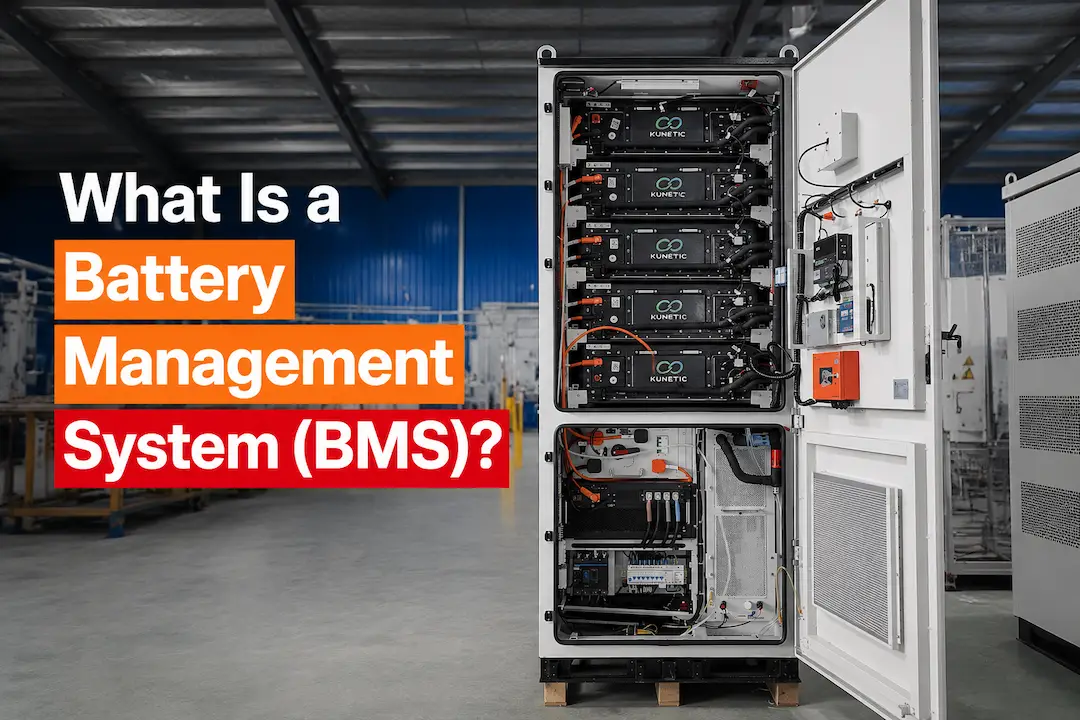
A BMS battery management system is the hardware and software control layer that monitors a rechargeable battery and keeps it within defined operating limits. In a lithium-ion battery energy storage system, it tracks voltage, current and temperature and estimates battery states such as state of charge (SOC) and state of health (SOH). It supports cell balancing, applies protection logic, and sends battery status or operating limits to other controllers.
BMS stands for Battery Management System. It is not the battery cell, inverter or power conversion system (PCS). The BMS manages the battery side of the system. For the wider system architecture, see KUNETIC's What Is BESS? guide.
MathWorks lists monitoring, state estimation, cell balancing, power management, thermal management, protection and communications among the main BMS functions. DOE describes the BMS as a hardware and software component connected with the EMS and PCS in a BESS. (MathWorks, DOE)
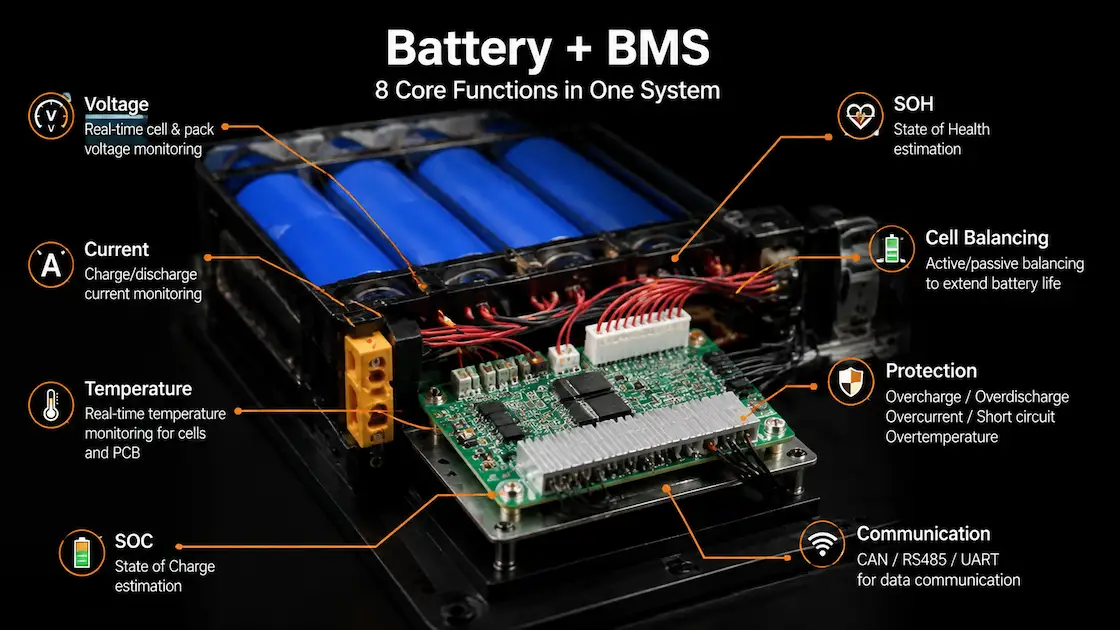
What does a BMS monitor and control?
Measurement is only the starting point. A BMS uses measured and estimated values to judge whether the battery can keep operating, whether charge or discharge limits should change, and whether the system should warn or protect.
BMS function | What it means |
Voltage monitoring | Tracks cell, module or pack voltage |
Current monitoring | Measures charging and discharging current |
Temperature monitoring | Tracks battery thermal conditions |
SOC estimation | Estimates how much charge is available |
SOH estimation | Estimates battery condition relative to its earlier performance |
Cell balancing | Reduces charge imbalance between cells |
Protection limits | Helps keep operation within allowed electrical and thermal boundaries |
Communication | Sends battery status, limits, alarms and other data to external controllers |
SOC and SOH describe different things. SOC estimates how much charge remains available at a given time. SOH describes battery condition and may use indicators such as capacity or internal resistance. MathWorks notes that there is no single universal definition of SOH.
Cells in a pack do not stay perfectly identical over time. The BMS can use balancing strategies to reduce these differences so that one cell does not become the limiting point for the pack.
How does a battery management system work?
The basic flow is:
Measure → Estimate → Decide → Protect → Communicate
Sensors first provide measurements such as voltage, current and temperature as real time data. The BMS processes those measurements, estimates internal states such as SOC, and compares the results with the battery's configured operating boundaries.
When the battery approaches a limit, the BMS may reduce the allowable charge or discharge range, issue a warning, or request a change from another system controller. Under fault conditions, protection logic can trigger stronger actions according to the system design.
The BMS does not replace the equipment that converts power. In a BESS, the PCS normally performs bidirectional power conversion between the battery and the AC system. The BMS manages battery conditions and communicates what the battery can currently accept or deliver. The exact control sequence and protection logic depend on the system design.
How is BMS architecture organized in a BESS?
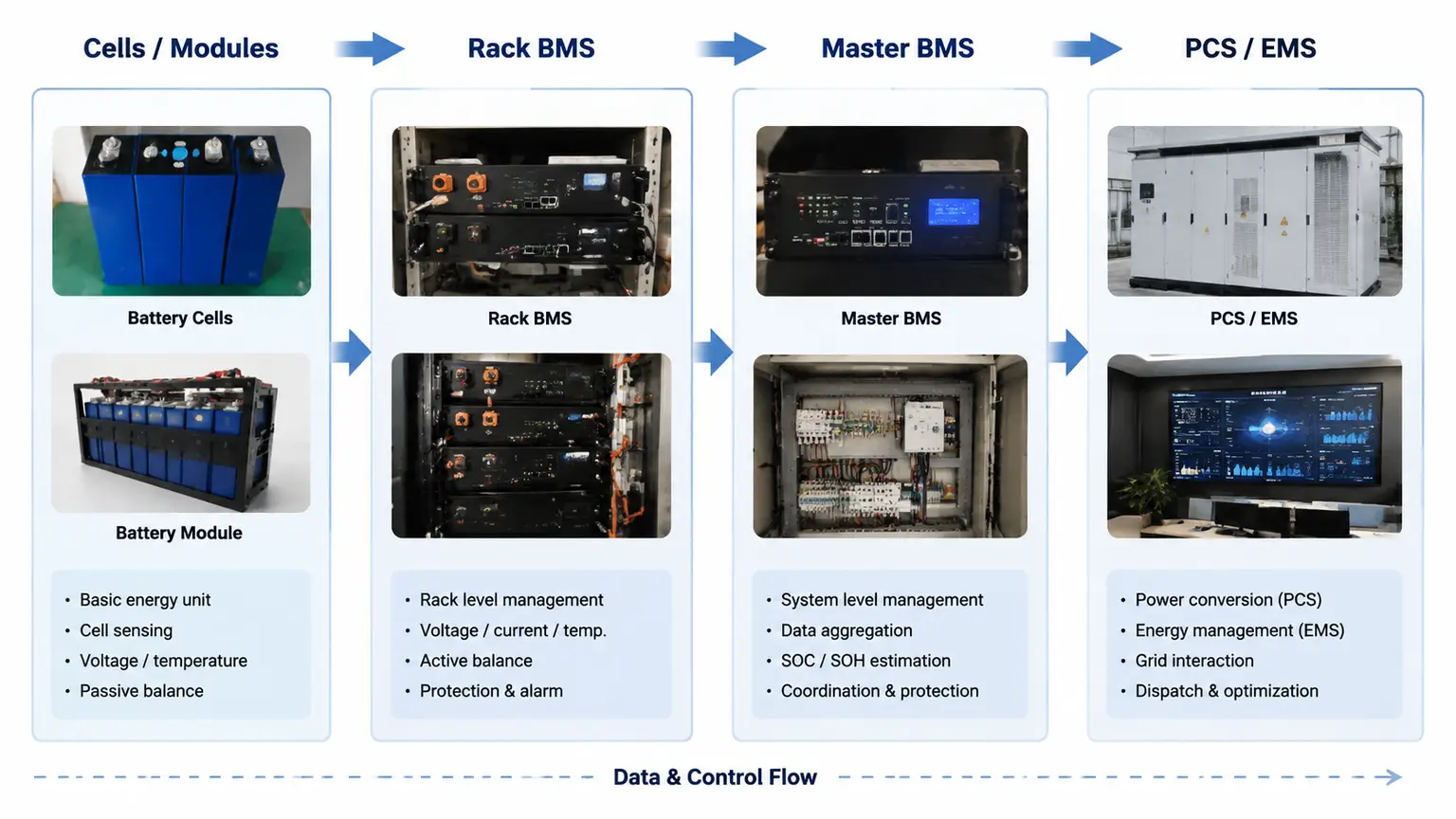
A small battery pack may use a compact BMS arrangement. A commercial or utility-scale BESS contains many more cells, modules, packs or battery clusters, so battery monitoring is commonly organized in layers.
A simplified hierarchy looks like this:
Cells / Modules → Module or Rack BMS → Master BMS → PCS / EMS
Supplier terminology varies. Lower-level controllers collect detailed battery measurements close to the cells, modules or racks. Higher-level BMS controllers bring that information together, coordinate operating limits, and make battery status available to other system controllers.
This layered arrangement matters in systems rated in the hundreds of kWh or in MWh. The BMS must identify abnormal conditions at lower levels while also presenting a coherent battery state and operating envelope to the power conversion and energy management layers.
IEEE Std 2686-2024 specifically addresses battery management systems in stationary energy storage applications. Sandia's summary of the standard says it covers hardware and software architectures, BMS functions, communication structures, data models, interoperability and cybersecurity considerations. (Sandia National Laboratories)
BMS vs PCS vs EMS: what is the difference?
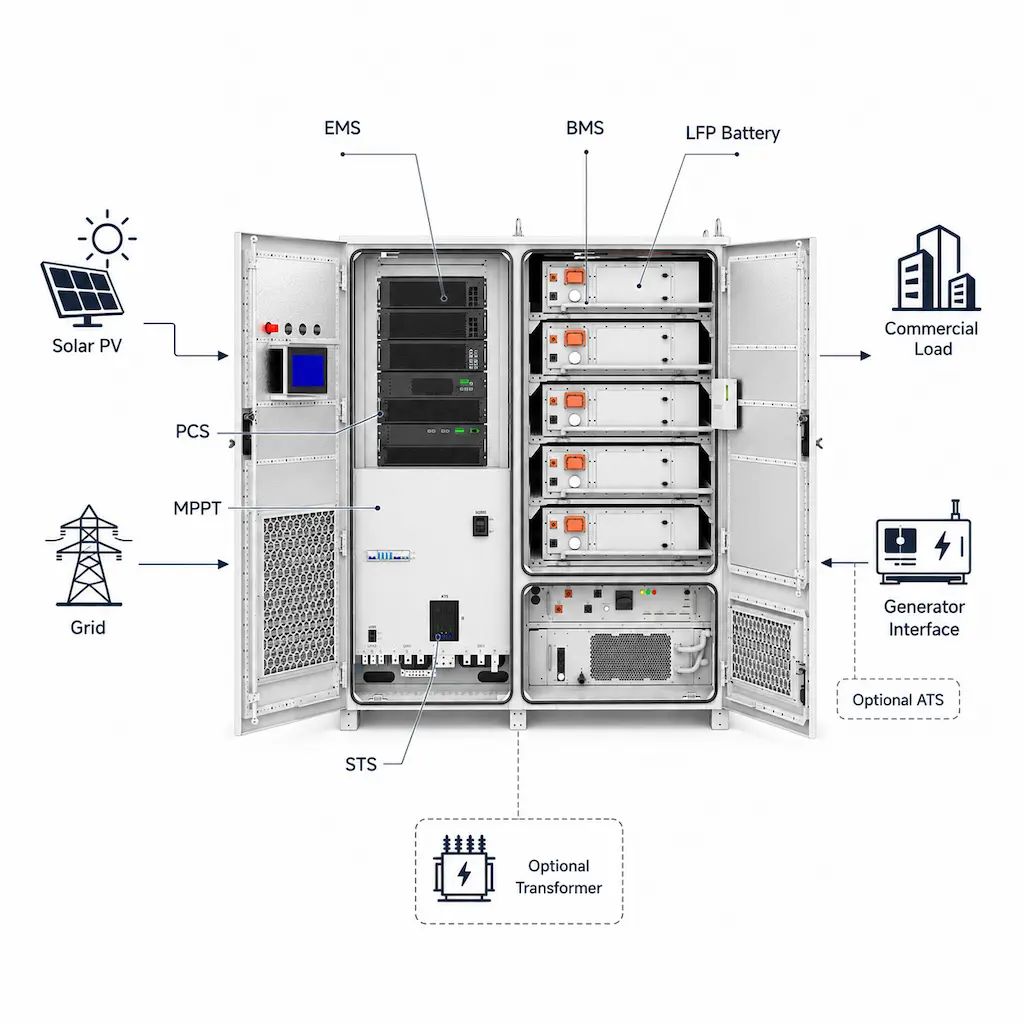
BMS, PCS and EMS are often discussed together in a battery energy storage system, but each has a different job.
System | Main role |
BMS | Manages battery condition, operating limits and protection |
PCS | Converts power between the battery and the AC electrical system |
EMS | Coordinates the higher-level operating strategy of the energy system |
A simple summary is:
The EMS decides the strategy, the PCS moves the power, and the BMS defines what the battery can safely accept or deliver.
This is a simplified description, not a complete control diagram, but it captures the basic separation of responsibilities.
KUNETIC's 125kW / 261kWh liquid-cooled commercial BESS is one example of an integrated C&I platform that includes an LFP battery system, PCS, BMS and EMS in the cabinet architecture. For a closer look at how battery storage fits into a solar-storage power path, see the 261kWh Solar-Storage Integrated System.
What should a BESS buyer check in a BMS?
For a commercial BESS buyer, asking only whether a system "has a BMS" does not reveal much. A modern lithium-ion BESS normally includes battery management. The more useful questions concern what the BMS monitors, how it communicates operating limits, and what information is available when a fault occurs.
Before approving a system configuration, ask:
- Which battery values are monitored at cell, module, rack or system level?
- What SOC and SOH information is available to the owner or operator?
- How are warnings, alarms and fault detection events recorded?
- How are allowable charge and discharge limits communicated to the PCS?
- What communication interfaces and data points are available for integration?
- How does the BMS exchange information with the EMS or site controller?
- Can the BMS architecture support the planned number of racks, cabinets or future expansion?
- How are firmware, configuration changes and service support handled?
- What operating and fault history can be exported for troubleshooting?
These answers matter during commissioning and later service. The BMS sits inside the system's diagnostic and control chain, so its data and communication capabilities affect how operators identify problems and understand battery behavior.
For projects moving from battery selection into C&I system design, KUNETIC's Lithium Ion Solar Battery guide covers the battery-side fundamentals, while the commercial BESS product page shows one current integrated system configuration.
Battery management system FAQ
Does a BMS charge the battery?
Not by itself in the way a charger or PCS does. The BMS monitors battery conditions, estimates battery state, applies protection logic, and determines or communicates allowable operating limits. The charger, inverter or PCS performs the electrical power conversion used to charge or discharge the battery.
Can a lithium-ion BESS operate without a BMS?
A stationary lithium-ion BESS is not a collection of cells that can operate without battery management. The BMS is a control and protection layer that monitors cell and pack conditions, manages operating boundaries, and communicates battery status to the rest of the system. The required architecture and protection functions depend on the system design and applicable project requirements.