Table of Contents
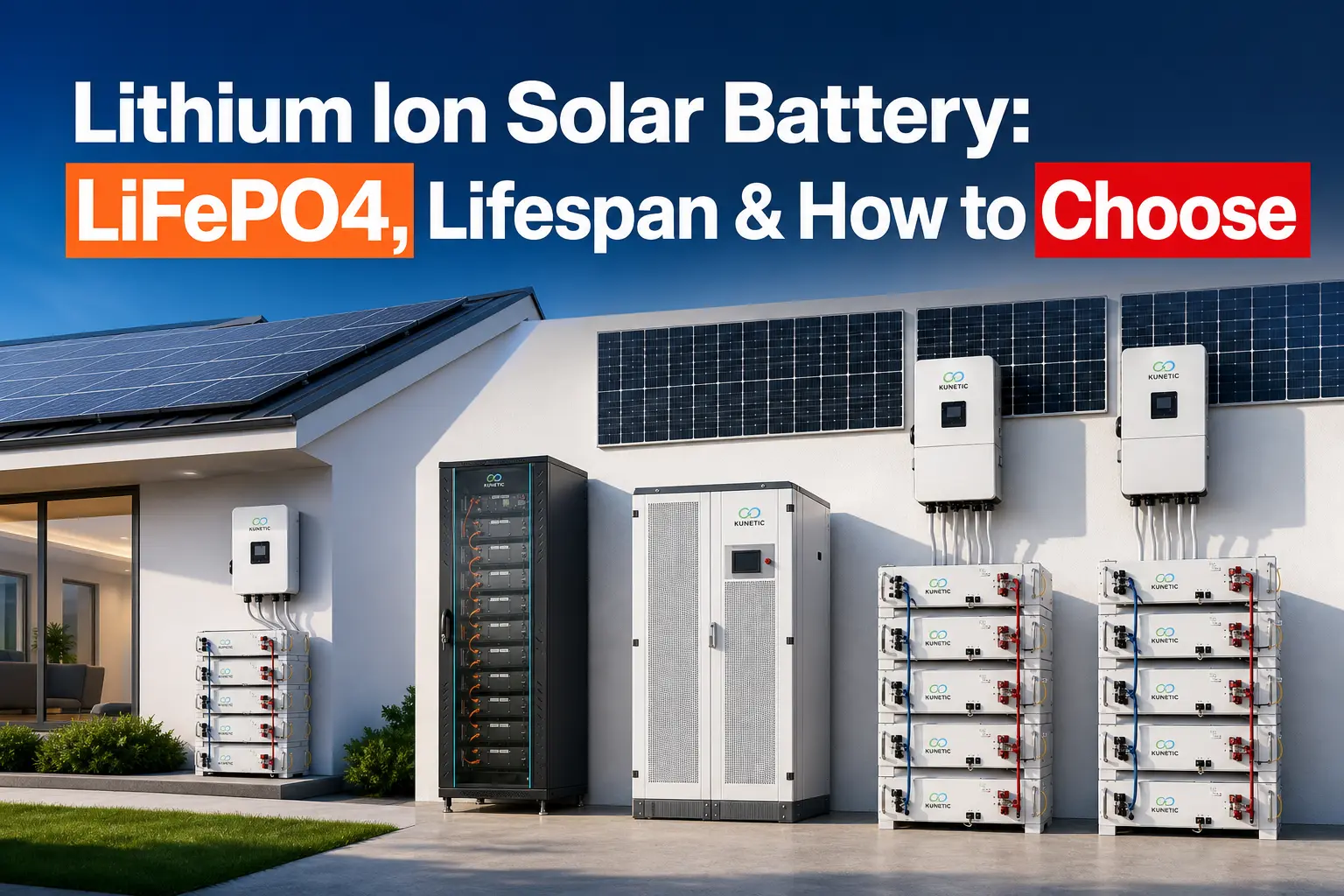
A lithium ion solar battery stores electricity from solar panels for use later, such as after sunset, for backup power during an outage, or when site demand rises.
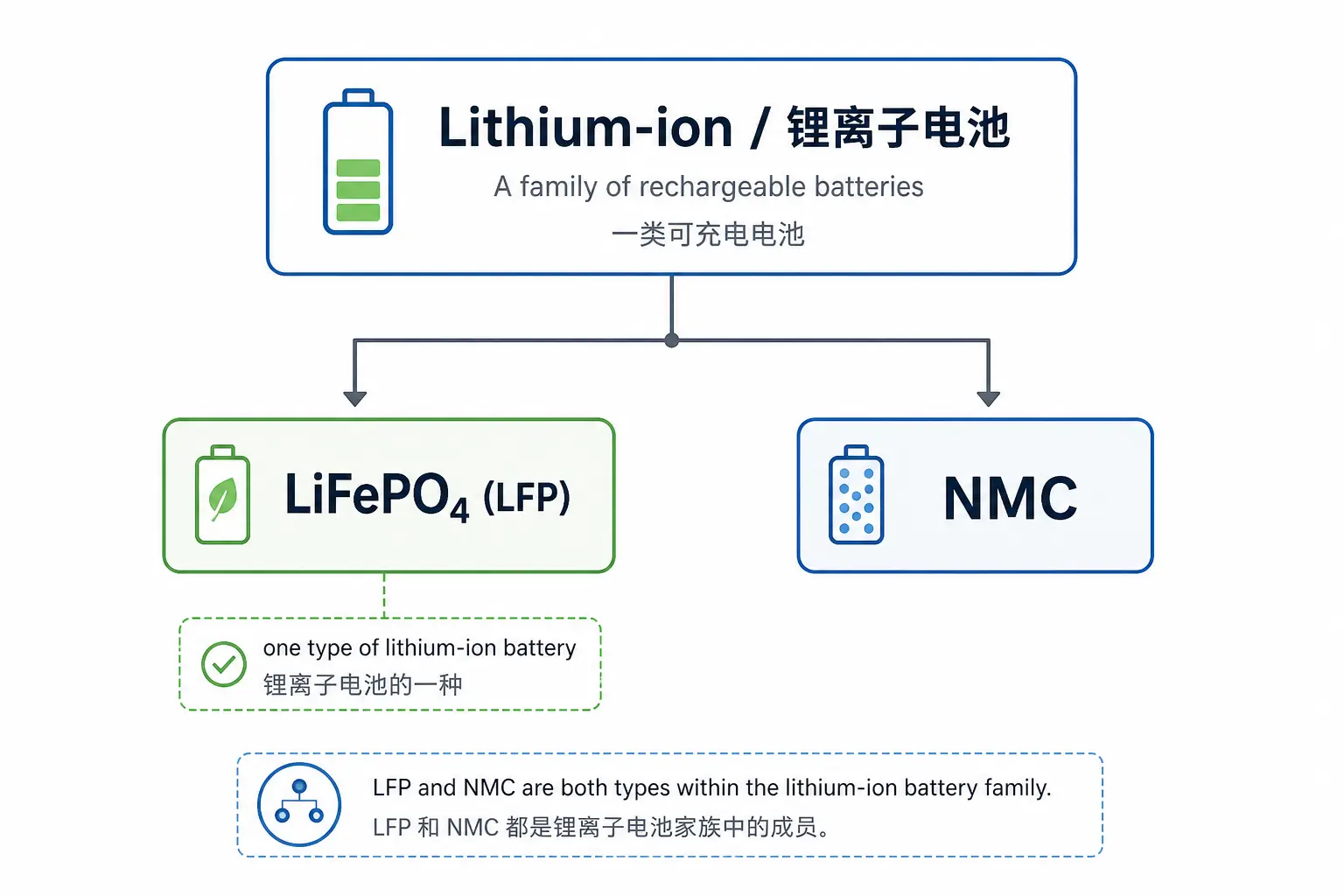
LiFePO4 (LFP) is one type of lithium-ion battery chemistry, not a separate battery family.
When choosing a solar battery, compare energy capacity in kWh, power in kW, inverter compatibility, backup requirements, operating conditions and control strategy.
What is a lithium ion solar battery?
A lithium ion solar battery is a rechargeable battery connected to a solar-plus-storage system. Solar panels generate electricity during daylight hours, and the battery can store part of that energy for later use. The U.S. Department of Energy explains why this matters: solar generation and electricity demand do not always occur at the same time, so storage lets a site move solar energy from one part of the day to another.
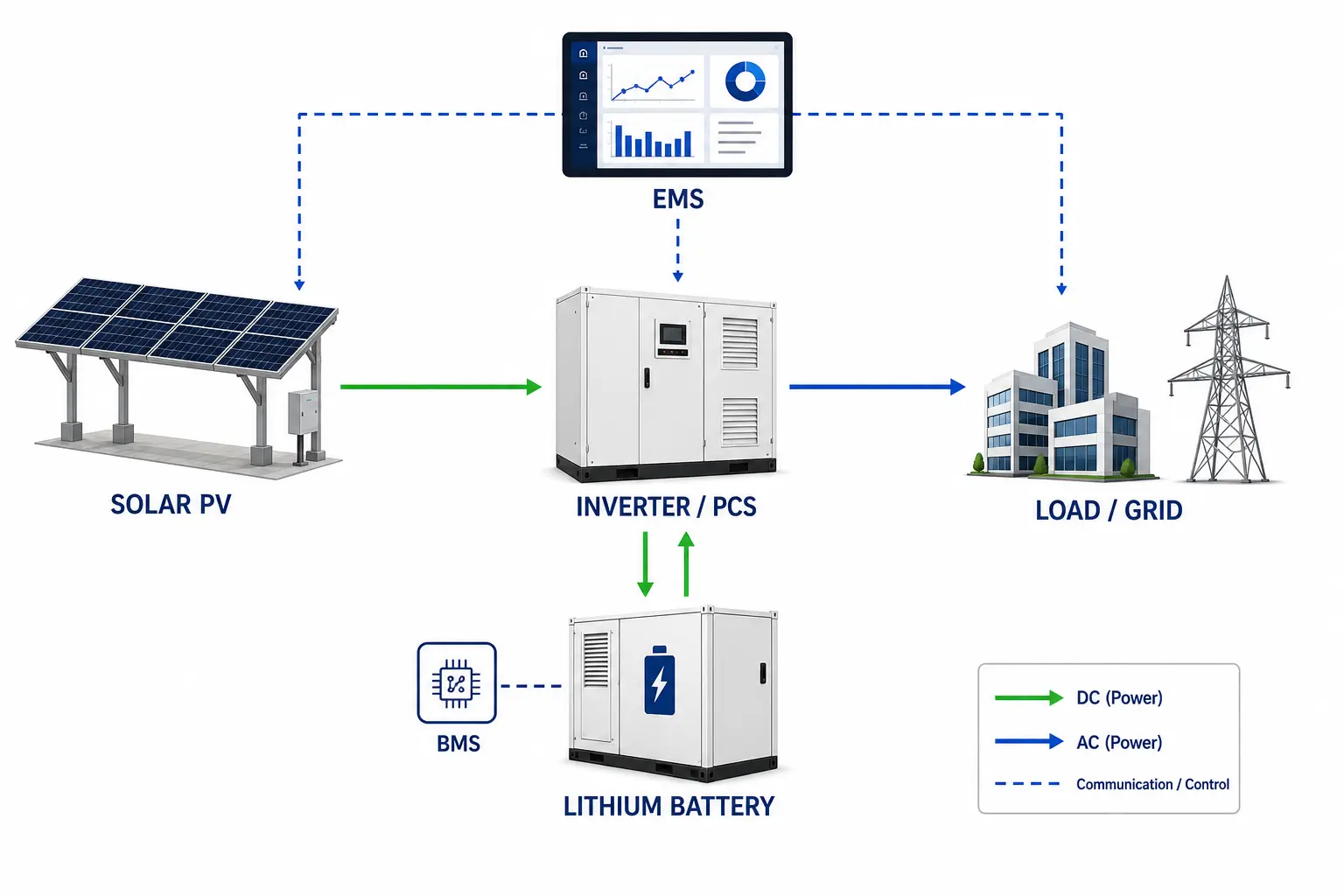
A simplified power path is:
Solar PV → Inverter / PCS → Battery → Loads / Grid
The exact path depends on whether the system is AC-coupled or DC-coupled. Either way, the battery is only one part of the system.
The inverter or power conversion system handles electrical conversion. The battery management system (BMS) monitors battery operation and protection.
Larger systems may also use an energy management system (EMS) to decide when to charge, discharge or hold energy.
For the wider system architecture, see KUNETIC's What Is BESS? guide.
Is LiFePO4 a lithium-ion battery?
Yes. LiFePO4, usually shortened to LFP, is a lithium-ion battery chemistry. A LiFePO4 solar battery is therefore a lithium-ion battery built around LFP cells. Nickel manganese cobalt (NMC) is another lithium-ion chemistry.
The NREL Annual Technology Baseline places both LFP and NMC under lithium-ion batteries and notes that LFP became the primary chemistry represented for stationary storage starting in 2021.
| LFP | NMC |
Battery family | Lithium-ion | Lithium-ion |
Typical design priority | Stationary use, cycle-life and thermal-behavior priorities | Higher energy density |
Common fit | Solar storage and stationary BESS | Applications where energy density matters more |
LFP is not automatically the right chemistry for every battery application. A DOE-backed comparison study found NMC cells offer better energy density, while the tested LFP cell responded less severely in thermal-runaway testing. In stationary solar storage, weight and volume are usually less restrictive than in vehicles or portable electronics. That makes LFP's characteristics a practical fit for many stationary systems, and its current market position reflects that.
For product-level comparisons rather than chemistry alone, see Best Solar Energy Batteries 2026.
How long does a lithium ion solar battery last?
There is no useful single lifespan number for every lithium ion solar battery. The cell chemistry and the way the system is operated determine a lithium ion solar battery lifespan.
NREL's BLAST battery lifetime work models degradation from temperature, state-of-charge history, current, cycle depth and cell balance. A separate NREL study of large-format lithium-ion cells also found that chemistry, temperature and depth of discharge can materially change degradation behavior.
Three terms are worth separating:
- Calendar life is aging that happens with time, including periods when the battery is not cycling heavily.
- Cycle life describes aging from repeated charging and discharging.
- Warranty is the manufacturer's contractual coverage and may include time, throughput, retained capacity and operating limits.
Two batteries with the same nominal kWh rating can therefore age differently in different climates or duty cycles. When comparing products, read the warranty alongside the temperature range, usable depth of discharge and expected operating profile. A large cycle-count number on its own tells you very little about how the battery will behave in your project.
How do you choose the right lithium ion solar battery?
Start with what the battery needs to do, then compare the specifications that affect that job.
What to check | Why it matters |
Capacity (kWh) | How much energy the battery can store |
Power (kW) | How much power it can deliver at one time |
Inverter / PCS compatibility | Whether the battery can integrate with the electrical system |
Backup requirement | How much energy and what switching arrangement the project needs |
BMS | How battery operation is monitored and protected |
Temperature / cooling | Operating temperature affects performance and degradation |
Expansion | Whether more capacity can be added later |
Certification / warranty | Project acceptance and long-term support |
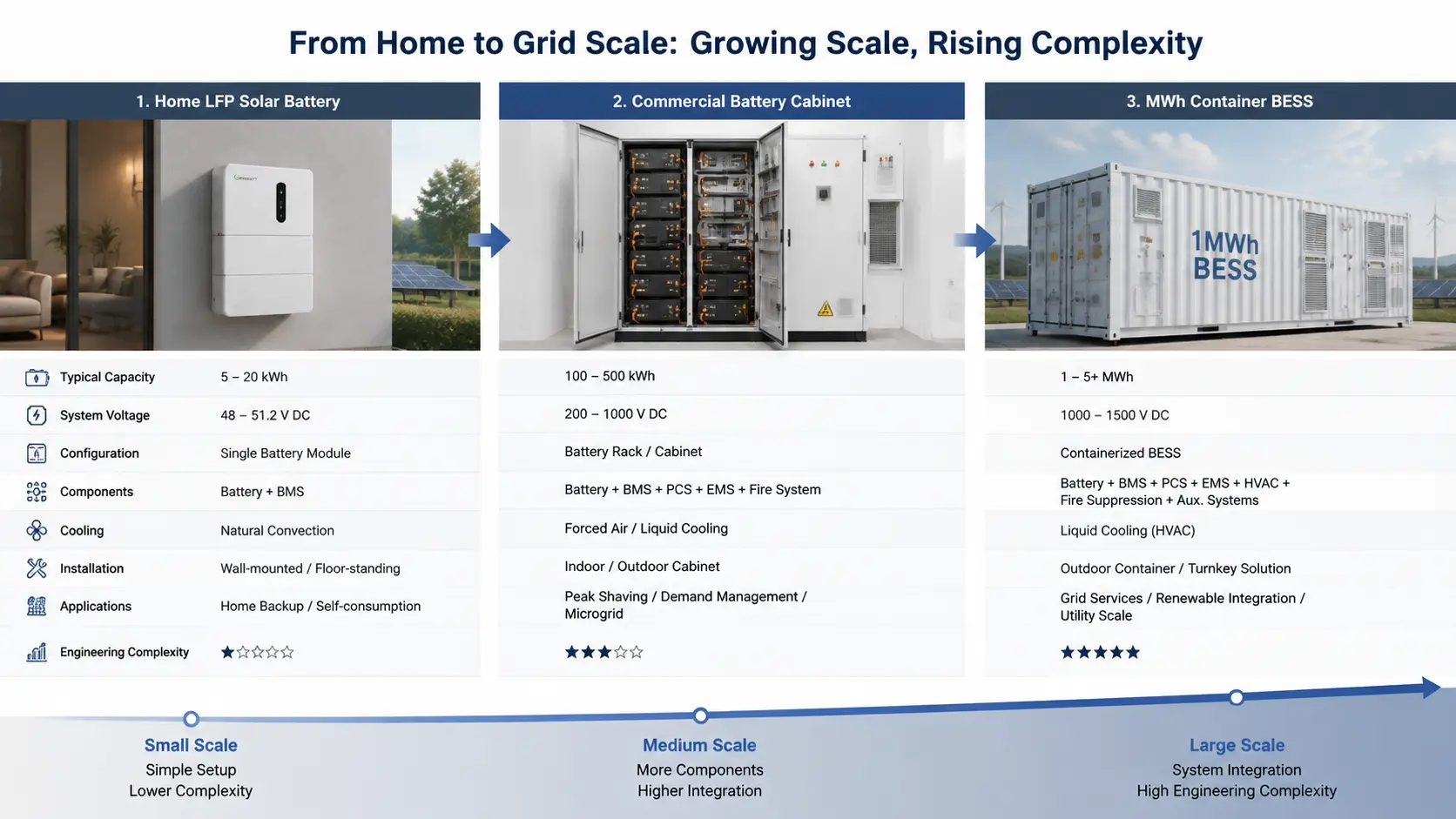
For a home system, sizing usually starts with household electricity use, solar production and the loads that need to stay powered during an outage. KUNETIC's residential range, for example, uses modular LFP batteries for solar applications.
Commercial projects need a different level of engineering. A factory, warehouse or charging site may need tens or hundreds of kWh or more, but battery capacity is only one input. Engineers also need the interval load profile, peak power, grid voltage, PCS rating, backup scope, thermal-management approach and control strategy. KUNETIC's 125kW / 261kWh liquid-cooled commercial BESS is one example of this scale, integrating LFP storage with PCS, MPPT, STS, BMS, EMS and liquid cooling.
For C&I sizing and system selection, continue with the Commercial Battery Storage guide. For a closer look at solar-storage electrical architecture, see the 261kWh Solar-Storage Integrated System. The latter documents a real KUNETIC DC-coupled architecture using PV, MPPT, battery storage, DC/DC conversion and PCS.
If you are planning a commercial solar-storage project, prepare the solar capacity, interval load profile, grid voltage, critical-load requirement, backup duration and installation location before requesting a configuration. Those inputs tell an engineer far more than a requested kWh number by itself.
Lithium ion solar battery FAQ
Is LiFePO4 better than other lithium-ion batteries for solar storage?
LFP is widely used in stationary storage because its characteristics suit applications that value repeated cycling and long-term stationary operation. It is not the best battery type for every application. Chemistry should follow the design priorities. NREL's current stationary-storage modeling likewise treats LFP as the primary lithium-ion chemistry for stationary storage rather than claiming it is universally superior for every use case.
How many kWh of solar battery storage do I need?
Start with electricity consumption, solar generation, the loads you want to support and the required backup duration. Commercial projects also need interval load data and peak-power information. kWh alone does not determine the system size.
Can I add a lithium-ion battery to an existing solar system?
Often, yes. Check the existing inverter architecture, battery compatibility, AC- or DC-coupled design, electrical protection and control strategy before selecting equipment.