



Reliable Energy Storage — Download Free Catalog Download Now
KUNETIC 125kW 261kWh liquid-cooled commercial battery energy storage system

Outdoor C&I Battery Energy Storage System

KUNETIC 125kW 261kWh Liquid-Cooled Commercial Battery Energy Storage System

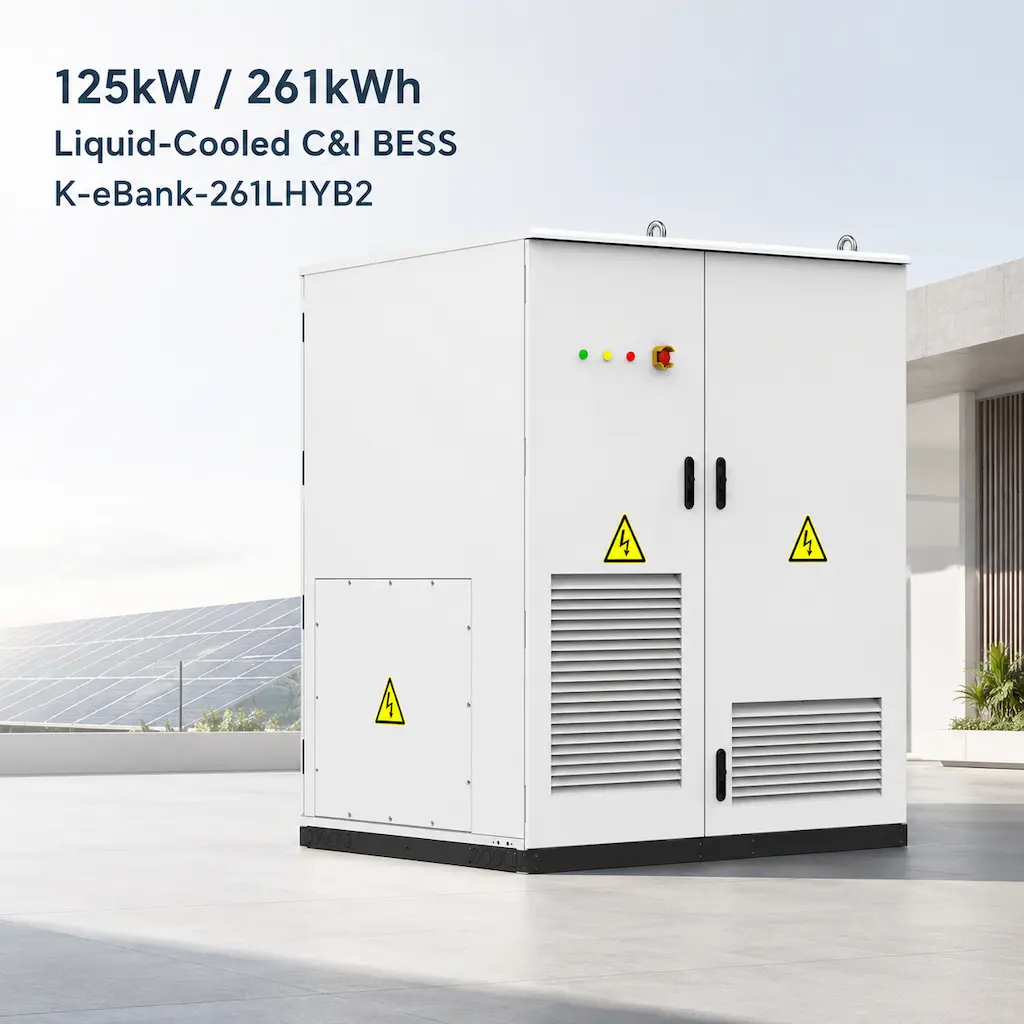
The KUNETIC K-eBank-261LHYB2 is a 125kW / 261kWh liquid-cooled commercial battery energy storage system for C&I sites. The IP54 outdoor cabinet combines the LFP battery system, PCS, 120kW MPPT, 250kW STS, BMS, EMS, liquid cooling and pack-level and cabinet-level fire protection. The system is intended for solar self-consumption, peak demand management, selected critical-load backup and hybrid microgrids. An isolation transformer and ATS are optional and are selected to suit the site electrical design.

261kWh Rated Energy
125kW Rated PCS Power
120kW MPPT Power
<10ms STS Transfer Time

Overview

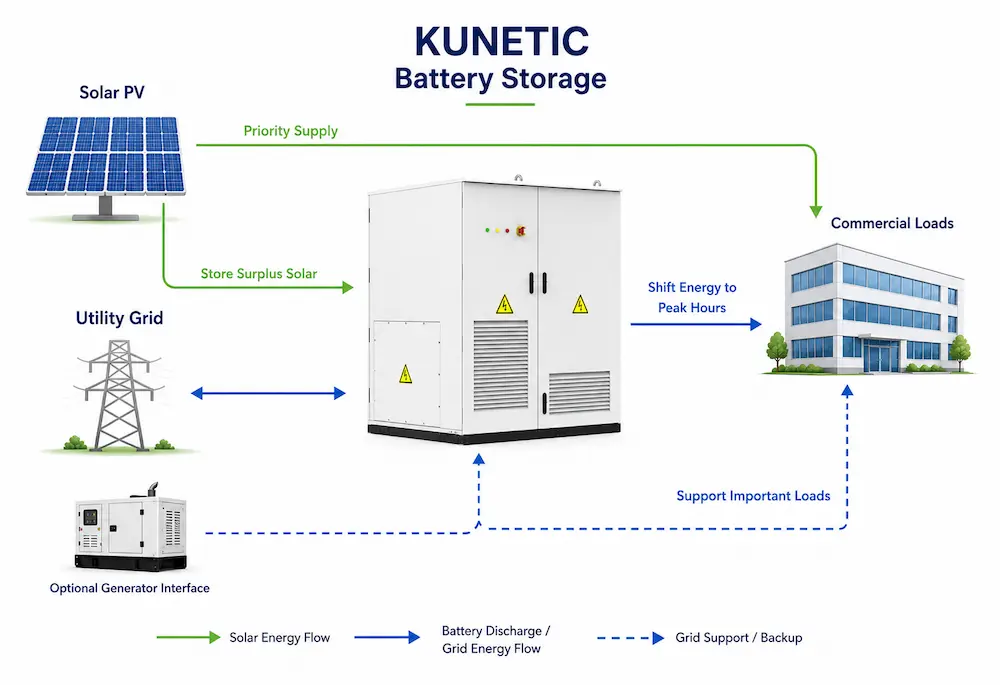
One Outdoor System for Solar, Storage, Grid and Generator Coordination

The K-eBank-261LHYB2 combines battery storage, power conversion, solar input, grid/off-grid transfer, energy management, thermal control and fire protection in one outdoor cabinet. Housing these functions in one system gives EPC contractors and integrators fewer separate devices to match during design. The electrical arrangement is then defined around the site load, PV capacity, grid conditions, backup requirements and generator interface.

What It Solves

Increase Solar Self-Consumption

Surplus PV generation can charge the battery instead of being exported immediately. The stored energy is then available when site demand rises or solar output falls, helping the facility use more of its own solar production.

Control Peak Demand

During high-demand periods, battery discharge can reduce the load seen by the grid connection. The control strategy is set from the site load profile, tariff structure and target demand limit.

Support Selected Critical Loads

The STS handles grid-to-off-grid transfer in less than 10ms at module level. The loads covered and the available operating time depend on usable battery energy, reserve settings, conversion losses, load changes and the project control strategy.

Coordinate PV, Storage and Generator Operation

The cabinet can be included in a hybrid power system with PV, grid supply and a generator. ATS and transformer arrangements remain optional and are selected as part of the project electrical design.

One Outdoor System for Solar, Storage, Grid and Generator Coordination system topology diagram

Technical Specifications

KUNETIC KUNETIC 125kW 261kWh Liquid-Cooled Commercial Battery Energy Storage System Technical Specifications

Engineering data from the product sheet.

MODEL
KUNETIC 125kW 261kWh Liquid-Cooled Commercial Battery Energy Storage System
System
Model K-eBank-261LHYB2
Rated Energy 261.248kWh
Rated PCS Power 125kW
Maximum PCS Power 150kW
MPPT Power 120kW
STS Power 250kW
Rated AC Voltage 380/400V
Rated Frequency 50/60Hz
Cooling Method Liquid cooling
Installation Environment Outdoor
Protection Rating IP54
Dimensions (W × D × H) 1700 × 1350 × 2050mm
Weight Approx. 2.9t
Battery
Cell Chemistry Lithium iron phosphate (LFP)
Cell Capacity 314Ah
Battery Configuration 260S1P
Battery Pack Quantity 5
Rated Voltage 832V
Maximum Continuous Charge Current 157A
Maximum Continuous Discharge Current 157A
Power Conversion and Transfer
Rated PCS Power 125kW
Maximum PCS Power 150kW
MPPT Power 120kW
STS Power 250kW
Grid-to-Off-Grid Transfer Time <10ms at STS module level
Safety and Management
Battery Management BMS
Energy Management EMS
Fire Protection Pack-level and cabinet-level protection
Thermal Management Liquid cooling
Optional Configuration
Isolation Transformer Optional
ATS Optional
Other Capacity, Power and Project Configurations Subject to engineering review

CORE FEATURES

Built-In Protection, Cooling and Power Continuity

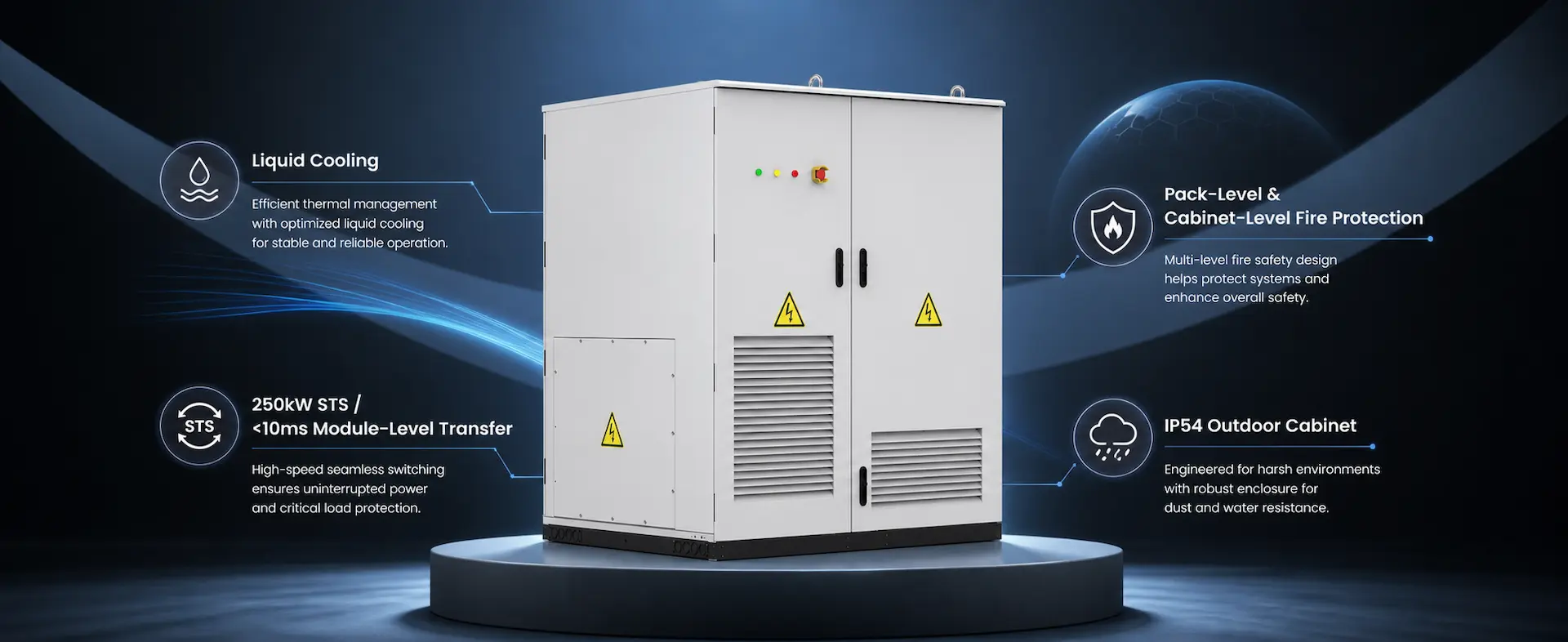
The K-eBank-261LHYB2 integrates thermal management, fire protection, power transfer and outdoor enclosure in one system.

Liquid cooling, BMS, fire protection, STS and IP54 outdoor protection for the KUNETIC C&I BESS

THERMAL MANAGEMENT

Liquid-Cooled Battery Operation

A liquid-cooling circuit regulates temperature across the five battery packs during charging and discharging. The system uses 314Ah LFP cells and provides an actively controlled thermal environment inside the cabinet.
SYSTEM PROTECTION

Pack-Level and Cabinet-Level Fire Protection

The system provides fire protection at both battery-pack and cabinet level. The approved project design defines the alarm logic, protection details and response requirements for the installation environment and local rules.

POWER CONTINUITY

Fast Grid / Off-Grid Transfer with STS

The integrated 250kW STS has a grid-to-off-grid transfer time of less than 10ms at module level. Actual site performance depends on the load, wiring, control logic, commissioning and overall system configuration.

OUTDOOR DEPLOYMENT

IP54 Outdoor Cabinet for C&I Projects

The IP54 enclosure houses battery storage, PCS, MPPT, STS, BMS, EMS, liquid cooling and system protection. This integrated layout suits C&I projects where installation space, equipment coordination and site execution need to be planned together.

Applications

Commercial Battery Storage for Real Project Loads

A 125kW / 261kWh platform for solar utilization, demand control, backup and hybrid power projects.

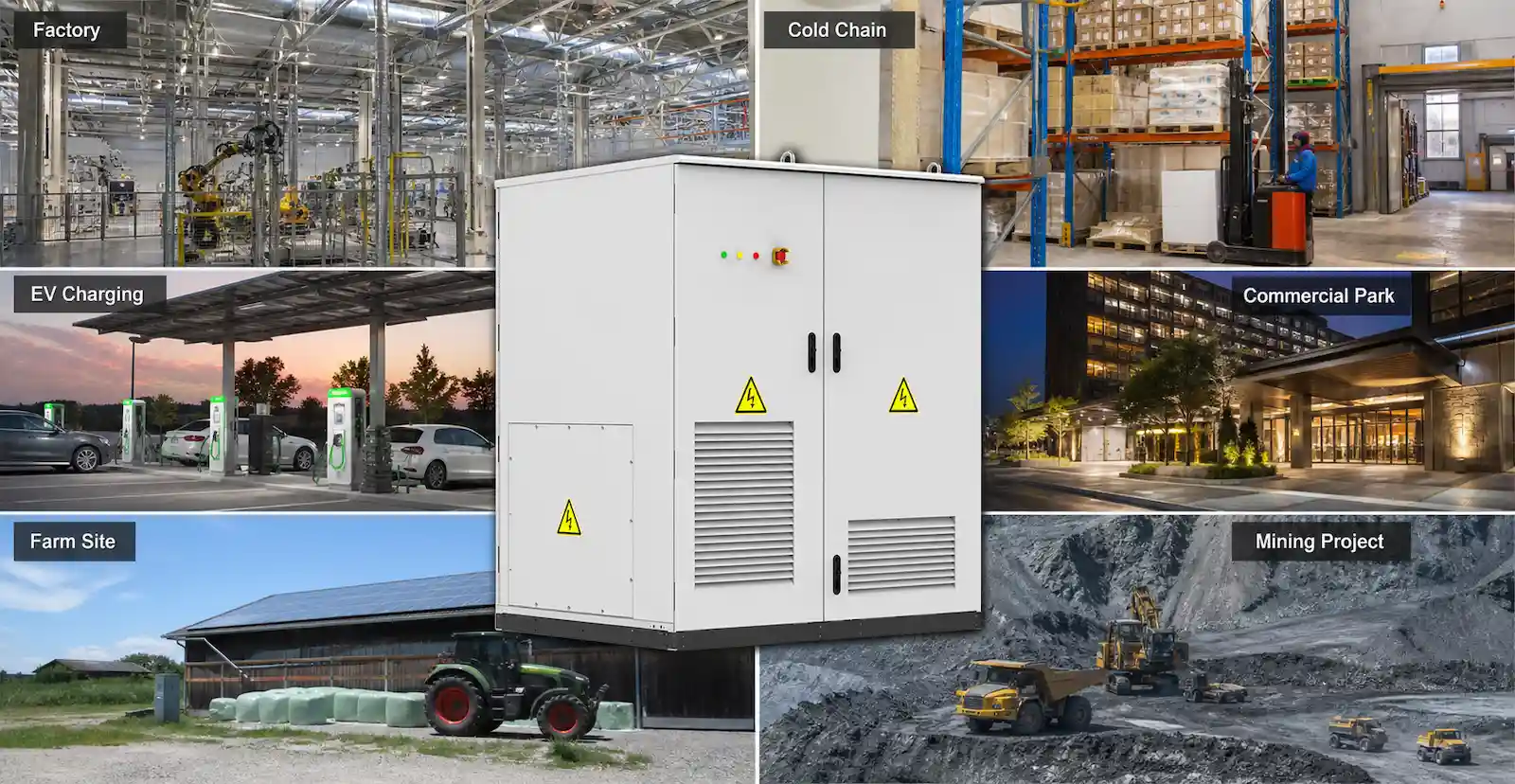
Commercial battery storage for factories, EV charging, commercial buildings, farms and remote industrial sites

Factories and Industrial Parks

Factories can use the system to raise solar self-consumption, manage demand peaks and support selected production or facility loads during grid events. Sizing starts with the plant load curve, peak demand, operating schedule and required backup scope.

Warehouses, Cold Storage and Logistics

Battery discharge can be coordinated with refrigeration, material handling, lighting and other high-demand loads. Stored solar energy can also be used later in the day when the site is still operating but PV output has fallen.

EV Charging Stations and Fleet Depots

At EV charging sites, the battery can cover part of short charging peaks and coordinate charging demand with available PV generation. The project assessment should include charging power, vehicle arrival patterns, grid capacity, simultaneous demand and solar production.

Hotels, Commercial Buildings and Campuses

Commercial buildings can store surplus solar energy, manage daytime demand and support selected essential services. Backup priorities should be set before configuration so the system is sized for the required loads rather than the full building load by default.

Farms and Remote Commercial Sites

Where grid supply is weak, limited or unavailable for part of the operating cycle, the system can coordinate PV, battery storage and generator-supported power. Generator rating, start logic, seasonal load changes and operating schedules all affect the final design.

Mining and Remote Industrial Projects

Remote industrial sites can use the system within a hybrid power setup that combines PV, battery storage and generator supply. Configuration depends on PV production, generator availability, critical loads and the site's operating schedule.

System sizing starts with the load profile, peak power, daily energy use, solar array size, grid voltage and frequency, backup load, target duration, generator rating, installation conditions and target-market requirements.

OEM / ODM SUPPORT

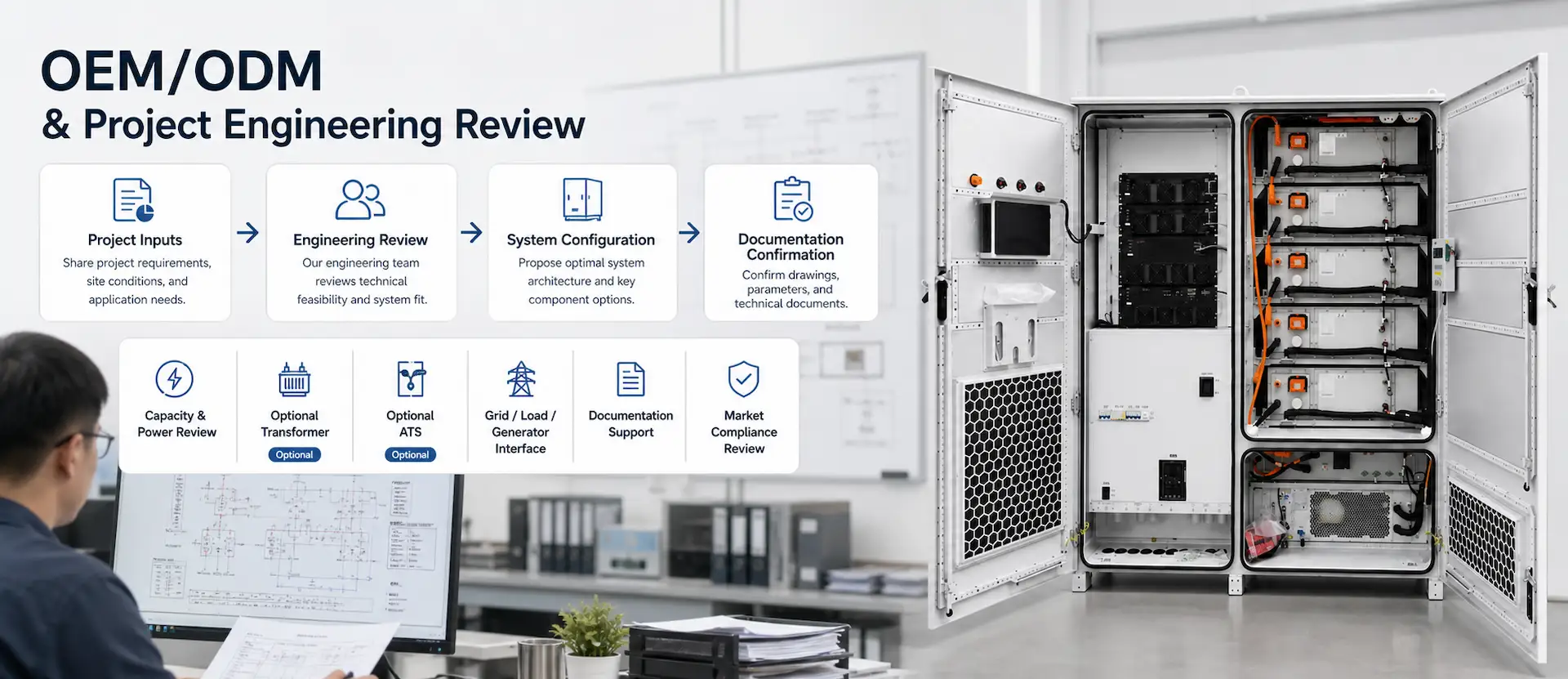
Configure the System Around Your Project Requirements

The standard K-eBank-261LHYB2 configuration combines 125kW rated PCS power with 261.248kWh of battery energy. Engineering review can cover selected project parameters and optional equipment according to the application, electrical design, installation environment and target market.

Capacity and Power Configuration

Other capacity, power and project configurations can be evaluated for specific applications. Available combinations are confirmed through engineering review and should not be assumed from the standard model.

Optional Transformer and ATS

The isolation transformer and ATS are not included as standard. They can be selected when required by the site voltage, generator interface, load arrangement or switching strategy.

Grid, Load and Generator Interface Review

Before confirming the electrical arrangement, the project team reviews grid voltage and frequency, load characteristics, generator rating, PV capacity and backup priorities.

Project Documentation Support

Technical documents and project-specific information can be prepared for the confirmed system scope. Branding, labeling and document customization remain subject to commercial and engineering confirmation.

Market Compliance Review

Certification and grid-connection requirements differ by country and project. Required standards should be identified before order confirmation so the relevant system and component documents can be checked.

KUNETIC K-eBank-261LHYB2 125kW / 261kWh C&I BESS Datasheet KUNETIC K-eBank-261LHYB2 125kW / 261kWh C&I BESS Datasheet

Downloads

KUNETIC K-eBank-261LHYB2 125kW / 261kWh C&I BESS Datasheet

Download the K-eBank-261LHYB2 datasheet for confirmed system, battery, PCS, MPPT and STS specifications, along with cabinet dimensions, outdoor protection and optional equipment notes.

FAQ

The 125kW figure is the rated PCS power, while 261.248kWh is the battery system's rated energy. At a constant 125kW load, dividing rated energy by rated power gives a theoretical duration of about 2.1 hours. Usable runtime will be lower or higher depending on SOC limits, reserve settings, conversion losses, temperature, load changes and the control strategy.

Runtime depends on the average supported load. A basic estimate divides available battery energy by that load. The project calculation must also allow for conversion losses, operating reserve, battery limits, changing demand and any PV or generator contribution during the event.

The system includes a 250kW STS for grid-connected operation and grid/off-grid transfer. Protected loads, switching logic, wiring and the operating mode are confirmed during engineering and commissioning.

PV connects through the integrated 120kW MPPT section. Generator-supported operation is defined in the project electrical design, with optional ATS and transformer arrangements added when required. Generator rating, voltage, frequency, start logic and load priorities must be checked before configuration is finalized.

No. The isolation transformer and ATS are optional, project-dependent items. Selection depends on site voltage, the grid and generator arrangement, load architecture and switching requirements.

The STS handles fast electronic transfer between grid-connected and off-grid supply paths. Its module-level transfer time is less than 10ms. The optional ATS switches between power sources such as the grid and a generator. Their exact roles depend on the approved project topology.

Please provide the load profile, peak demand, daily energy use, solar array size, grid voltage and frequency, backup load, target backup duration, generator rating, installation location, ambient conditions and required certifications or market standards. These details are used to review the system against the actual project.

Selected capacity, power, transformer, ATS and project-interface options can be evaluated. Voltage, certification, communication and market-specific requirements must pass engineering and compliance review before order confirmation.

Request a Project Quote

Tell us about your site load, PV capacity, backup requirements, or target project size. Our engineers will help configure the right system for your needs.