Table of Contents
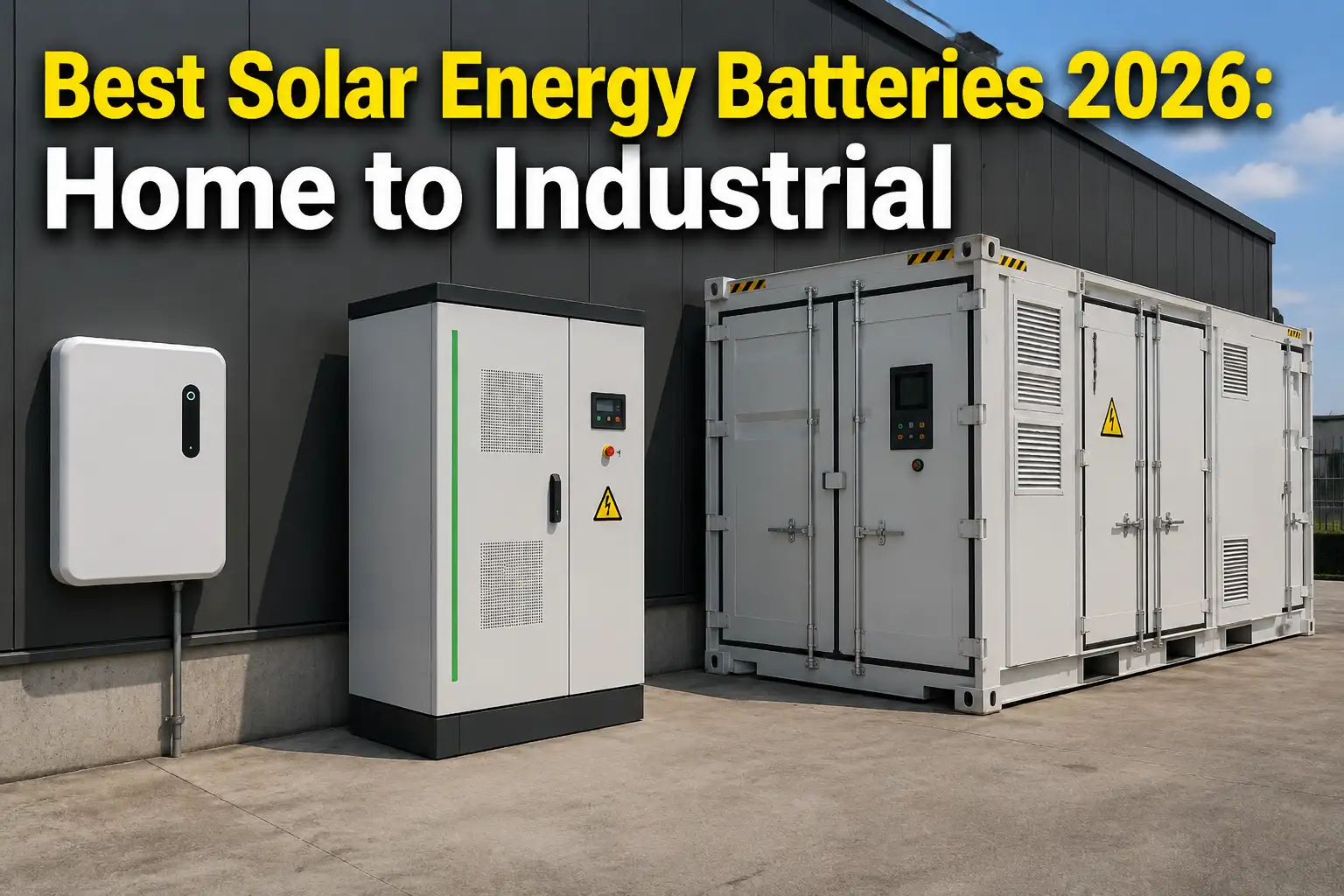
A 5 kWh battery keeps your lights and fridge running overnight. A 100 kWh cabinet shaves peak demand for a mid-size factory. A 5 MWh containerized BESS powers an off-grid island.
The best battery is not a brand name. It is the one sized right for your load, your grid, and how fast you need the money back.
A homeowner wants the fridge running during a blackout. A factory floor manager needs demand charges to drop - every month, on the invoice she actually sees. Those are different batteries. Start there.
2026 Best Solar Energy Batteries - Compared
This solar battery comparison covers seven systems across the full spectrum from residential backup to utility-scale storage. The "Scale Fit" column tells you what each unit was actually engineered for, not what a marketing team claims it can do.
Battery | Usable Capacity | Continuous Power | Chemistry | Scale Fit | Est. $/kWh |
5 kWh | 3.84 kW | LFP | Home | ~$1,400 | |
13.5 kWh | 11.5 kW | LFP | Home | ~$1,000 | |
KUNETIC Wall-Mount | 5-20 kWh | 5-10 kW | LFP | Home / Light Comm | ~$400-600 |
BYD Battery-Box Premium | 5-60 kWh | 3-25 kW | LFP | Home / Business | ~$500-800 |
15 kWh | 10 kW | LFP | Home / Light Comm | ~$1,200 | |
KUNETIC C&I Cabinet | 50-500 kWh | 30-125 kW | LFP | Commercial | ~$300-500 |
Containerized BESS | 1-5 MWh | 250-500 kW | LFP | Industrial | ~$250-400 |
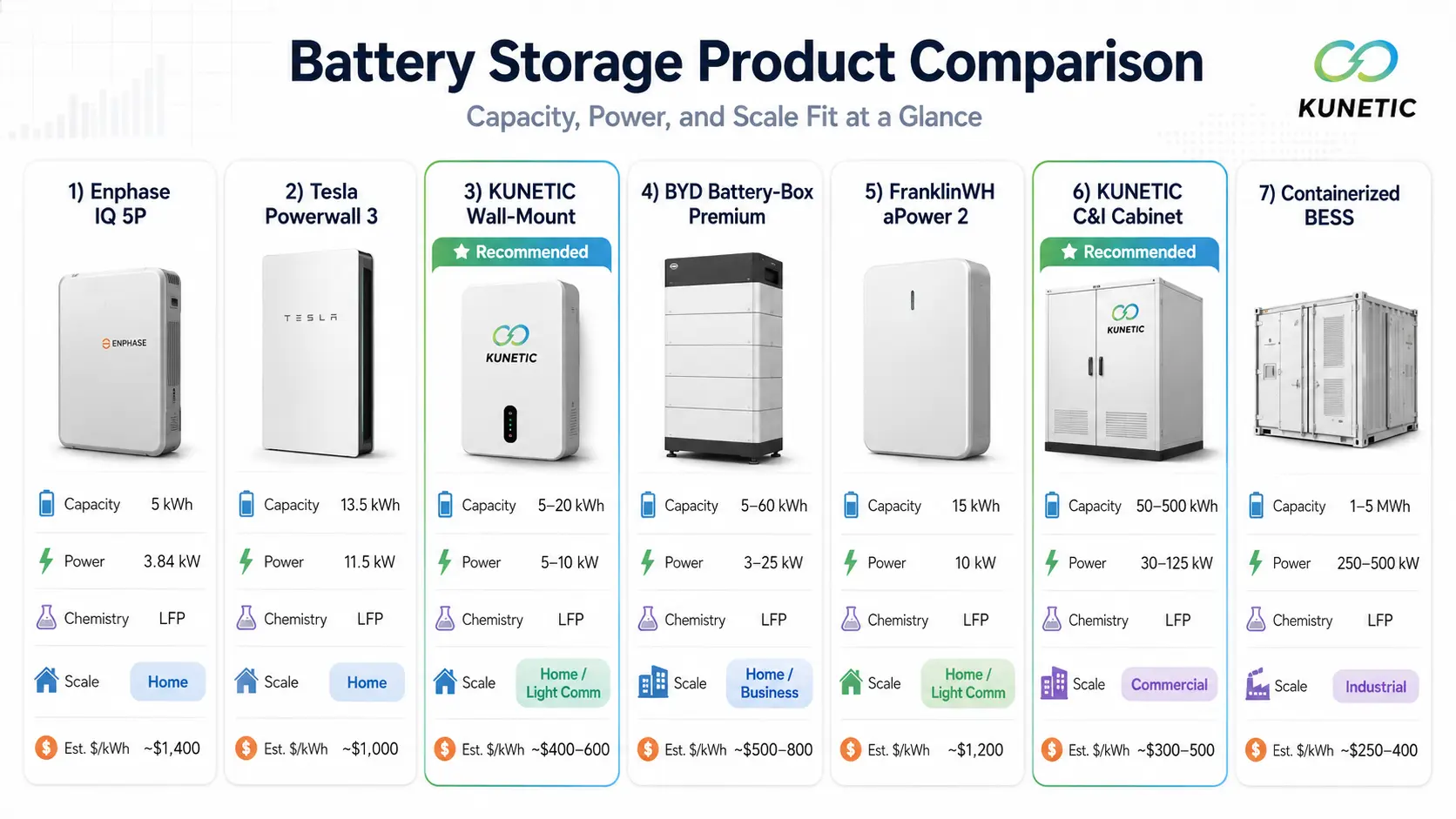
Each of these batteries is built for a different job. Using a home battery storage system for commercial peak shaving wastes money and shortens cycle life. Dropping an industrial battery cabinet into a 5 kWh home backup is massive overkill.
Home and Small Business (5-100 kWh)
For most homes, 5 to 15 kWh covers essential backup. Lights, refrigerator, Wi-Fi, garage door. At this scale, a single wall-mounted LFP unit installs in an afternoon and pairs with most hybrid inverters and solar panel systems on the market.
Step up to 15-30 kWh and you enter whole-home territory - overnight autonomy with solar recharge the next morning. This is where modular systems earn their premium. Start at 10 kWh, stack another module next year when needs grow.
At 50-100 kWh, the math changes. You are not buying backup anymore.
A restaurant or small workshop running a 50 kWh cabinet can shave 30-40% off monthly demand charges. Typical payback: 3 to 5 years - faster than what most residential solar setups save on the electricity bill.
Top picks: Tesla Powerwall 3 (13.5 kWh, integrated hybrid inverter), BYD Battery-Box Premium (modular, 5-60 kWh, strong global support), and KUNETIC Wall-Mount Series (5-20 kWh, factory-direct pricing, UL 1973 and IEC 62619 system-level certification).
Commercial and Industrial (100 kWh - MWh+)
Most battery buying guides stop here. That is a mistake - this is where the real money sits.
Above 100 kWh, requirements change fast. Passive cooling stops being enough. Cycle rates jump from one to multiple charge-discharge cycles daily. Downtime means lost revenue, not just a dark living room.
C&I cabinets at 100-500 kWh use active air or liquid cooling. They handle 2-3 full cycles daily for peak shaving and load shifting. ROI math shifts here. Demand charge savings and time-of-use arbitrage push most projects to breakeven within 3-4 years.
Above 500 kWh, liquid cooling becomes standard. Cells rated for 8,000+ cycles keep degradation under 2% annually. Fire suppression shifts from passive to active: aerosol or gas-based systems. UL 9540A large-scale fire testing is now table stakes in North America.
At MWh scale, containerized BESS powers microgrids, mining sites, island grids. A 40-foot unit holds 3-5 MWh with integrated HVAC, fire suppression, and remote EMS. This is infrastructure procurement, not shopping. You compare deployment track records and service networks, not spec sheets.
For commercial energy storage in this range: KUNETIC C&I Cabinets (50-500 kWh, configurable liquid or air cooling, in-house BMS), BYD C&I Series, and containerized BESS from Tier-1 manufacturers with verified multi-site deployment data. At this scale, insist on references - not brochures.
What to Check Before Buying at Any Scale
Before you compare spec sheets, check five things I look at when auditing a battery supplier.
First: who made the cells? Most lithium ion batteries source cells from a handful of major factories. Which one? Tier-1 automotive-grade LFP costs more. You feel it in year five, when generic cells have drifted 15% apart in capacity and yours are balanced within 2%. Ask for the cell datasheet - not a marketing slide.
Second: is the BMS built in-house, or bought off a shelf? In-house means firmware updates keep coming. Off-the-shelf means your long-term support depends on someone else chip vendor. If the manufacturer hesitates when you ask who writes their BMS firmware, walk.
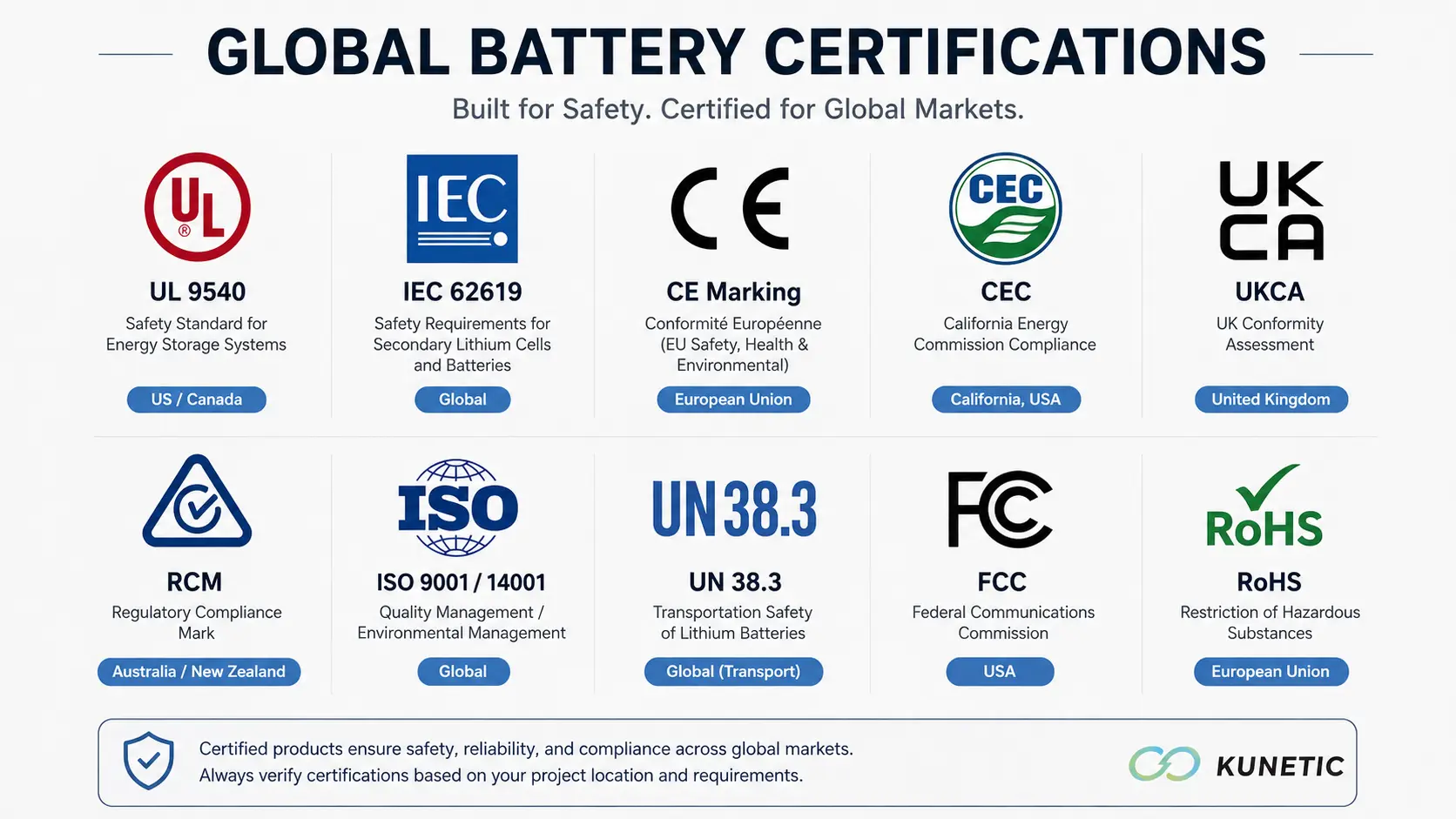
Third: match certifications to your market, not a spec sheet. UL 9540 for North America. IEC 62619 plus CE for Europe. CEC for Australia. A UL 1973 cell inside an uncertified enclosure is not a certified system.
Fourth: warranty fine print. Most warranties list a year limit and a throughput limit in MWh. For systems running multiple daily cycles, throughput always hits first. Run the math on your actual cycling rate.
Fifth: ask to visit the factory. A supplier who says yes and shows you the production floor, the aging test logs, and the weld quality station is not hiding anything. A polished showroom with a coffee machine is not a factory tour.
Frequently Asked Questions
Which solar battery lasts the longest?
Any LFP battery with a decent BMS and active thermal management should hit 15 years at one cycle per day. The brand matters less than whether the cooling and cell balancing are done right.
Is LFP always better than NMC for stationary storage?
Yes. For anything that sits in a building, factory, or container - LFP wins on safety, cycle life, and total cost. NMC still makes sense where weight matters, like cars. Not here.
What does a solar battery cost in 2026?
A best solar battery pick does not have to be the priciest. Installed costs range from roughly $250-400/kWh for containerized MWh-scale BESS to $1,000-1,400/kWh for premium home units. Project scale, certification requirements, and whether you install alongside solar or as a retrofit drive most of the variance.
Can I add more capacity later?
Modular systems from BYD, KUNETIC, and FranklinWH let you stack more units. Have your installer confirm the original inverter and BMS can handle it before ordering.
Do I need liquid cooling?
Only if you are above 500 kWh per unit, or in a hot climate where air cooling falls off fast. Below 100 kWh, air cooling covers you in most places without added complexity.
Ready to find the right battery for your project? Contact KUNETIC for a specification discussion - no sales pitch, just engineering.