Table of Contents
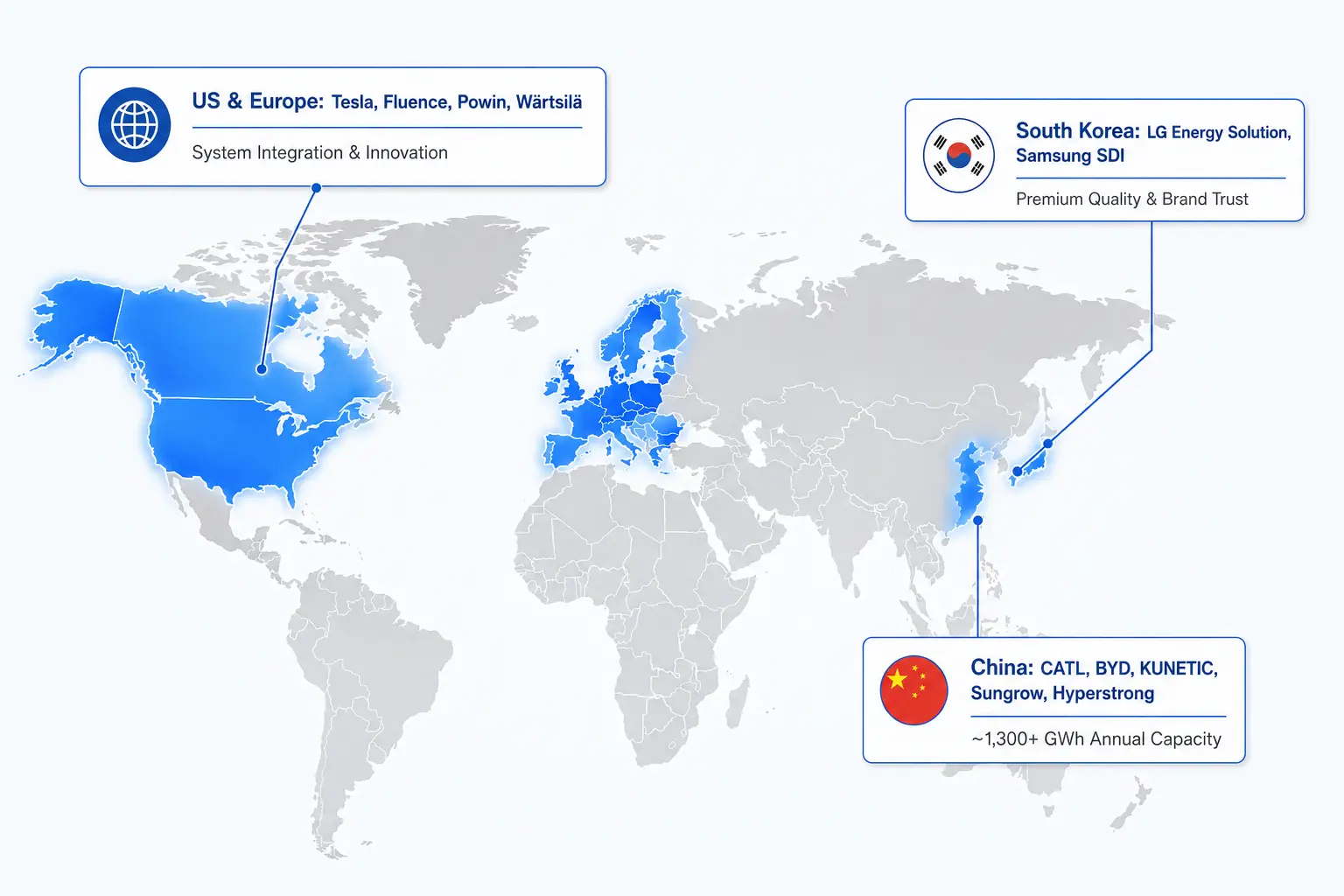
Energy storage battery manufacturing clusters in three global regions. China leads with CATL, BYD, Sungrow, Hyperstrong, and KUNETIC. South Korea contributes LG Energy Solution and Samsung SDI. The US and Europe are home to Tesla, Fluence, Powin, and Wärtsilä.
Each company focuses on different technologies and markets. If you are new to battery storage, start with our BESS guide for foundational knowledge. For C&I projects using LiFePO4, the leading choices are CATL, BYD, Sungrow, KUNETIC, and Powin. This guide walks through 15 manufacturers across 7 key criteria. Whether you need a utility-scale system or a residential battery, it helps you evaluate commercial energy storage options side by side.
1. How We Evaluated
We looked at seven dimensions, not just a numbered list.
Technology and Chemistry. LiFePO4 (LFP) leads with 4,000 to 6,000 cycle life and the lowest per-kWh cost. NMC packs more density but wears out faster. Sodium-ion is new and uses cheaper raw materials.
Manufacturing Capacity. Annual output in GWh tells you about pricing power and whether the supply chain is reliable. Certifications. UL 1973, UL 9540, and IEC 62619 are non-negotiable. You cannot sell into North America or Europe without them.
Track Record, Presence, and Warranty. Deployed megawatt-hours prove the system works in the real world. Local service teams matter when something breaks. And a warranty that only says "10 years" without specifying cycle count is barely worth the paper.
3. Global BESS Manufacturing Landscape 2026
The global market for battery energy storage systems hit about 170 GWh of deployments in 2025, according to BloombergNEF. That is more than double the previous year. The IEA puts global battery manufacturing capacity above 2,500 GWh.
Three regions dominate. China makes over 70% of the world's batteries, with CATL alone supplying roughly a third of the global total. South Korea is home to LG and Samsung SDI, known for premium quality. The US and Europe host Tesla, Fluence, Powin, and Wärtsilä. Energy storage manufacturers in the USA focus mostly on system integration and software.
A few trends worth watching: LiFePO4 keeps taking share from NMC. Sodium-ion batteries are starting to ship commercially. Iron flow batteries from companies like ESS Inc. are finding a niche in long-duration storage, where 8+ hours of discharge matters.
4. Head-to-Head Manufacturer Comparison
CATL is the world's largest battery maker. It had 772 GWh of production capacity in 2025 and is on track to exceed 1,000 GWh in 2026. BYD installed 285.6 GWh in 2025, up nearly 47% from the year before, using its Blade LFP technology. KUNETIC Tech operates 5+ GWh of annual capacity, focused on LiFePO4 systems for C&I and residential projects.
Tesla Megapack runs utility-scale storage from factories in California and Shanghai. LG Energy Solution has a 140 GWh ESS order backlog and is building toward 60+ GWh of dedicated ESS capacity, mostly in North America.
Fluence has put over 7 GWh into operation globally, backed by 15 to 20 year warranties. Powin offers 20-year warranties on more than 6 GWh deployed. Both source cells from multiple suppliers, which gives their customers supply chain flexibility.
5. By Technology: Battery Chemistry Comparison
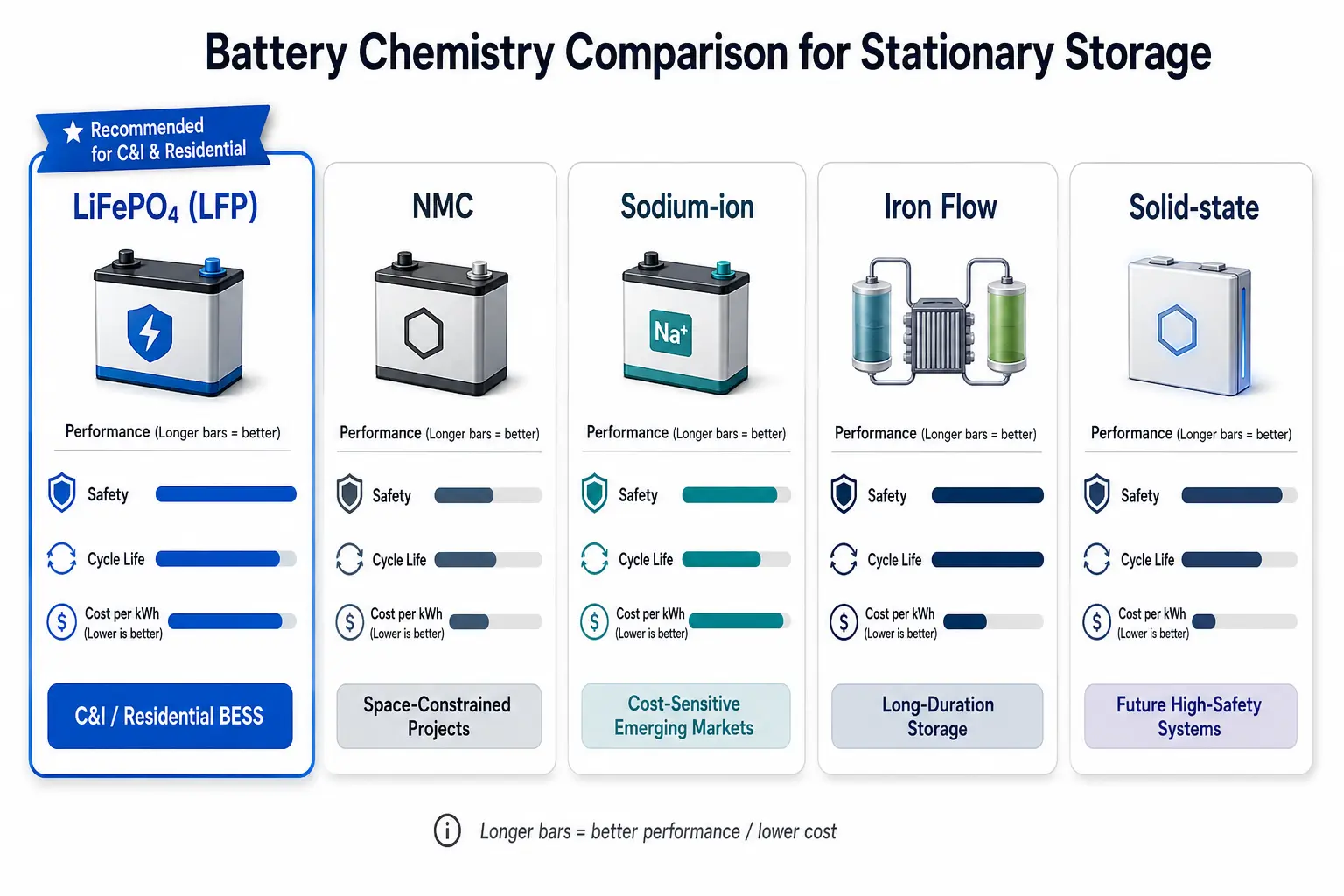
LiFePO4 (LFP) gives you 90 to 140 Wh/kg, 4,000 to 6,000 cycles, and the best thermal safety in its class. It costs 80 to 130 dollars per kWh. For C&I and residential storage, this is the one to beat.
NMC delivers 150 to 220 Wh/kg but only lasts 2,000 to 4,000 cycles. It also carries more fire risk and costs 100 to 160 dollars per kWh. Most new stationary storage projects have moved on from NMC.
Sodium-ion is the newcomer: 100 to 150 Wh/kg, 3,000 to 5,000 cycles, non-flammable, aiming for 70 to 100 dollars per kWh. Iron flow batteries from ESS Inc. can hit 20,000+ cycles and work well for 8+ hour storage, though they cost more upfront. For most buyers right now, LiFePO4 is the safe bet.
7. How to Choose a Manufacturer: 8 Steps
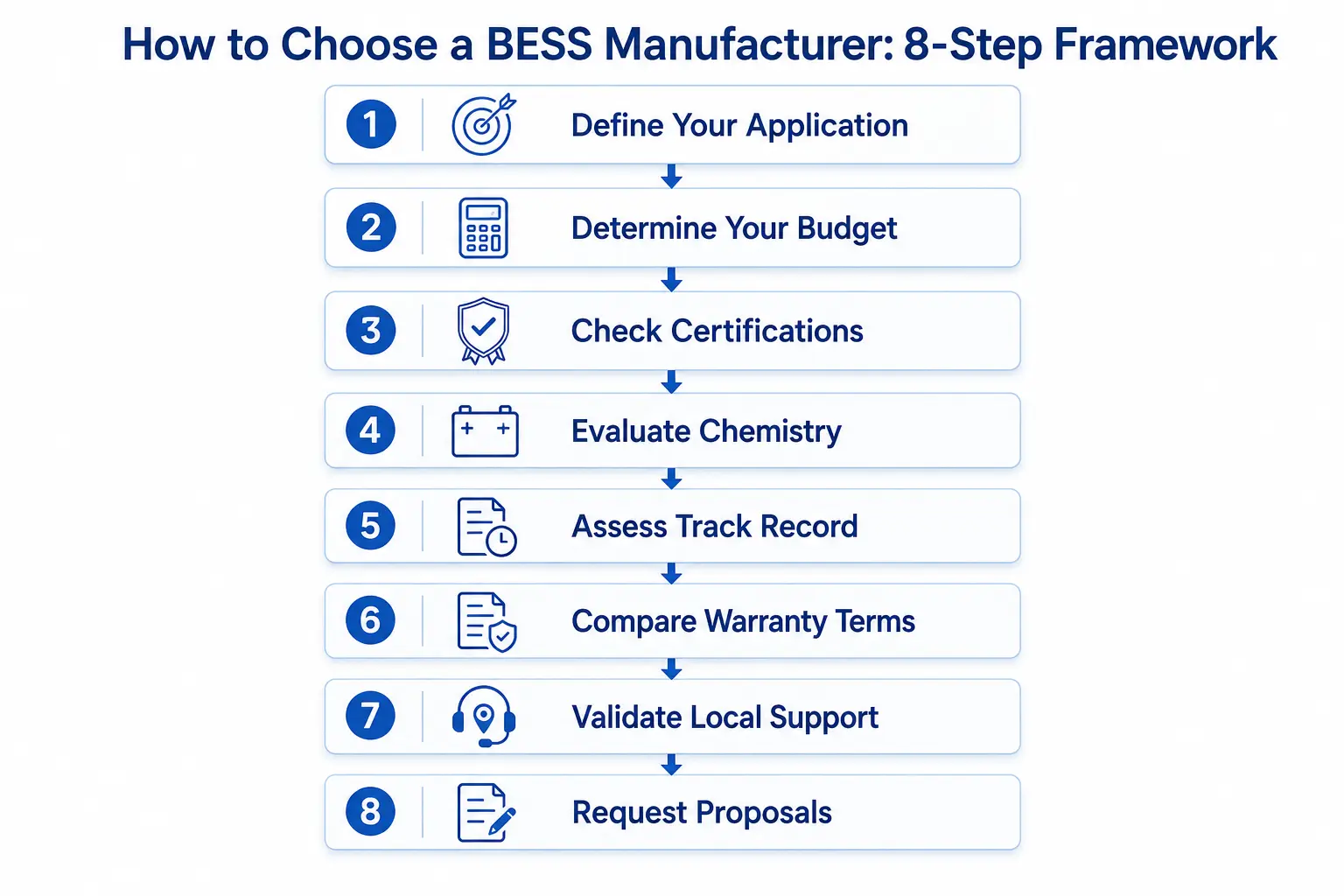
Step 1: Define Your Application. Residential (5 to 30 kWh), C&I (50 to 500 kWh), or utility (1 MWh+). Step 2: Set Your Budget. Installed C&I systems run 250 to 450 dollars per kWh, all-in. Add in ongoing costs for energy management software and maintenance.
Step 3: Verify Certifications. Check the UL Product iQ directory yourself. Step 4: Pick Your Chemistry. LiFePO4 is the safe default. Step 5: Check Their Track Record. Ask for three references with systems running at least two years.
Step 6: Read the Warranty. Cycle counts and capacity retention curves matter more than the number of years. Step 7: Confirm Local Support. Who shows up when something goes wrong, and how fast? Step 8: Get Multiple Quotes. At least three, and compare specs and warranties, not just the headline price.
8. Certifications That Matter
UL 1973 covers cell and module safety. You need it for North America. UL 9540 covers the complete system. UL 9540A is the large-scale fire test that many US fire codes now require. Always verify certificates on UL Product iQ.
IEC 62619 is the international standard for industrial batteries. CE Mark gets you into the European Union. UN38.3 is mandatory for shipping lithium batteries anywhere.
ISO 9001 and ISO 14001 cover quality and environmental management. Worth checking, but they are process certifications, not safety tests. Always verify the certificate numbers yourself on the issuing body's website. Do not take a manufacturer's word for it.
9. Red Flags When Choosing a Supplier
Five things that should make you pause. No third-party certification reports you can verify. A warranty that says "10 years" without mentioning cycle count or capacity retention. Zero reference customers with systems like yours. A price far below everyone else, which usually means B-grade cells or corners cut somewhere. And delivery promises that beat the 12 to 16 week industry norm for C&I systems.
10. FAQ: Common Questions About BESS Manufacturers
Who are the top energy storage battery manufacturers in 2026? CATL, BYD, KUNETIC, and Sungrow lead in China. LG and Samsung SDI in South Korea. Tesla, Fluence, Powin, and Wärtsilä in the US and Europe.
Which chemistry is best for commercial storage? LiFePO4. It is the safest, lasts the longest, and costs the least per cycle. What certifications do I need? UL 1973 and UL 9540 for North America. IEC 62619 and CE for international markets.
How much does a commercial BESS cost? 250 to 450 dollars per kWh installed, all-in.
How long do BESS batteries last? 10 to 15 years or 4,000 to 6,000 full cycles, whichever comes first.
How do I verify a manufacturer's claims? Look up their certifications yourself. Call their reference customers. If the project is large enough, visit the factory.
11. Finding the Right Partner
Choosing a BESS manufacturer comes down to matching three things: your application, your budget, and the certifications your market requires.
Battery costs have never been lower. LiFePO4 is the chemistry most buyers pick now. And the market gives you real options, from the biggest cell manufacturers to nimble integrators and a new crop of sodium-ion startups.
KUNETIC Tech provides LiFePO4 energy storage solutions for C&I and residential use. We integrate Tier-1 LFP cells with our own BMS, PCS, and EMS. If you want a proposal for your project, contact us.