Table of Contents
What is utility-scale battery storage?
Utility-scale battery storage is a grid-connected battery energy storage system (BESS) that stores electricity and feeds it back into the power system when needed. In U.S. Energy Information Administration (EIA) reporting, utility-scale systems have at least 1 MW of net generation capacity. Smaller systems are reported separately. The 1 MW threshold is a U.S. statistical convention, not a universal legal definition for every market.
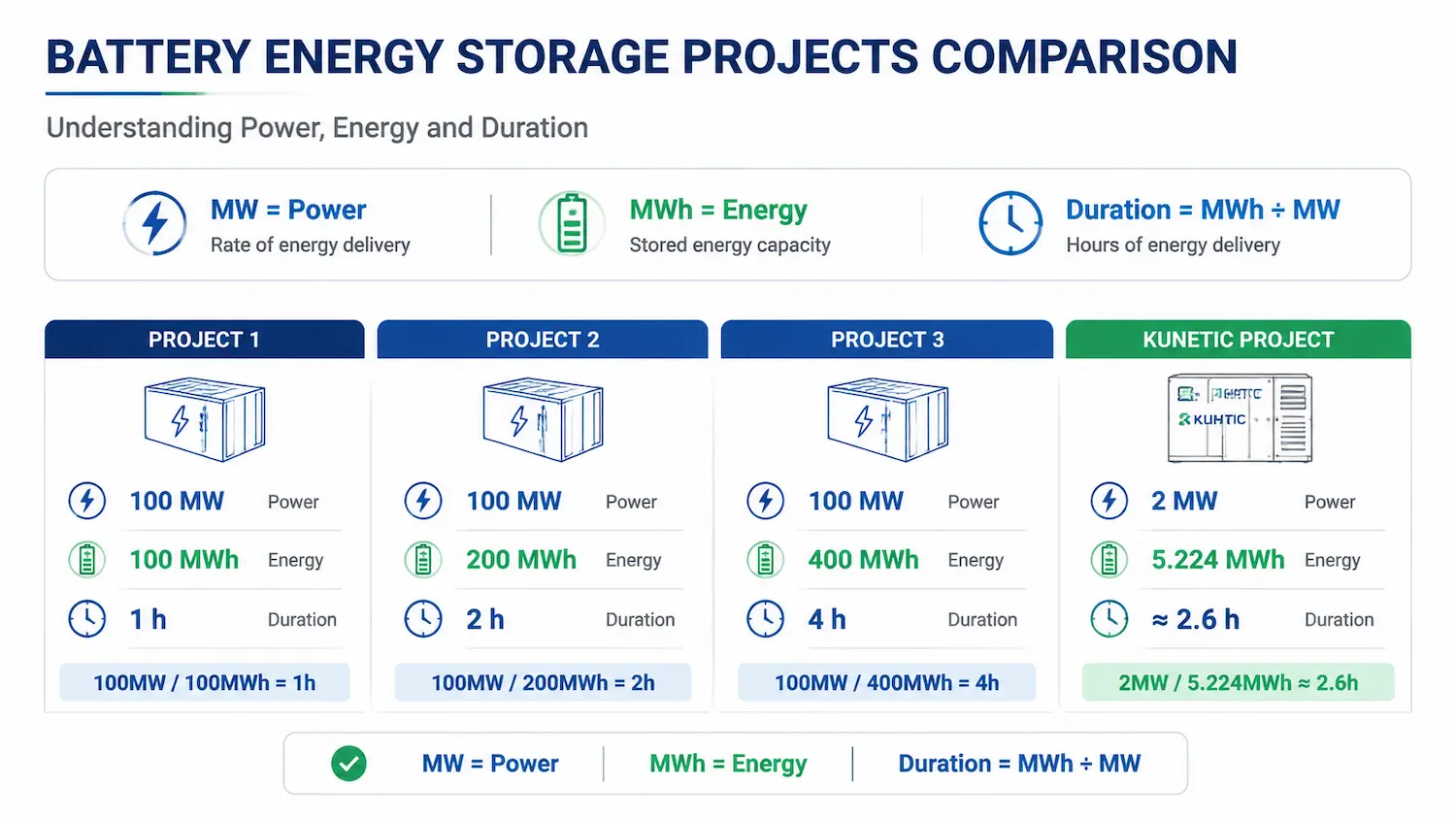
A utility-scale project is described by both power in MW and stored energy in MWh. MW tells you how much power the system can deliver at a given moment. MWh tells you its energy storage capacity. It shows how much energy it can store. Divide MWh by MW and you get the nominal discharge duration.
These systems are used for grid support, renewable integration, energy shifting, capacity support, or a mix of these functions. For a broader introduction to battery energy storage, see KUNETIC's What Is BESS? guide. For behind-the-meter factory and commercial applications, see our Commercial Energy Storage Systems guide.
The market is growing quickly. The IEA reported 108 GW of new battery storage deployment worldwide in 2025. Around 80% was utility-scale. Most new deployments used lithium-ion batteries, and LFP accounted for about 90% of deployments.
MW vs MWh: power, energy and storage duration
A simple way to understand a utility-scale BESS is to separate power from energy.
MW tells you power
MW is the rate at which the BESS can charge or discharge. A 100 MW system can deliver up to 100 MW of power at its rated operating point, subject to its design and operating limits.
MWh tells you stored energy
MWh is the amount of energy stored. Two projects can both be rated at 100 MW and still have very different storage capability.
Project rating | Nominal duration | What it means |
100 MW / 100 MWh | 1 hour | High power, short energy duration |
100 MW / 200 MWh | 2 hours | Same power, twice the stored energy |
100 MW / 400 MWh | 4 hours | Same power, four-hour nominal duration |
2 MW / 5.224 MWh | ~2.6 hours | KUNETIC factory reference design |
The EIA calculates battery duration by dividing energy capacity in MWh by power capacity in MW. That result is the nominal duration, not a guaranteed usable runtime. The permitted state-of-charge window, conversion losses, operating reserve, temperature, degradation and dispatch strategy all affect how long a project can actually deliver power.
For project sizing, do not start with the number of containers. Start with what the system needs to do. The required grid service determines the MW requirement and the duration. Those two inputs then determine the MWh requirement and the number of battery and power-conversion blocks.
How does a utility-scale battery storage system work?
A utility-scale BESS is not one oversized battery. In practice, utility-scale battery energy storage systems combine repeatable battery, power-conversion and control blocks.
In one KUNETIC factory reference design, a 2 MW / 5.224 MWh system uses 20 battery clusters rated at 261.24 kWh each, four 500 kW MPS power-conversion blocks and an EMS. The system scope also includes 20-foot container enclosures, power and communication cabling, and auxiliary systems.
At a high level, the power path is:
Battery cells → packs → clusters → battery containers/blocks → PCS or MPS → AC/MV collection → transformer/switchgear → grid connection
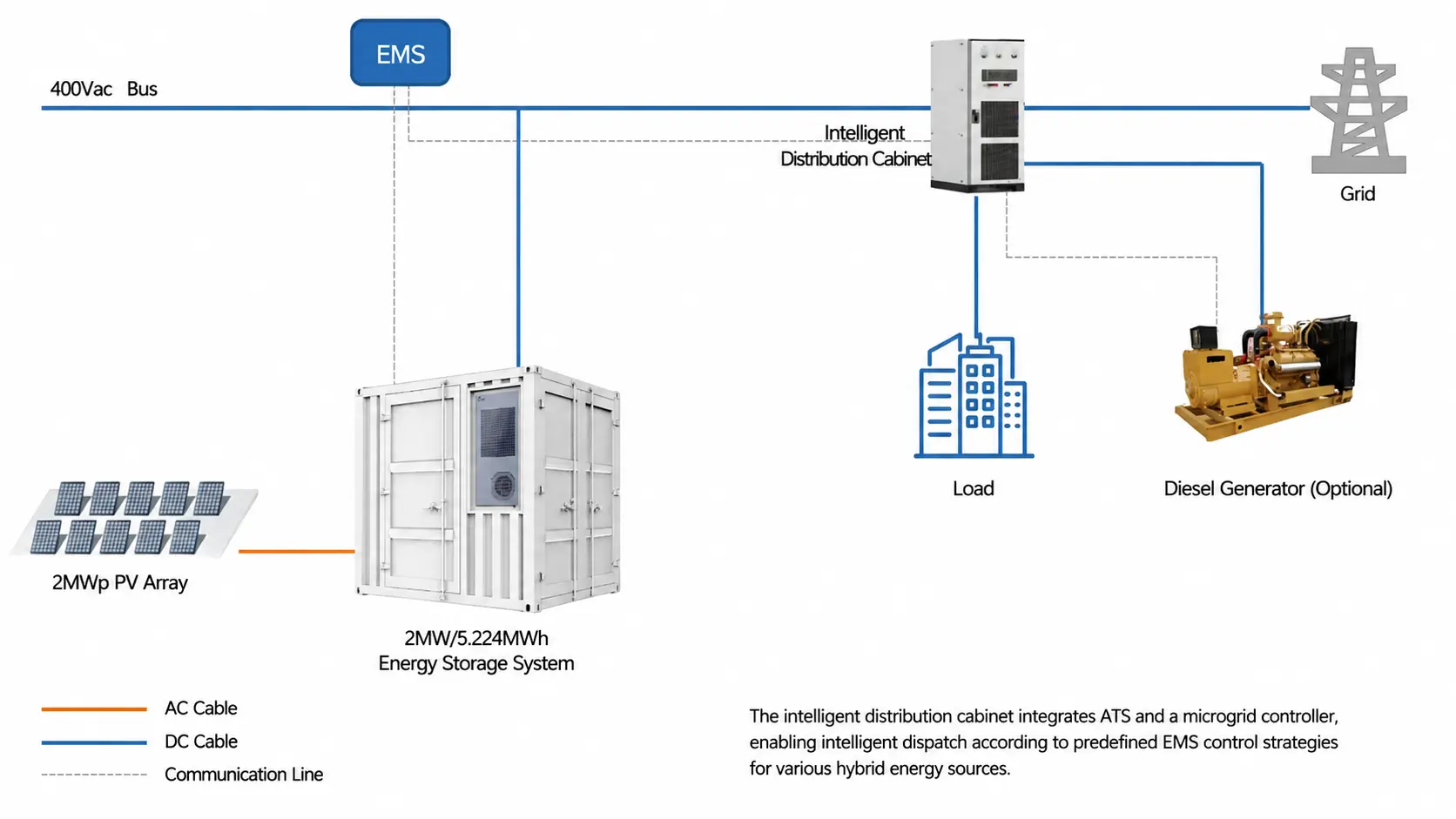
The BMS monitors the battery side, including voltage, temperature, state of charge and protection limits. The PCS or MPS converts power in both directions between the battery and the AC system. The EMS or plant controller sits above those subsystems and coordinates charge/discharge commands, operating limits and system measurements. In the factory reference topology, PV, storage, the grid and the load are all coordinated through the control system.
This modular structure lets a large project scale by repeating validated blocks instead of making a single battery unit indefinitely larger. KUNETIC's BESS Container Guide explains the container form factor in more detail.
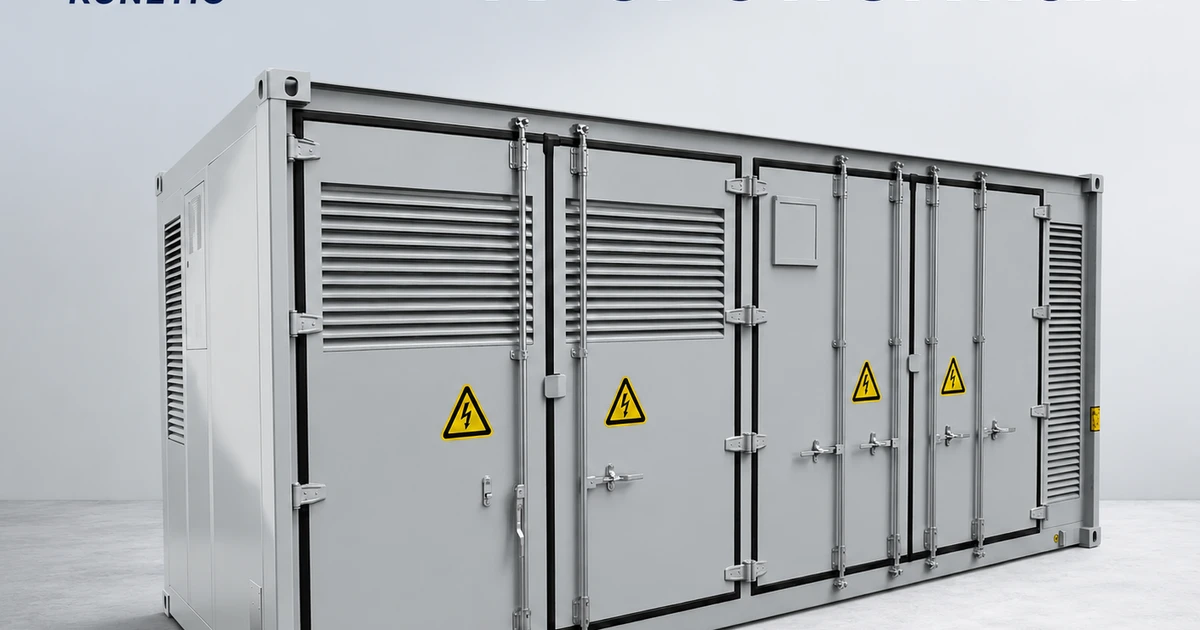
KUNETIC 750kW / 1.446MWh Container BESS: view system details →
What does utility-scale battery storage do for the grid?
Often called grid-scale battery storage, a utility-scale BESS helps the grid by changing when electricity is available.
For energy shifting or arbitrage, the BESS charges when electricity is abundant or lower-value and discharges when demand or market value is higher. Utilities also use batteries for short-term grid-stability services such as frequency response, to help meet peak demand, and for other balancing functions.
Battery storage can also support peak capacity. During a high-demand period, a BESS can discharge quickly. The limit is duration. A 100 MW / 400 MWh battery can nominally sustain 100 MW for four hours, not indefinitely.
In a utility-scale solar battery storage project, a BESS adds another use case. Instead of exporting all solar production when output is strongest, a project can store part of that energy and dispatch it later.
A KUNETIC factory solar-storage reference design combines 2 MWp of PV with a 2 MW / 5.224 MWh BESS, EMS, grid connection and load-side distribution. PV produces the energy, the battery shifts part of it through time, and the control system manages how the resources operate together.
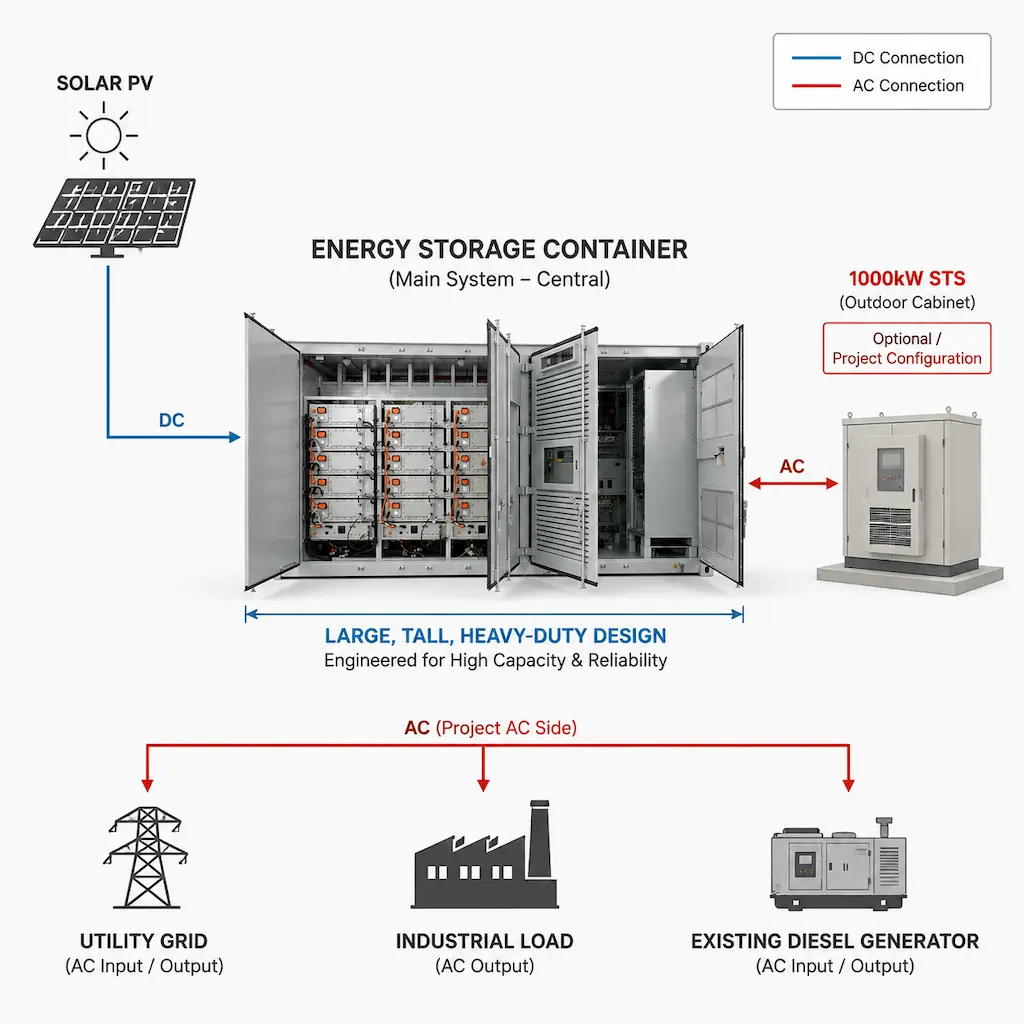
See KUNETIC solar-plus-storage and battery projects in our Projects in Action section →
How do sizing, cost and limits shape a utility-scale BESS project?
Start with the use case, not the container count
A project built mainly for fast frequency response can need a different power-to-energy ratio from one intended to shift several hours of solar production. Peak capacity, curtailment reduction and hybrid operation can also lead to different system designs.
A practical sizing sequence is:
Use case → required MW → required duration → required MWh → cycling/degradation margin → battery and PCS blocks → grid-connection design
This is why a request such as "I need a 20 MW battery" is incomplete. The engineer still needs to know how long that 20 MW must be available and what operating duty the project will perform.
The same modular logic appears in KUNETIC factory engineering materials for smaller hybrid systems. The 220 kW and 400 kW designs use repeatable battery and PCS blocks, while the 400 kW design also shows master/slave EMS control and AC combining for parallel expansion. These systems are not utility-scale projects themselves, but their architecture shows how modular BESS design can be expanded.
What drives project cost?
There is no single useful utility-scale BESS price without a defined project boundary. Project cost can include battery hardware, PCS, medium-voltage equipment, transformers and switchgear, EMS/PPC/SCADA, fire and thermal systems, civil works, EPC, commissioning and grid interconnection.
The National Laboratory of the Rockies' 2025 utility-scale battery cost update uses low, mid and high cost scenarios for four-hour lithium-ion systems rather than one universal cost figure. Cost comparisons only become meaningful after the duration, project scope and site conditions are defined.
What batteries cannot do
Battery storage moves electricity through time. It does not create electricity. The battery must first be charged, and conversion losses plus auxiliary consumption mean not all of that energy returns to the grid.
Duration is finite as well. A battery can respond quickly, but it cannot run forever at rated power. Its available capacity also changes over time with cycling, temperature, SOC window and operating conditions.
Cycle life, calendar life and warranty are separate specifications. KUNETIC factory reference material includes battery-module test conditions showing 6,000 cycles at the stated test conditions / 70% SOH and a 15-year calendar-life figure. The same material notes that warranty terms depend on the actual warranty agreement. These figures should therefore not be read as a universal warranty promise.
What do you need to evaluate a utility-scale BESS project?
Before choosing containers or asking for a price, define the inputs that drive the system design:
- Target power in MW
- Target energy in MWh or required duration
- Main use case or grid service
- Grid/interconnection voltage
- Project location and site conditions
- Solar or wind profile, if co-located
- Expected cycling and operating strategy
- Target commercial operation date
With those inputs, an engineering team can translate the project objective into battery blocks, PCS capacity, electrical architecture and controls.
Planning a multi-MWh battery storage project? Share your target MW/MWh, grid voltage, application and project location with KUNETIC for an initial system configuration review.
Utility-scale battery storage FAQ
What size is considered utility-scale battery storage?
In U.S. EIA reporting, utility-scale generation and storage systems are generally 1 MW or larger. Other markets or project documents may use the term differently, so the local regulatory and interconnection context still matters.
How long can a utility-scale battery supply power?
Divide energy capacity in MWh by power capacity in MW to estimate nominal duration. A 100 MW / 400 MWh system is nominally a four-hour battery. Actual usable runtime depends on SOC limits, efficiency, reserve requirements and operating strategy.
What is the typical ROI for utility-scale battery storage?
There is no universal ROI. Returns depend on CAPEX, market rules, arbitrage spreads, capacity or ancillary-service revenues, cycling, degradation, interconnection cost, financing and the project's revenue stack.