Table of Contents
Quick Answer: BESS stands for Battery Energy Storage System. It stores electricity in rechargeable LiFePO4 batteries. When you need power, it releases that stored energy for cost savings, backup, or grid support.
A BESS combines four key subsystems into one intelligent unit: battery management, power conversion, energy management, and thermal management. The result is not just a battery cabinet, but a controlled energy storage system that can charge, store, and discharge power when your site needs it.
1. What Is BESS and What Does It Mean?
BESS means Battery Energy Storage System. It stores electricity from solar, wind, or the utility grid, then releases that energy on your schedule. For businesses, the practical value is simple: lower peak demand, stronger backup power, better solar self-consumption, and more control over energy costs.
- Battery modules store the electrical energy.
- Power electronics convert and control electricity flow.
- Energy management software decides when to charge, discharge, or hold power.
- Safety systems handle thermal management, fire suppression, and fault protection.
Bottom line: A BESS is the practical bridge between renewable energy, grid reliability, and business energy savings.
2. How Does a BESS Battery Work?
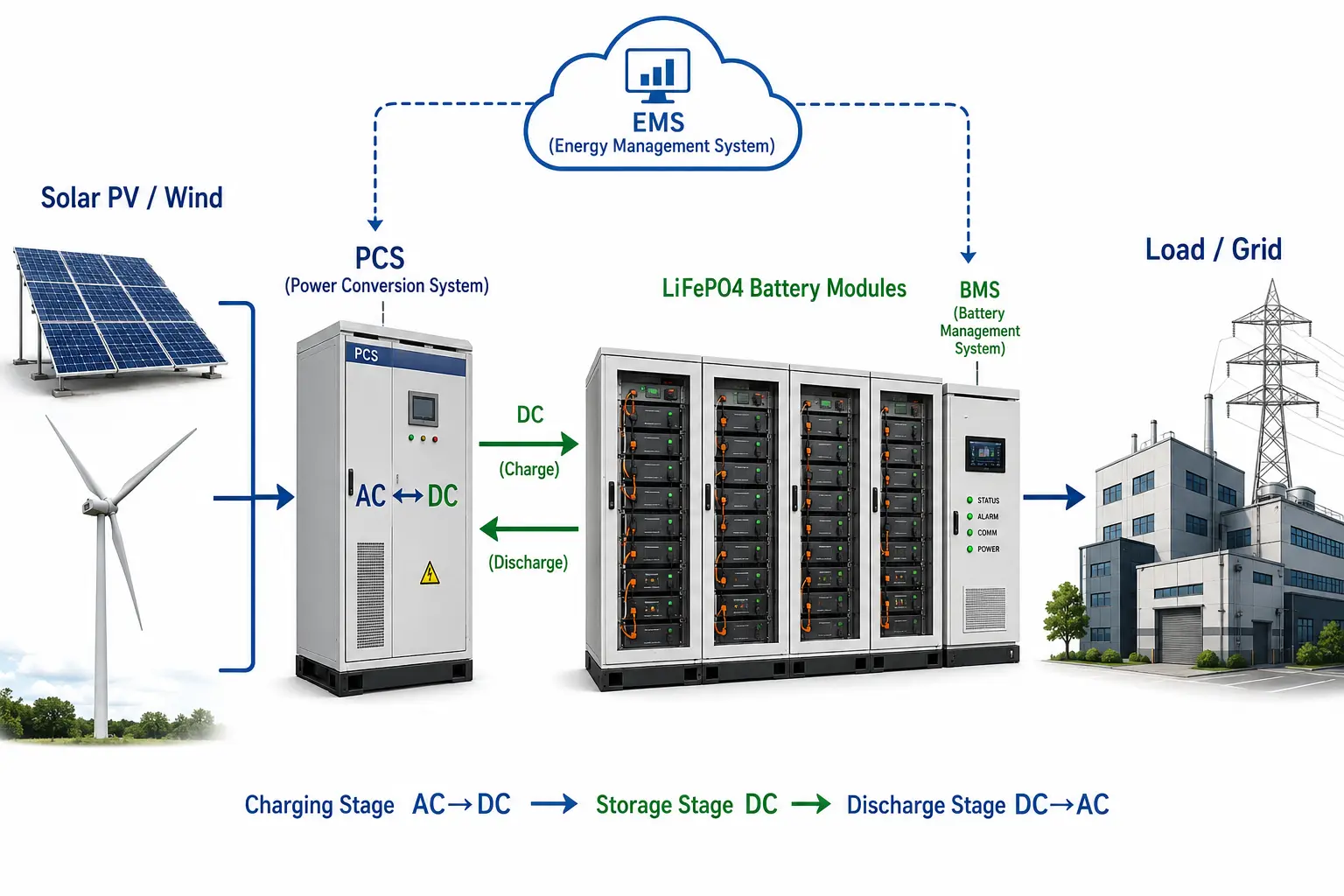
A BESS works through three basic phases: charging, storage, and discharging. During charging, electricity from solar PV, wind, or the grid flows into the system. The Power Conversion System converts AC power to DC power. During storage, LiFePO4 battery cells hold the energy while the BMS monitors voltage, temperature, state of charge, and state of health. During discharging, the PCS converts DC power back to AC power for your building, factory, charger, or microgrid.
Phase 1: Charging
The system charges during low-cost grid periods or when solar production exceeds site demand.
Phase 2: Storage
Battery modules store DC electricity while the BMS protects the cells and balances performance.
Phase 3: Discharging
The EMS decides when to release stored power based on electricity price, load profile, solar forecast, and backup needs.
3. Core Components of a BESS
A complete commercial BESS has six integrated subsystems:
- Battery Modules: Store energy in LiFePO4 cells. Cell brand, cycle life, and warranty terms matter.
- BMS: Protects cells from overcharge, over-discharge, overheating, and imbalance.
- PCS: Handles two-way AC/DC conversion and grid compliance.
- EMS: Runs intelligent scheduling, peak shaving, and grid interaction.
- Thermal Management: Keeps the system in a safe operating temperature range.
- Enclosure & Safety: Provides physical protection, fire suppression, and environmental sealing.
4. BESS vs Other Energy Storage Technologies
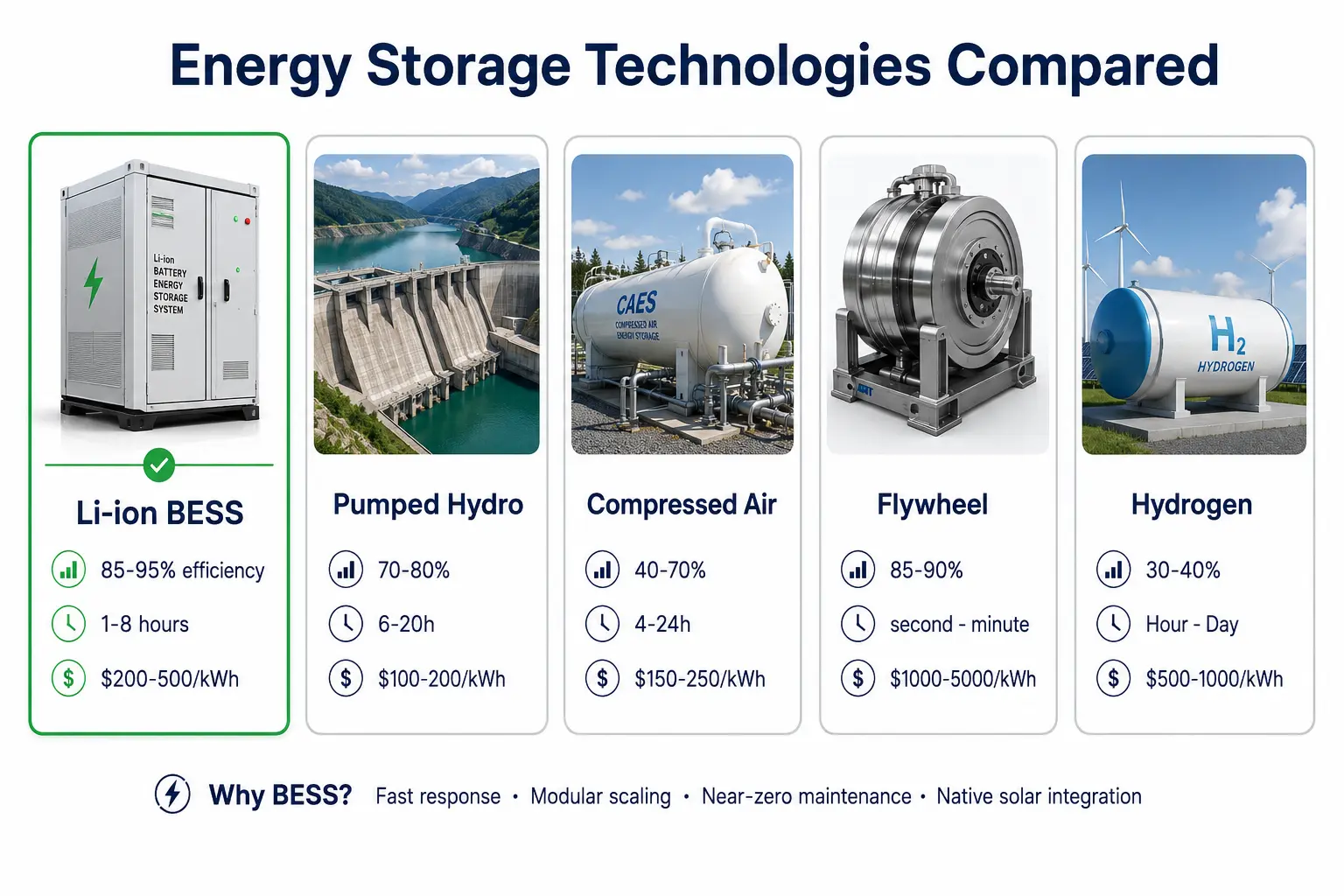
BESS is not the only way to store energy. Here is how the main storage technologies compare:
| Technology | Response Time | Duration | Efficiency | Best Use Case |
|---|---|---|---|---|
| Li-ion BESS | Milliseconds | 1-4 hours | 85-95% | Commercial, industrial, solar, and grid support |
| Pumped Hydro | Minutes | 6-20 hours | 70-80% | Large utility projects with suitable geography |
| Compressed Air | Minutes | 4-24 hours | 40-70% | Long-duration storage in special geological sites |
| Flywheel | Milliseconds | Seconds-minutes | 85-90% | Short bursts, frequency response, and power quality |
| Hydrogen | Seconds-minutes | Hours-days | 30-50% | Seasonal storage and hard-to-electrify sectors |
Why BESS dominates C&I: You get fast response, modular scaling, near-zero maintenance, and native solar integration that other energy storage systems cannot match.
5. Commercial Energy Storage: Types of BESS by Scale
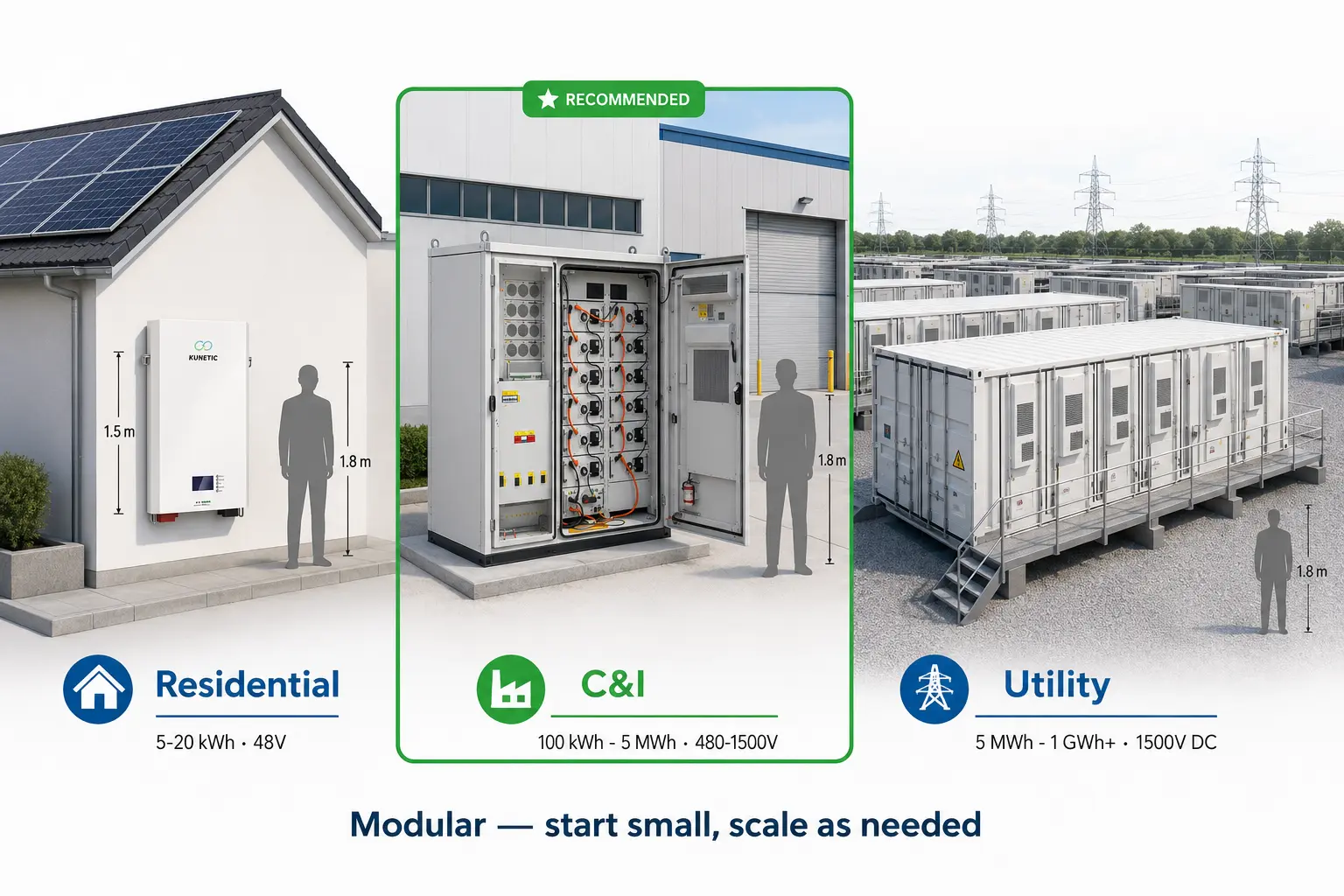
| Scale | Typical Capacity | Form Factor | Main Application | Typical Buyer |
|---|---|---|---|---|
| Residential | 5-30 kWh | Wall-mounted or stackable | Home solar self-consumption and backup | Homeowners |
| Small Commercial | 30-200 kWh | All-in-one cabinet | Small business peak shaving | Retail, offices, small sites |
| C&I | 100 kWh-5 MWh | Cabinet cluster or 20ft container | Demand charge reduction and solar shifting | Factories, warehouses, campuses |
| Utility Scale | 5 MWh-GWh+ | Containerized battery blocks | Frequency regulation and renewable firming | Utilities and IPPs |
Most commercial and industrial buyers need 100 kWh to 5 MWh. A typical factory might install 500 kWh to shave peak demand charges and store daytime solar for evening use.
6. Battery Chemistry Comparison
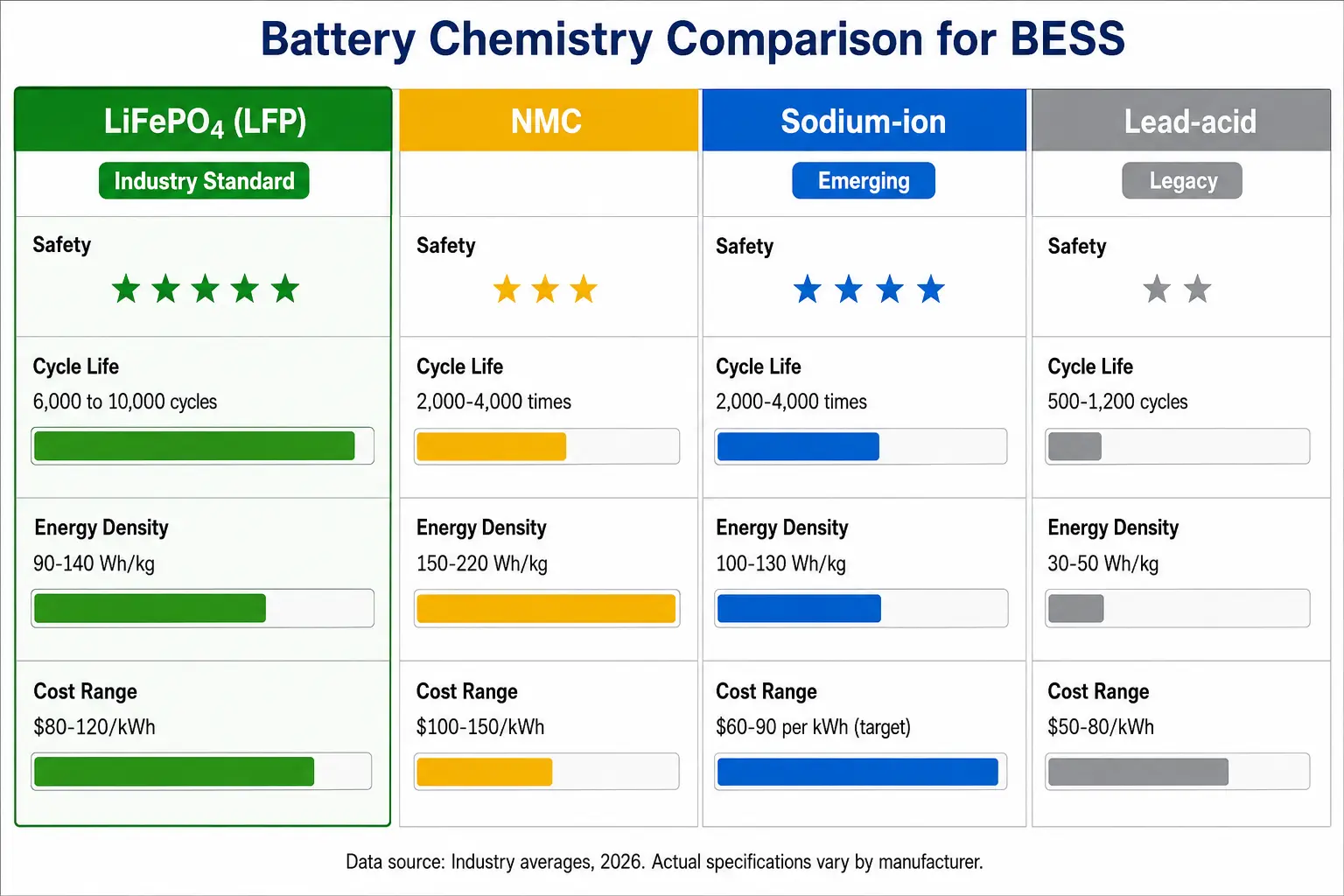
Not all BESS batteries use the same chemistry. In 2026, LiFePO4 remains the practical standard for commercial and industrial energy storage.
| Chemistry | Safety | Cycle Life | Energy Density | Best Fit |
|---|---|---|---|---|
| LiFePO4 (LFP) | Excellent | 6,000-10,000 cycles | 90-140 Wh/kg | C&I and residential BESS |
| NMC | Moderate | 2,000-4,000 cycles | 150-220 Wh/kg | Space-constrained systems |
| Sodium-ion | Good | 3,000-6,000 cycles | 100-130 Wh/kg | Emerging low-cost storage |
| Lead-acid | Limited | 500-1,200 cycles | 30-50 Wh/kg | Budget short-term backup |
- Safety: LFP has a higher thermal runaway threshold than NMC.
- Lifespan: 6,000-10,000 cycles supports 15+ years of daily use.
- Cost: LFP cell prices continue to fall as supply scales.
- Supply chain: no cobalt means simpler sourcing and fewer ethical concerns.
7. Key Benefits of BESS for Businesses
- Peak Shaving: Charge when electricity is cheap and discharge when it is expensive.
- Demand Charge Reduction: Lower your peak kW draw from the grid.
- Solar Self-Consumption: Store excess daytime solar for evening use.
- Backup Power: Switch seamlessly during outages and reduce downtime risk.
- Grid Revenue: Participate in frequency regulation and capacity markets where available.
- Carbon Reduction: Cut fossil fuel use and support ESG goals.
Real-world example: a manufacturing plant with a 500 kW peak load installs a 250 kW / 500 kWh BESS. Demand charge reduction and load shifting can save tens of thousands of dollars per year, especially when combined with solar and local incentives.
8. BESS Applications by Industry
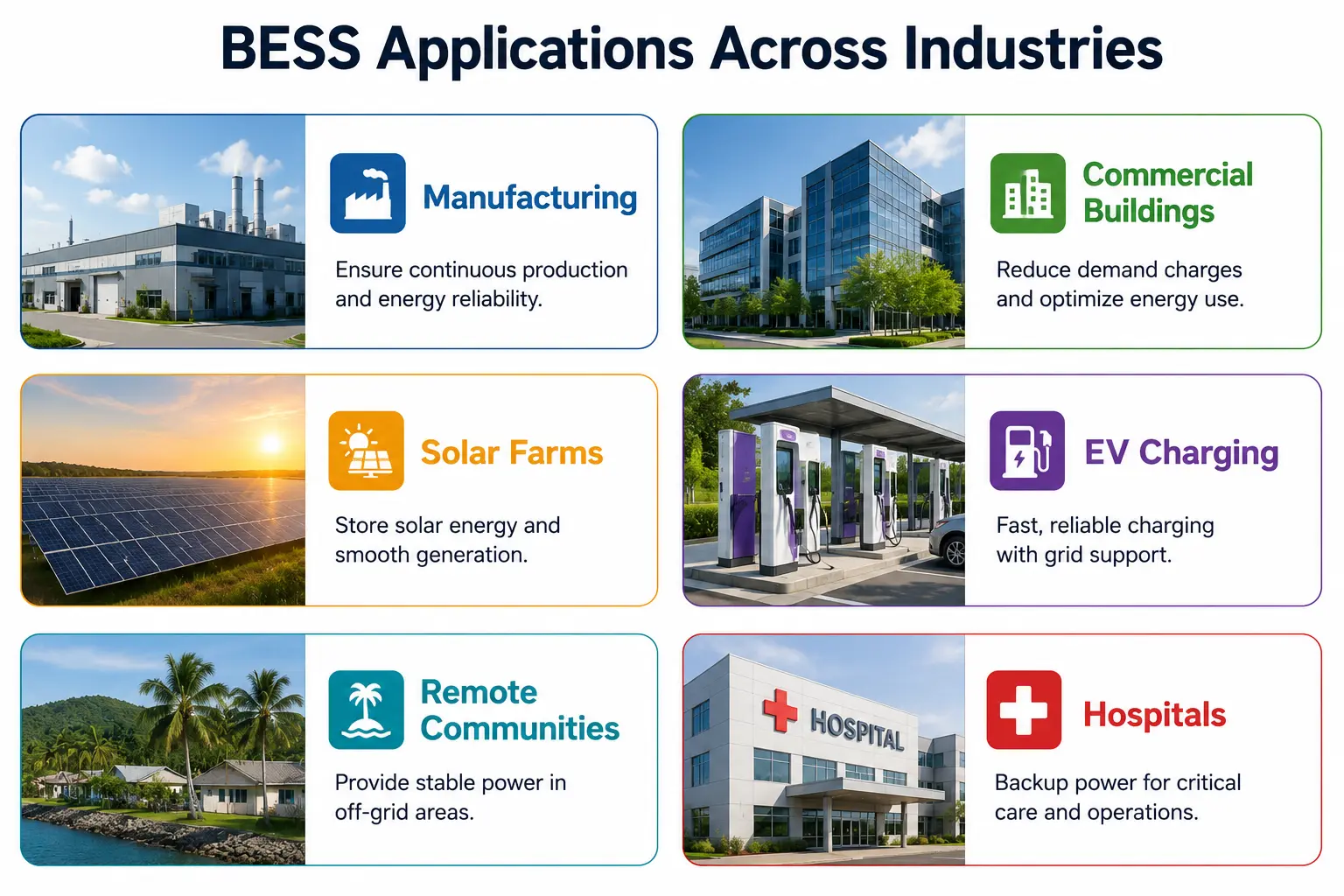
- Manufacturing & Industrial Plants: Reduce demand charges and keep production running during unstable grid conditions.
- Commercial Buildings & Retail: Shave HVAC peak loads and buffer EV charging stations.
- Solar Farms & Renewable Integration: Store excess midday generation for evening peaks.
- EV Charging Stations: Avoid grid upgrades and demand spikes from high-power chargers.
- Remote Communities & Islands: Run solar + BESS microgrids with less diesel dependency.
- Hospitals & Critical Infrastructure: Provide instant backup for life-safety equipment and sensitive loads.
9. BESS Costs in 2026
BESS pricing keeps falling, but installed cost still depends on project size, battery cell pricing, PCS capacity, installation complexity, and compliance requirements.
| Segment | Installed Cost Range | Battery Share | Balance of System | Typical Project |
|---|---|---|---|---|
| Residential | $600-$900/kWh | 40-50% | 50-60% | 5-30 kWh home backup |
| C&I | $300-$500/kWh | 50-60% | 40-50% | 100 kWh-5 MWh commercial energy storage |
| Utility | $200-$350/kWh | 60-70% | 30-40% | 10 MWh+ grid-scale storage |
Total cost of ownership matters more than purchase price. A LiFePO4 BESS has higher upfront cost than a diesel generator, but far lower fuel and maintenance cost over a 10-year period.
10. How to Choose a BESS Supplier
Evaluate suppliers against these eight criteria before choosing a commercial energy storage partner:
- Manufacturing track record and annual production capacity.
- Battery cell source and batch traceability.
- Certifications including UL 1973, UL 9540, UL 9540A, IEC 62619, CE, and UN38.3.
- Warranty terms for product life, cycles, throughput, and temperature limits.
- Single-vendor system integration across BMS, PCS, EMS, and enclosure.
- Remote monitoring, alerts, reports, and firmware support.
- After-sales service, spare parts, and SLA commitments.
- Reference projects matching your scale and application.
Working with KUNETIC: 15+ years manufacturing experience, LiFePO4-based system design, commercial energy project support, and global shipping.
11. BESS FAQ
What does BESS stand for?
BESS stands for Battery Energy Storage System. It is an integrated rechargeable battery system that stores and releases electricity.
How is BESS different from ESS?
ESS covers all energy storage types. BESS means battery-based energy storage specifically.
How long does a BESS battery last?
Modern LiFePO4 systems usually last 10-15 years, depending on operating conditions and cycle profile.
Can BESS work completely off-grid?
Yes. Many systems support off-grid or hybrid microgrid operation with solar panels and optional generators.
What size BESS do I need?
Sizing depends on peak load, daily energy use, solar production, backup duration, and electricity tariff. For precise sizing, review your 12-month electricity bills and 15-minute interval data.
12. Conclusion: Is BESS Right for Your Business?
Your business likely benefits from BESS if you have high demand charges, solar power, outage risk, time-of-use electricity pricing, or sustainability goals. BESS technology has matured, prices are lower, and incentives remain strong in many markets.
Ready to explore BESS for your project? KUNETIC Energy delivers LiFePO4-based BESS solutions from 30 kWh to 5 MWh+, built for commercial, industrial, and utility applications. Email: eliza@lithiumaabatteries.com