Table of Contents
Commercial Energy Storage Systems: The Complete 2026 C&I Buyer's Guide
Quick Answer: A commercial energy storage system — also called a C&I BESS (Commercial & Industrial Battery Energy Storage System) — is a behind-the-meter battery solution that stores electricity and dispatches it strategically to cut energy costs, provide backup power, and integrate with solar. In 2026, with battery prices at historic lows, the 30% federal Investment Tax Credit, and electricity rates rising, a properly sized commercial BESS typically delivers a 3-7 year payback and generates pure savings for the remaining 10-15 years of system life.
1. Why Invest in Commercial Energy Storage Systems Now
Three forces are converging in 2026 to make commercial battery storage one of the best infrastructure investments a business can make.
Battery Prices at Historic Lows
LFP (lithium iron phosphate) battery cell prices have fallen below $50/kWh at the cell level in China, down from over $120/kWh in 2022. Turnkey installed C&I systems now range from $300-500/kWh, a 40% drop in four years. This is not a temporary dip — manufacturing scale, chemistry improvements, and supply chain maturity have structurally reset battery costs.
Electricity Rates Keep Rising
Commercial electricity rates in the US have risen 15-25% since 2020, with demand charges now accounting for 30-70% of a typical commercial bill. Time-of-use (TOU) rate spreads — the gap between peak and off-peak pricing — have widened in most major markets, creating larger arbitrage opportunities.
Incentives Have Never Been Better
The US federal Investment Tax Credit (ITC) now covers 30% of standalone energy storage (no solar required). Through the IRA's transferability provision, companies without sufficient tax liability can sell their ITC for 90-95 cents on the dollar. Combined with MACRS accelerated depreciation, the effective first-year reduction can reach 40-50% of system cost.
How a C&I BESS Saves and Earns Money
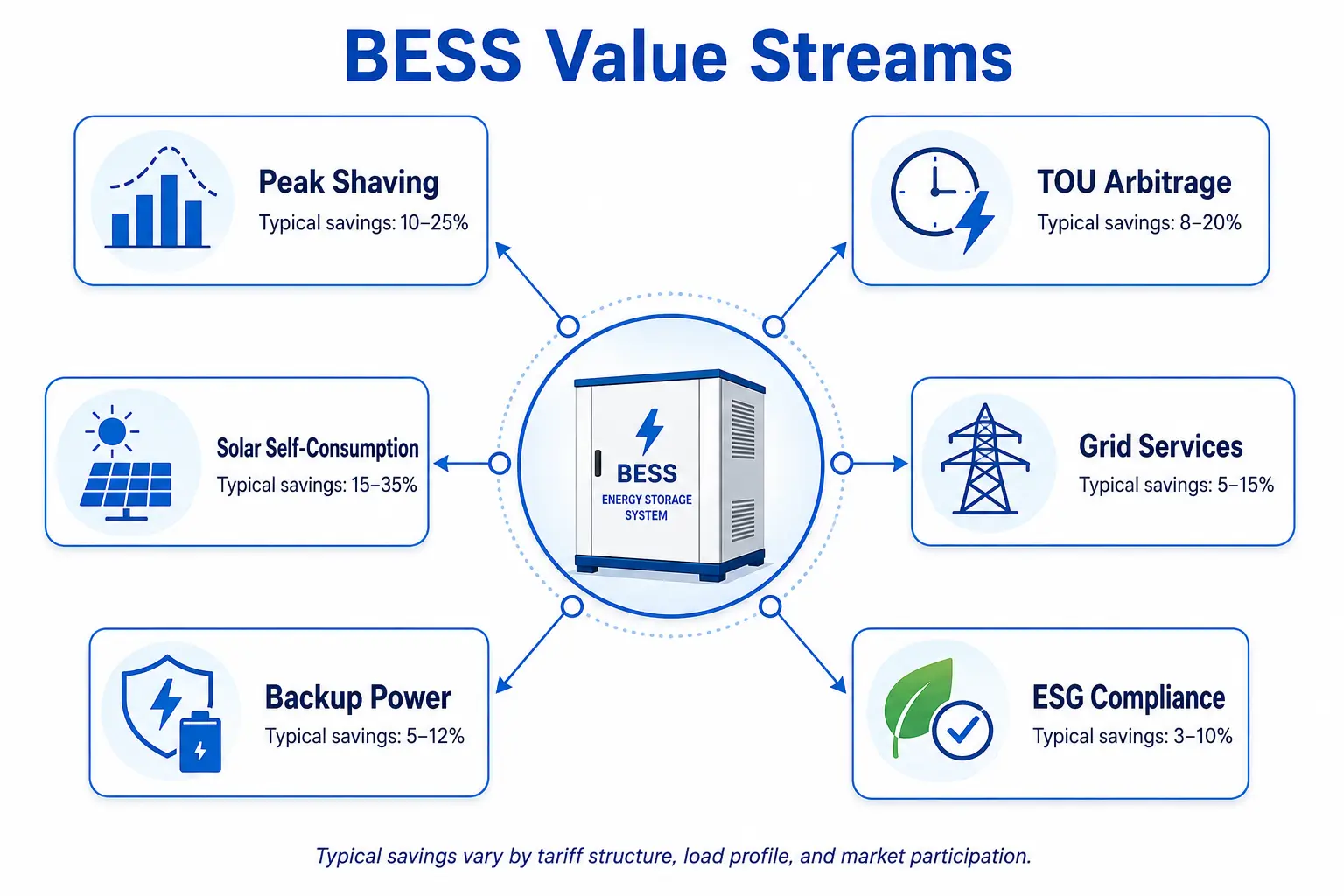
A commercial BESS stacks multiple value streams simultaneously:
• Peak Shaving / Demand Charge Reduction: Battery discharges during peak kW demand to lower utility meter readings — typically 30-50% reduction in demand charges, often the biggest saver.
• Time-of-Use Arbitrage: Charge during cheap off-peak hours, discharge during expensive peak. $0.25-0.40/kWh spread, generating $10,000+/year for a 500 kWh system.
• Solar Self-Consumption: Store excess midday solar for evening loads, improving self-consumption from approximately 35% to 70-80%.
• Grid Services Revenue: Participate in frequency regulation, demand response, or VPP programs for additional $10-50/kW/year in eligible markets.
• Backup Power: Seamless transition during grid outages (under 20ms response), avoiding downtime costs of $10K-100K+ per hour for factories.
• Carbon and ESG Compliance: Reduce fossil fuel reliance, meet sustainability targets, qualify for green financing and EU supply chain compliance.
The key insight: these streams run simultaneously. A single BESS can shave demand peaks at 2 PM while arbitraging TOU rates and keeping reserve capacity for backup — all coordinated by the Energy Management System (EMS). For practical examples of BESS across industries, see commercial and industrial energy storage applications.
2. C&I BESS System Design: Sizing, Architecture & Battery Tech
How to Size Your Commercial Energy Storage System
The fundamental sizing formula: System Capacity (kWh) = Peak Load Reduction Target (kW) × Planned Discharge Hours (h).
Example: A factory with a 350 kW peak load wants to shave 150 kW for 3 hours → 450 kWh system.
You need 12 months of 15-minute interval data from your utility (this aligns with how utilities bill demand charges), load profile analysis to understand when peaks occur and how long they last, and growth margin for EV chargers, production expansion, or additional solar.
C-Rate matters: 0.5C (e.g., 200 kW / 400 kWh) optimizes for arbitrage and self-consumption. 1C or higher suits grid frequency services. Most C&I projects are sized at 0.5C to 1C.
Cabinet vs Container: C&I BESS Form Factors
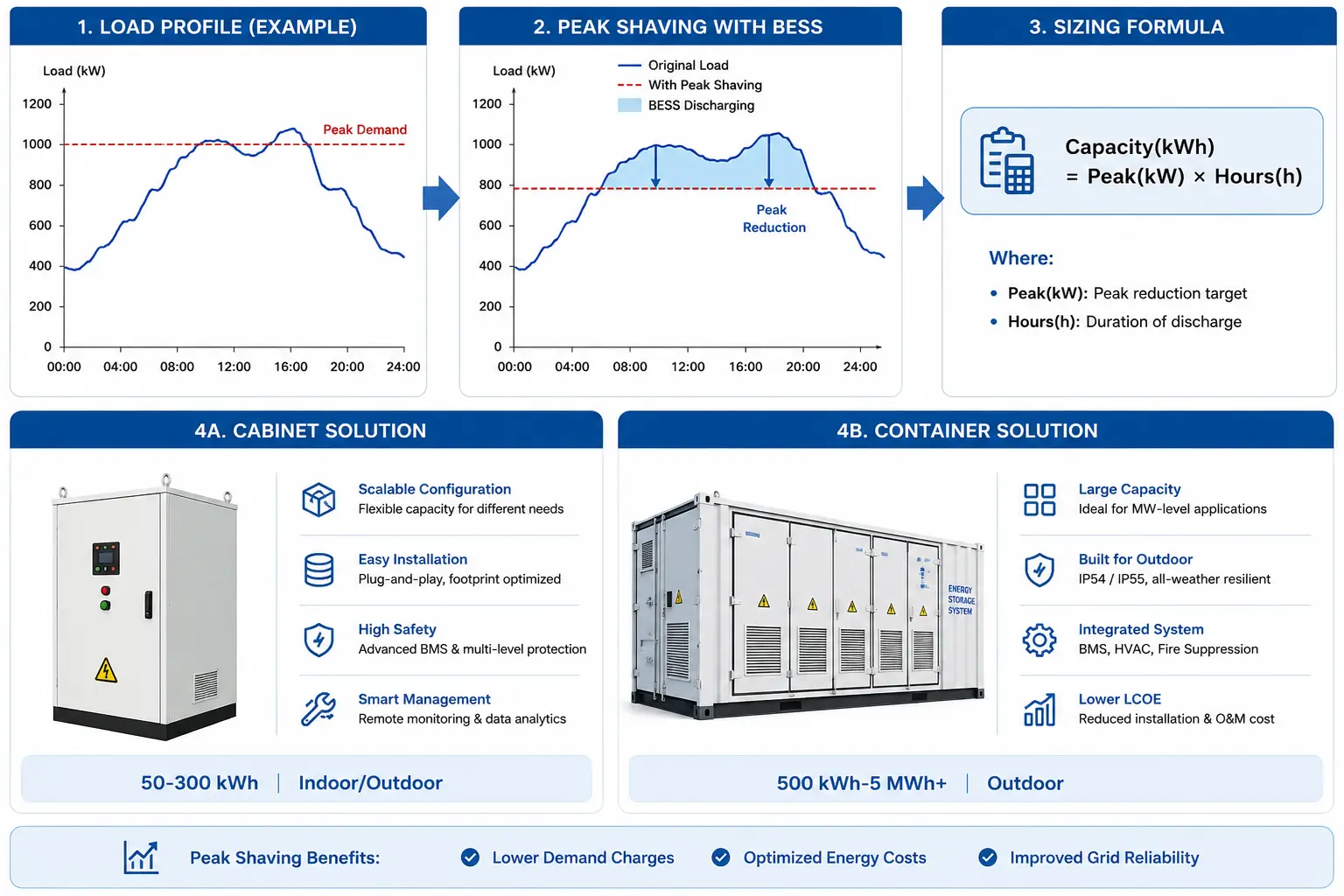
Cabinet systems (50-300 kWh) offer compact footprint for indoor or outdoor use, days-long installation with minimal civil works, and easy incremental expansion — best for small-medium commercial and constrained spaces.
Containerized systems (500 kWh-5 MWh+) use 20ft/40ft outdoor containers, require weeks for installation with crane and concrete pad, offer pre-engineered faster deployment at scale with lower cost per kWh — best for industrial, multi-MWh, and utility-scale.
AC-Coupled vs DC-Coupled
If you already have solar panels, choose AC-coupled — it connects on the AC side of your existing inverter, requiring zero modification to solar panels. 93-95% efficiency. If you are building new solar+storage from scratch, DC-coupled offers higher efficiency (96-98%) with fewer conversion stages.
Battery Chemistry: Why LFP Dominates C&I BESS
For commercial stationary storage in 2026, the chemistry decision is settled: LFP (Lithium Iron Phosphate) dominates.
• Thermal runaway threshold: above 270°C (vs 150-200°C for NMC). LFP does not release oxygen during failure.
• Cycle life: 6,000-10,000 cycles (vs 2,000-4,000 for NMC). At one cycle per day, that's 16-27 years.
• Cell cost: $45-55/kWh (vs $70-90 for NMC). No cobalt — simpler supply chain, fewer ethical concerns.
• Insurance: Broadly insurable. NMC faces higher premiums; some carriers refuse coverage entirely.
LFP is safer, lasts 2-3 times longer, costs less, and is more insurable. NMC's higher energy density matters for EVs — not stationary storage where space is less constrained. For a deeper dive into battery chemistries, see our complete BESS guide. Sodium-ion is gaining traction for ultra-low-cost applications but remains unproven at commercial scale.
Thermal Management for Commercial Energy Storage
Liquid cooling is now standard for mid-to-high-end C&I systems in 2026, offering tighter cell temperature variance (under 3°C vs 5-8°C for air), higher energy density, and stable performance in hot climates. Air cooling remains relevant for small systems, budget-constrained projects, and mild climates. The tighter temperature uniformity of liquid cooling directly translates to longer battery life.
3. Commercial Battery Storage Cost & ROI: 2026 Guide
Turnkey Installed Costs by Scale
• 50 kW / 100 kWh (small office, retail): $60,000-90,000 ($600-900/kWh)
• 100 kW / 200 kWh (supermarket, mid office): $110,000-150,000 ($550-750/kWh)
• 250 kW / 500 kWh (mid manufacturing, cold storage): $250,000-350,000 ($500-700/kWh)
• 1 MW+ / 2-5 MWh (heavy industrial, data center): $350-500/kWh
Where the Money Goes
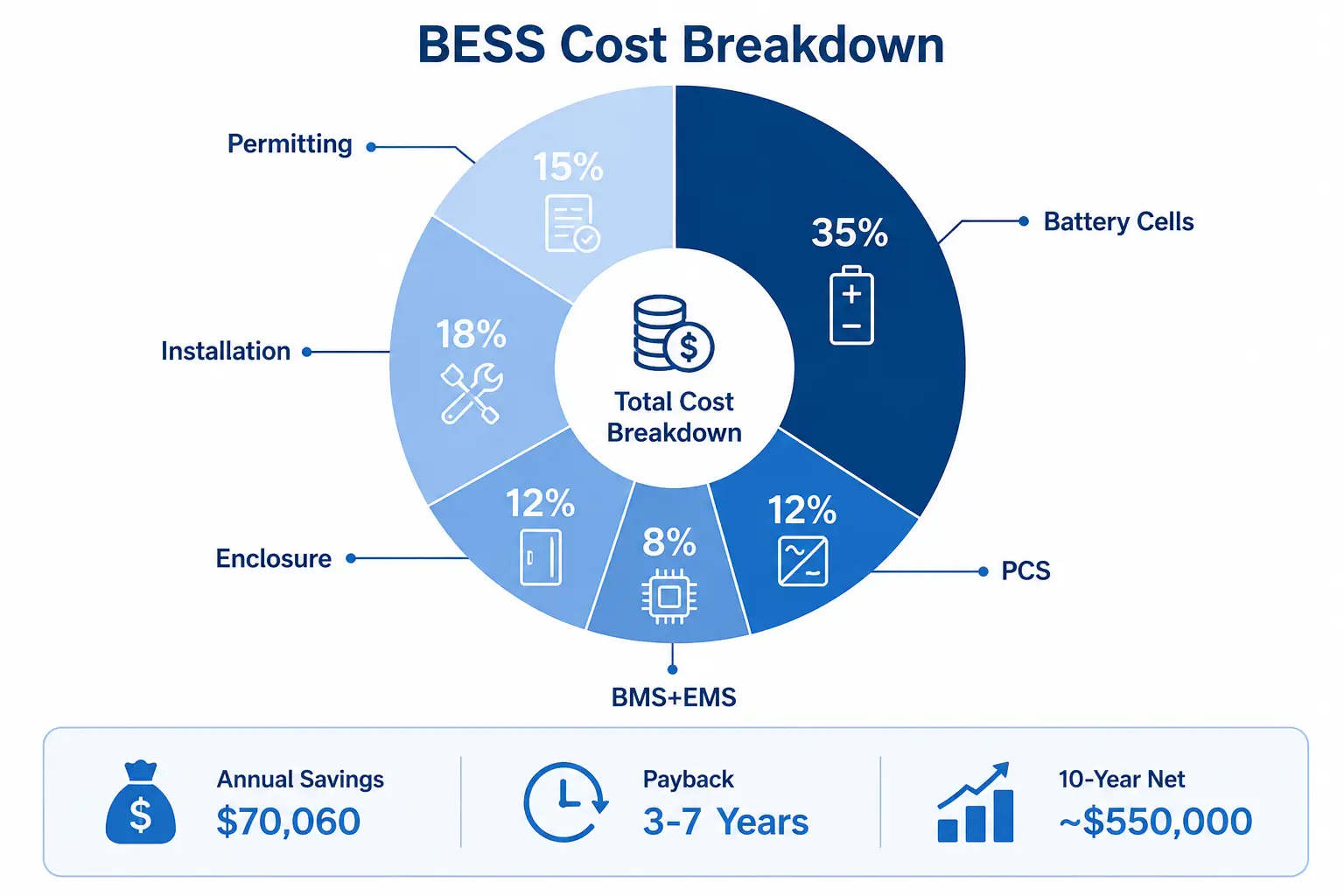
• Battery cells and modules: 30-40% of total cost
• PCS (Power Conversion System): 10-15%
• BMS + EMS software: 5-10%
• Enclosure + thermal management: 10-15%
• Installation, commissioning, grid connection: 15-20%
• Permitting, engineering, soft costs: 10-15%
TCO: BESS vs Diesel Generator (10 Years)
A 500 kWh LiFePO4 BESS costs approximately $300,000 upfront with $3,000-5,000 annual maintenance and zero fuel cost over 10 years — totaling approximately $350,000. A 500 kW diesel generator costs $50,000 upfront but $8,000-12,000 annual maintenance and $250,000-450,000 in fuel over 10 years — totaling $450,000-650,000. The BESS wins on total cost of ownership by a wide margin.
C&I BESS ROI Example: 500 kWh Factory System
A medium manufacturing plant with a 350 kW peak load installs a 250 kW / 500 kWh BESS. Annual savings include $27,000 from demand charge reduction (150 kW × $15/kW/month), $27,000 from TOU arbitrage (300 kWh/day × $0.30/kWh spread × 300 days), and $16,060 from solar self-consumption increase (200 kWh/day × $0.22/kWh × 365 days). Total annual savings: $70,060.
System cost is $300,000. The 30% ITC reduces it by $90,000. MACRS Year 1 depreciation provides approximately $60,000 in tax benefit. Net effective cost is approximately $150,000. Simple payback: approximately 2.1 years after incentives, or 4.3 years before incentives. 10-year net savings total approximately $550,000 after recovering the investment.
US Federal Incentives for Commercial Energy Storage (2026)
• ITC (Investment Tax Credit): 30% of system cost. Standalone storage qualifies, no solar required.
• IRA Transferability: Sell unused ITC at 90-95 cents on the dollar for companies without sufficient tax liability.
• MACRS: 5-year accelerated depreciation with significant first-year write-off.
• State-level incentives: Additional programs available in NY, CA, MA, NJ, and IL.
4. Safety, Compliance & Insurance
Safety compliance determines whether your project can be permitted, insured, and financed.
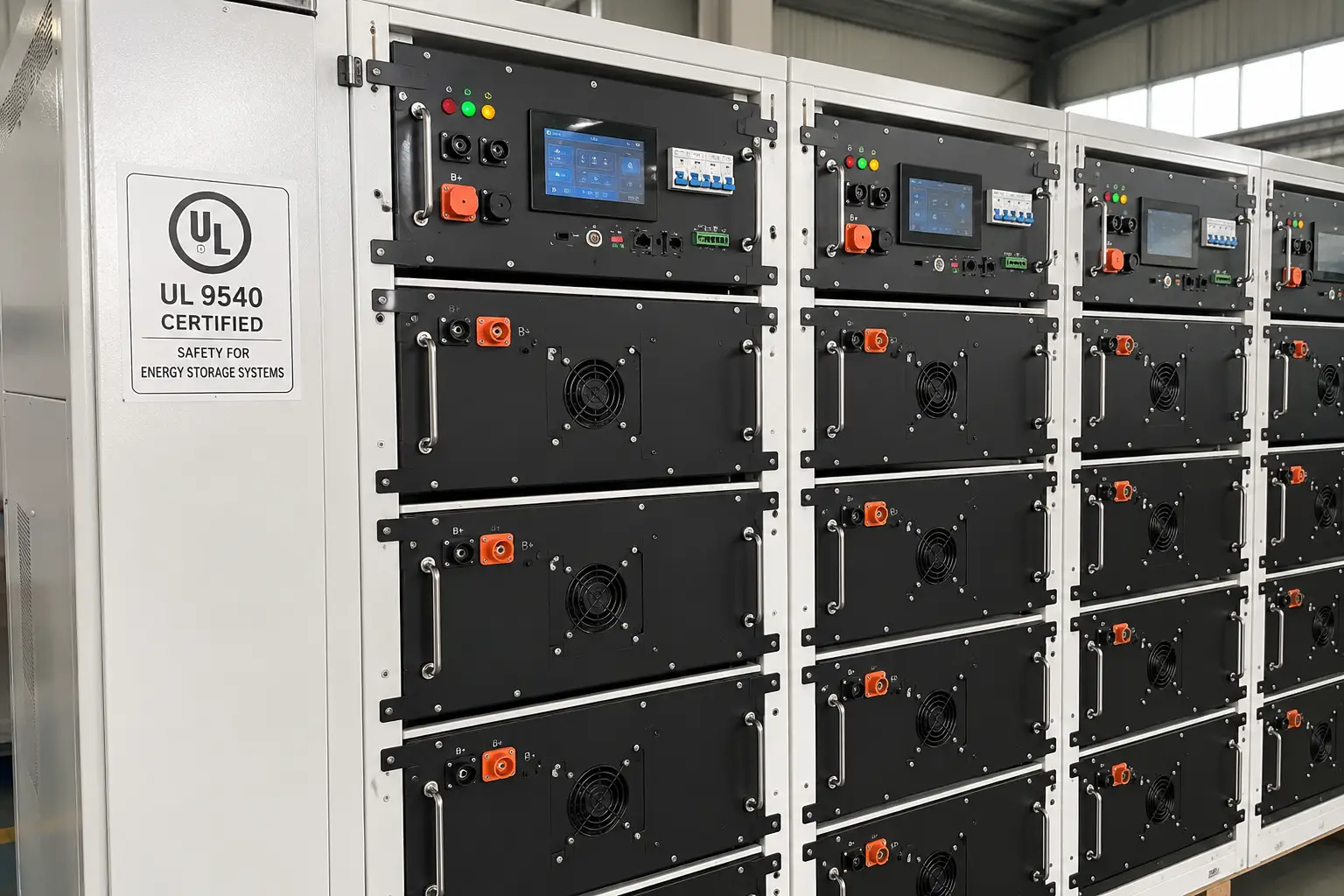
C&I BESS Certification Stack: UL 9540 to NFPA 855
• UL 9540: Complete system-level safety. Required by most US AHJs (Authorities Having Jurisdiction).
• UL 9540A: Thermal runaway fire propagation test. This is the document insurers actually read — it proves fire will not spread between cabinets.
• NFPA 855: Installation siting, spacing, and ventilation. Determines where you can physically place the system.
• UL 1973: Battery cell and module safety. Necessary but not sufficient alone.
• IEC 62619 / UN38.3: International battery safety and transport certification.
Commercial BESS Insurability: The Hidden Gatekeeper
The single most important step before signing a BESS purchase contract is often overlooked: submit the UL 9540A test report to your insurance broker before committing. If the system's thermal runaway propagation test shows fire can spread between cabinets, your insurer may demand additional firewalls, enhanced sprinkler systems, or increased setbacks — costs that can add $20,000-100,000+ to a project and destroy the ROI model. Or they may simply refuse to cover it.
Siting costs hit fast. If your planned installation location doesn't meet NFPA 855 spacing requirements, you'll face added mitigation costs. Factor this into site selection before signing.
C&I BESS Safety Features to Require
• Multi-layer BMS protection from cell to module to rack to system level
• Module-level aerosol fire suppression that catches fires at the source, not after propagation
• Deflagration venting panels compliant with NFPA 69
• Combustible gas detection for hydrogen and CO off-gassing
• 24/7 remote monitoring with automatic shutdown triggers
5. How to Choose a C&I BESS Supplier
Choosing the right supplier is more important than choosing the right battery cells. Here are 8 criteria to evaluate every vendor against:
The 8-Point Supplier Evaluation
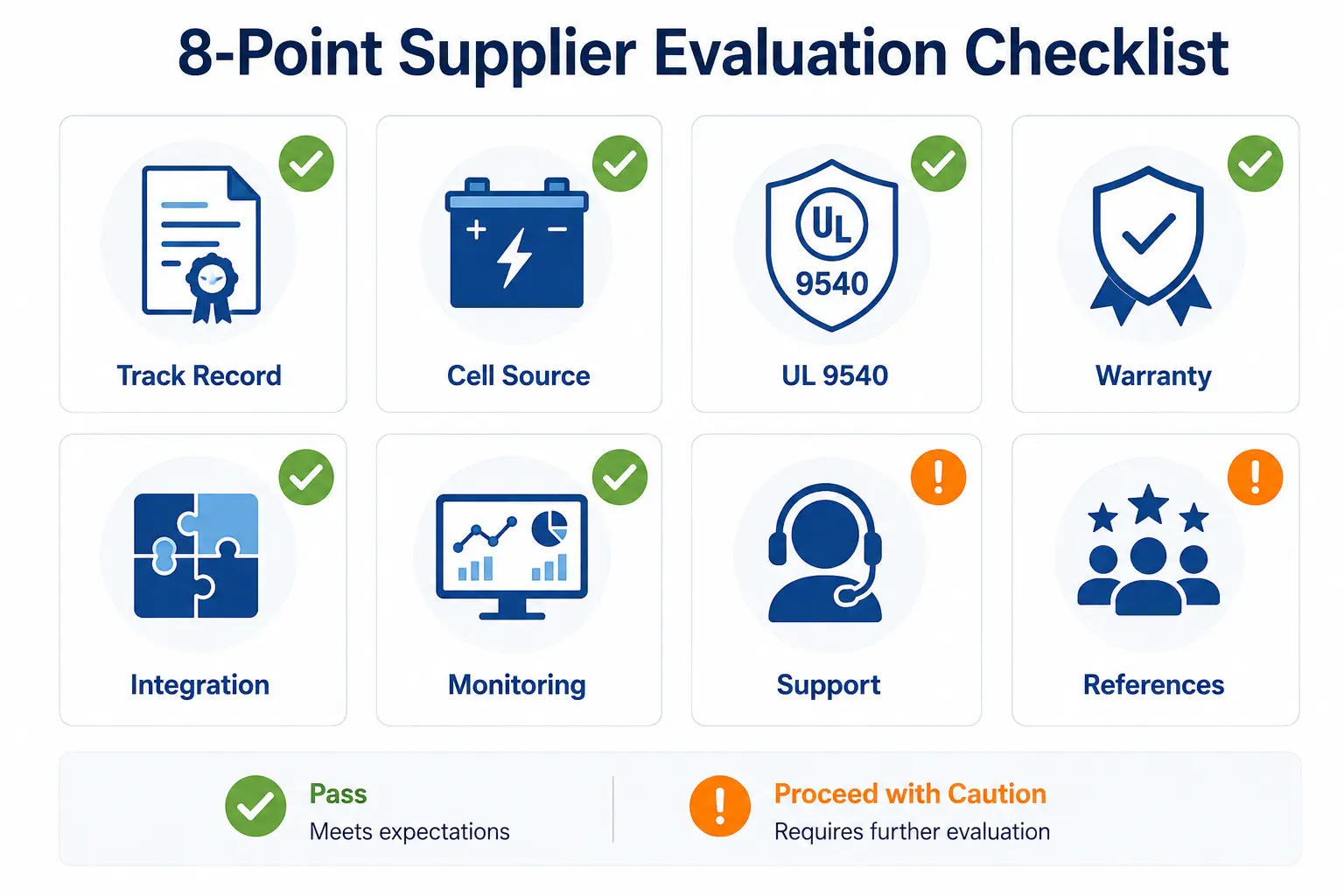
• Manufacturing Track Record: Years in business? Annual MWh shipped? Reference projects in your industry? Red flag: no verifiable references, no project photos.
• Battery Cell Source: Tier 1 cells (CATL, BYD, EVE, Gotion) or own production? Batch test reports available? Red flag: won't disclose cell supplier, no traceability.
• UL 9540 System Certification: Is the entire system UL 9540 certified — or just the cells? Red flag: "Our cells are UL certified" — that's not the system.
• Warranty vs Performance Guarantee: Both device warranty AND capacity fade guarantee? Clear SoH measurement methodology? Red flag: only device warranty, no performance terms.
• System Integration: One manufacturer for BMS/PCS/EMS — or pieced together from multiple vendors? Red flag: "Frankenstein systems" causing communication protocol failures.
• Remote Monitoring & SoH Visibility: Cloud EMS with mobile app? Real-time degradation trends? Red flag: basic dashboard only, no degradation analytics.
• After-Sales Support: Response time SLA? Local service presence? Spare parts availability? Red flag: remote-only support, no SLA commitments.
• Project Experience: 3-5 case studies similar to your scale and application? Can you contact references? Red flag: no case studies, no references.
Commercial Energy Storage: The China Supply Chain Advantage
One fact is often missing from US/EU buyer guides: over 80% of global LFP battery cell production is in China. This has practical implications for C&I buyers. Chinese-manufactured BESS systems are typically 15-30% cheaper than US/EU equivalents at the same specification level — driven by vertical integration, manufacturing scale, and mature LFP supply chains. Standard C&I cabinets often ship in 4-8 weeks from China vs 12-20+ weeks from domestic manufacturers.
Tier 1 Chinese manufacturers now hold full UL 9540/9540A certifications and serve Fortune 500 clients globally. The "cheap Chinese = low quality" assumption is outdated for certified Tier 1 suppliers. Not all Chinese manufacturers are equal — apply the same 8-point evaluation. Some are world-class, others cut corners. Certification and references separate them.
KUNETIC Energy provides 15+ years manufacturing experience, UL 1973 and UL 9540 certified LFP BESS from 30 kWh to 5 MWh+, with US-based support and projects across 30+ countries. Get a free BESS design and ROI analysis.
6. From Plan to Operation: Timeline & Financing
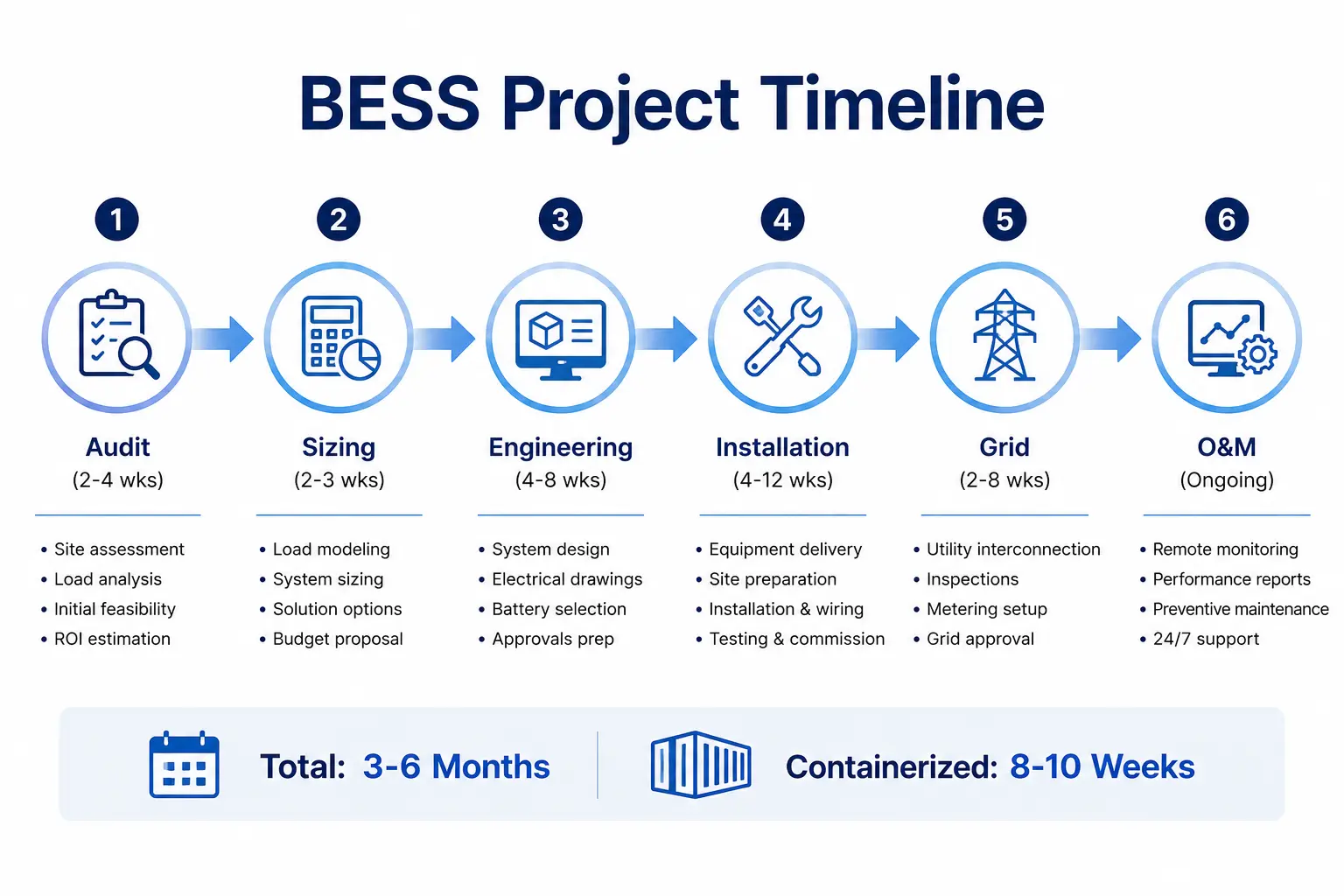
Commercial BESS Project Timeline: 6 Stages
• Stage 1 — Energy Audit (2-4 weeks): 15-minute interval data collection, load profile analysis, savings quantification.
• Stage 2 — Sizing & Financial Modeling (2-3 weeks): Optimal capacity sizing, 15-year cashflow model, incentive application.
• Stage 3 — Engineering & Permitting (4-8 weeks): Electrical design, site plan, AHJ permit submission, grid interconnection application.
• Stage 4 — Installation & Commissioning (4-12 weeks): Equipment delivery, electrical installation, EMS configuration, testing.
• Stage 5 — Grid Interconnection (2-8 weeks): Utility approval, meter configuration, grid service registration if applicable.
• Stage 6 — Ongoing O&M: Remote monitoring, annual preventive maintenance, performance reporting.
Total timeline: 3-6 months from audit to operation. Pre-engineered containerized systems can be as fast as 8-10 weeks. The biggest variable is permitting and grid interconnection approval, not equipment delivery.
Commercial Energy Storage Financing Options
• Direct Purchase (CAPEX): 100% upfront cost, you own the system, capture 100% of savings and incentives. Best for capital-rich companies seeking maximum ROI.
• Leasing: 10-20% upfront, lessor owns during term, predictable payments. Best for cash-flow focused organizations. May not capture full ITC.
• ESCO / Shared Savings: Zero upfront cost, ESCO takes 20-40% of savings, you share upside. Best for conservative organizations with zero-capex preference.
• PPA / Energy-as-a-Service: Zero upfront, pay a fixed rate per kWh. Simplest structure but lowest retained savings.
Contract tip for shared-savings models: define the baseline methodology, performance guarantee responsibilities, and how revenue volatility caused by tariff changes or grid rule updates is allocated between parties. These details determine whether the deal is fair — or a trap.
FAQ — 12 Common Questions Answered
Q1: What are commercial energy storage systems? A C&I BESS (Commercial & Industrial Battery Energy Storage System) is a behind-the-meter battery solution for businesses. It stores electricity — typically from the grid during off-peak hours or from on-site solar — and discharges it when electricity is expensive or during outages. Unlike residential systems, C&I BESS handles higher power loads (50 kW to 5 MW+), cycles more frequently, and is optimized for demand charge reduction and energy arbitrage.
Q2: How much does a commercial BESS cost in 2026? Turnkey installed costs range from $300-900/kWh depending on scale. A typical 250 kW / 500 kWh system costs $250,000-350,000 before incentives. The 30% federal ITC reduces this significantly, and MACRS accelerated depreciation provides additional first-year tax benefits.
Q3: What size BESS do I need for my business? Rough sizing guide: Small business (peak under 50 kW): 30-100 kWh. Medium commercial (50-200 kW): 100-500 kWh. Industrial (200+ kW): 500 kWh-5 MWh. For accurate sizing, share 12 months of 15-minute interval data with an engineer.
Q4: What is the ROI of a commercial BESS? Typical payback is 3-7 years before incentives, 2-4 years after the 30% ITC. Primary drivers are demand charge reduction and TOU arbitrage. A 500 kWh system in a mid-size factory can save $50,000-70,000 per year.
Q5: Which battery chemistry is best — LFP or NMC? LFP. Always LFP. For stationary C&I storage, LFP wins on safety (thermal runaway threshold above 270°C vs 150°C for NMC), cycle life (6,000-10,000 vs 2,000-4,000), cost ($45-55/kWh vs $70-90/kWh), and insurability. NMC has higher energy density — but that matters for EVs, not stationary storage.
Q6: Cabinet or container — which form factor should I choose? Cabinet (50-300 kWh) for smaller footprint, indoor/outdoor flexibility, and easier incremental expansion. Container (500 kWh-5 MWh+) for lower cost per kWh at scale and faster pre-engineered deployment. Choose container if you need 500+ kWh; cabinet for smaller or space-constrained sites.
Q7: What certifications does a C&I BESS need? Minimum for the US market: UL 9540 (complete system), UL 9540A (thermal runaway fire propagation test), and NFPA 855 (installation siting). Also important: UL 1973, IEC 62619, UN38.3. Always verify that UL 9540 applies to the complete system, not just individual cells.
Q8: How long does a commercial BESS last? 10-15 years or 6,000-10,000 charge/discharge cycles for LFP systems. At one full cycle per day, that's 16-27 years. Most manufacturers warrant 70% or higher capacity retention at 10 years. Liquid cooling extends calendar life by reducing temperature-induced degradation.
Q9: Can I add BESS to existing solar panels? Yes — AC-coupled. An AC-coupled BESS connects on the AC side of your existing inverter, requiring zero modification to solar panels. This is the most common C&I configuration. For new solar+storage installations, DC-coupled is more efficient.
Q10: How do I finance a commercial BESS? Four main paths: Direct purchase (max ROI, you keep 100% of savings and ITC), leasing (lower upfront, fixed payments), ESCO/shared savings (zero upfront, share savings with provider), PPA/Energy-as-a-Service (pay per kWh, simplest). Most C&I buyers with capital choose direct purchase to capture the full 30% ITC.
Q11: How long does installation take? 3-6 months from audit to operation. Pre-engineered containerized systems can be as fast as 8-10 weeks. The biggest variable is permitting and grid interconnection approval — not equipment delivery.
Q12: Is commercial BESS safe? What about fire risk? Yes — when properly specified. LFP-based BESS with UL 9540A-tested thermal runaway protection, multi-layer BMS, module-level fire suppression, and 24/7 remote monitoring is extremely safe. Fire incidents in certified commercial LFP systems are rare. The key is insisting on UL 9540A test data and NFPA 855-compliant siting before purchase.
Conclusion: Is C&I Energy Storage Right for Your Business?
You are a strong candidate for commercial battery storage if you check 2 or more of these:
• Monthly electricity bill exceeds $5,000
• Demand charges are above 30% of your total bill
• You operate in a region with significant TOU rate spreads
• You have existing or planned solar PV
• Your operations are sensitive to power interruptions
• You have ESG or carbon reporting requirements
• Your utility offers demand response or grid service programs
Battery prices are at historic lows. The 30% ITC is available now. Electricity rates are not going down. The question is not whether to adopt energy storage — it is who to partner with and when to start.
Ready to explore C&I energy storage for your facility? KUNETIC Energy provides UL-certified, LFP-based BESS solutions from 30 kWh to 5 MWh+, designed and manufactured for commercial and industrial applications. Our engineering team will analyze your load profile, size a system to your needs, and deliver a free, no-obligation ROI model. Contact KUNETIC or email info@kunetictech.com to get started.