Table of Contents
Introduction
At 4,000 meters above sea level in the Atacama Desert, every liter of diesel arrives with a story.
It starts at a coastal refinery. Trucks haul it 300 kilometers across salt flats and mountain switchbacks. At the mine gate, 4,000 meters up, that liter costs $2.10. The fuel didn't change. The distance did.
Now multiply that liter by 980,000. That was one mine's annual diesel burn — a site KUNETIC Tech assessed in early 2025.
Nearly a million liters. Over two million dollars. Every year. All for a generator that sat idle 90% of the time.
That project is now running on a hybrid PV-BESS-diesel system. It burns 500,000 fewer liters of diesel annually. It paid for itself in just over five years.
Your diesel generator isn't a power solution. It's a fuel logistics company you never asked to run. (New to battery storage? Start with our What Is BESS guide.)
We've learned this the hard way. We design and deploy hybrid energy systems for mines, island resorts, and remote communities across three continents. Here are the real costs, the real savings, and what actually happens when you swap diesel for brains.
What Diesel Actually Costs — The Bill Your Dealer Won't Show You
Diesel generators look cheap on the invoice. A 500 kW unit might run you $15,000 to $40,000 for the hardware — sometimes less on the used market. The dealer hands you the keys, and for a brief moment, it feels like a smart purchase.
That feeling fades the first time you refuel.
Fuel: The Gift That Keeps on Taking
Let's walk through the real fuel math, using publicly available benchmarks from NREL and IEA:
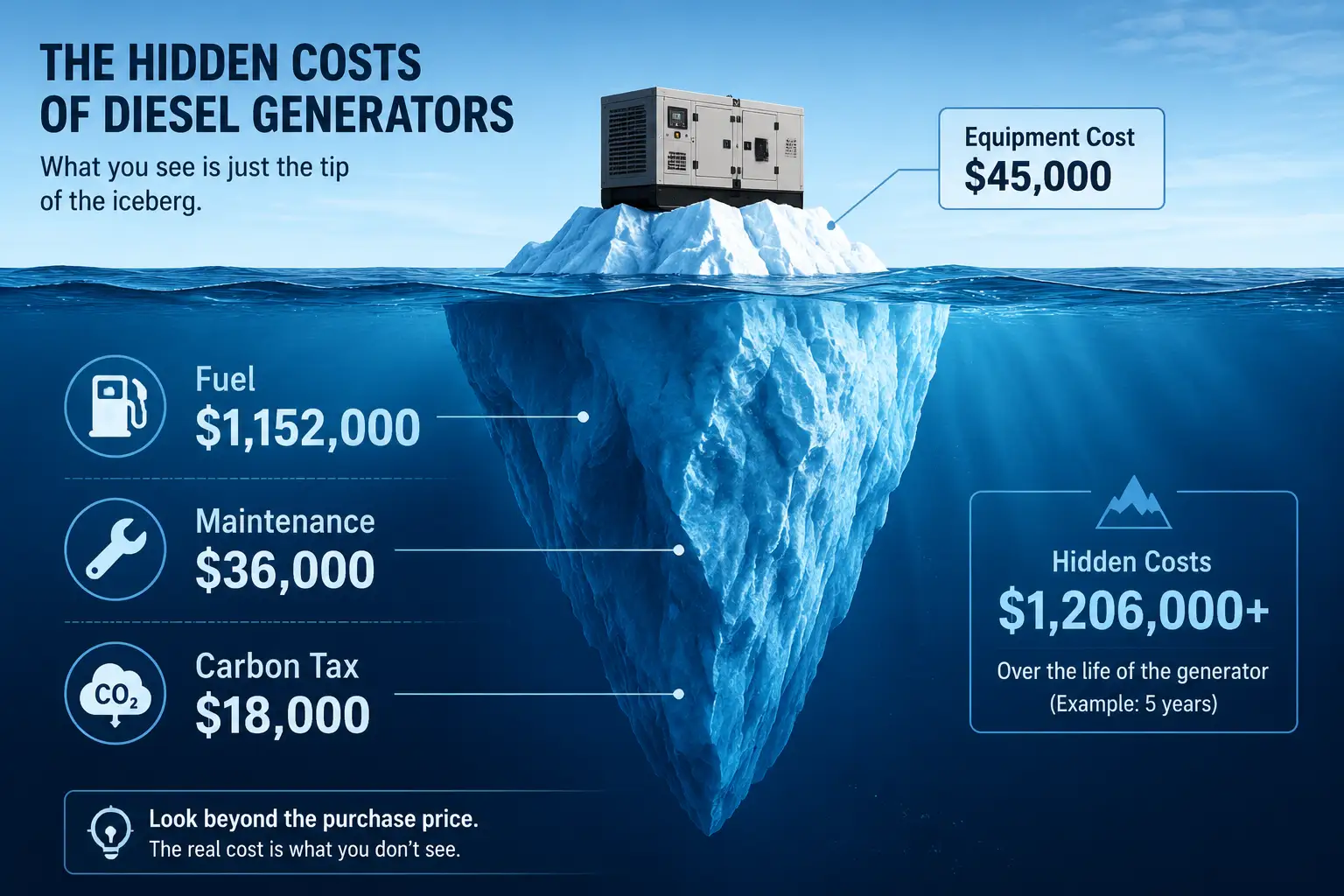
A 500 kW diesel generator running 8 hours a day burns about 96,000 liters of diesel per year. At an industrial diesel price of $1.20 per liter — and remote sites often pay much more — that's $115,200 a year. In fuel alone.
Over ten years? Over $1.15 million. Just for fuel. That doesn't include delivery, storage, or the fuel that degrades in tanks you have to maintain.
For remote locations — mines, islands, off-grid communities — delivered diesel costs hit $1.50 to $2.50 per liter. The IEA flags fuel logistics as the single largest expense for off-grid power worldwide.
At $2.10 per liter, that Atacama mine was spending over $2 million a year. Just to keep the fuel trucks running.
Now compare that to a battery energy storage system (BESS) with solar PV. Once installed, the fuel cost is zero. The "fuel" is sunlight.
Off-peak grid charging runs $0.04 to $0.08 per kWh. Diesel-generated electricity? $0.34 per kWh.
Maintenance + Emissions: The Hidden Payroll
Diesel generators have moving parts — pistons, injectors, turbochargers, cooling systems. They need oil changes every 250 to 500 hours. Filters. Coolant. Belt replacements. Load bank testing.
After 15,000 to 20,000 hours, you're looking at a major overhaul. Or a replacement engine.
Upfront costs only tell part of the story. Industry benchmarks peg diesel generator maintenance at 8% to 12% of equipment value per year. For a $30,000 unit, that is $2,400 to $3,600 annually — and that number climbs as the engine ages.
A BESS has no pistons. No oil changes. No exhaust to scrub.
Maintenance is simple: thermal checks, BMS monitoring, periodic electrical inspections. Annual costs: about 1% to 2% of system value.
Then there is the environmental impact. Carbon pricing is expanding worldwide. The EU's Carbon Border Adjustment Mechanism took full effect in 2026. Canada, Indonesia, and others are tightening carbon taxes.
Every liter of diesel burned costs more — at the pump, and on the balance sheet.
BESS vs Diesel — The 10-Year Numbers Don't Lie
In late 2024, a resort operator in Southeast Asia contacted KUNETIC Tech. The property — a 120-room beachfront resort on a small island — ran entirely on diesel. Electricity cost: $0.38 per kWh. Annual diesel spend: $310,000.
The operator had a simple question: is there a better way?
There was. KUNETIC designed a 600 kWp solar array and 1.2 MWh LFP battery system. One diesel generator stayed for backup during monsoon weeks. The system went live in mid-2025.
The result: $0.12 per kilowatt-hour blended electricity cost. Diesel consumption down 78%. Projected payback: 4.2 years.
How BESS Flips the Math
Commercial energy storage cost has dropped over 90% in the past decade. But the economics hinge on one structural difference: diesel is an OPEX machine. BESS is a capital asset that generates savings every day it runs.
A battery system doesn't just wait for blackouts. Batteries store energy from solar during the day and release it when needed. Every day it absorbs cheap off-peak power or surplus solar and discharges during peak-rate hours.
It participates in demand response programs. It provides frequency regulation and grid services.
A diesel generator does exactly one thing: burns fuel for power generation. When it is off, it generates nothing — no savings, no revenue, no value.
Take a typical 500 kW / 2 MWh commercial system. Here's the 10-year picture, built from real project parameters and verified industry benchmarks:
| Cost Category | Diesel Generator (500 kW) | BESS + Solar (500 kW / 2 MWh) |
|---|---|---|
| Initial equipment & installation | $45,000 | $480,000 |
| 10-year fuel / electricity | $1,152,000 | $96,000 (off-peak grid top-up) |
| 10-year maintenance & repairs | $36,000 | $12,000 |
| Major overhaul / battery replacement (year 8) | $25,000 (engine rebuild) | $80,000 (partial augmentation) |
| Emissions / carbon costs (estimated) | $18,000 | $0 |
| 10-year total | $1,276,000 | $668,000 |
| Annualized cost | $127,600 | $66,800 |
Note: 500 kW prime power, 8 hrs/day, 300 days/year. Diesel at $1.20/L. BESS assumes solar PV or off-peak grid charging. Battery degradation at 2%/year with augmentation in year 8. All figures in 2026 USD.
BESS + Solar delivers about 48% lower total cost of ownership over a decade. The break-even point arrives around year 4. After that, every year of operation is pure savings versus the diesel baseline. That gap only widens.
The Smart Play — Hybrid PV + BESS + Diesel
We hear this assumption often: "So you want me to rip out my generators?"
No. That's rarely the right answer, and not what KUNETIC recommends.
Don't Rip and Replace — Hybridize
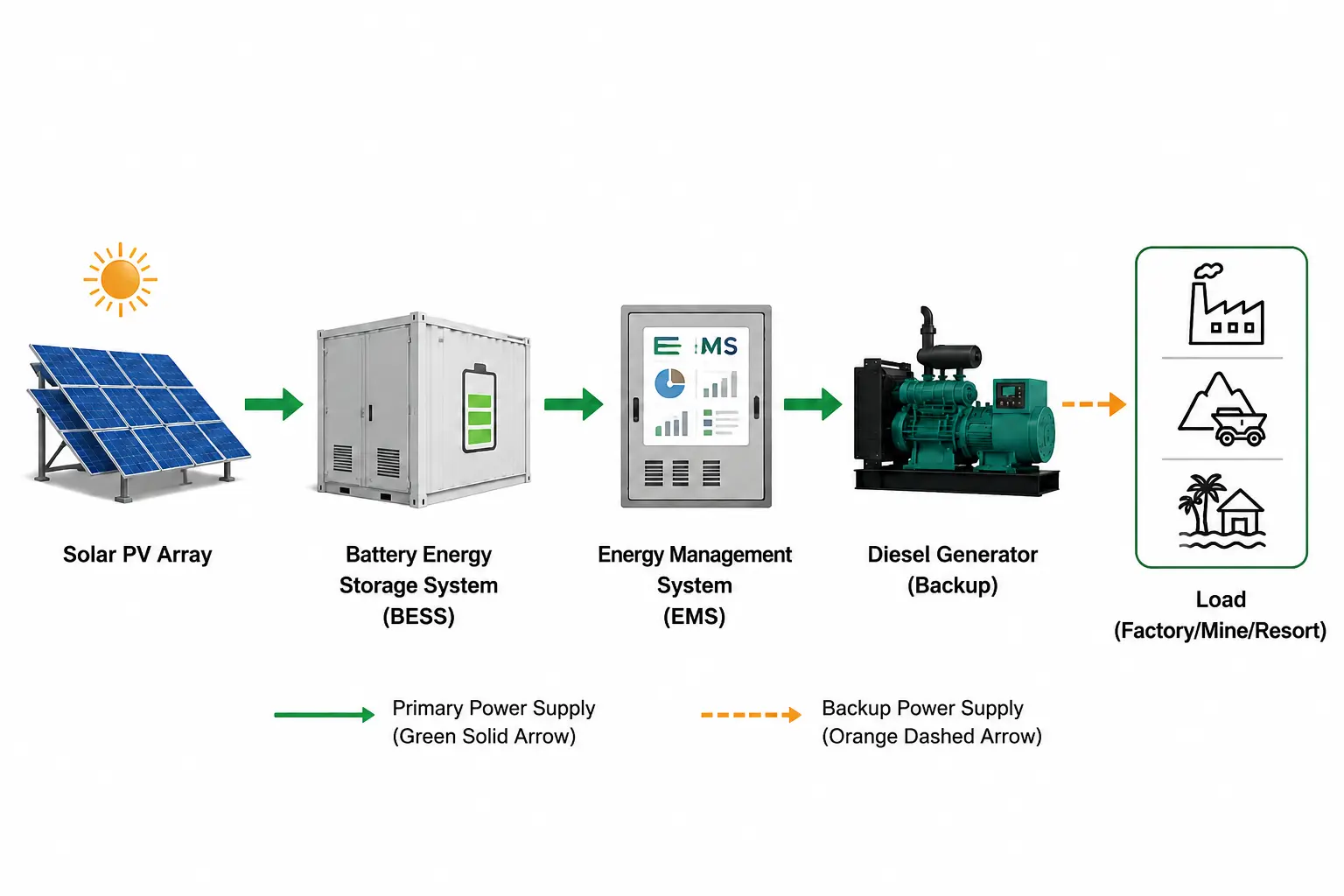
The smartest approach keeps diesel generators in the mix — not as primary power, but as insurance.
In a hybrid solar diesel system, solar and batteries handle daily baseload, peak shaving, and short-duration backup. The diesel generator only starts during extended low-solar periods — multi-day storms, heavy demand, or scheduled battery maintenance.
First, you preserve capital already sunk into diesel infrastructure. No write-offs. The generators stay — they just run far less.
Second, you dramatically reduce fuel consumption without sacrificing reliability. The generator is still there. It still works. It just does not run 3,000 hours a year anymore. More like 300.
Third, the battery generates daily value through peak shaving, load shifting, and solar self-consumption. The generator becomes the safety net. Division of labor beats either/or thinking.
The 70/30 Rule
Across KUNETIC's projects, the pattern is clear: a hybrid system cuts diesel consumption by 65% to 80%.
The sweet spot? About 70% reduction. That cuts fuel costs by two-thirds. Generators stay ready for the rare hours solar can't cover.
Response time matters. A BESS responds in milliseconds. A diesel generator needs 10 to 30 seconds.
For telecom towers, cold storage, and medical facilities, that gap is critical. BESS bridges it seamlessly.
Where Batteries Already Win — Real Projects
Three projects, three scales — here's what the transition looks like.
Mining: Chilean Copper Operation Cuts Diesel by 51%
The Atacama mine from our introduction is real. KUNETIC Tech deployed a 6.2 MW solar array and 12 MWh battery system. An intelligent EMS tied it into the existing 4 MW diesel fleet.
Before: 980,000 liters of diesel per year, $2.06 million in fuel costs.
After: diesel dropped to 480,000 liters per year. Solar covers 70% of daily demand. Batteries handle evenings and overnight. Diesel only fires during extended overcast.
Total installed cost: $11.4 million. Annual fuel savings: about $1.05 million. Payback: 5.2 years.
Over 15 years, net savings exceed $7 million in fuel. That is before counting avoided maintenance, longer generator life, and carbon credits.
Utility-Scale: How One Grid Operator Saved $140 Million
In 2026, Synapse Energy Economics analyzed a choice for Maritime Electric in Canada: two 50 MW diesel generators, or one 100 MW battery facility.
Diesel: $411 million. Battery: $271 million. A $140 million difference — 34% cheaper, before saving a single liter of diesel.
The battery charges during low-price periods and discharges during peaks. It provides frequency regulation, spinning reserve, and grid stability — services diesel generators can't match.
Grid operators worldwide are reaching the same conclusion. For a deeper look at how to evaluate energy storage for your operation, see our C&I Buyer's Guide.
Remote Communities: From Dependency to Independence
In early 2025, KUNETIC Tech completed a project that illustrates what energy transition means at the community level.
A rural clinic in East Africa serving 15,000 people relied on one 30 kVA diesel generator. It ran 12 hours a day. Fuel deliveries were erratic. When the generator failed, vaccine refrigeration stopped and emergency lights went dark.
KUNETIC installed a 45 kWp solar array with an 80 kWh LFP battery bank. The diesel generator stayed — as emergency backup only.
The clinic now has 24/7 electricity — true energy independence for a community that lived at the mercy of fuel deliveries. Diesel consumption dropped from 14,000 liters to about 1,500 — nearly 90% less. The annual fuel savings alone cover an additional health worker's salary.
In every project, the diesel generators stayed. Their job just changed — from running 24/7 to running a few hundred hours a year. Same machines. Radically better economics.
Is It Time to Switch? A Quick Decision Framework
Not every diesel generator should be replaced tomorrow. The decision depends on runtime, fuel cost, project horizon, and operational requirements.
| Your Situation | Best Approach | Typical Payback |
|---|---|---|
| Diesel runs >6 hours/day, fuel above $1.20/L, project life >8 years | Full PV + BESS + Diesel hybrid | 4-6 years |
| Diesel runs 2-6 hours/day, moderate fuel cost | BESS + Diesel hybrid (smaller battery) | 5-8 years |
| Diesel runs <2 hours/day, strictly backup | Keep existing diesel; add small BESS for bridging | 8-12 years |
| Remote site, no solar resource, high reliability need | Diesel with BESS for spinning reserve | — |
| Grid-connected, high peak demand charges | BESS only (peak shaving) | 3-5 years |
When Diesel Still Makes Sense
Some scenarios still favor diesel. A diesel generator replacement for a unit that runs 50 hours a year doesn't justify a BESS. Sites with constrained space, poor solar resource, or less than three years of remaining project life may not make the hybrid economics work.
But those are edge cases now. For any operation running generators more than a few hours per day, the hybrid math has shifted. It's not "can we justify this?" anymore. It's "how fast can we get it built?" Explore our PV-ESS-EV charging solutions for integrated energy systems.
Your Roadmap — From Diesel to Hybrid in 3 Phases
Based on KUNETIC's field experience, a successful transition follows three stages. For a tailored assessment, contact our engineering team.
Phase 1: Energy Audit
Before spec'ing a single solar panel, you need data. At least 30 days of monitoring: load profiles, peak demand, generator runtime, fuel use, and solar resource at your site.
Most sites discover their actual load profile differs from assumptions. Generators are often oversized. Peak demand spikes are shorter than expected. Right-sizing batteries saves significant capital.
Phase 2: Right-Size Your System
This is where engineering meets economics. The goal isn't maximum solar — it's optimal total cost. Balance PV capacity, battery duration, and diesel backup to minimize your levelized cost of electricity.
For most operations, 4 to 6 hours of battery storage is the sweet spot. Longer durations bring diminishing returns.
Phase 3: Integrate and Optimize
Hardware is half the equation. An EMS makes the hybrid intelligent. It decides in real time: charge, discharge, or start the generator. It learns patterns, anticipates weather, and optimizes for minimum cost.
A well-tuned EMS can squeeze 5% to 10% more diesel savings beyond a simple controller. That means faster payback.
The Writing Is on the Generator Shed Wall
If you're still running diesel as primary power in 2026, the math is working against you. Diesel prices don't trend down. Carbon regulation isn't relaxing.
Fuel logistics get more expensive every year. That generator from five years ago? It's now the fastest-growing line in your operating budget.
On the other side: battery costs dropped over 90% in a decade. Solar PV is the cheapest electricity in history, per the IEA. Hybrid systems that raised eyebrows in 2020 are standard practice in 2026.
Diesel generators aren't going anywhere. They'll always serve emergency backup, extreme environments, the hardest-to-reach places. But as everyday power? That era is ending.
The mines, resorts, and clinics we work with have already moved. The question isn't whether. It's when, and who you want engineering the system.
Want to see what hybrid PV-BESS-Diesel looks like for your site? Talk to KUNETIC's engineering team. We'll model your load profile, your solar resource, your real fuel costs. No pitch. Just the numbers.
FAQ
How long until a BESS pays for itself compared to a diesel generator?
For operations running generators 6+ hours daily at fuel above $1.20/L, payback is 4 to 6 years. Operations with lower runtime or cheaper fuel may see payback in 6 to 8 years. After break-even, every year of operation saves 40% to 60% compared to continuing with diesel-only power.
Can BESS completely replace my diesel generators?
The battery storage vs generator question is not all-or-nothing. KUNETIC recommends against full replacement for off-grid sites. Keep diesel generators for backup — running 300 hours a year instead of 3,000.
Best balance of savings and reliability. Your diesel generator is insurance. You want it there, just not running constantly.
What happens during extended cloudy periods?
The battery handles short-term fluctuations and overnight loads. For multi-day low-solar events, the diesel generator starts automatically. The difference: in a hybrid system, generator runs are the exception, not the routine. The EMS manages the handoff seamlessly.
Is BESS reliable enough for critical operations like mining or medical facilities?
Yes. Modern LFP battery systems deliver over 6,000 cycles with minimal degradation. They respond in milliseconds — far faster than mechanical generators. The key is proper system design: adequate sizing, redundant protection, and diesel retained as backup.
What is the lifespan difference between BESS and diesel generators?
A well-maintained diesel generator lasts 15 to 25 years, with a major engine overhaul at 15,000 to 20,000 hours. An LFP battery system has a design life of 12 to 15 years, with modules augmented at year 8 to 10. The solar PV array routinely delivers 25+ years with minimal degradation.