Table of Contents
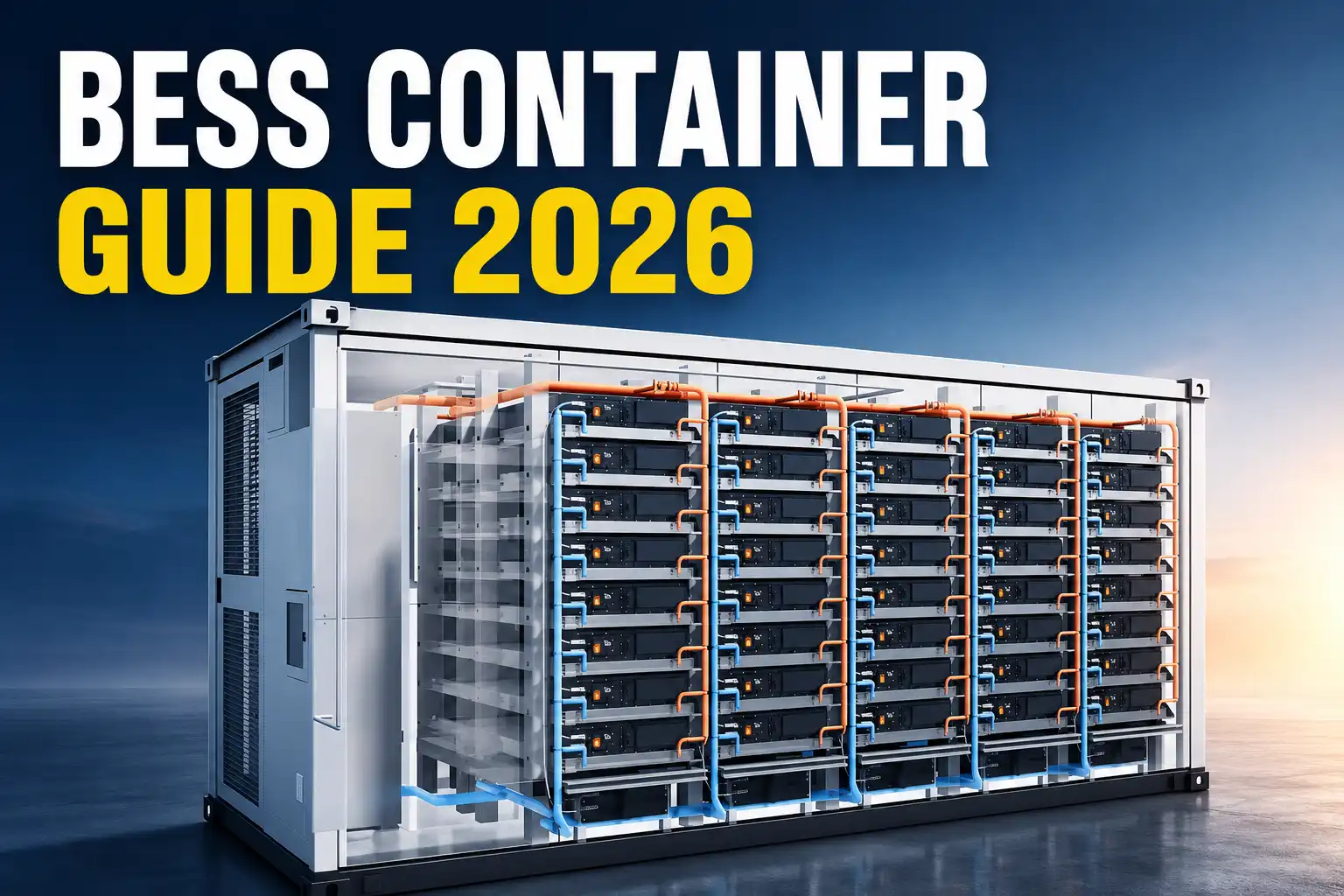
BESS Container Guide 2026: Containerized Battery Storage
A BESS container is a factory-built battery storage system that fits in a standard ISO shipping container. Most units deliver between 1 MWh and 6.5 MWh. They arrive on a truck, plug into the grid, and start running.
This article covers what a BESS container is and the six subsystems inside. It also covers how to pick the right size, what one costs in 2026, and where containers beat other storage formats.
What Is a BESS Container?
An energy storage container is what the industry calls a BESS container. ISO shipping standards govern the box dimensions and structural design.
Inside each container, six core subsystems work together. Those subsystems: battery racks, a BMS, a PCS, thermal management, fire suppression, and an EMS.
Compare that to a site-built battery room. You pour a concrete pad. You pull permits. You run conduit. You commission each subsystem by itself. That takes months.
A container BESS arrives on a flatbed truck. A standard crane lifts it into place. You connect power and data cables. The system is running within a week.
That means no months of on-site electrical and civil work. No concrete pour. No conduit runs. No subsystem-by-subsystem commissioning.
Standard container dimensions for BESS:
| Format | External Dimensions | Typical Capacity Range | Weight (loaded) |
|---|---|---|---|
| 20 ft | 6.06 x 2.44 x 2.59 m | 250 kWh - 3.0 MWh | 15,000 - 26,000 kg |
| 40 ft | 12.19 x 2.44 x 2.59 m | 1.0 - 6.5 MWh | 25,000 - 60,000 kg |
| 40 ft High-Cube / Custom | 12.19 x 2.44 x 2.90 m | 3.0 - 6.5+ MWh | 40,000 - 60,000 kg |
High-density liquid-cooled designs now pack 6.25 MWh into a single 20 ft container. That is roughly double what was on the market three years ago.
Six Core Components of a Container BESS
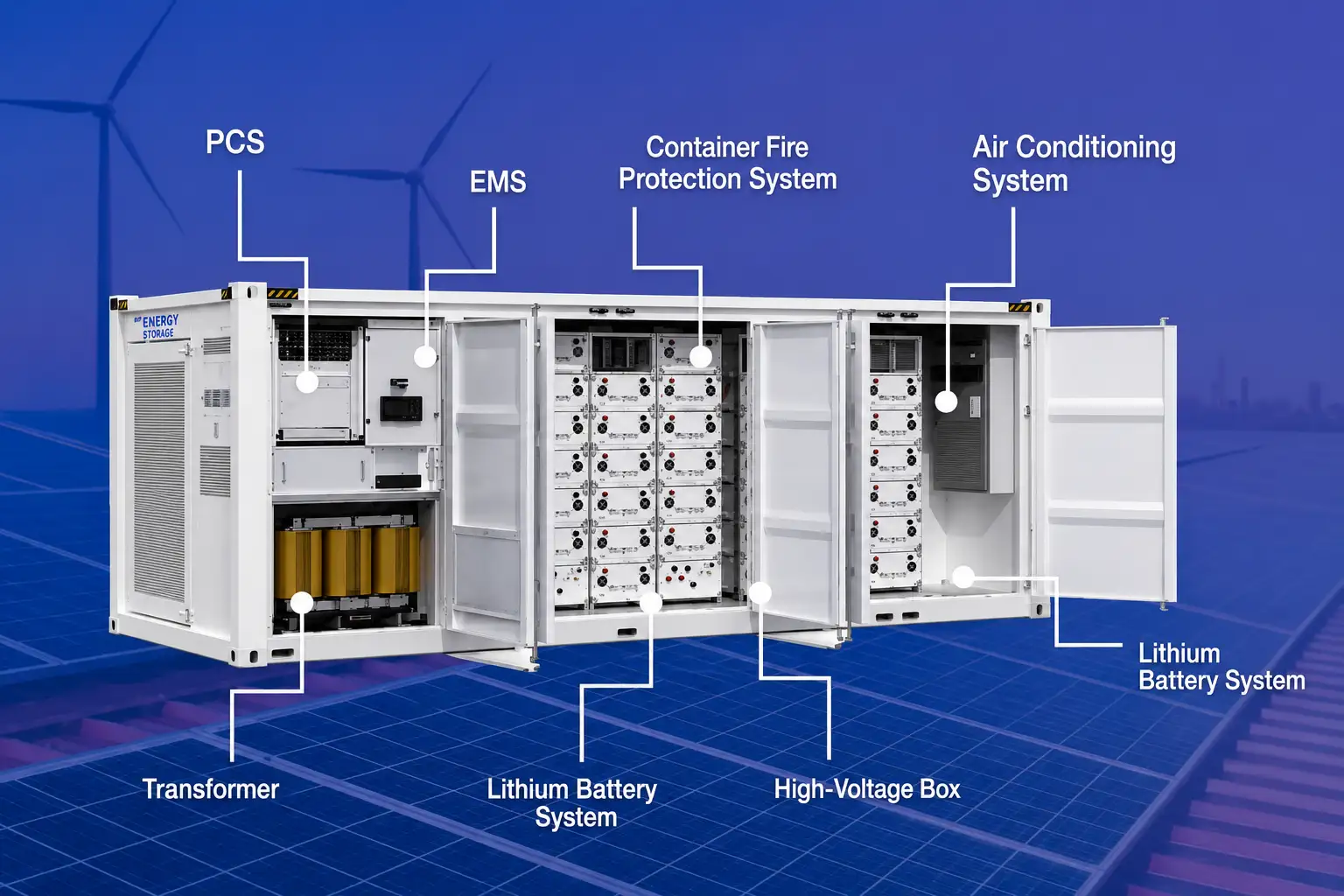
Every container BESS (Battery Energy Storage System) has six subsystems. Know what each one does and you can tell which suppliers cut corners.
1. Battery Cells and Modules
The battery sets the energy capacity, cycle life, and safety. Nearly all container BESS today use lithium iron phosphate (LiFePO4 / LFP) cells. LFP leads stationary storage because it handles heat well and delivers 6,000 to 15,000 cycles.
Cells go into modules, modules into racks. A typical module has 10 to 20 cells in series-parallel. A rack might hold 8 to 15 modules. The rack-level DC voltage feeds the PCS for conversion to AC.
Cell format: prismatic or cylindrical.
Cell manufacturer: CATL, BYD, EVE, and Gotion are tier-1.
Cell connections: bolted (you can service them) or welded (you cannot).
2. Battery Management System (BMS)
The BMS watches voltage, current, and temperature for every cell. It enforces safe operating limits. A BMS that misses a drifting cell can destroy an entire rack.
Cell-level: monitors individual voltage and temperature.
Module-level: balances cells within millivolt tolerance.
System-level: protects against over-charge, over-discharge, short-circuit, and over-temperature.
In-house BMS means one thing: the manufacturer owns the code. They control protection logic. They push firmware updates. And they do it for the full 15 to 20 year life of the system.
3. Power Conversion System (PCS)
The PCS changes DC from the batteries into AC for the grid. It also converts AC back to DC for charging. In a container, the PCS can sit inside the box or on a separate skid.
A 1 MWh container usually pairs with a 250 to 500 kW PCS. Higher power means shorter runtime but faster response for jobs like frequency regulation. PCS efficiency runs 97 to 98% at rated power. That number directly affects round-trip efficiency.
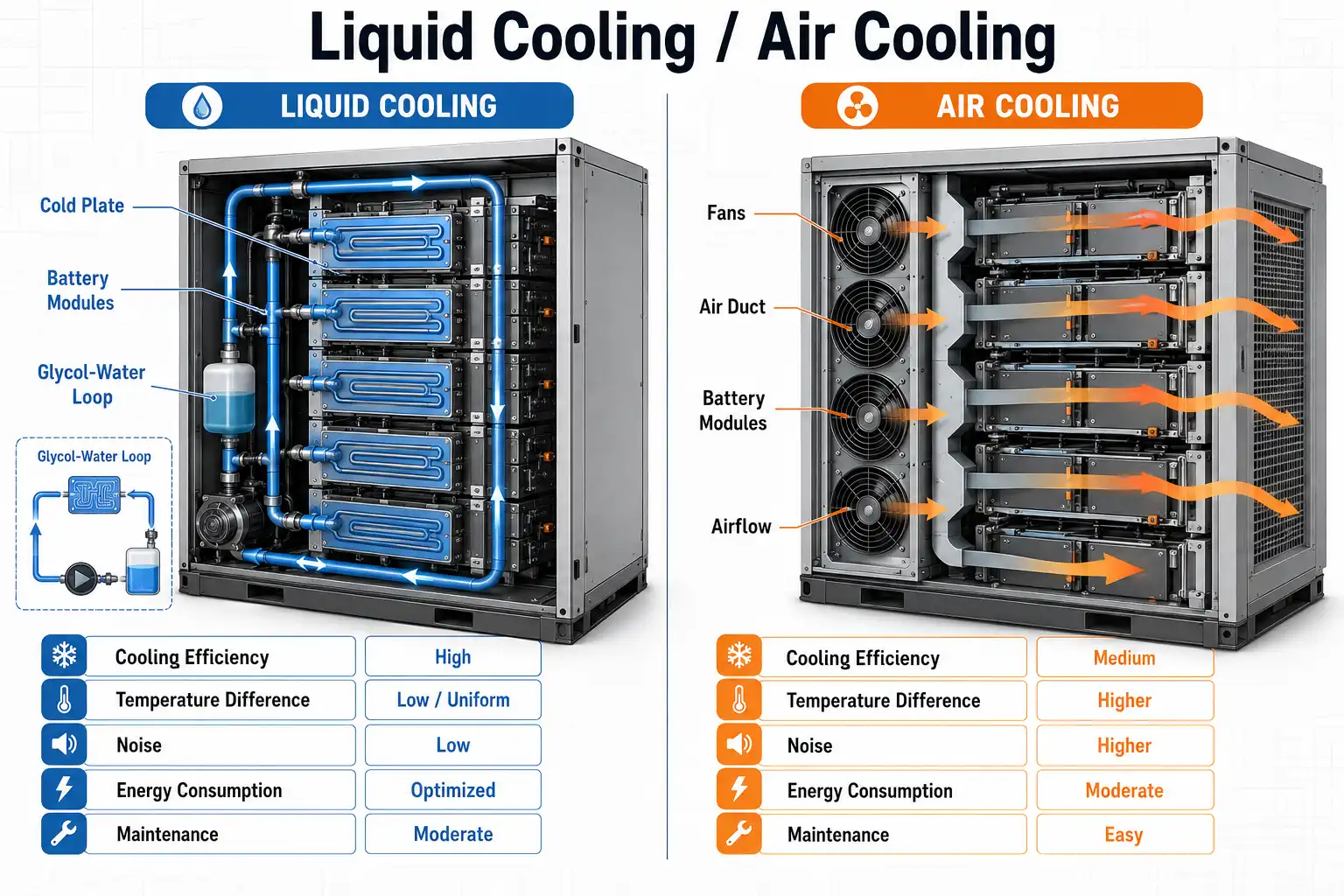
4. Thermal Management: Liquid Cooling vs. Air Cooling
Thermal management is what separates a container BESS that hits its rated cycle life from one that falls short. Batteries degrade faster when hot. They degrade unevenly when temperatures differ across a rack.
| Liquid Cooling | Air Cooling (Forced Air) | |
|---|---|---|
| Cooling efficiency | 95-98% | 80-85% |
| Cell temperature spread | <=3degC | 5-10degC |
| Auxiliary power consumption | 2-3% of system capacity | 5-8% |
| Round-trip efficiency (RTE) | ~90.3% | ~85.5% |
| Noise level | under 50 dB | 60-75 dB |
| Cycle life impact | +20-30% over air-cooled | Baseline |
| Operating ambient range | -40degC to +60degC | -20degC to +45degC |
Sources: Solar Power World (Jan 2025), Nordic Smart Grid Solutions (2025), ScienceDirect (2025).
For containers above 2 MWh, the industry has mostly moved to liquid cooling. The cold plates, pumps, and glycol cost more upfront. But the savings from lower auxiliary power and longer battery life pay back in 2 to 4 years. Air cooling still works for units under 1 MWh in moderate climates.
5. Fire Safety System
A container BESS uses two layers of fire protection: prevention and suppression.
Most fire incidents start with a BMS that missed a bad cell. The cell overheats. That heat breaks down the neighboring cells. From there, the problem spreads fast.
Suppression takes over when prevention fails.
Aerosol-based (rack level): fast activation, no residue on electronics.
Gas-based (Novec 1230, FM-200): needs a sealed enclosure.
Water mist: effective but can short undamaged components.
Look for containers with pack-level fire detection. Confirm UL 9540 and UL 9540A compliance for thermal runaway testing.
6. Energy Management System (EMS)
In a commercial setup, the EMS makes two decisions. When to charge: low grid prices or surplus solar. When to discharge: high demand charges or peak export prices.
Modbus TCP/RTU and IEC 61850 for SCADA integration.
Cloud monitoring over 4G or Ethernet.
User-configurable scheduling for time-of-use, peak shaving, and self-consumption.
BESS Container Sizes: How to Choose
| Container Size | Typical Capacity (LFP) | Best Fit |
|---|---|---|
| 20 ft | 500 kWh - 1.5 MWh | Small C&I, EV charging, remote microgrids, telecom backup |
| 20 ft (high-density, liquid-cooled) | 2.0 - 3.7 MWh | Medium C&I, solar farms under 5 MW, island grids |
| 40 ft | 2.0 - 5.0 MWh | Utility-scale, industrial parks, grid ancillary services |
| 40 ft + (high-density, liquid-cooled) | 5.0 - 6.5 MWh | Large solar + storage farms, frequency regulation |
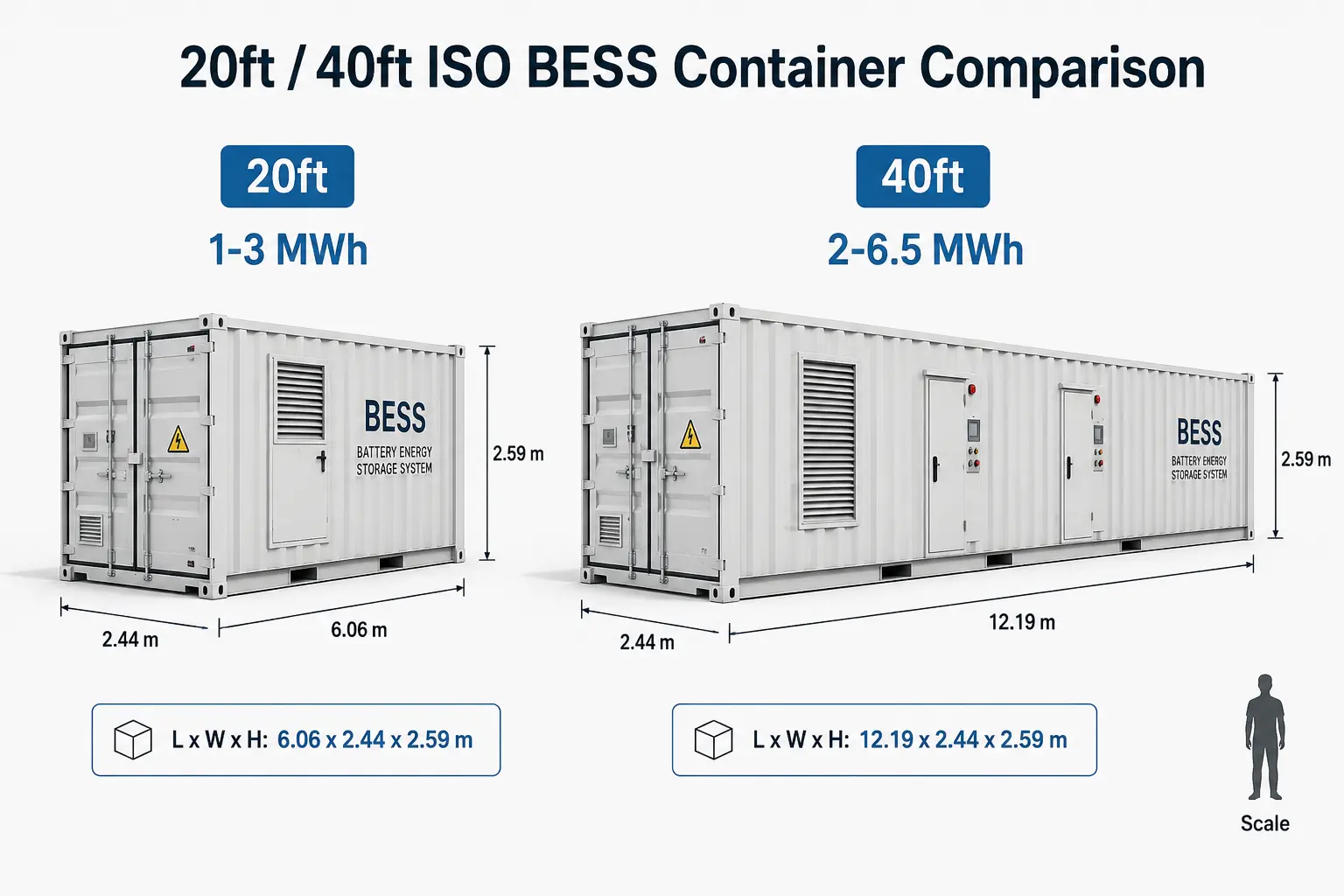
Match discharge duration to your job. A 1 MWh container at 250 kW PCS gives 4 hours at rated output (0.25C). That is solar shifting. The same 1 MWh container at 500 kW PCS gives 2 hours (0.5C). That is peak shaving.
How Much Does a BESS Container Cost in 2026?
Battery costs have dropped roughly 70% since their 2022 peak. Current numbers:
| Market | Turnkey Cost ($/kWh, 4-hour system) |
|---|---|
| China (ex-works) | $63 - 73 |
| Global average | $110 - 150 |
| United States | ~$236 |
| Europe | $177 - 275 |
Sources: BloombergNEF, ITK Research, CNTE Power.
Choosing a container energy storage system means weighing upfront hardware cost against total installed cost. A 20 ft, 1.5 MWh air-cooled container from a Chinese manufacturer runs $95,000 to $140,000 ex-works (DC side only). Add the PCS, shipping, local installation, grid connection, and a transformer. The all-in project cost in the US or Europe can hit $250 to $350 per kWh.
A 40 ft, 5 MWh liquid-cooled container runs $550,000 to $700,000 for DC hardware. Project-level all-in costs land around $180 to $230 per kWh in Europe. The US runs higher because of tariffs and prevailing-wage labor.
Where the money goes inside a typical container BESS:
| Component | Share of Hardware Cost |
|---|---|
| Battery cells & modules | 40-48% |
| Power Conversion System (PCS) | 15-18% |
| Battery Management System (BMS) | 8-12% |
| Thermal management | 5-7% |
| Enclosure, fire suppression, auxiliaries | 12-16% |
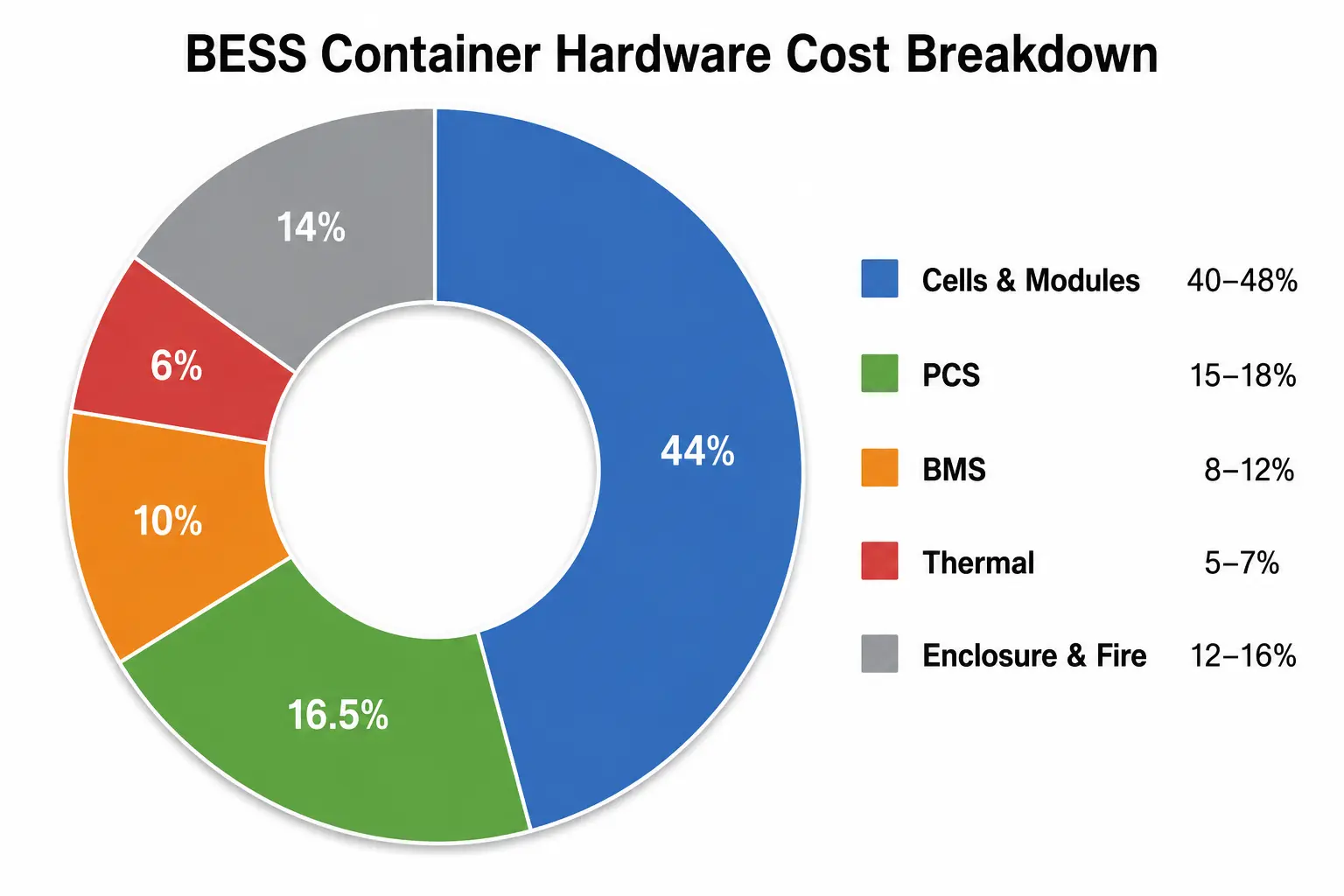
But the days of 30%+ annual price drops (2023 through 2025) are over.
China is phasing out VAT export rebates on battery products (to zero by January 2027). Lithium carbonate prices have leveled off. The cost curve is flattening.
Container BESS vs. Other Storage Formats
| Container BESS | Modular Cabinet (Indoor) | Rack-Mount (Server Room) | |
|---|---|---|---|
| Typical capacity | 0.5 - 6.5 MWh | 50 - 500 kWh | 5 - 100 kWh |
| Installation | Drop-and-connect, days | Indoor space, HVAC needed | IT room, rack rails |
| Scalability | Parallel containers | Add cabinets over time | Add racks, limited by room |
| Transportability | Standard ISO, truck/rail/ship | Pallet or skid, short hauls | Ship as equipment |
| Weather protection | IP54-IP55, outdoor rated | Needs building | Indoor only |
| Best for | Utility, C&I, remote sites | Office buildings, retail | Labs, small commercial |
Key Applications
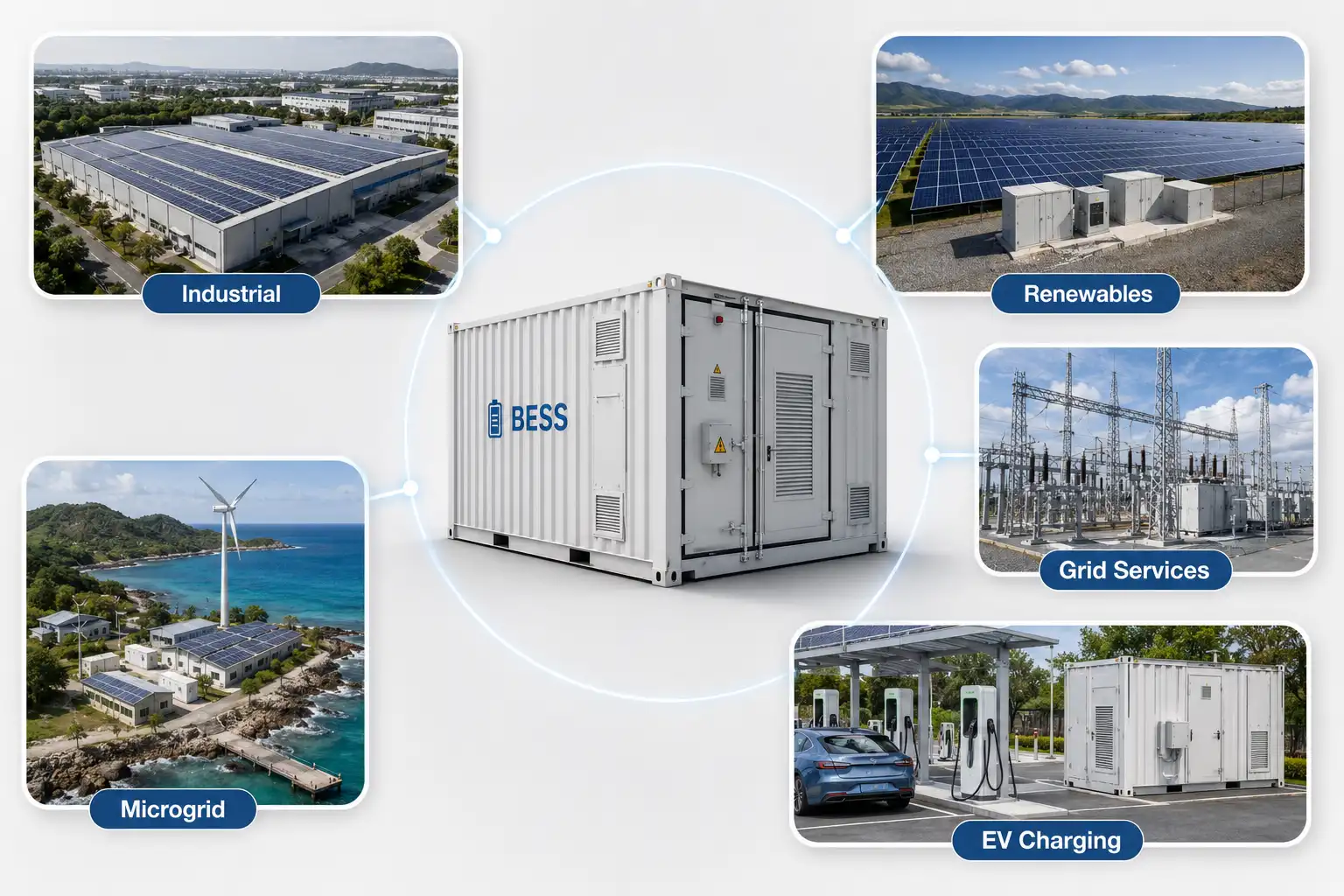
Industrial parks and factories. Charge the container from rooftop solar during the day. Discharge during evening production. This cuts demand charges and keeps production running through short grid outages.
Renewable energy firming. Solar and wind farms pair with container BESS to smooth out intermittent output. A 40 ft, 5 MWh container time-shifts 5 MW of solar from midday to the evening peak.
Microgrids and off-grid. Mines, island communities, and remote telecom towers use container BESS to cut diesel generator runtime. A 20 ft container plus a solar array and the existing diesel genset forms a hybrid microgrid.
Grid ancillary services. Frequency regulation and voltage support need millisecond response. Container BESS with properly sized PCS can bid into ancillary service markets where they exist.
EV charging hubs. Fast chargers draw huge spikes of power, triggering punishing demand charges. A container BESS buffers the grid connection: charge slowly, discharge fast to vehicles.
BESS Container FAQ
What is a BESS container? A BESS container is a self-contained battery energy storage system housed in an ISO shipping container. It packs batteries, BMS, PCS, cooling, fire suppression, and EMS into one transportable unit. You connect it to the grid or a microgrid and it runs.
How much does a BESS container cost? A turnkey 20 ft container runs $255 to $295 per kWh installed. That is for a 1 to 2 MWh unit, in North America or Europe.
Liquid cooling vs. air cooling? Liquid cooling pushes glycol-water through cold plates touching the battery modules. It hits 95 to 98% cooling efficiency and keeps cell temperatures within 3degC of each other.
Air cooling uses fans and ducts. It reaches 80 to 85% efficiency with a 5 to 10degC spread.
Liquid costs more upfront but improves round-trip efficiency by roughly 5 points and stretches battery life by 20 to 30%.
Can a BESS container run off-grid? Yes. The PCS can run in grid-forming mode, making a stable AC waveform on its own to power a local load with no grid. You need a PCS rated for it and an EMS set up for islanded operation.
How long does a BESS container last? The steel enclosure carries a 15 to 25 year outdoor rating.
How long to install? The manufacturer tests the container at the factory before it ships.
How to Choose a BESS Container Manufacturer
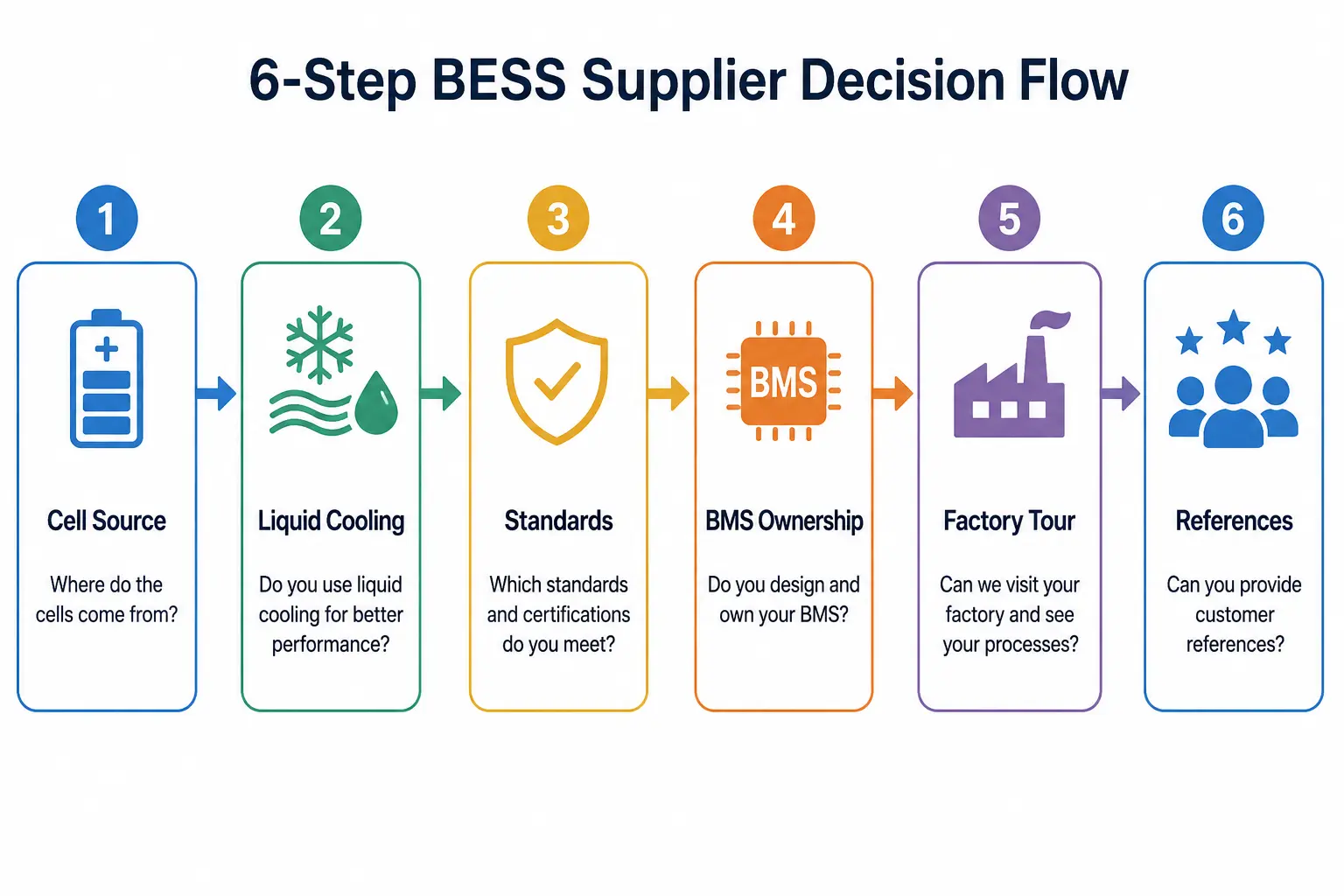
Check the cell source. The container is only as good as its cells. Ask which manufacturer supplies the modules. Tier-1 LFP cells from CATL, BYD, or EVE carry a proven track record.
Look for liquid cooling capability. Even if your first project uses air cooling, pick a supplier that offers liquid-cooled designs. It shows thermal engineering depth. When your storage needs grow, you want a manufacturer that can scale with you.
Verify standards compliance.
No certificates, no deal.
Marine or offshore: DNV type approval.
Europe: IEC 62619 and IEC 62477-1.
North America: UL 9540 (system safety), UL 9540A (thermal runaway), UL 1973 (battery modules).
Ask who owns the BMS. A third-party BMS means firmware fixes go through another company. That company may not be in a hurry. And by then your container is already running, installed on the other side of the world.
Visit the factory or get a video tour.
Watch how modules go together.
See how they test the BMS.
Check whether the production line runs the same way every day, not just when visitors show up.
A clean floor with traceable quality records says more than any sales deck.
Ask for reference projects. Get contacts for two or three customers with systems running more than two years. Ask those references about uptime, how fast service responds, and whether real performance matched the spec sheet.
For more on picking energy storage suppliers, read our guide on how to choose a BESS manufacturer. For commercial project planning, see our C&I energy storage buyer's guide. To talk about a container BESS project with our engineering team, contact KUNETIC.