Table of Contents
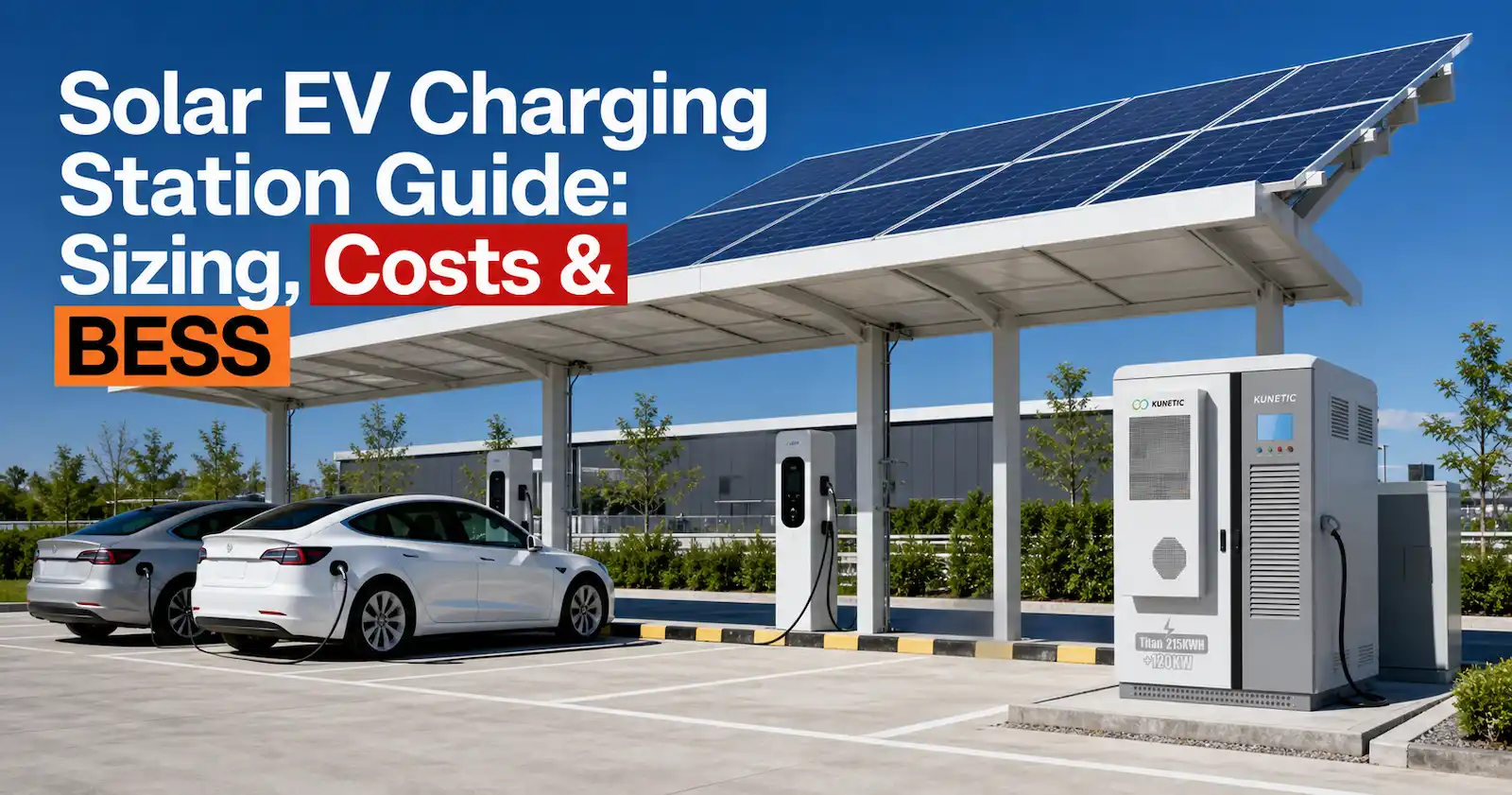
A commercial solar EV charging station brings solar generation, EV chargers, and site power controls into one system. Battery energy storage is optional.
BESS for EV charging becomes useful in three situations. First, charging demand exceeds the grid connection. Second, solar output and charging demand occur at different times. Third, the site needs peak control or backup power.
The basic sizing method is straightforward. Use the site's temporary power deficit to estimate BESS power in kilowatts. Then use the duration and frequency of that deficit to estimate battery energy in kilowatt-hours. Charger nameplate power alone does not provide enough information.
What is a solar EV charging station?
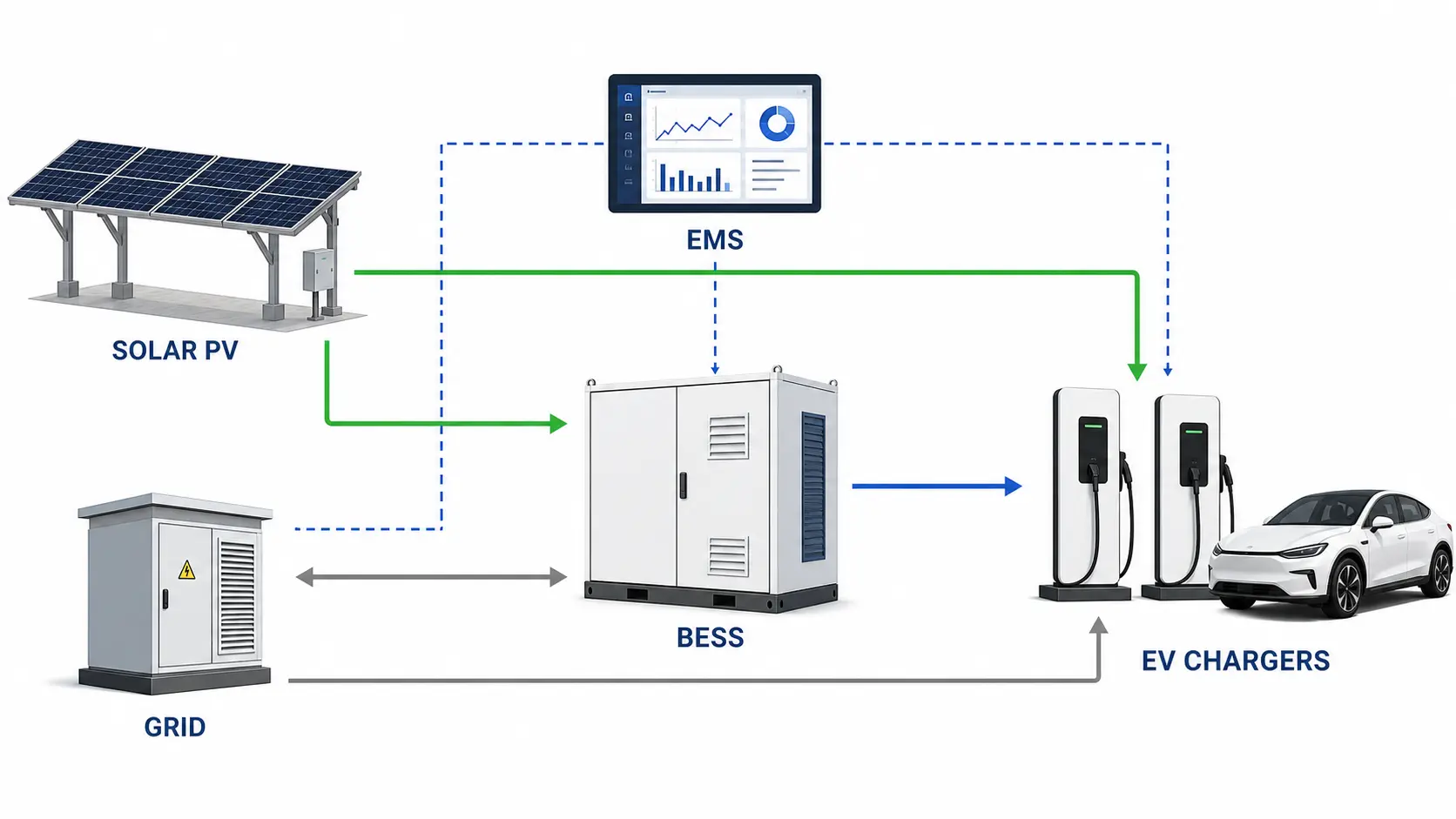
A commercial solar EV charging station has several main parts. These include rooftop solar panels or a solar carport, EV chargers, and a utility connection. It also includes metering, switchgear, and electrical protection. Some projects also include a battery energy storage system (BESS), a PCS or inverter, and an energy management system.
The grid, PV system, and battery may all supply charging power. Their contribution changes with solar output, site demand, battery state of charge, and EMS settings.
"Solar EV charger" and "solar powered EV charger" can both refer to one charger or a small solar charging setup. A commercial solar EV charging station is a complete site. A PV-ESS-EV system goes a step further by adding battery storage and coordinated energy management.
Not every project needs a battery. A site may work well without storage. It needs enough grid capacity, moderate charging demand, and electric vehicles that charge during sunny hours. BESS becomes more relevant as charging power rises or the grid becomes a limiting factor.
NREL has published guidance on battery storage for EV charging infrastructure. It includes battery-buffered options for sites with restricted grid capacity.
Why add BESS to EV charging?
Support limited grid capacity
Battery storage for EV charging stations helps manage power peaks and grid limits. DC fast chargers can create a high power peak for a relatively short period. At the same time, the site may be running HVAC, lighting, production equipment, or other building loads.
A BESS can discharge to cover part of the gap. It does this when total demand exceeds the available utility or transformer capacity. Engineers often call this battery-buffered EV charging.
Storage does not always remove the need for a grid upgrade. It may reduce or delay the upgrade, or let the first project stage use the existing connection.
Smart charging can also cap total power and divide the available supply among connected vehicles. U.S. Department of Energy guidance notes that coordinated charging can reduce coincident peaks. It can also help fleets stay within transformer or service-panel limits.
Use solar energy after daylight hours
Solar output is usually strongest around midday, while fleet or public charging demand may peak later.
A battery stores surplus solar power and releases it when vehicles arrive or PV output falls. The EMS decides when to charge the battery, supply the chargers, import from the grid, or limit charger output.
Control charging peaks
The EMS can reduce costly peaks through peak shaving. This works when the electricity tariff includes demand charges or time-of-use pricing. The EMS coordinates the chargers, BESS, and other site loads.
The result depends on the local tariff, load profile, battery size, and operating strategy. Use interval-load data and the actual utility tariff rather than a generic savings percentage.
Support weak-grid and remote sites
Mines, construction sites, and remote transport hubs may use PV and BESS with an unstable grid or a diesel generator.
The battery handles fast load changes, solar variation, and short charging peaks. The generator provides longer support when PV and stored energy are not enough.
KUNETIC's PV-ESS-EV project material covers grid-connected stations. It also covers weak-grid projects with diesel backup and shared DC-bus microgrids. These serve remote or high-power charging.
How to size BESS power and energy
Engineers should size battery energy storage systems from site data, not a preselected battery cabinet.
Calculate the site power deficit
A useful preliminary relationship is:
Temporary power deficit = simultaneous charging demand + other site loads - available grid power - reliable real-time PV contribution
Use a conservative PV figure. The full array nameplate rating is rarely available throughout the charging period. Output changes with weather, temperature, and time of day.
Consider a simplified example:
- Simultaneous EV charging demand: 300kW
- Other operating site loads: 80kW
- Power available from the grid: 250kW
- Dependable real-time PV contribution: 30kW
The temporary power deficit is:
300kW + 80kW - 250kW - 30kW = 100kW
The project would then assess a BESS and PCS that can supply roughly 100kW, with an appropriate operating margin. This is an early estimate, not a final electrical design.
Size BESS power in kW
The BESS power rating shows how much charging demand the system can support at one moment.
The calculation should account for several factors. These include simultaneous charging, other site loads, grid and transformer capacity, EMS charger limits, PCS ratings, and planned expansion.
Do not add every charger nameplate rating unless the chargers will genuinely run at full output at the same time.
A site with six 120kW charging points has 720kW of installed charging capacity. The real peak demand may be much lower. Vehicle state of charge, charging curves, arrival patterns, dwell times, and EMS power allocation all change the actual demand.
DOE guidance recommends collecting vehicle schedules, dwell periods, charger inventory, building loads, renewable-generation profiles, and transformer-capacity data before selecting a control strategy.
Size battery energy in kWh
Battery energy determines how long the BESS can maintain its output.
A preliminary calculation is:
Required usable energy = power deficit × deficit duration
If the site has a 100kW deficit for one hour, it needs about 100kWh of usable energy for that event.
The installed nominal capacity will be higher. This allows for several factors. Depth of discharge, conversion losses, reserve state of charge, and repeated peaks all count. Degradation, backup needs, and future expansion also matter.
A 100kW/100kWh system and a 100kW/400kWh system can deliver the same maximum power. They cannot support that power for the same length of time. This is why engineers must size kW and kWh separately.
Choose the right system architecture
Grid-connected PV + BESS + EV charging
This is a practical arrangement for commercial parking areas, shopping centers, industrial parks, and urban charging stations.
The grid supplies the base load. PV reduces daytime energy consumption. BESS supports charging peaks and shifts stored energy into later periods.
A grid-connected design is usually simpler for a solar power charging station. This applies when the site does not need full off-grid operation.
Hybrid grid with diesel backup
Remote construction projects, mines, and heavy-duty fleet sites may have weak, intermittent, or no utility power.
PV, BESS, grid power, and a diesel generator operate together. The battery handles rapid peaks and power-quality changes, while the generator supplies energy for longer periods. The EMS can start or stop it according to battery state of charge and site demand.
DC-coupled or shared DC-bus microgrid
A shared DC bus can connect PV, battery storage, and DC chargers with fewer AC/DC conversion stages.
This approach may suit high-power charging or sites with little grid access. It also demands careful integration, control, protection, and maintenance. Fewer conversion stages do not automatically make it right for every project.
KUNETIC offers project-based PV-ESS-EV charging solutions for grid-connected, hybrid-grid, and DC-bus applications. The solution scope includes commercial EV hubs, industrial parks, remote sites, and charging microgrids.
Commercial applications and KUNETIC project examples
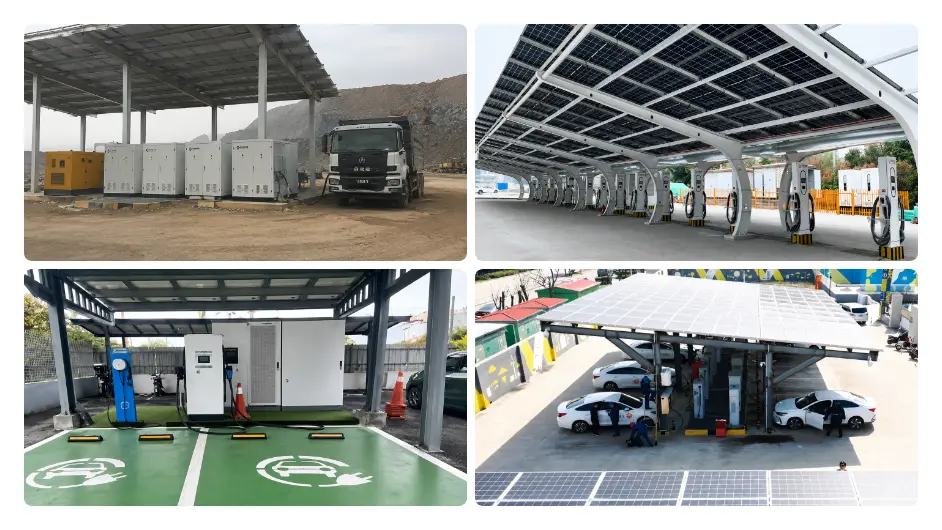
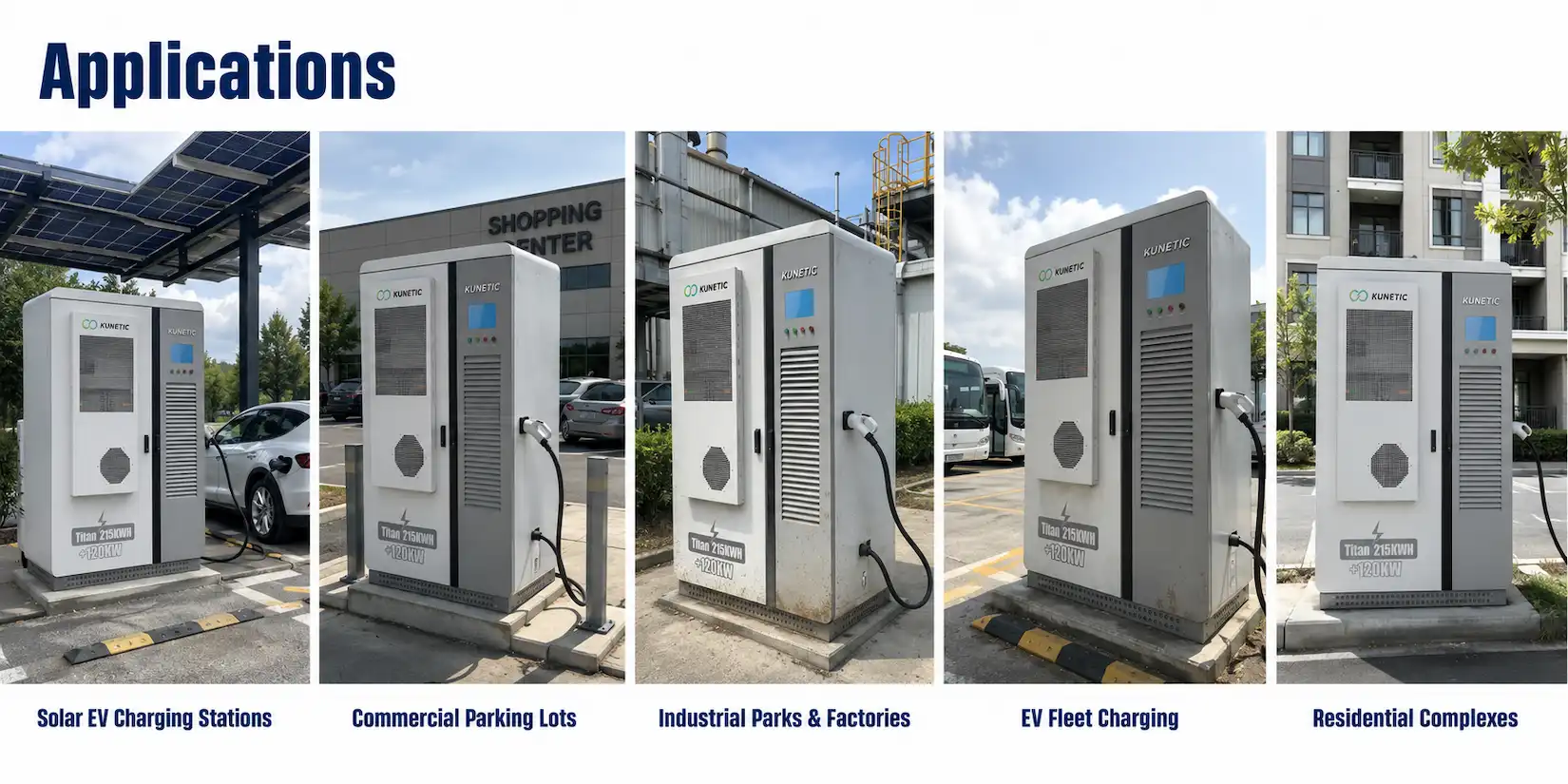
Solar EV charging stations appear in many locations. These include commercial parking areas, shopping centers, and factories. They also include fleet depots, logistics hubs, and public fast-charging stations. Mines and construction sites are further examples.
For commercial EV charging, the operating pattern matters as much as the site category. A fleet depot may have a predictable overnight schedule. A public fast-charging station has less predictable arrivals and shorter, higher-power sessions.
Two KUNETIC projects show why charger capacity alone cannot determine the BESS size.
A project in Shenzhen, China, combines:
- 720kW charging capacity
- 12 charging connectors
- 50kWp PV
- 375kW/723kWh BESS
A project in Guangxi, China, also has 720kW charging capacity and 12 connectors. Its configuration is different:
- 116kWp PV
- 200kW/230kWh BESS
Both sites have the same installed charging capacity, but their storage systems differ substantially. Grid availability, solar production, charging schedules, other site loads, and the operating target all affect the final design.
What affects solar EV charging station cost?
EV charging station installation cost varies with charger quantity, grid work, and site preparation.
No reliable global price exists for a solar EV charging station. Different sites have different needs.
Different sites differ in equipment and construction. Examples include:
- an existing commercial car park
- a highway charging hub
- a solar carport
- a remote mining microgrid
The main cost areas are:
Cost area | Main cost drivers | Project data required |
EV charging | Charger quantity, rated power, and connector type | Vehicle types, arrival pattern, and charging schedule |
Grid connection | Available capacity, transformer, switchgear, and required upgrade | Utility limit and existing site load |
Solar | PV capacity, modules, inverters, and carport structure | Available roof or parking area |
BESS | Power, energy, cooling, protection, and PCS | Power deficit and required duration |
Site work | Foundations, trenching, cabling, and drainage | Site drawing and cable routes |
EMS | Monitoring, charger allocation, and dispatch scope | Operating and control strategy |
Permitting, grid studies, local standards, freight, installation, and commissioning also affect the final cost.
Commercial solar battery storage economics depend on the site tariff, load profile, and operating strategy. A low battery price per kilowatt-hour does not guarantee a low project cost. The wrong power rating, communication interface, or control strategy may add integration work. Compare the installed and commissioned system, not the battery price alone.
When is an integrated storage-and-charging cabinet suitable?
An integrated cabinet places battery storage, PCS, and charging equipment in one enclosure or coordinated equipment package.
This format may suit projects with limited space, moderate charging and storage requirements, or fewer equipment interfaces. It also suits projects with a short deployment schedule. Some sites can add more units as demand grows.
Separate BESS and charging equipment may be better in several cases. These cases include multi-megawatt sites and large groups of charging dispensers. Long cable distances, high redundancy requirements, or heavily customized microgrids are also examples.
The KUNETIC Titan-215 integrated storage and EV charging cabinet is one example of the integrated approach.
Titan-215 has:
- 215.04kWh nominal LFP battery storage
- 206.43kWh dischargeable energy
- 120kW PCS matching power
- An optional 40kW EV charging module
- Air cooling
- IP55 outdoor protection
It serves commercial parking, industrial parks, fleet charging, and solar EV charging projects. The 120kW rating is the PCS matching power. That rating does not mean the optional EV charging module is a 120kW charger.
What to prepare before requesting a system design
A useful proposal requires more than the number of chargers.
Prepare the charger quantity, rated power, connector type, vehicle type, expected simultaneous charging, usual session length, and daily schedule.
Also provide the available grid capacity, transformer rating, existing site peak load, planned PV capacity, and backup requirement. Add your equipment space, expansion plan, applicable standards, installation responsibility, and target commissioning date. Interval-load and fleet-schedule data are more useful than monthly electricity totals alone.
Share your charger quantity, charger power, available grid capacity, daily charging profile, and planned PV capacity with KUNETIC. The engineering team can recommend a preliminary BESS power and energy range. They can also advise whether an integrated cabinet or a larger project-based solution is more suitable.
Frequently asked questions
Does every solar EV charging station need a battery?
No. A site with enough grid capacity and charging demand that matches solar-production hours may not need storage.
BESS helps most in three situations. The site has limited grid power. Solar output and charging demand occur at different times. The project needs peak management or backup.
How much battery storage does an EV charging station need?
Calculate the temporary power deficit in kW, then determine how long and how often it occurs. The final kWh capacity must also allow for efficiency, usable state-of-charge range, reserve capacity, degradation, and future expansion.
Can BESS reduce the need for a transformer upgrade?
Sometimes. BESS and smart charging can keep demand within the existing capacity during short peaks. A site with continuous high charging demand may still need a transformer or grid upgrade.
Can a solar EV charging station operate off-grid?
Yes, but PV, BESS, the charging schedule, and backup generation must cover the full operating requirement. Off-grid fast charging normally needs more storage and tighter control than a grid-connected site.
What is the difference between PCS power and EV charging power?
PCS power is the rate at which the battery system converts and supplies power. EV charging power is the output available to the vehicles. The two ratings interact within the system, but they are not automatically equal.
Is Titan-215 a 120kW EV charger?
No. Titan-215 provides 120kW of PCS matching power. The EV charging module is an optional 40kW configuration. Projects that need higher charging power require a different or project-based charging configuration.
Final takeaway
Design a solar EV charging station from the site's power balance, not from a product catalogue.
Calculate the temporary power deficit to estimate BESS kW. Calculate the duration and frequency of that deficit to estimate kWh. Then choose the architecture according to grid conditions, charging behavior, solar availability, and backup requirements.
This process produces a system based on how the site will operate, rather than the sum of the charger nameplate ratings.