Table of Contents
Quick Answer: In 2026, a turnkey commercial battery storage system costs $290 to $700 per kWh installed in the US market. A 100kWh system runs $40,000–$65,000 before incentives. Three factors drive the price: system size, battery chemistry, and certification level. The 30% federal Investment Tax Credit cuts your net cost significantly.
1. How Much Does Commercial Battery Storage Cost Per kWh in 2026?
The per-kWh price drops sharply as systems get larger. A small 30kWh cabinet costs far more per unit than a 5MWh container — the same dynamic you see with our containerized BESS systems.
Turnkey installation pricing — hardware, labor, and commissioning included:
| System Size | Typical Application | Installed Cost (Total) | Cost per kWh |
|---|---|---|---|
| 30 kW / 60 kWh | Small retail, office backup | $39,000–$48,000 | $650–$800 |
| 50 kW / 100 kWh | Restaurant, small warehouse | $55,000–$70,000 | $550–$700 |
| 150 kW / 300 kWh | Mid-size manufacturing | $135,000–$165,000 | $450–$550 |
| 500 kW / 1 MWh | Factory, cold storage | $360,000–$450,000 | $360–$450 |
| 1 MW+ / 3–5 MWh | Heavy industrial, data center | $870,000–$1,450,000 | $290–$340 |
Sources: Foxtheon 2026 industry report; Sunway Solar BESS cost guide; cross-referenced with CNTE Power component pricing.
Hardware-only pricing — cells, BMS, PCS, and enclosure without installation — typically runs 30–40% lower than turnkey. But "hardware only" means you handle shipping, customs, site preparation, electrical integration, and grid interconnection yourself.
2. Where Does the Money Actually Go?
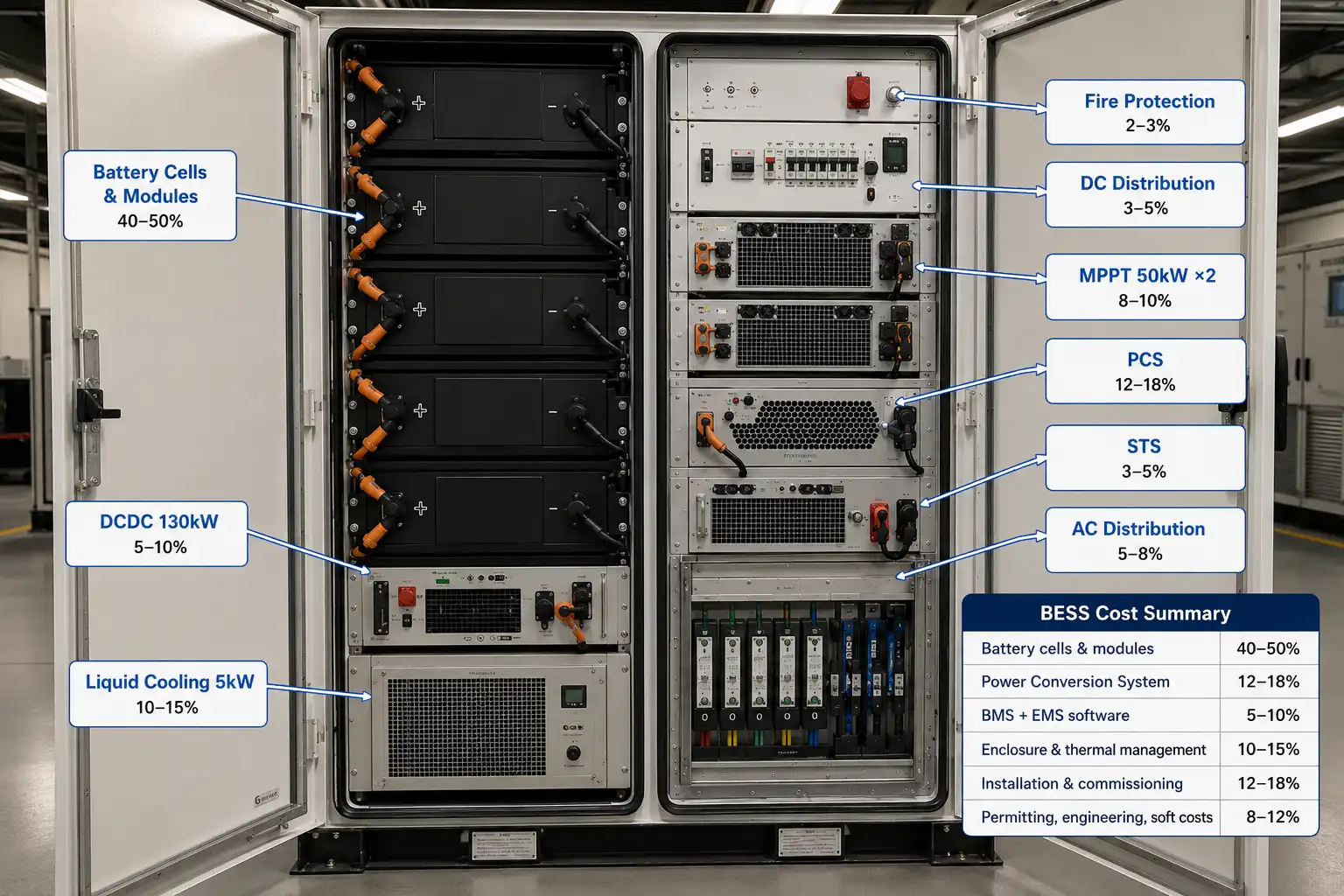
A commercial BESS stores energy in LFP battery modules and has six major cost components. Knowing what each one costs helps you spot where a quote might be cutting corners. For background on how these components work together, see our BESS fundamentals guide.
A 500kW/1MWh system breaks down like this:
| Component | % of Total Cost | Approx. $ at 1MWh Scale | What You are Paying For |
|---|---|---|---|
| Battery cells & modules | 40–50% | $144,000–$225,000 | LFP cells, module assembly, racking |
| Power Conversion System | 12–18% | $43,000–$81,000 | Bidirectional inverter, transformer |
| BMS + EMS software | 5–10% | $18,000–$45,000 | Cell monitoring, thermal control, energy scheduling |
| Enclosure & thermal management | 10–15% | $36,000–$67,500 | Cabinet/container, HVAC or liquid cooling |
| Installation & commissioning | 12–18% | $43,000–$81,000 | Labor, electrical integration, grid connection |
| Permitting, engineering, soft costs | 8–12% | $28,800–$54,000 | AHJ permits, structural engineering, project management |
Percentages compiled from CNTE Power 2026 cost structure report, FFD Power BESS pricing breakdown, and ESZONEO manufacturer analysis.
Battery cells dominate the bill. LFP cell prices have fallen to about $40/kWh at the factory gate in China — down over 60% from 2022, according to BloombergNEF's annual battery price survey. That 60% drop is why these systems can now pay for themselves within a few years.
The BMS is a small line item but a critical one. A well-tuned BMS can add years to pack life. A cheap one can destroy a $200,000 battery bank.
3. Why Do Two 100kWh Systems Cost Completely Different Amounts?
You will see quotes for a 100kWh system ranging from $35,000 to $75,000. The spread comes down to three things: chemistry, certification, and what is actually included in the quote.
Battery chemistry matters, but the choice is settled. For stationary commercial storage, LFP (lithium iron phosphate) is the standard. It costs 20–30% less than NMC (nickel manganese cobalt) and lasts 6,000–10,000 cycles versus 2,000–4,000. The only reason to consider NMC is if floor space is extremely constrained. For almost everyone else, LFP wins on both upfront price and total cost of ownership. Lead-acid batteries, by comparison, last 300–1,000 cycles and cost more per usable kilowatt-hour over their lifetime.
UL certification separates insurable from experimental. A system with UL 9540 certification for the complete assembly adds about 8–15% to the hardware cost. That premium buys you an insurable installation. Skipping system-level certification may save $5,000–$12,000 upfront and cost $50,000+ in insurance premiums later.
| Scenario | Price (Turnkey) | What You Get |
|---|---|---|
| Budget import | $35,000–$42,000 | LFP cells with module-level certs only, air cooling, basic BMS, no US service presence |
| Mid-tier certified | $48,000–$58,000 | UL 9540 system cert, liquid cooling, Tier 1 cells, US-based support, 10-year warranty |
| Premium integrated | $62,000–$75,000 | Full certs, active balancing BMS, EMS with AI forecasting, remote O&M, performance guarantee |
4. What Hidden Costs Do Buyers Usually Miss?
The quoted hardware price is rarely the final number. These seven items show up after the contract is signed — and together they can add 20–35% to your project cost.
| # | Hidden Cost | Estimated Impact | How to Catch It Early |
|---|---|---|---|
| 1 | Site preparation & civil works | $8,000–$35,000 | Get a site walk before quoting |
| 2 | Grid interconnection study & fees | $5,000–$25,000 | Ask your utility upfront |
| 3 | Fire suppression upgrades | $3,000–$18,000 | Submit UL 9540A report to your AHJ early |
| 4 | Extended warranty beyond Year 5 | $3,000–$8,000/year | Clarify what "standard warranty" covers |
| 5 | Shipping, customs & duties | 5–12% of hardware | Confirm Incoterms; US imports from China face Section 301 tariffs |
| 6 | Spare parts & on-site service SLA | $2,500–$6,000/year | Get the O&M contract in writing before purchase |
| 7 | End-of-life decommissioning | $3,000–$10,000 | Ask who handles removal and recycling |
5. Is Commercial Battery Storage Worth It in 2026?
For most US commercial facilities with demand charges above $10/kW/month, the answer is yes. A BESS cuts your bill through peak shaving — discharging during peak demand hours when rates are highest — and provides backup power during outages. Battery prices are at historic lows. The 30% ITC is still available for projects that begin construction by July 4, 2026. Electricity rates are not going down. For a full picture of the buying process, read our C&I BESS buyer's guide.
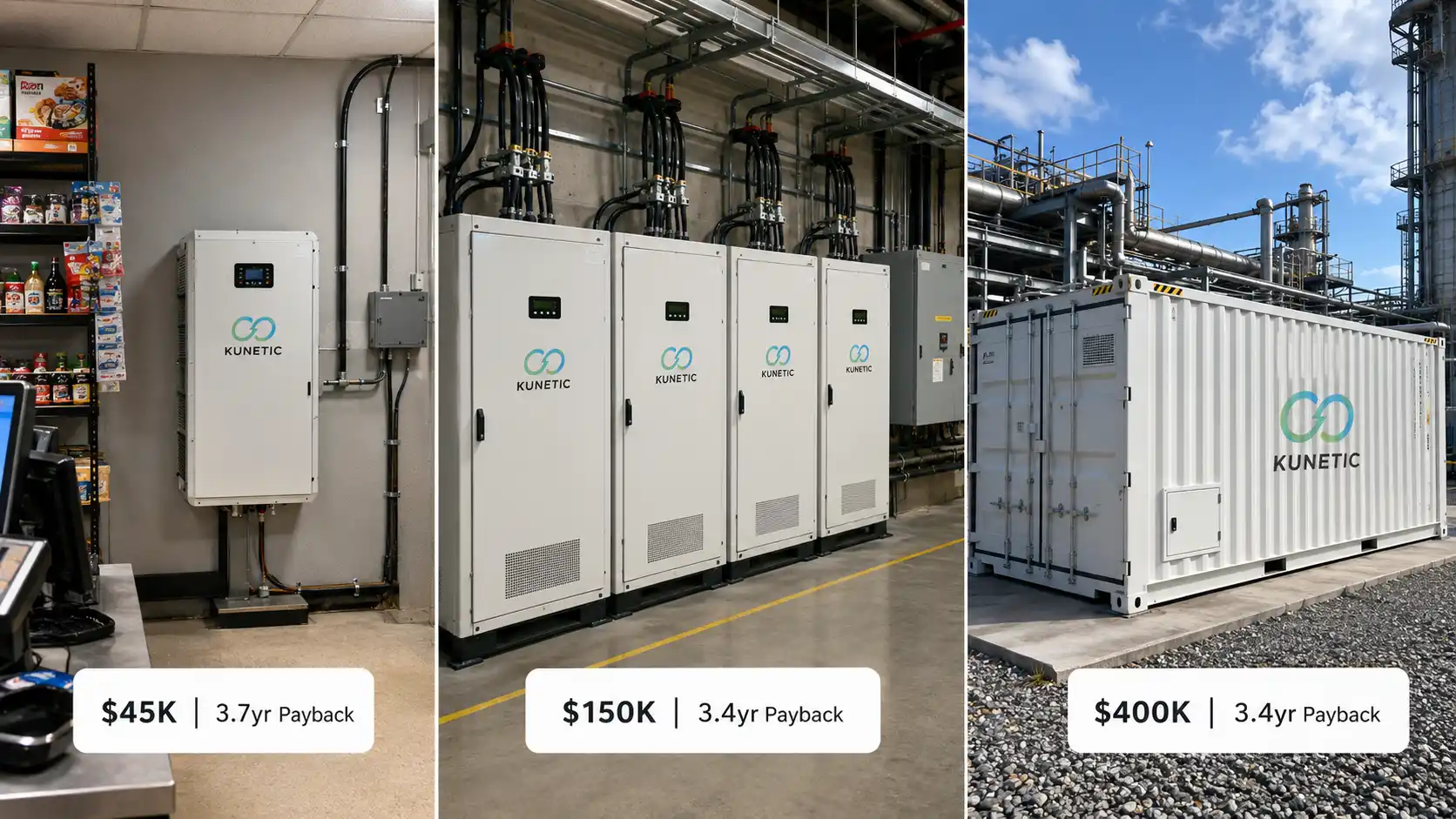
| Scenario | System | Installed Cost | Net Cost (after ITC) | Annual Savings | Simple Payback |
|---|---|---|---|---|---|
| Small retail | 30kW/60kWh | $45,000 | $31,500 | $8,500 | 3.7 years |
| Mid manufacturing | 150kW/300kWh | $150,000 | $105,000 | $31,000 | 3.4 years |
| Large industrial | 500kW/1MWh | $400,000 | $280,000 | $82,000 | 3.4 years |
Assumptions: US average commercial TOU rates, one full cycle per weekday, demand charge reduction included. Actual savings vary by utility tariff, load profile, and solar integration.
The incentive window is closing. Projects starting construction after July 4, 2026 enter a different phaseout timeline. MACRS bonus depreciation drops from 20% in 2026 to zero in 2027. The best time to lock in both the full 30% ITC and current depreciation rules is now.
6. Frequently Asked Questions
How much does a 100kWh commercial battery system cost?
A turnkey 100kWh LFP system costs $48,000–$70,000 installed in the US in 2026. Hardware-only without installation runs $30,000–$45,000. The 30% federal ITC reduces net cost by $15,000–$21,000.
What is the cost per kWh of commercial battery storage?
Installed costs range from $290/kWh for large containerized systems (3–5MWh) to $800/kWh for small cabinet systems (60kWh). The most common mid-range (500kW/1MWh) runs $360–$450 per kilowatt-hour (kWh) installed.
Why do commercial battery storage prices vary so much?
The biggest driver is scale — a container on a concrete pad costs far less per kWh than a custom indoor cabinet. Certification level (UL 9540 system cert adds about 10%) and installation complexity account for the rest.
How much have battery storage prices dropped?
LFP cell prices have fallen about 60% since 2022, from over $100/kWh to approximately $40/kWh at the factory gate. Turnkey system costs have dropped 35–40% over the same period, driven by manufacturing scale and chemistry improvements.
Is commercial battery storage eligible for the 30% ITC?
Yes. Standalone battery storage qualifies for the full 30% federal Investment Tax Credit under Section 48E of the Internal Revenue Code. No solar installation is required. Projects must begin construction by July 4, 2026 to lock in current rules.
How long does a commercial battery storage system last?
LFP-based commercial systems are rated for 6,000–10,000 cycles to 80% capacity retention. At one full cycle per weekday, that is 23–38 years of operational life. Most manufacturers warrant 10 years or a specified energy throughput, whichever comes first.
What is the payback period for commercial battery storage?
Simple payback is usually 3–5 years after the 30% ITC, depending on local utility rates and demand charge structure. Facilities with demand charges above $15/kW/month and significant peak/off-peak spreads see the fastest returns.
Can I install battery storage if I already have solar panels?
Yes. An AC-coupled BESS connects on the AC side of your existing solar inverter. You do not need to modify your panels. This is the most common configuration for commercial retrofits and qualifies for the standalone storage ITC.
A commercial battery storage system is a 15-year infrastructure decision. The best way to get an accurate price is to share 12 months of interval data from your utility. A competent integrator can model your savings to within 5–10% from that data alone.
Ready to see what battery storage would cost for your facility? Contact KUNETIC for a free load analysis and ROI estimate.