
 English

Table of Contents
When adding battery storage to a site that already has solar and a diesel generator, check microgrid controller compatibility against the exact equipment models and firmware. Ask the supplier which commands the controller can send and what feedback confirms each action. Agree what the supplier will demonstrate at the factory and what the project team will verify with the installed equipment on site.
What Does a Microgrid Controller Do?
A microgrid controller coordinates the site's power sources and controllable loads. It can tell the battery to charge or discharge and request power from a generator. On a site designed for island operation, it also coordinates the change between grid-connected and island modes. The IEEE specification for microgrid controllers covers control functions above the individual equipment level.
At a hybrid site, the battery management system (BMS) reports battery condition and operating limits, and the power conversion system (PCS) converts power between the battery and the AC system. The generator has its own controller. Switchgear and protection equipment handle the electrical switching and protective functions specified for the site. A dashboard may show you every device on site. Ask the supplier which of those devices the controller can command and what it can tell them to do. For more on the equipment and costs involved, see our microgrid systems guide.
How to Check Compatibility With Existing Equipment
Give the supplier the model and firmware of each solar inverter, the generator controller, and any other equipment you plan to keep. If the quote just says “Modbus,” ask for the interface list. The list should cover the readings you need, available commands, and the feedback that confirms each action. Check who supplies any gateway, hardwired connection, or controller upgrade.
Say you want the generator to take over when a battery reaches its reserve. Can the controller request a start? How does it know when the generator is ready to take load? Which signal confirms the switch position? If the operating mode depends on those signals, ask the supplier what the controls do when one is missing. If you're still deciding whether to keep the generator, our guide to adding storage to an existing genset covers that purchase decision.
What Should Happen When the Grid Goes Down?
When the utility fails at our example factory, a system designed to run in island mode separates from the grid and supplies the loads assigned to the island. Ask the supplier to show which equipment establishes voltage and frequency. Depending on the design, that might be a grid-forming battery inverter or a suitable generator. Ask which equipment executes the transfer, how its position is confirmed, and which loads the system is expected to keep running. NLR's microgrid controls research explains why the island needs its own voltage and frequency reference.
When utility power returns, the project team should verify the approved conditions for reconnecting or transferring back. Ask how the supplier will measure interruption at the critical load during both transfers. The switch log shows when the switch moved. The load measurement shows how long the equipment lost power, if at all.
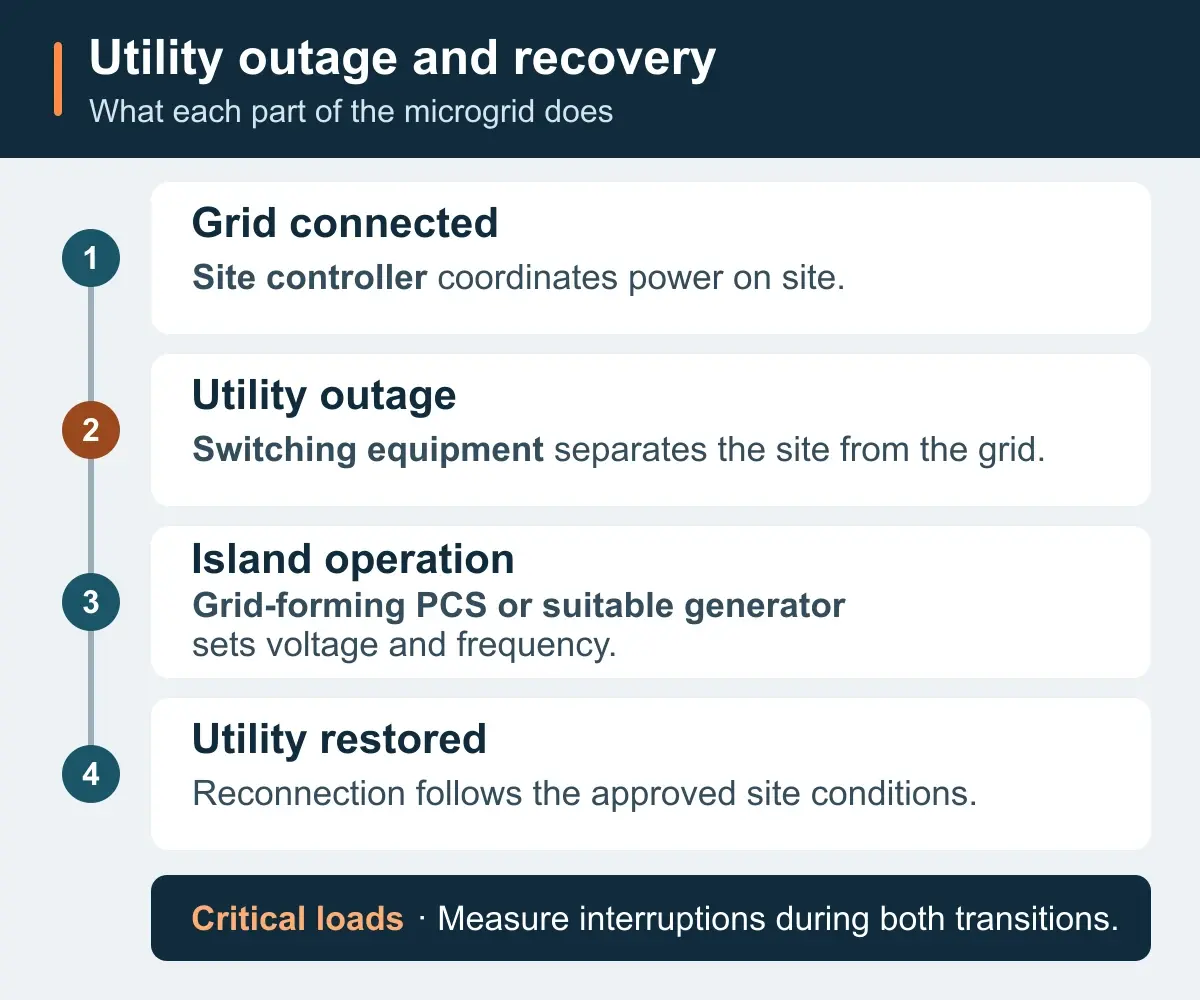
If the entire site has lost power, restarting without an external AC supply is a separate capability called black start. If you need it, specify which source can start from a de-energized system, which loads must be restored, and how the team will demonstrate that capability.
What Should FAT and SAT Prove?
Use the factory acceptance test (FAT) to check the agreed control logic and interfaces before shipment. Ask which devices will be present, which signals will be simulated, and what will still need a site test.
Use the site acceptance test (SAT) to verify the installed equipment and agreed behavior under the project's test conditions. IEEE 2030.8-2018 describes the scope of microgrid controller testing. Write the pass criteria into the project documents, including the maximum interruption the critical loads can tolerate.
Test scenario | What to agree before ordering | Evidence to ask for |
Generator start and switch feedback | Which controller sends the request, what counts as generator ready, and where switch position is confirmed. | FAT record of the commands and feedback, with simulated signals identified. SAT event log from the installed equipment. |
Utility supply lost and restored | Which loads should remain supplied, what interruption they can tolerate, and when the system can transfer back or reconnect. | FAT sequence and results. SAT time-stamped switch events and measurements at the agreed load or measurement point. |
Generator fails to start or a required signal is lost | Which alarm the operator should see and what response the project team expects for each condition. | FAT record of the simulated condition and observed response. SAT verification of the agreed checks under the approved site test plan. |
Ask for a test record that shows the starting conditions, what was meant to happen, what actually happened, and any items left open. If the supplier uses a simulator because the existing generator stays at the project site, put the real generator interface on the SAT list and identify who will sign it off.
What to Send Before Requesting a Quote
Send the current single-line diagram and a recent load profile. Include the device and controller models and firmware. Mark the loads that need to stay on, how long they can lose power, and which operating modes you need. For quotes you can compare, ask each supplier for the following.
- An equipment and interface list showing what you can keep and what needs to be added or changed.
- A scope of supply naming who provides the controls, switchgear interfaces and commissioning.
- A FAT scope and SAT plan showing what will be tested, where, and who will verify it.
KUNETIC's off-grid town microgrid design shows where the new supply ends and the existing equipment begins. The design keeps the town's diesel generators. The proposed supply includes power conversion equipment, a transfer switch and an energy management system that coordinates the power conversion and transfer control. The existing generator controls still need to be checked as part of the retrofit.
Send your equipment list and operating requirements to KUNETIC's solar, battery and diesel solutions team to review the equipment and integration scope for your site.
