Reliable Energy Storage — Download Free Catalog Download Now
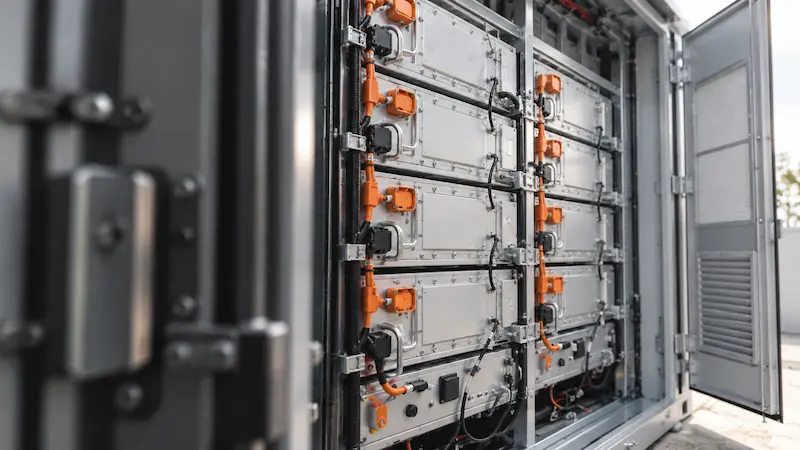
Close-up of silver battery modules and orange DC connectors inside an open storage enclosure

SOLAR FARMS & RENEWABLE PROJECTS

Solar Energy Storage.
Built Around Your PV Plant.

Move daytime generation into the hours your project needs. Plan solar farm battery storage for a new or existing PV plant.

Discuss Your Solar Project
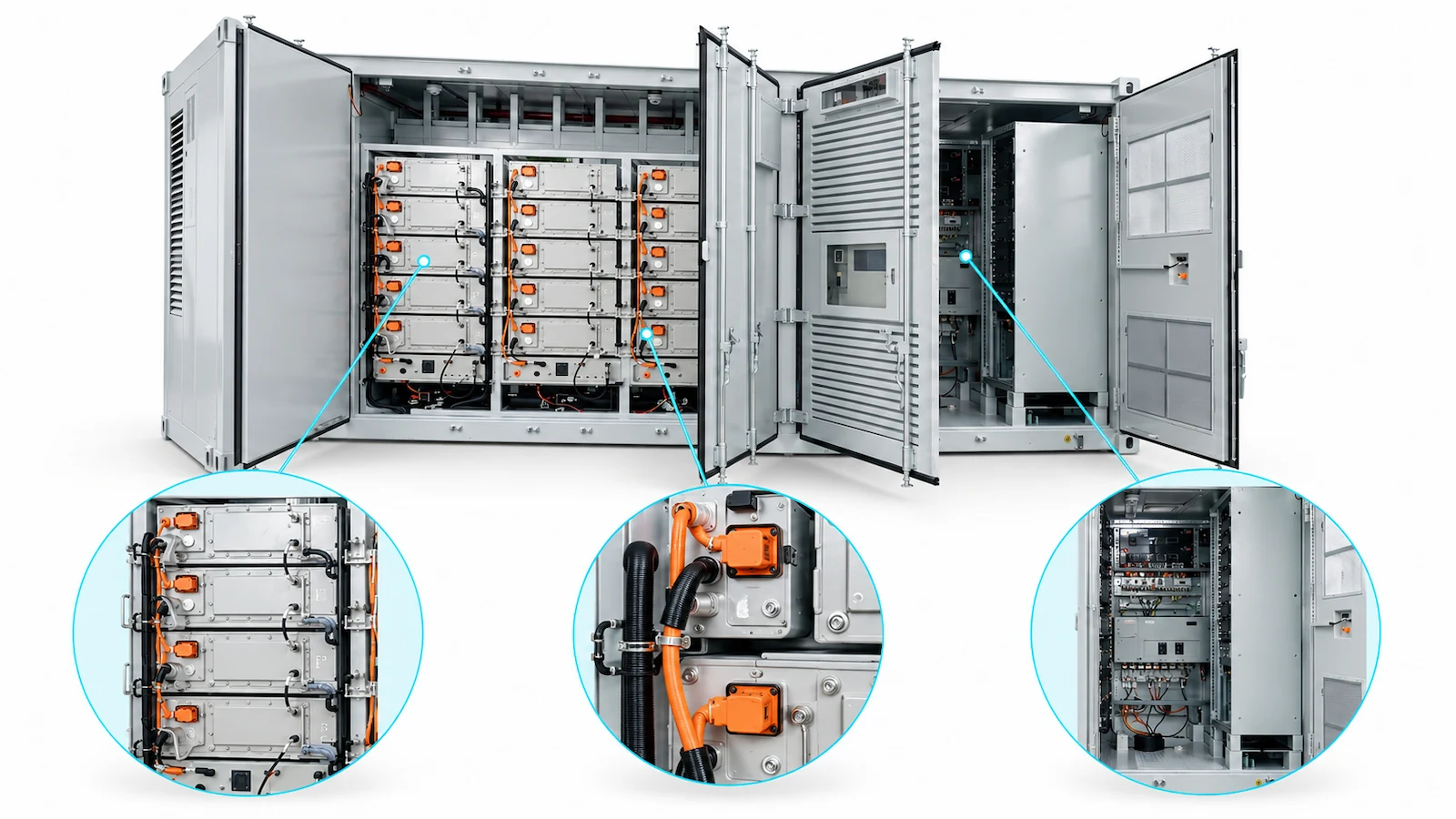
Open battery enclosure with enlarged photographic details of modules, DC connectors and the control compartment
Battery modulesDC connectionsControl compartment
Enclosure and component details — equipment illustration.

FROM GENERATION TO DELIVERY

Solar energy storage starts with your operating plan.

A solar power plant generates electricity from sunlight. Its solar panels produce power during the day. A battery energy storage system (BESS) stores part of that output for later use.

KUNETIC helps project owners, developers and EPC teams define the battery, conversion equipment and controls around that duty. Begin with the generation profile and connection limit, then choose the equipment package.

Explore the System
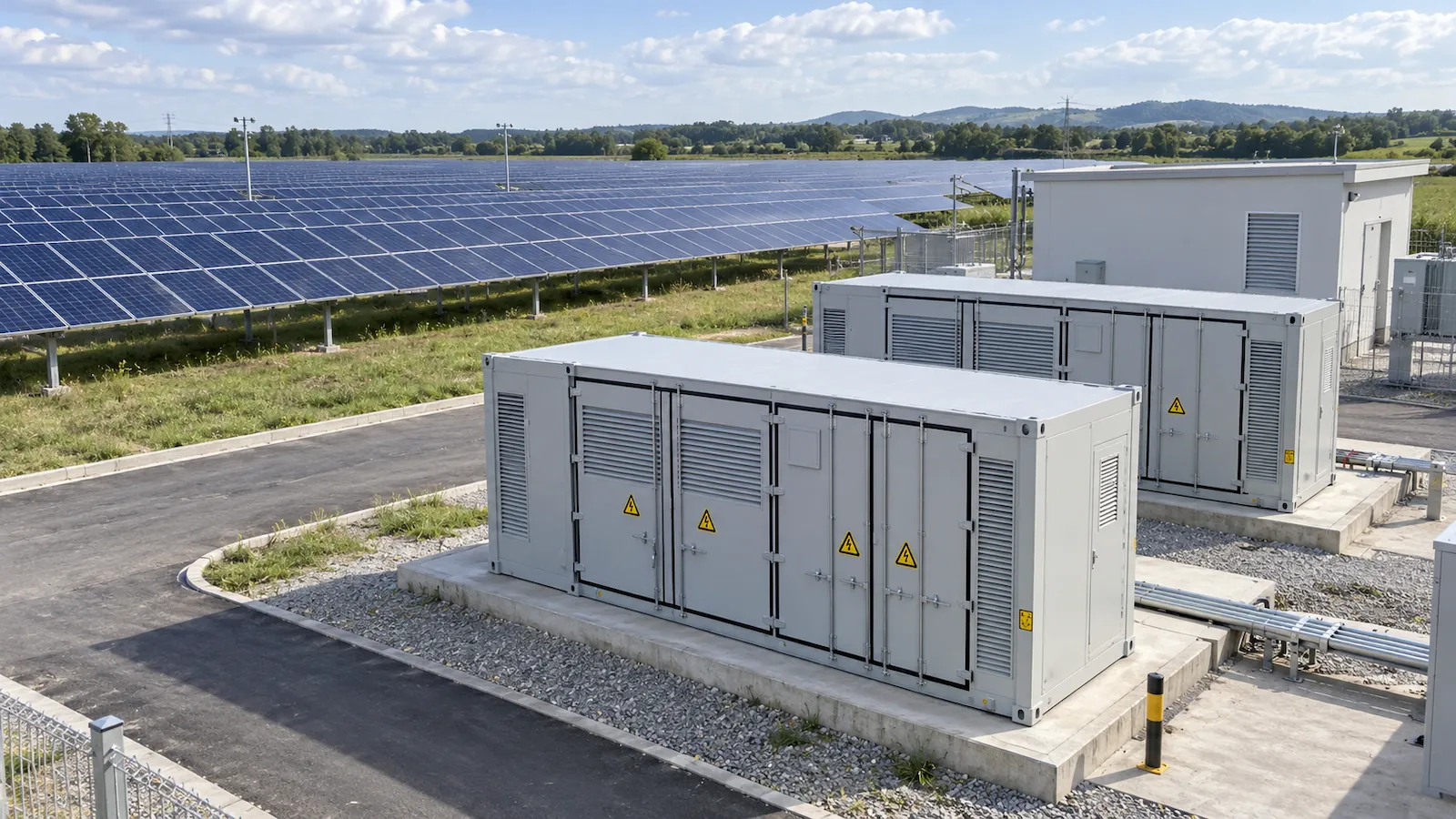
Elevated view of solar arrays, battery enclosures and a utility building in a planned equipment area

01 / NEW PV PLANT

Plan solar and storage
as one project.

Set the export target, charging window and site layout together. Compare AC and DC coupling before your team fixes the equipment interfaces.

Review the available solar surplus, expected delivery hours and transformer arrangement. Leave practical space for access, cable routes and future expansion.

See the Planning Inputs
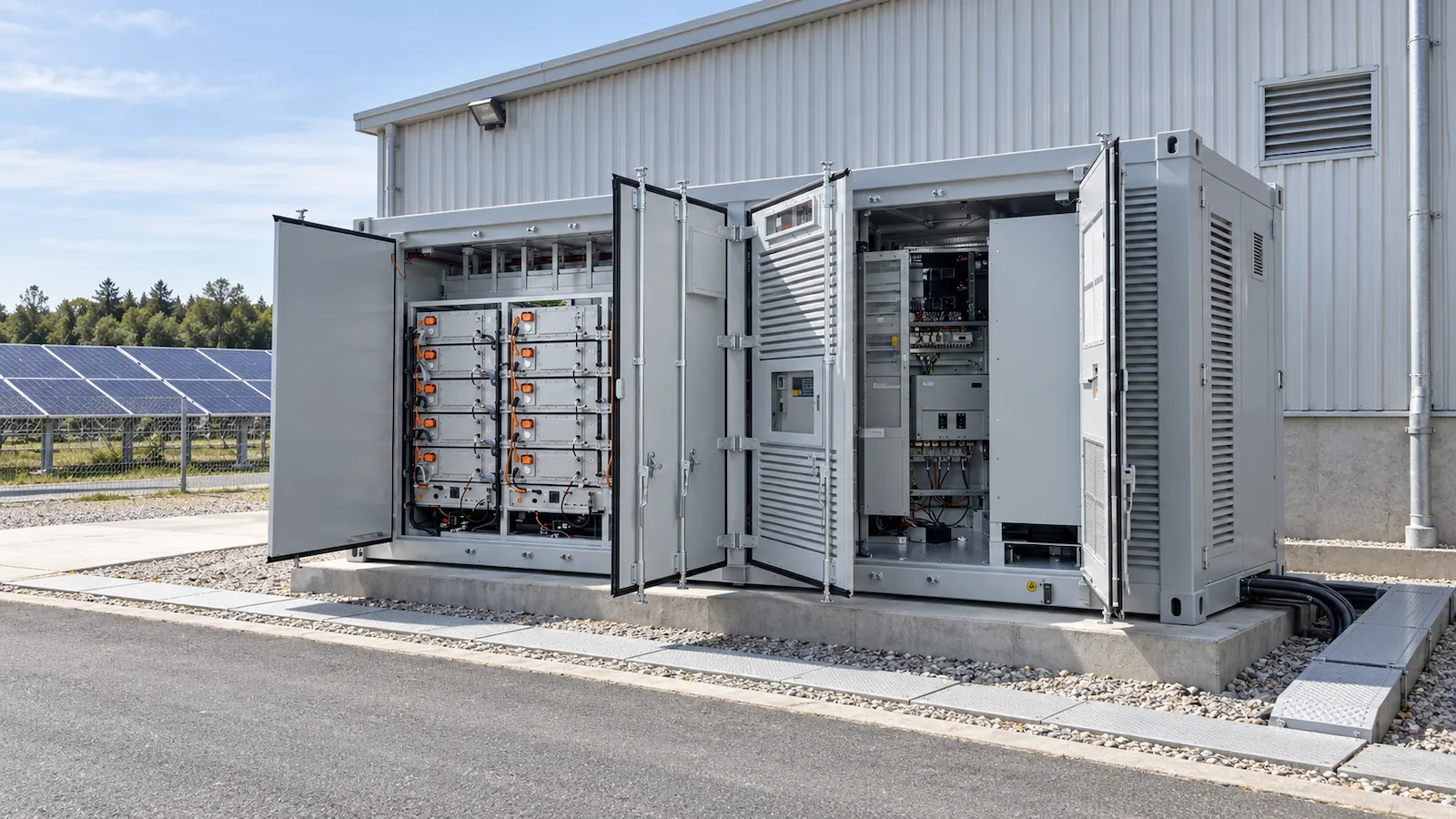
Open battery enclosure showing service access beside an existing utility building and solar array

02 / EXISTING SOLAR FARM

Add storage around
what is already on site.

An existing PV plant needs a connection review before it needs a battery quotation. Start with the inverter arrangement, transformer capacity, protection and export agreement.

AC coupling can keep the PV conversion path separate. The final design must coordinate plant controls and the permitted import and export at the connection point.

Compare the Connection Routes

ONE PLANT. CLEAR EQUIPMENT ROLES.

Understand what goes between
the panels and the grid.

Renewable energy storage involves more than the battery enclosure. Agree the interfaces before choosing a package.

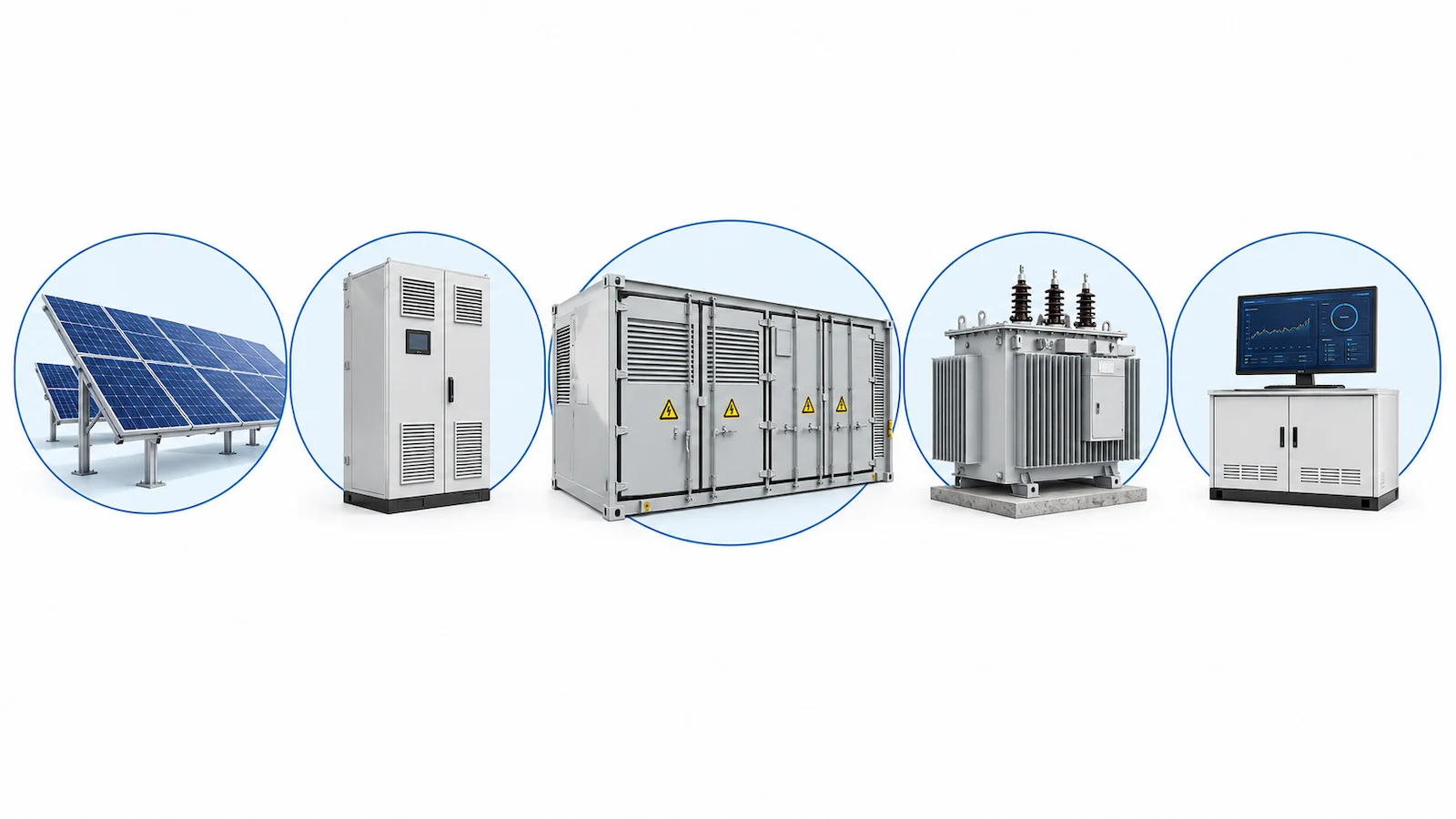
Five equipment roles shown separately: solar array, power converter, battery enclosure, transformer and monitoring terminal
01PV generation02Power conversion03Battery storage04Grid interface05Monitoring & control

Swipe to explore the equipment view.

Equipment roles only. Electrical connections, protection and the final layout are engineered for the project.

CHOOSE THE CONNECTION ROUTE

AC or DC coupling?

The right route depends on the existing plant, the chosen conversion equipment and the grid connection agreement.

SEPARATE CONVERSION PATHS

AC-coupled storage

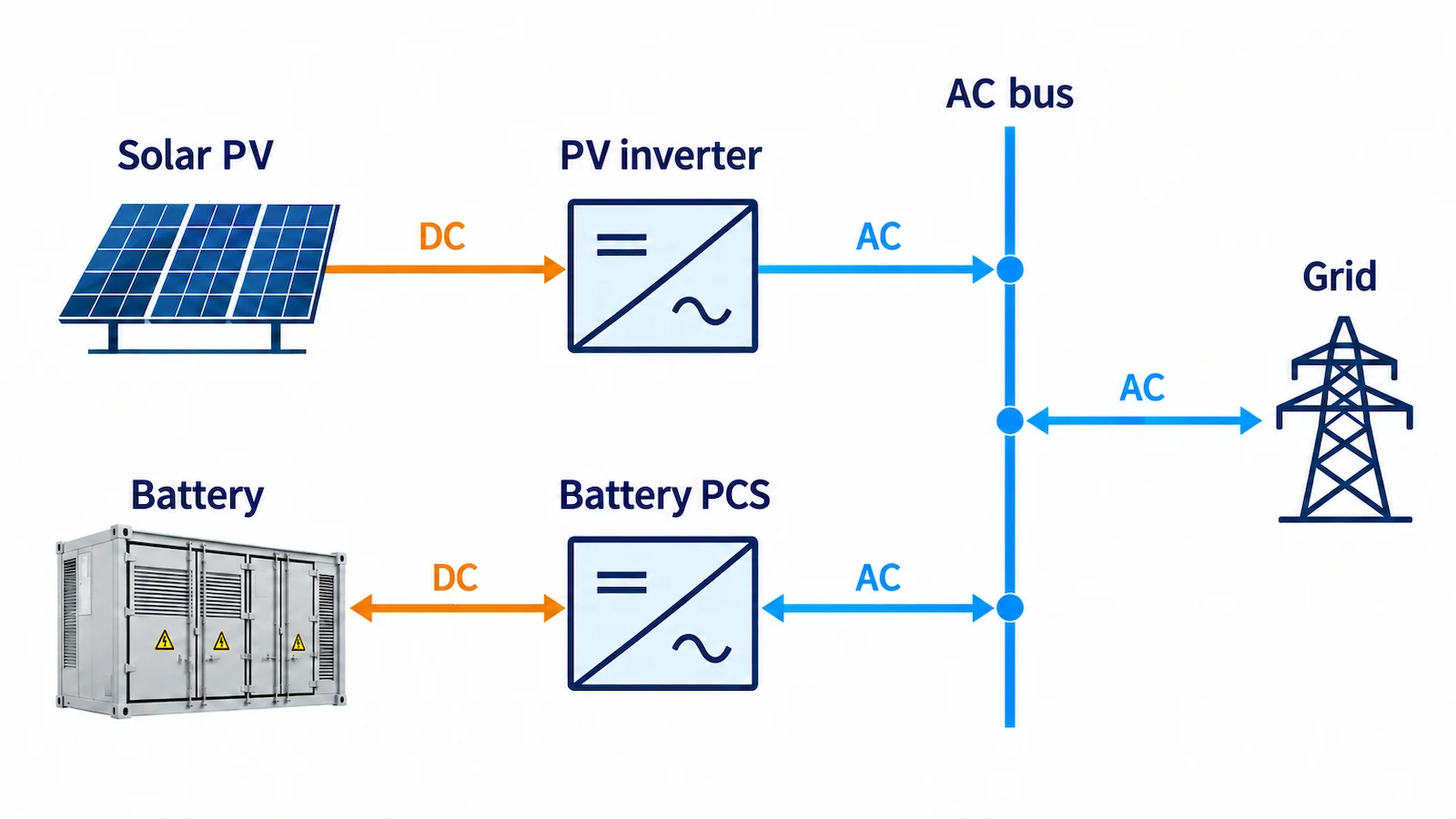
PV inverters and the battery PCS connect on the AC side. This is a useful route to evaluate for an existing solar farm.

Check first: available AC capacity, transformer loading, export control and compatibility with the plant controller.

AC coupling: the PV inverter and battery PCS each connect to a shared AC bus and then the grid
Separate PV inverter and battery PCS. Shared AC connection.

COORDINATED PV & BATTERY DESIGN

DC-coupled storage

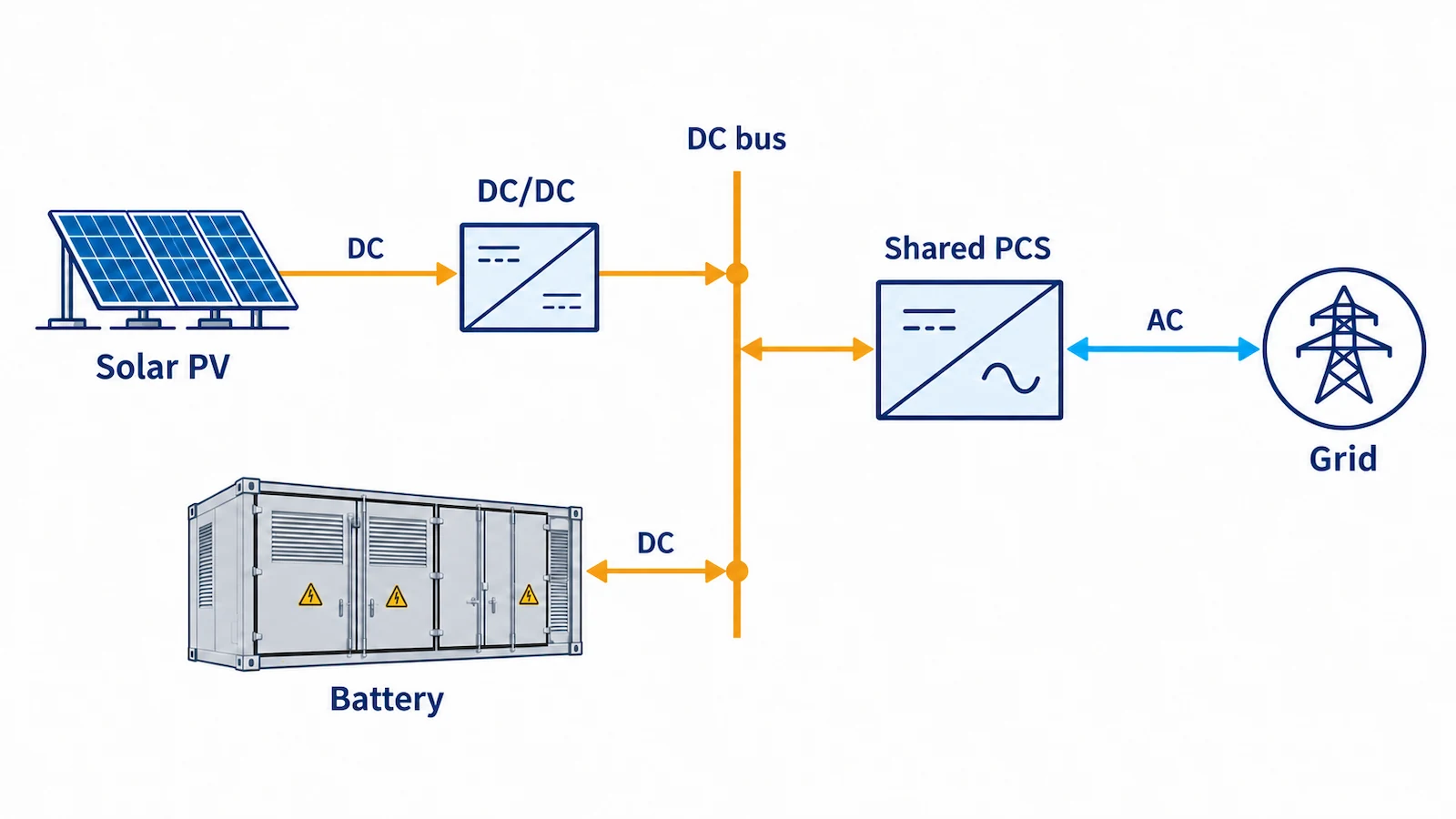
Compatible PV and battery equipment share a DC-side architecture. Review this option early in a new-build design with suitable MPPT / conversion equipment.

Check first: PV and battery voltage ranges, conversion limits, operating modes and the approved grid interface. A DC battery enclosure alone does not provide a complete PV system.

DC coupling: solar PV through DC/DC conversion and the battery join a DC bus before a shared PCS connects to the grid
PV and battery meet on the DC side, before shared conversion.

Blue: ACAmber: DCConceptual energy paths. Protection, metering and auxiliary equipment are omitted. Final equipment and permitted operating modes are project-specific.

POWER × TIME = ENERGY

Size the delivery window.
Then size the battery.

MW tells you how much power the system delivers. MWh tells you how much energy it must deliver over time. The solar array’s MWp rating does not set either figure on its own.

Compare two energy windows at the same example power. Then allow for losses, equipment power use, operating limits and battery ageing.

A daily cycle also needs enough energy to charge the battery. Check the solar surplus across the year, including low-output months. For long-term planning, agree the required energy at the delivery point and the battery capacity available later in its service life.

ILLUSTRATIVE DELIVERY TARGET

2 MW × 2 hours

4 MWh

Energy delivered at the defined output point.

Planning example, not a product rating. Nominal battery capacity must be higher than the required usable delivery energy.

DEFINE THE SUPPLY BOUNDARY

A package your project
team can build around.

Discuss a battery equipment package or a wider solar-storage system. The proposal should identify included equipment, site work and the interfaces owned by each party.

Explore Container BESS
Battery enclosure & internal systems

Battery modules, BMS, thermal management and the specified detection / protection systems. Confirm the selected model, environment and operating limits.

Conversion, distribution & controls

Define the PCS / MPS, electrical distribution and EMS scope. Select the transformer, switchgear and grid protection to suit the project voltage and connection rules.

Installation & project interfaces

Allocate foundations, cabling, earthing, access, permits, local installation and commissioning responsibilities. Confirm drawings and acceptance criteria before procurement.

START WITH THE PROJECT DATA

Five inputs for a useful proposal.

Send what is available. Mark the unknowns so the next discussion resolves the right questions.

Project information for the first technical review
Planning itemWhat to provideWhy it matters
PV plantInstalled or planned DC capacity; inverter AC ratingSeparates generation size from storage duty
Energy profileHourly generation, export and curtailment recordsShows when energy is available to charge
Storage dutyDischarge MW, delivery hours and operating scheduleDefines the required usable energy window
Grid connectionExport / import limits, voltage and single-line diagramSets conversion, transformer and control requirements
Site & scopeCountry, layout, access and requested equipment packageDefines the supply boundary and installation interfaces

Swipe horizontally to view the complete table.

PUT YOUR PLANT INTO THE DISCUSSION

Tell us what you need
the stored energy to do.

Share the solar plant size, country and intended delivery hours. Include a single-line diagram or generation data if available.

  1. Define the operating duty.New plant or retrofit, charging source and delivery window.
  2. Review equipment interfaces.Battery, conversion, grid connection and control scope.
  3. Develop a project proposal.Configuration, supply boundary and outstanding technical inputs.

Discuss Your Solar Storage Project

For project owners, developers, EPCs and system integrators.

Minimum 10 characters.

Drag & Drop a Project File Here

PDF, JPG, PNG, WEBP, DOCX, XLSX or ZIP · Max 8 MB

SOLAR PLUS STORAGE, EXPLAINED

Questions before you specify.

What does battery storage add to a solar farm?

A battery energy storage system stores electricity for later use. At a solar farm, it can shift some daytime generation into a later delivery window. Where plant controls and connection rules allow, it can also help manage an export limit. The benefit depends on the generation profile, available charging energy, electricity prices and the approved operating plan.

Can storage be added to an existing solar power plant?

Yes, subject to an engineering review. An AC-coupled BESS can connect alongside existing PV inverters at a suitable AC point. Review the single-line diagram, transformer capacity, protection, export agreement and inverter controls before selecting equipment. Installation work and connection approval still need to be planned locally.

How long can solar energy storage supply power?

Duration depends on usable energy and discharge power. For example, delivering 2 MW for 4 hours requires 8 MWh at the stated delivery point. The battery needs extra nominal capacity to cover losses, equipment power use and its operating limits. Allow for capacity loss over time as well. The same battery can supply a lower power level for longer, within those limits.

Does a 5 MW solar farm need a 5 MW battery?

There is no fixed one-to-one ratio. PV capacity describes generation equipment; BESS power and energy describe a different duty. Start with the required discharge power, delivery hours, solar surplus and grid limit. These inputs determine whether a smaller or larger battery system makes sense.

Will solar plus storage keep operating during a grid outage?

Only if the complete system is designed for islanded operation. A standard grid-connected BESS should not be assumed to provide backup. Suitable conversion equipment, isolation, protection, controls and a defined restart sequence are required. Specify outage support at the start of the project if it is needed.

What should I send to request a solar storage proposal?

Send the country, PV capacity and whether the plant is new or existing. Include generation or export data, target BESS power and delivery hours. A single-line diagram and grid connection limits help define the equipment. If some data is missing, share what you know so we can identify the next decisions.

Connection diagram

AC coupling: separate PV inverter and battery PCS join a shared AC bus

Conceptual energy paths. On a small screen, swipe horizontally to see the complete diagram.