
 English

Table of Contents
If your solar panels are already on the roof, start with the inverter you have. The model number is your first clue to whether you can add a LiFePO4 battery or need a separate storage system. Once you know what can connect, figure out which appliances you want to run and for how long.
Can You Keep Your Existing Solar Inverter?
If your inverter has a supported battery input, check the exact battery model and firmware with your installer or supplier. Compare the inverter's battery voltage range and charge and discharge limits with the battery specifications. For example, a battery sold in the 48 V class may have a nominal voltage of 51.2 V. The inverter and the battery management system (BMS) also need a shared communication protocol. Ask for the supported pairing even if both devices have a CAN or RS485 port.
If your inverter only handles solar, a compatible AC-coupled system can let you keep it. The existing solar inverter still converts panel output to AC. A separate battery inverter or AC-coupled storage unit manages battery charging and discharging. Ask the installer to confirm what the old and new equipment can do together. How AC and DC coupling work
If you're starting from scratch or planning to replace the inverter, compare a hybrid inverter with a compatible battery against an all-in-one cabinet that includes both. If you're reusing your panels, have the installer check the array against the new inverter's input limits.
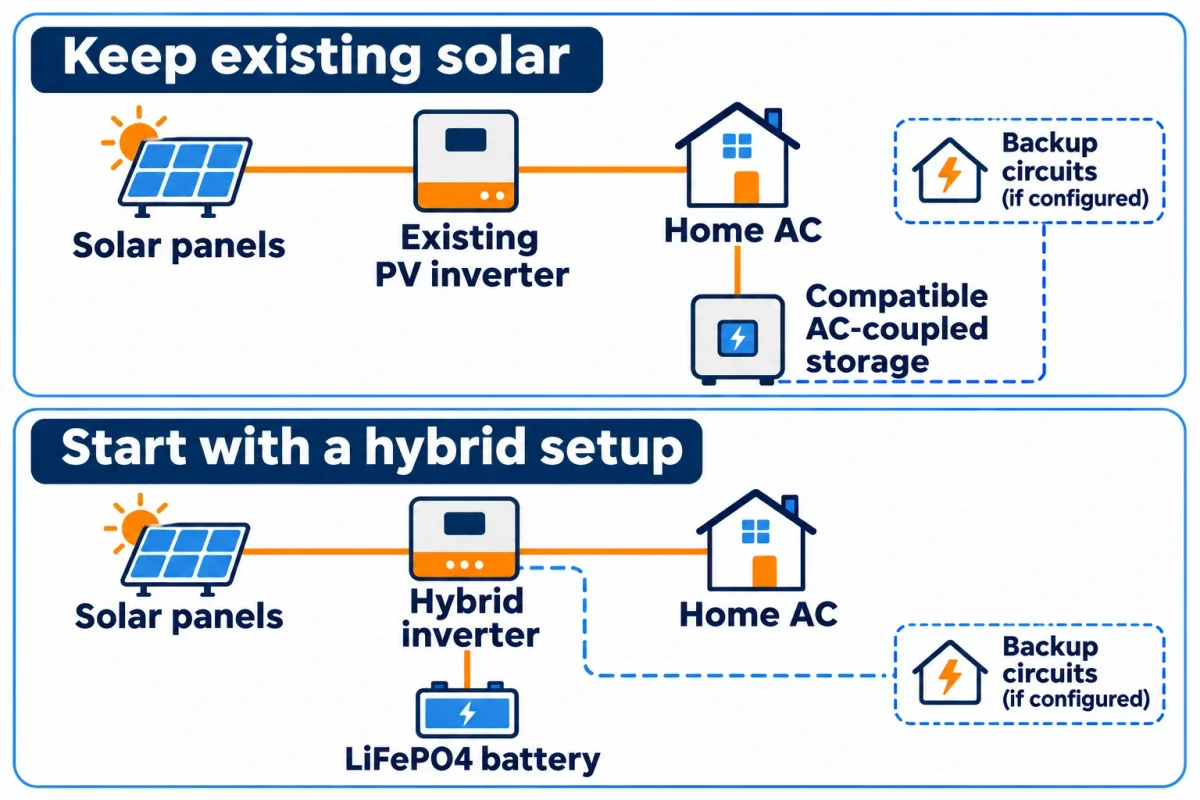
If you're buying for outages, ask two separate questions. Which circuits will the battery power, and can the solar panels recharge it while the grid is down? Ordinary grid-tied solar generally shuts off in a blackout. Solar recharging during an outage requires equipment and controls that support it in backup mode. U.S. Department of Energy guidance on solar and outages
How Much Usable Energy and Backup Power Do You Need?
Suppose your refrigerator, Wi-Fi and a few lights average 0.6 kW together during an outage. Running them for eight hours would use 4.8 kWh at the loads. Use whatever your essentials actually draw for your own estimate. A refrigerator cycles on and off, and the power it draws at startup is a separate check.
A battery's nominal kWh is the energy on its spec sheet. For backup runtime, ask how much energy reaches your circuits after the battery reserve and inverter losses. Then check the inverter's continuous backup output and how much extra power it can supply briefly when a compressor or pump starts. If you want to run a 240 V appliance, confirm that the backed-up circuits have the required voltage and that the inverter can support the load during an outage. U.S. Department of Energy storage basics
Which Battery Setup Fits Your Home?
A wall battery saves floor space if you have a suitable wall. A rack module gives you a way to add capacity if you have room for the rack and distribution equipment. An all-in-one cabinet puts the inverter and battery in one enclosure. These three KUNETIC options differ in what comes with the battery.
KUNETIC option | What you get | What to check |
10.24 kWh nominal. Indoor wall-mounted battery. Pair it with a compatible external inverter. | Wall support and compatibility with your low-voltage inverter. | |
10.5 kWh nominal per 5U indoor rack module. Inverter, rack and distribution equipment selected separately. | Rack space, inverter compatibility and the distribution equipment needed for expansion. | |
20.48 kWh nominal. Battery, solar inverter and solar charge controls in one 120/240 V split-phase cabinet. | Floor space, solar array fit and the backup output and switching equipment in the proposed configuration. |
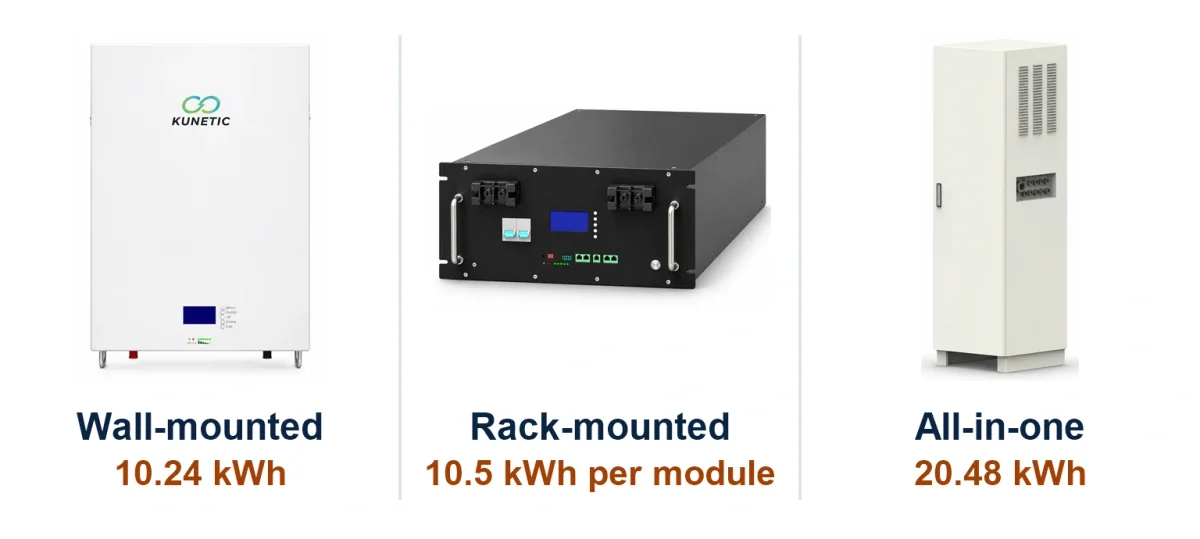
Both batteries near 10 kWh are rated at 51.2 V nominal. If you have a dry indoor utility room with a suitable wall and little floor space, the wall battery may fit. If you plan to add rack modules later, ask which rack, distribution hardware and inverter you would need for the larger bank. KUNETIC server rack battery guide
What Should Be Included in Your Quote?
Ask for separate line items for the battery, inverter, any backup switching or electrical panel work, installation and commissioning. If you're also adding panels, include those in the comparison. For a U.S. installation, ask your installer to verify the documents for the proposed battery and inverter combination. Ask for the listing for the complete system if your installation requires one. UL Solutions guidance on energy storage system listings
For a configuration quote, send a photo of your inverter nameplate if solar is already installed, your planned battery location, and a list of the circuits you want to run with your target backup time. Mention if you want the panels to keep charging the battery during an outage. Request a KUNETIC configuration quote
Frequently Asked Questions
Can solar panels charge a LiFePO4 battery?
Yes, through equipment that controls battery charging. A compatible hybrid inverter or solar charge controller can do this on the DC side. An AC-coupled system charges the battery after solar power has been converted to AC. If you need solar charging during a blackout, check that the system supports it in backup mode. U.S. Department of Energy guide to solar inverters
