
 English

Table of Contents
A 50 kW solar system can cover part of your business’s electricity use. How much depends on when your equipment runs. Compare your hourly electricity use with the output you expect from the roof. A battery can store any extra solar energy for use in the evening.
What Does 50 kW Mean in a Solar Quote?
Ask the supplier for three numbers on separate lines. You need the panel capacity in DC kWp, inverter output in AC kW, and battery capacity in kWh. A 50 kWp PV array has about 50,000 watts of rated panel capacity under standard test conditions. A 50 kW AC inverter rating describes the power the inverter can supply under its specified conditions. A battery's kWh rating describes how much energy it stores.
Two quotes labeled “50 kW solar system” can therefore cover different equipment. Compare the panel and inverter ratings first. If you need backup power, ask how much the inverter can deliver during an outage.
How Much Electricity Could a 50 kWp Array Produce?
In Columbus, Ohio, a 50 kWp rooftop array modeled in PVWatts produced an estimated 61,750 kWh of AC electricity in a typical weather year. The model used fixed, south-facing panels at a 10° tilt, 14% system losses and a DC-to-AC ratio of 1.2. It estimated about 7,190 kWh in June and 2,530 kWh in December.
The annual total gives you a sense of scale. To estimate how much power your business can use as the panels produce it, compare hourly generation with hourly demand. Run the model for your own location, roof orientation and shading. If you're still comparing sizes, start with this commercial solar planning guide.
When Would a Battery Help a 50 kW Solar System?
Take a factory that runs its main shift from 7 a.m. to 5 p.m. and a warehouse that runs from 2 p.m. to midnight. Both use 276 kWh over the day. Both generate about 164 kWh of solar power, based on one June day in the Columbus model. Their working hours determine how much solar power each can use on the spot.
Energy on the example day | Day-shift factory | Late-shift warehouse |
Total electricity used | 276 kWh | 276 kWh |
Solar generation | 164 kWh | 164 kWh |
Solar used directly as it is generated | 157 kWh | 83 kWh |
Surplus solar available to store or export | 7 kWh | 81 kWh |
Electricity needed from 8 p.m. to midnight | 16 kWh | 88 kWh |
The solar output is modeled. The two load schedules are illustrative. Figures are rounded.
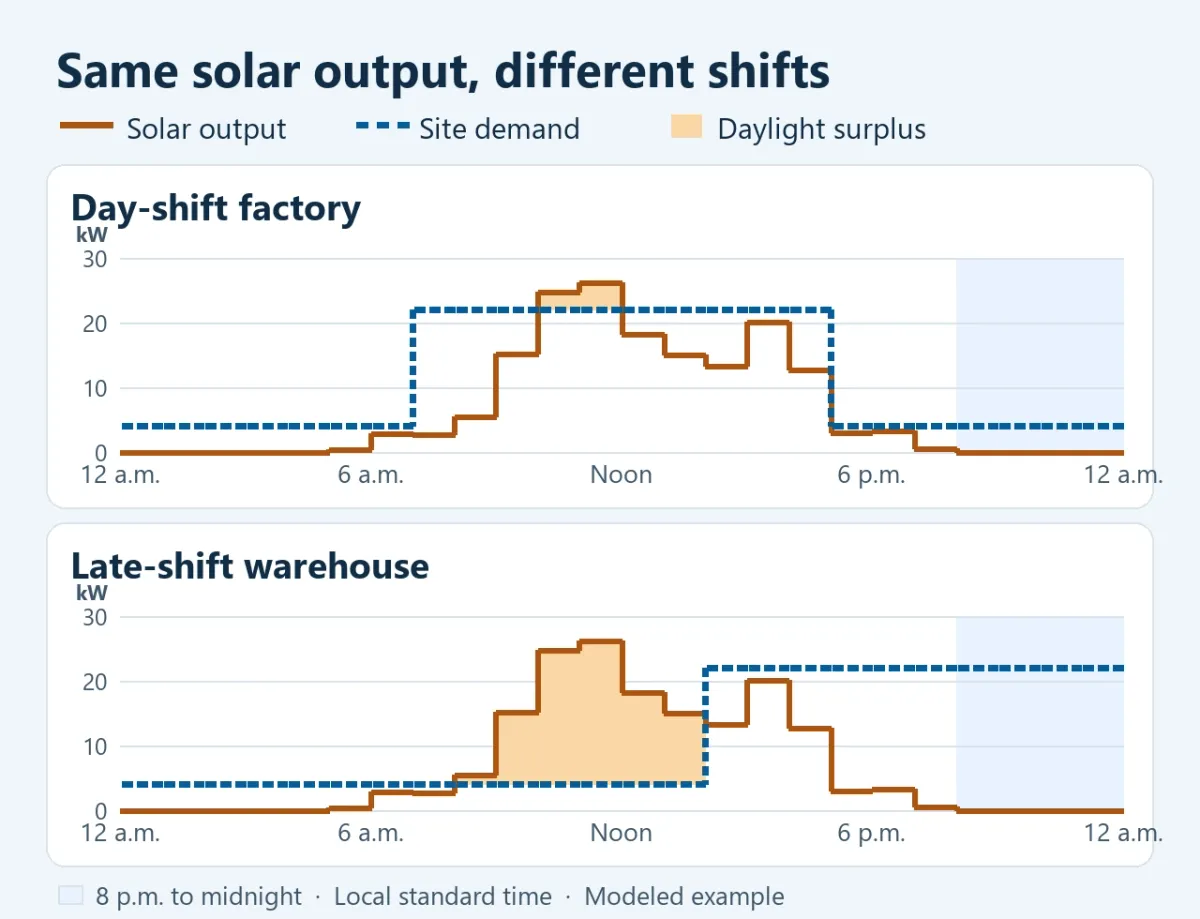
The factory already uses nearly all the solar it produces that day. A battery would have little surplus to shift, though backup or tariff management could still be worth evaluating. The warehouse has about 81 kWh of daytime surplus and 88 kWh of demand between 8 p.m. and midnight. At an illustrative 90% AC-to-AC round-trip efficiency, that surplus could deliver up to about 73 kWh later, provided the battery has enough available capacity and charge and discharge power.
For the warehouse, compare what it pays for evening imports with what the utility would credit for daytime exports. Repeat the comparison across representative days and seasons before using it to justify a battery purchase.
Size Backup Around the Loads You Need to Keep Running
Suppose refrigeration, controls and lighting draw an average of 20 kW during an outage and need to stay on for three hours. The battery system must deliver 60 kWh of usable AC energy to those loads.
Ask the supplier to account for the charge available when the outage starts, the reserve you want to keep and conversion losses. Check motor starting loads, the inverter's backup power rating and the equipment needed to isolate from the grid. The U.S. Department of Energy explains how solar and storage support resilience.
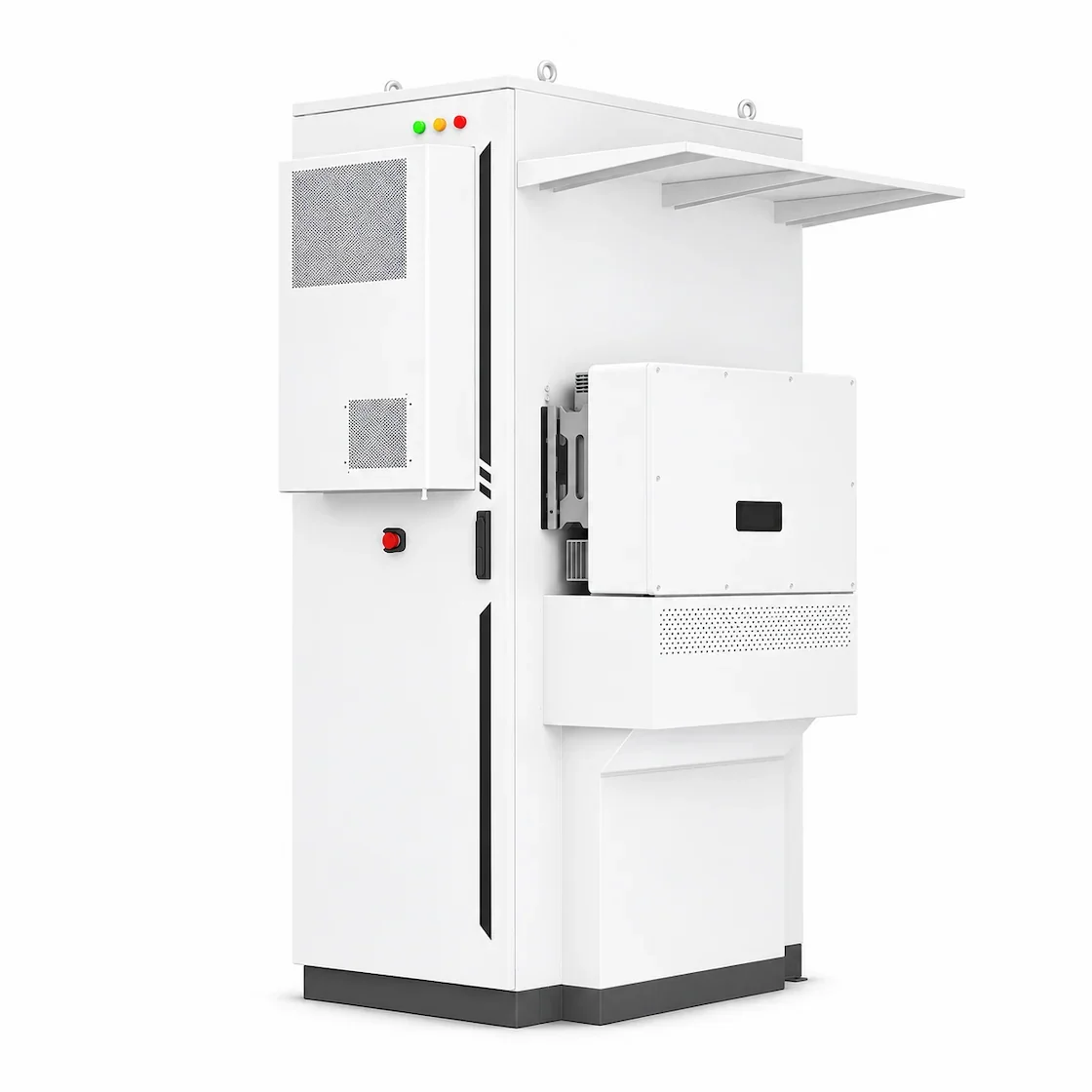
KUNETIC’s 50 kW three-phase hybrid inverter and 111 kWh rated LFP battery cabinet, supplied as one equipment package.
The KUNETIC 50 kW / 111 kWh hybrid package pairs the battery cabinet with a 50 kW three-phase hybrid inverter that accepts up to 75 kW of PV input. The published three-phase voltage options are 220/380 V, 230/400 V and 240/415 V. For a U.S. project, confirm the service voltage and local interconnection requirements before selecting the equipment. Ask your supplier to size the solar modules, site distribution equipment and any generator for your project.
Compare the Same Scope Before You Ask for a Quote
When you compare quotes for a 50 kW solar system, ask each supplier to itemize the panels, inverter, mounting, wiring and electrical work. If you need storage, have them list the battery's rated and usable energy and the cost of backup switching or controls. Check who handles permits, installation and commissioning. That gives you a way to compare an equipment-only price with an installed proposal.
For a first sizing discussion, gather the site location, available roof area, interval load data, service voltage and backup load list. Send KUNETIC your site details for help comparing the equipment and supply scope.
Questions Before You Order
How many panels and how much roof space does a 50 kWp system need?
At 550 W each, 91 solar panels add up to about 50 kWp. If each panel covers 2.6 m², the panels themselves occupy about 237 m² (2,550 sq ft). The required roof area depends on the mounting layout, spacing, obstructions and access paths.
Can a business add a battery to a 50 kW solar system later?
Yes, when the existing system and site can support a compatible storage connection. If you expect to add storage, ask now what the proposed inverter supports and where the battery equipment could go. For a system already in service, see the commercial solar battery retrofit guide.
