
 English

Table of Contents
Start with what the battery has to deliver at your site. For a megawatt-scale containerized battery energy storage system (BESS), specify the power, how long it has to last, and where it will be measured on the AC side. Those requirements help you choose the battery configuration and power conversion equipment, and give suppliers the same basis for their quotes.
Start with the Job the Battery Needs to Do
If you're trying to lower a factory's peak demand, open the load profile and mark where demand goes above your target. Look at how far above it the load goes and how long it stays there. A brief spike and a two-hour plateau can reach the same peak, but the plateau needs more energy. Check when the battery can recharge and how much spare power the site has during that window.
For solar shifting, check when surplus solar power is available and when the site needs that energy back. For backup, list the loads that have to stay on and for how long. Ask the project team how the site will isolate from the grid during an outage and confirm that the storage system supports that operating mode.
Size the System in MW and Usable MWh
Say a factory needs 1 MW of continuous output at an agreed AC metering point. For two hours, the battery system has to deliver 2 MWh at that point. For four hours at the same power, it has to deliver 4 MWh. The output target stays at 1 MW. The U.S. Energy Information Administration explains how power and energy determine storage duration.
The battery nameplate lists rated DC energy. For sizing, ask how much usable AC energy the system can deliver at the factory's meter. State-of-charge limits, reserve settings, conversion losses and auxiliary loads within the measurement boundary affect that figure. If the site needs the same output and runtime in a specified warranty year, put that requirement in the quote request and agree how it will be tested.
Choose Between an External PCS and an Integrated System
The power conversion system (PCS) moves electricity between the DC battery and the AC side of the project. A DC battery container connects to a separate PCS. An integrated container houses both the battery and PCS and provides an AC interface. In either layout, the connection voltage and site design determine whether you need a transformer or other AC equipment.
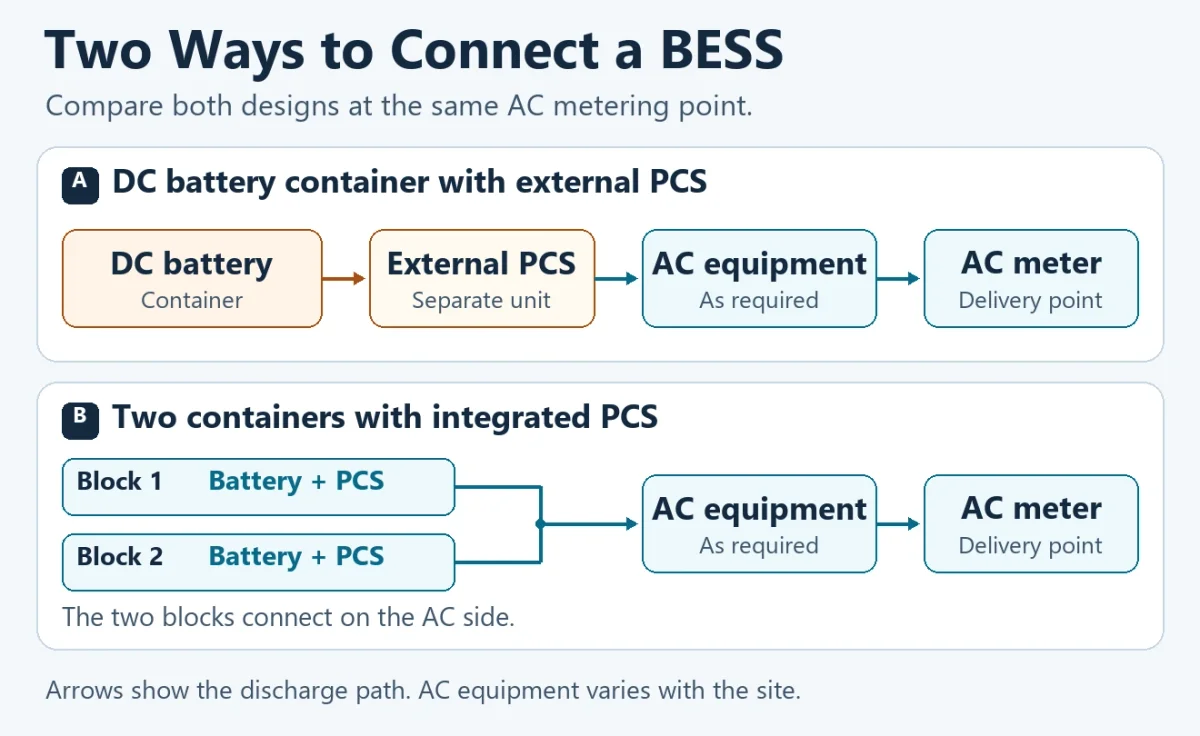
Two illustrative container arrangements, compared at the same project AC metering point.
A nominal 1 MW / 2 MWh system might use one 2 MWh DC battery container and an external PCS. Another layout might use two integrated blocks, each rated at 500 kW with roughly 1 MWh of battery energy. If the buyer needs two full hours at 1 MW, each bidder needs to confirm 2 MWh of usable energy at the agreed AC point. If the two blocks share the load, ask how much output remains when one is offline.
An external PCS can make sense when the site already has an AC equipment plan and the project team can manage the interfaces. Consider an integrated container when you'd prefer the battery and PCS in one package and its AC output suits the site. Ask how a technician would reach and replace the PCS. For either layout, agree who checks electrical and communications compatibility and who commissions the system.
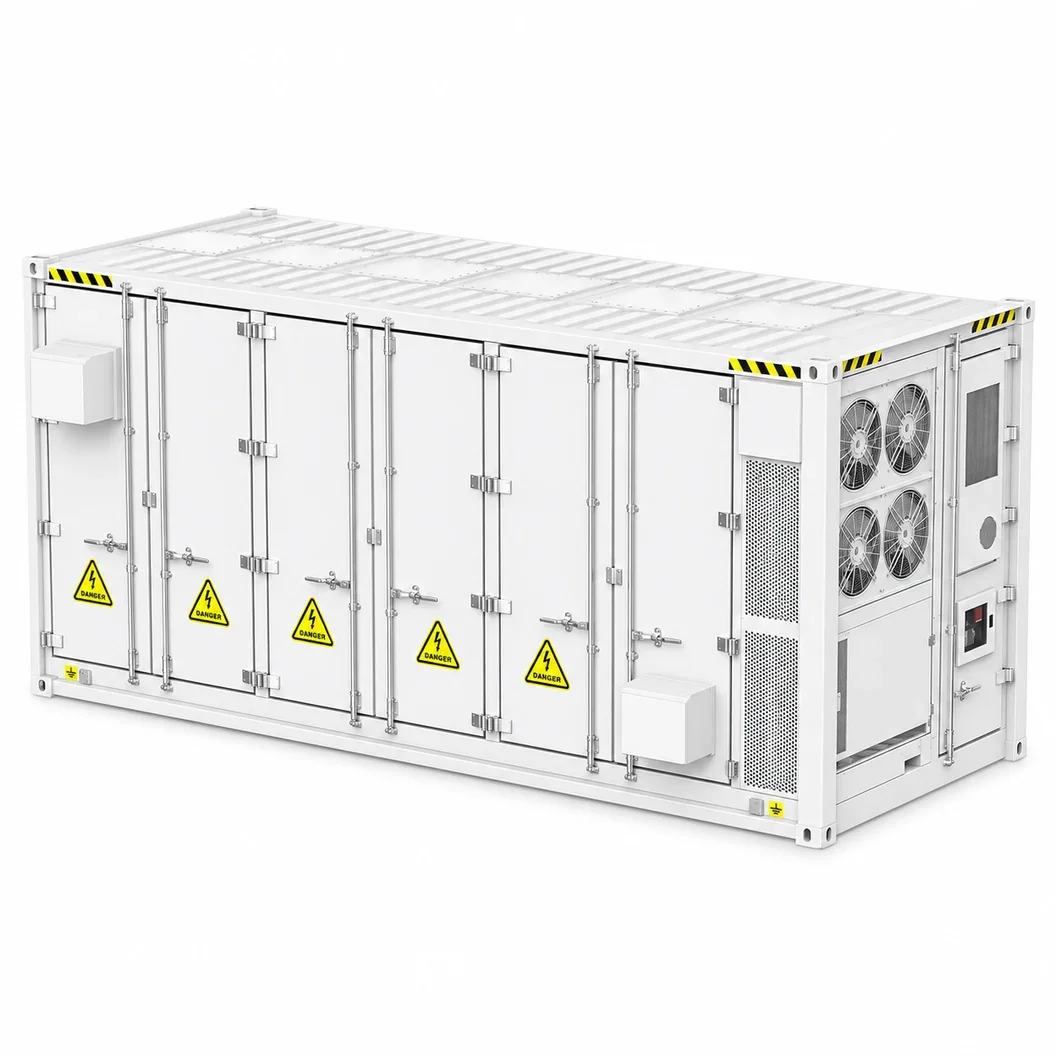
KUNETIC's 20 ft liquid-cooled DC battery storage container with 5.015 MWh of rated battery energy.
KUNETIC's 5 MWh battery storage container is designed to pair with an external PCS. The published 5.015 MWh is rated battery energy. To size this option for a site, confirm the PCS rating and the usable energy the complete system can deliver at the project's AC meter.
Check the Space for the Whole Installation
Before reserving space, ask for an equipment layout. Mark the container, any external AC equipment, cable routes and the unloading area. Check that a technician can open the doors and remove a component after everything else is in place. Give your site team the quoted equipment's dimensions, shipping weight and lifting details.
If you're connecting at an existing factory, share the proposed connection voltage and a single-line diagram if you have one. Confirm the connection arrangement and site requirements with the project team. The BESS container guide covers common enclosure formats and components.
Ask Suppliers to Quote the Same Scope
Give each supplier the same AC metering point, continuous output, runtime and operating conditions. Then ask them to say who supplies each item and which items are quoted separately. The EPRI energy storage specification template shows how to define the system and its connection boundary.
What to compare | What to ask each supplier to state |
Performance and acceptance | Continuous AC output, usable energy, duration, operating conditions and test point. Ask when performance is guaranteed and whether the figures account for auxiliary loads. |
Equipment and interfaces | Who supplies the battery container, PCS, transformer and switchgear where needed. Who checks electrical and communications compatibility? |
Site controls | Who supplies the energy management system (EMS), connects site meters, sets up dispatch and tests communications. |
Delivery and site work | Who handles shipping, unloading, foundations and field cable runs. Ask what the supplier means by installation support and who does the on-site work. |
Commissioning and support | Who starts the system, runs the acceptance tests and handles training, warranty claims and spares. |
For a first inquiry, pull together your interval load profile, output target, required runtime, charging window, connection voltage and site plan. See KUNETIC's containerized BESS options or send us your project details to discuss a configuration and what the quote should cover.
