English
 Deutsch
 Español
 Français
 Italiano
 Polski
 Română
 العربية
PROJECT DESIGN · CÔTE D'IVOIRE
Off-Grid EV Charging Station Design in Côte d'Ivoire
A customer in Côte d'Ivoire asked KUNETIC to plan a solar-powered charging station without a public grid connection. The proposed site measured 39 m by 39 m, with space also needed for an office and shops. The customer wanted to use that space well. Drivers needed room to move, and the service team needed access to the equipment.
The starting brief called for 30 fast-charging connectors and around 60 vehicles a day. Reviewing the available solar area changed the discussion. The customer needed to know how much charging energy the site could supply and when vehicles could use it.
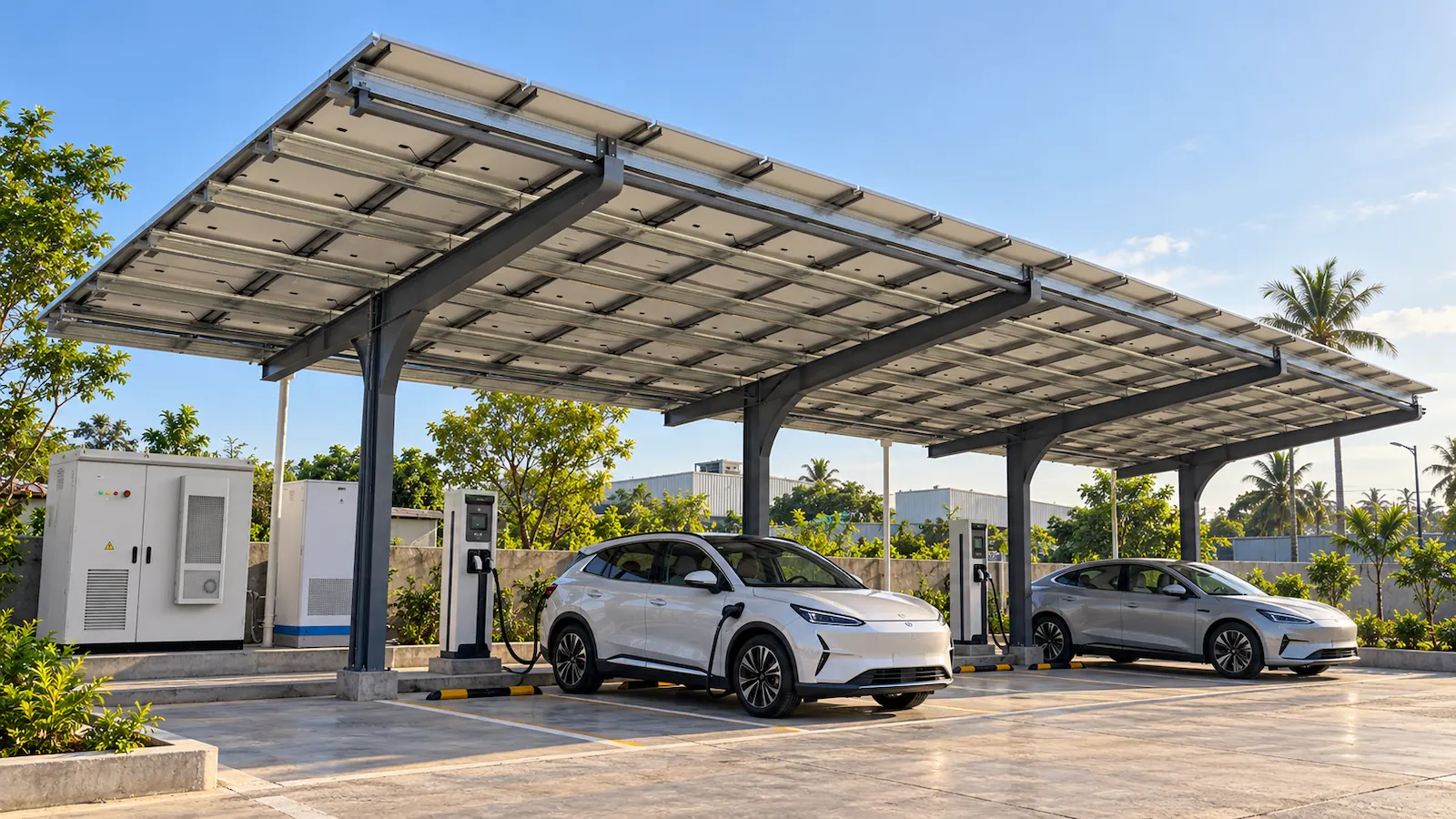
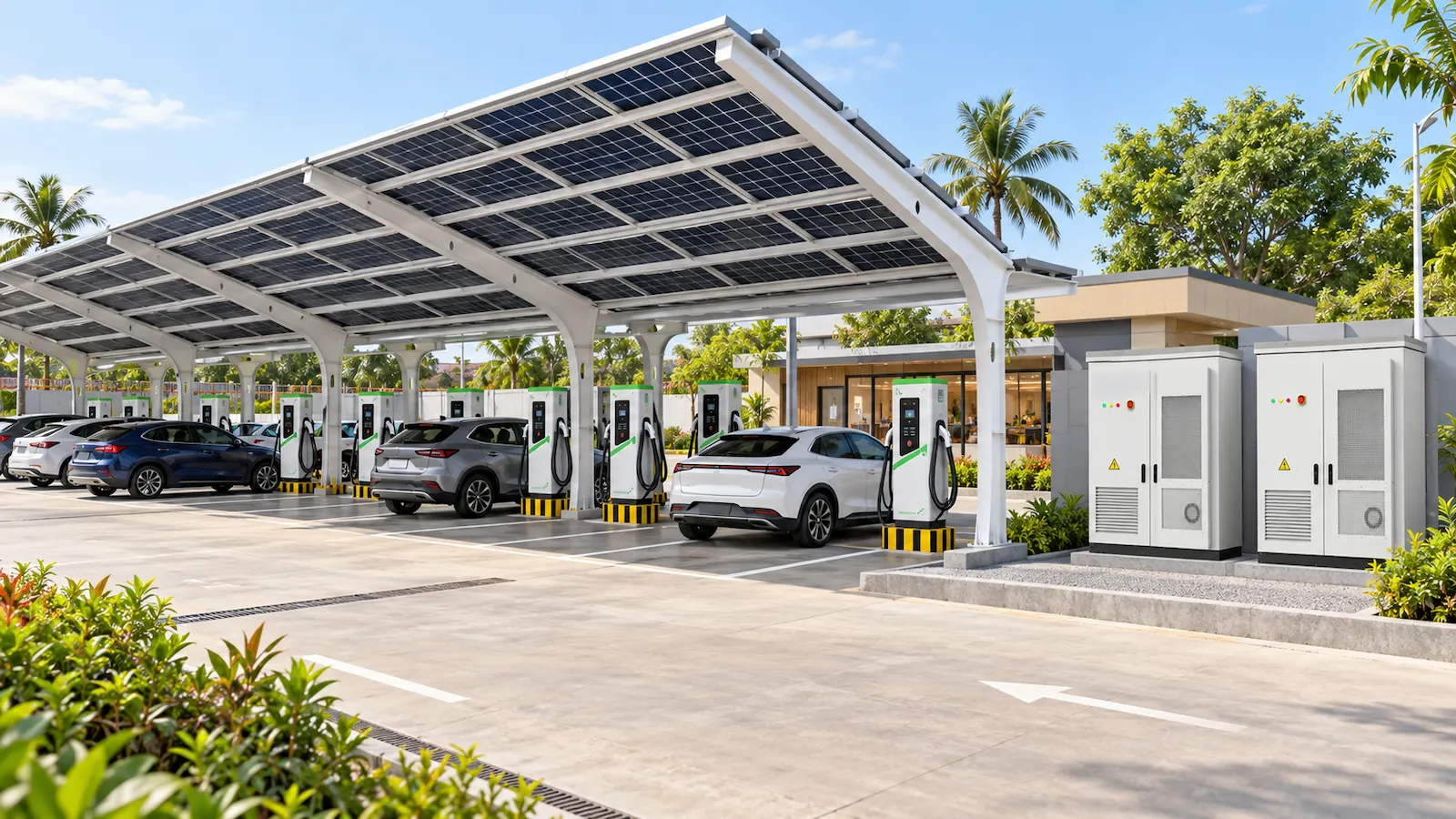
The proposed off-grid EV charging station uses about 236 kWp of solar PV and 522 kWh of nominal battery storage. Eight dual-connector DC chargers serve the bays. The charging schedule, layout and operating limits need detailed design.
Start with daily energy, then choose charging points
The requested connectors described how many vehicles the customer wanted to connect. Daily energy demand needed a separate calculation. Assume each vehicle needs 50 kWh. Serving the original target of 60 vehicles would then take 3,000 kWh a day. That demand excludes power lost in conversion, cooling and office use.
That is the energy demand in the initial brief. Solar output needs a separate study of the array area, shade and weather through the year. When vehicles arrive and how long they stay will affect how much solar power they can use directly. Some energy may need to pass through storage first.
For the customer, these figures answer different questions. Daily demand in kWh sets the energy requirement. The available power in kW limits simultaneous charging, while connector count sets the number of vehicles that can plug in. The customer needs a plan for each before ordering equipment.
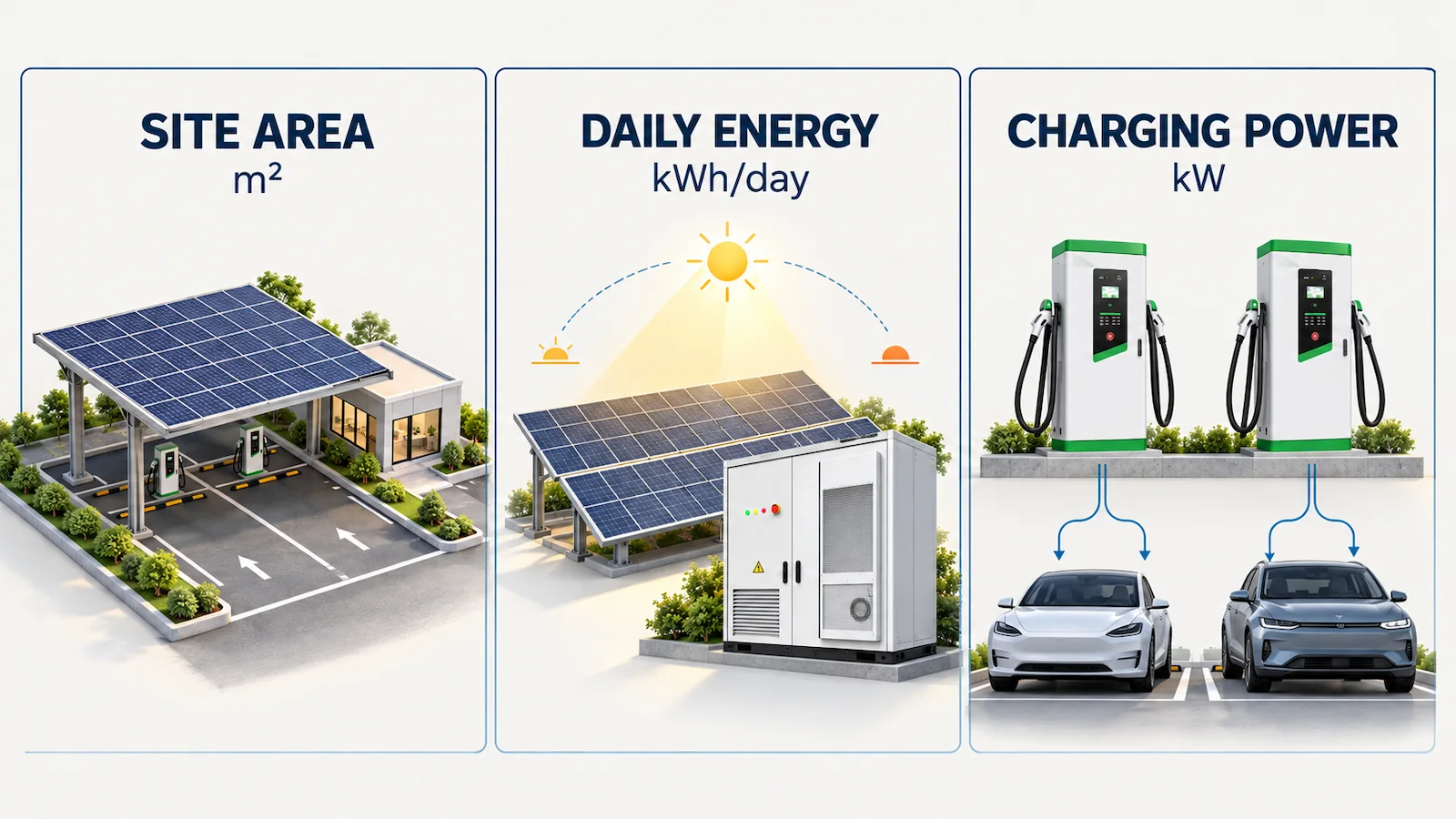
A solar carport with battery storage
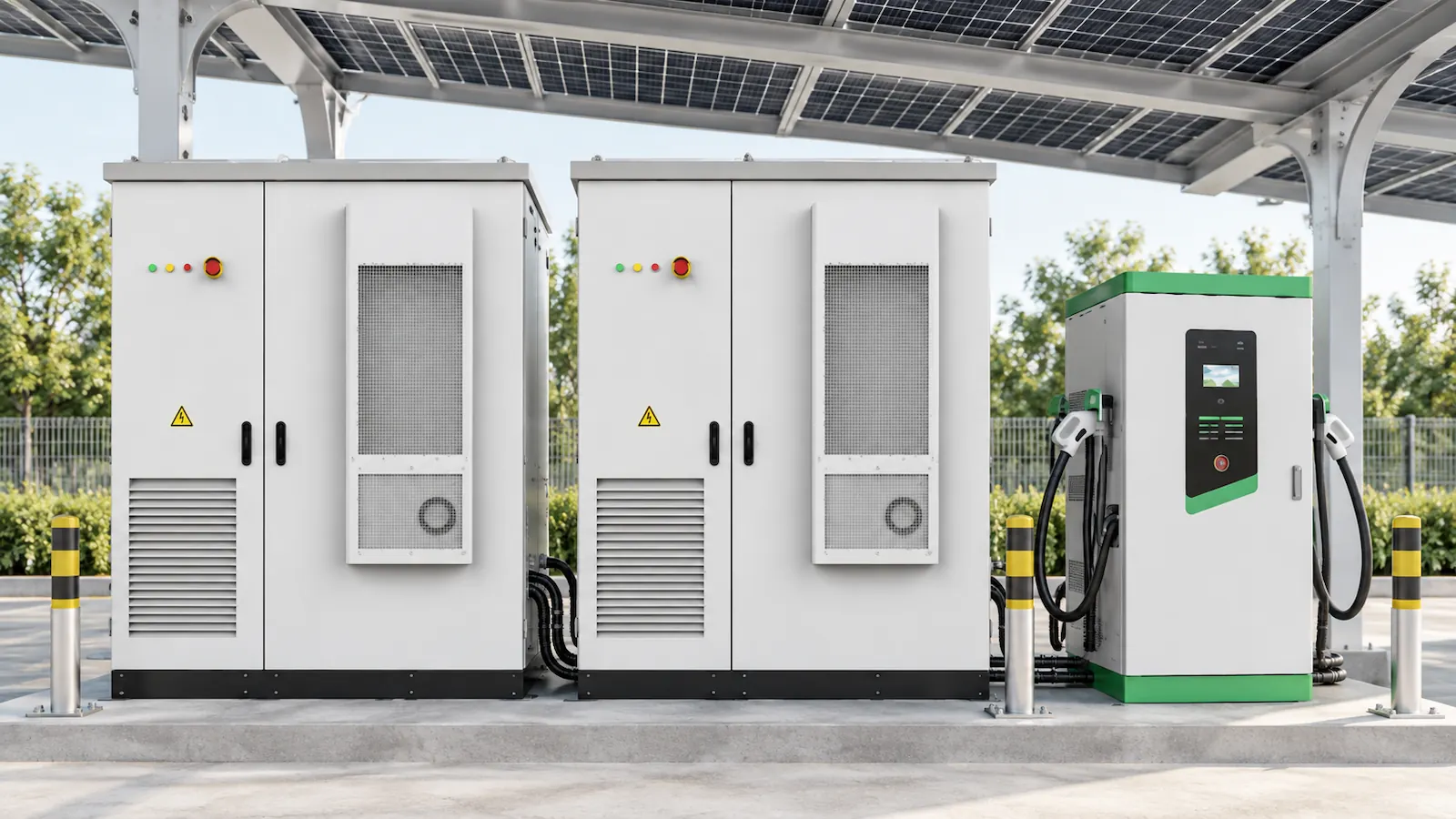
The design pairs the solar array with two 261 kWh battery systems. Their total nominal capacity is 522 kWh. Each has a 125 kW power conversion system (PCS). The combined reference PCS rating is 250 kW. Detailed design must confirm the parallel setup and operating limits.
| Component | Reference configuration | Purpose in this design |
|---|---|---|
| Solar PV | Approximately 236 kWp | Generate electricity within the proposed site layout |
| Battery storage | Two 261 kWh systems; 522 kWh nominal total | Store part of the solar generation for later charging |
| PCS | Two 125 kW units; 250 kW combined reference rating | Support controlled power conversion and the designed off-grid supply |
| DC charging equipment | Eight 120 kW dual-connector units | Provide up to 16 connection points with managed power allocation |
| Solar carport and mounting | Matched to the proposed PV arrangement | Support modules while maintaining vehicle and service access |
| Controls and protection | Defined during system integration | Coordinate charging demand, battery limits and electrical protection |
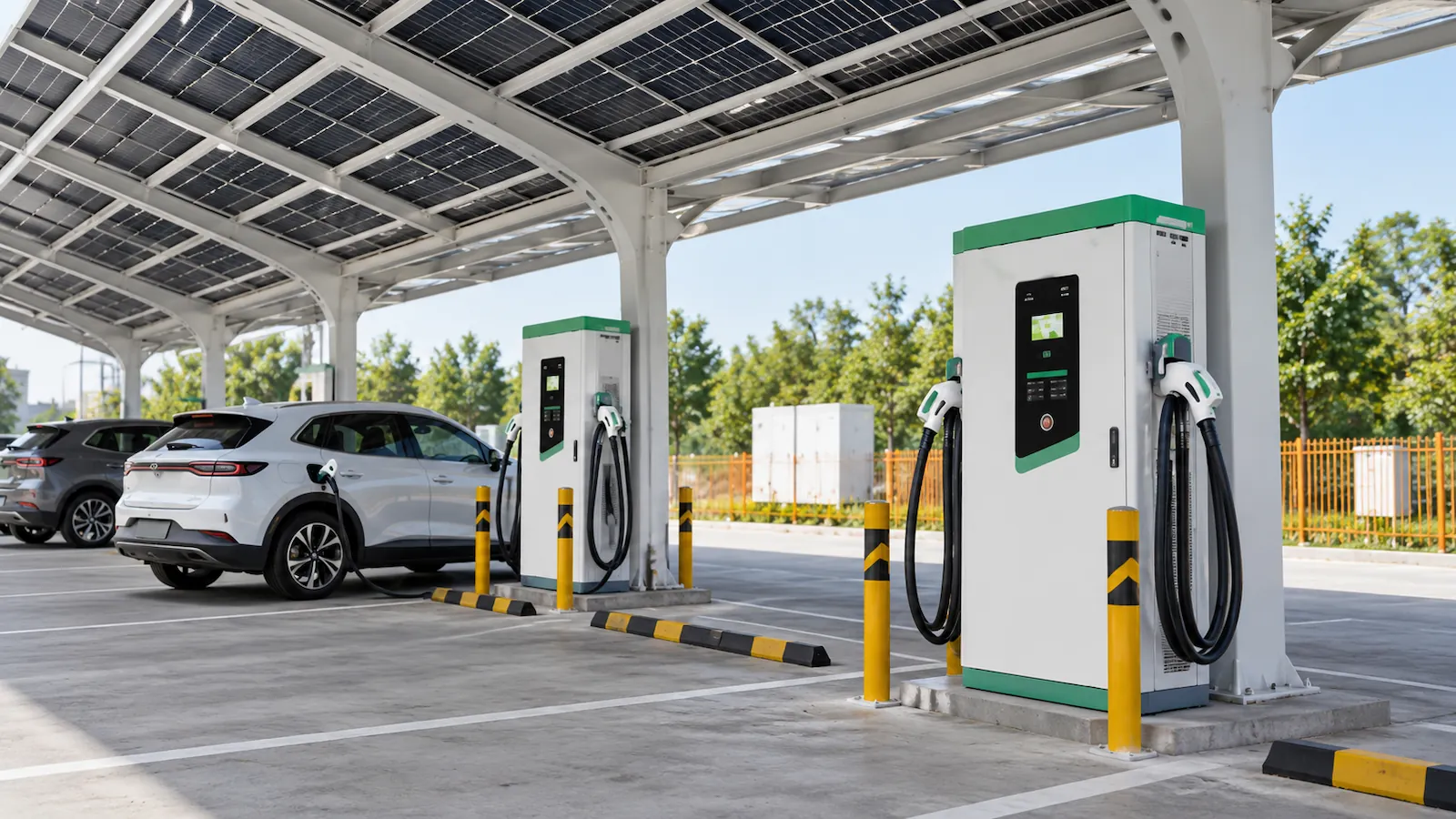
The eight units have 16 physical connectors. Each 120 kW EV charger shares its available output between vehicles. The power a driver receives also depends on what the vehicle can accept and how much power the station can supply.
This equipment plan gives the customer a starting point. The connector standard must match the vehicles. Final equipment options and protection settings also need to suit the site. See KUNETIC's solar and battery EV charging solutions for the wider system options.
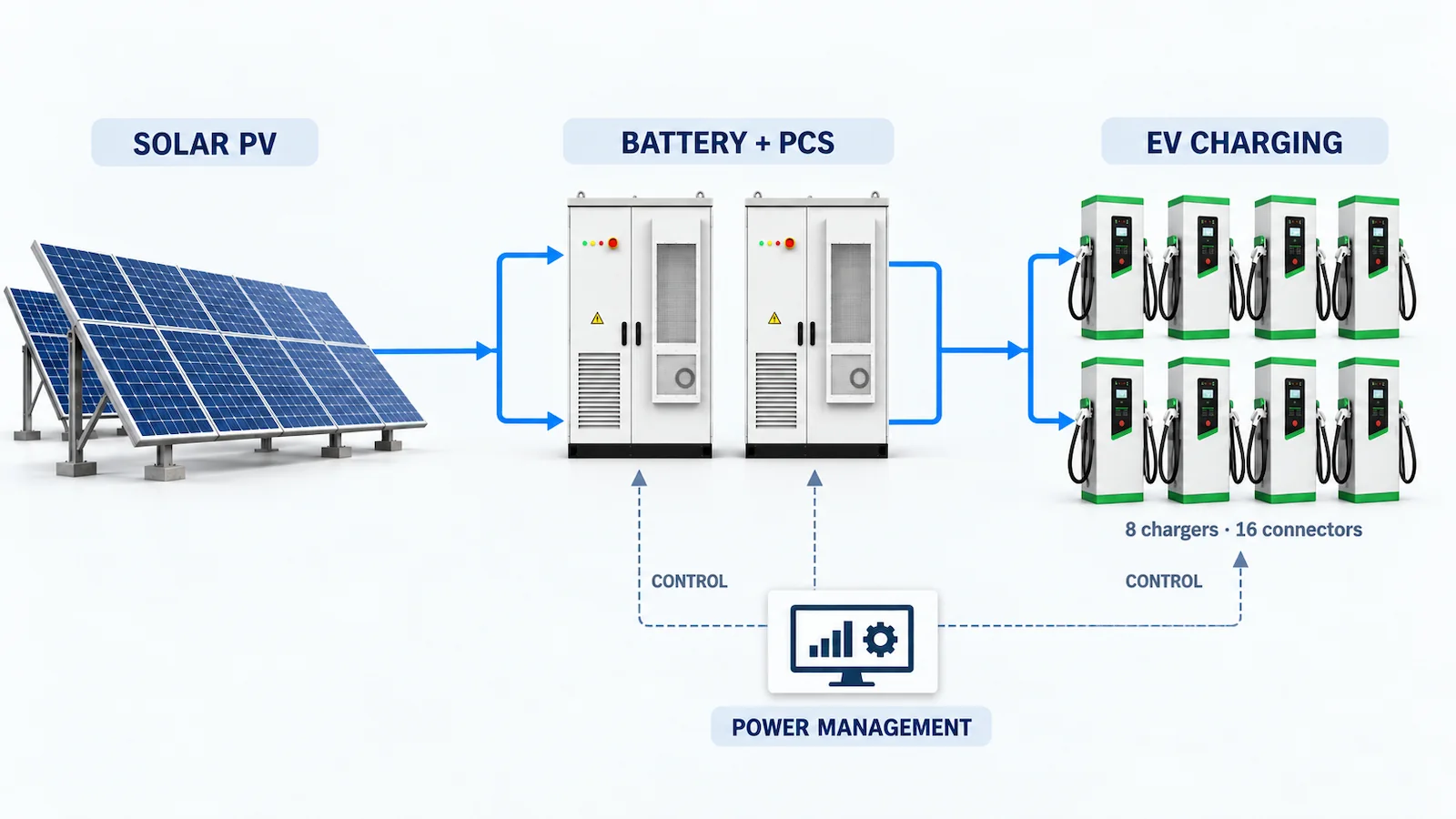
Share available power across the charging bays
Eight 120 kW charger ratings add up to 960 kW. This is the sum of charger nameplate ratings. The site supply sets a separate limit on how much power the chargers can use at once. The control system must keep that load within the approved supply limits and the solar and battery power available.
For this customer, the controls should reduce charging demand when solar output falls or the battery nears its reserve. Power can be shared across vehicles under an agreed service plan. A parked vehicle may stay plugged in at a lower rate or wait for its turn.
Vehicle arrival times will shape those settings. A steady flow over several hours creates a different load from a short evening rush. The customer needs an arrival schedule and a typical energy demand per session. The acceptable wait time also affects equipment choice.
Plan for evening charging and cloudy periods
Battery storage for EV charging holds solar energy for later use. The solar panels still set how much energy the site can collect. If most solar output is used by vehicles during the day, less remains available to recharge the battery for evening sessions.
The 522 kWh figure is nominal battery capacity. Only part of it may be available for charging. The allowed state-of-charge range and battery reserve set that limit. Conversion losses and other site loads also reduce what reaches the vehicles. These conditions set the night-time charging service.
The customer wants a solar-only, off-grid station. The design team must test the schedule against periods of low solar output. The plan should state when to reduce power or delay a session. If that service is too limited, the customer would need more solar area or an agreed other power source.
IEA PVPS links PV charging design to local site conditions, weather, user needs and power control. Its report on PV-powered charging stations explains these sizing considerations. This station still needs its own output study.
Keep the layout workable for drivers and maintenance
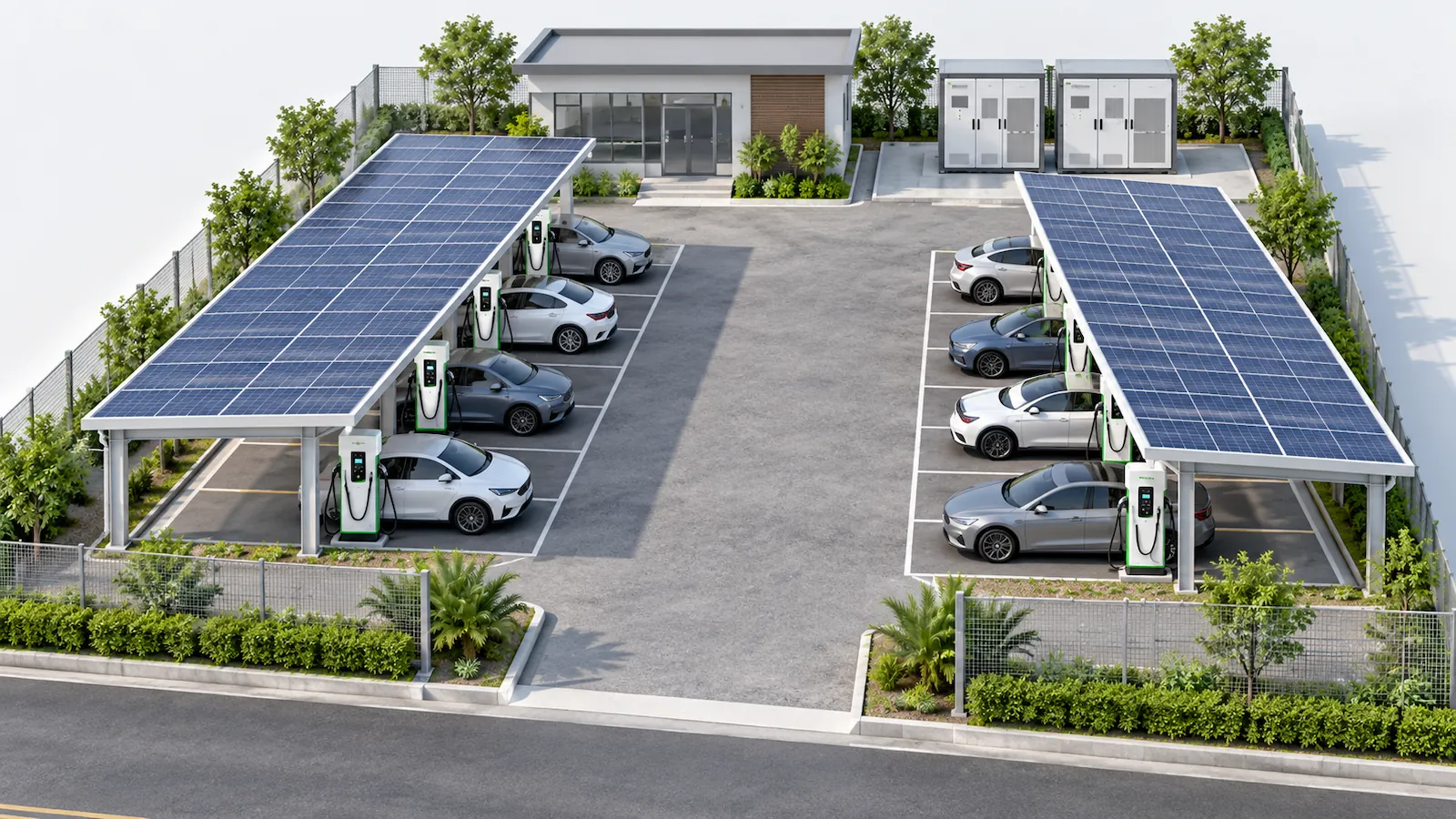
The customer's 1,521 m² plot also needs an office and shops. Driveways, service access and cable routes take up space. The final solar layout must leave these routes clear. It also needs to account for panel size, shade, drainage and the carport structure.
The battery area needs space for service and the separation required by the equipment and local rules. Charger cables should reach the vehicles while leaving walking routes and equipment doors clear.
These details affect output and installation cost. The illustrations show a proposed layout for discussion. Construction drawings and completed-site photos would belong to a later stage. A measured site plan is needed before setting the panel count and equipment positions.
Equipment budget and what changes the price
The proposed equipment budget is US$180,000–220,000, indicative FOB Shenzhen. It covers the station equipment package described below. Local installation, freight and import charges are priced separately. The final equipment selection and agreed supply scope determine the itemised quotation.
The proposed supply includes solar panels, two battery systems with PCS and eight dual-connector charging units. It also includes the agreed carport or mounting package. The final quote must list the controls, protection, other parts and services.
| Budget factor | What needs to be agreed |
|---|---|
| Available installation area | Surveyed PV coverage, shading, access and structure |
| Charging service | Vehicle types, connector standard, simultaneous charging and scheduling |
| Storage and conversion | Usable energy requirement, reserve, PCS arrangement and equipment variants |
| Site work | Foundations, drainage, cable routes, earthing and local installation |
| Delivery and support | Freight, insurance, import duties, taxes, commissioning and service responsibilities |
The equipment range excludes land, civil works, local installation, transport and import charges. It also excludes ongoing running costs. Any of these items must be priced separately unless the project quote includes them. Charging stations with fewer chargers or different hours need their own equipment plan and budget.
Prepare the information for your own station
For this Côte d'Ivoire customer, the site area and charging schedule shaped the proposal. To plan a similar off-grid solar charging station, send a site drawing and the area available for solar panels. Tell us which vehicles will use it and when they will arrive. Include the energy per session, evening demand and any limits on backup power.
KUNETIC can then discuss the PV, battery and charging equipment as one system. The solar EV charging station guide explains the main planning questions, while the Nigeria project design offers another configuration for comparison.
Discuss your charging station with KUNETIC and share the conditions that will shape your equipment proposal.
Questions about this off-grid charging design
Can a solar charging station operate without the grid?
Yes, with a design that matches solar supply, storage, power conversion and the charging schedule. Weather and stored energy will limit the service available. A solar-only station needs clear rules for periods of low output.
Why does the design show eight chargers and 16 connectors?
The equipment list has eight units, each with two physical connectors. They share the available power. The charger controls, vehicles and site supply limit set the rate.
Can all eight 120 kW chargers run at full power together?
Their nameplate power adds up to 960 kW. The actual station output has its own limit. Demand must stay within the power conversion and energy supply available. Detailed design sets the cap.
Does 522 kWh of storage guarantee overnight charging?
Nominal capacity alone cannot promise a fixed overnight service. What remains after daytime use matters. The allowed discharge range, reserve and losses also affect how much energy vehicles can receive at night.
Is the equipment budget the complete project cost?
No. The proposed US$180,000–220,000 range covers equipment supply. Site works, installation, transport, import charges and other services need a defined scope and a current quote.
Has this Côte d'Ivoire station been installed?
This is a project design based on a customer's brief and an equipment proposal. This case has no confirmed installation or measured operating results.