English

Table of Contents
A full tank can still leave the last row of an orchard short of pressure. To size a solar irrigation system, start with how much water the fields need, at what pressure, and over how many hours. From there you can work out whether to keep your current pump, add a booster, or supply power after sunset.
Start With the Irrigation Zones
For a peak irrigation day, note how much water each zone needs, the flow and pressure it runs at, and which valves you open together. Allow time for filter backwashing if your system requires it.
Say you have two orchard zones. Each needs about 26 US gallons per minute (6 m³/h) for three hours. With both running, the pump has to deliver about 53 gpm (12 m³/h) for three hours. Take turns and the flow drops to about 26 gpm, but the full run takes six hours. Both schedules deliver about 9,510 US gallons (36 m³) before any water for flushing or backwashing. Check how much water your source can supply and how much of the watering window the solar system can cover.
When Does Your Tank Need a Booster Pump?
Check the route from the water source to the tank and then from the tank to the field. An elevated tank can feed the field by gravity if it still delivers enough pressure at its lowest operating water level. Allow for losses through pipes, filters, and fittings. Check the hardest zone to serve while the water is flowing. That might be the highest block or the last one on a long pipe run.
A low tank or a sprinkler zone that needs more pressure may call for a separate booster pump. At a farm documented by Oregon State University Extension, a solar-powered submersible pump fills holding tanks and separate pressure pumps feed orchard drip lines. The solar-powered well pump guide covers the trip from the water source to the tank.
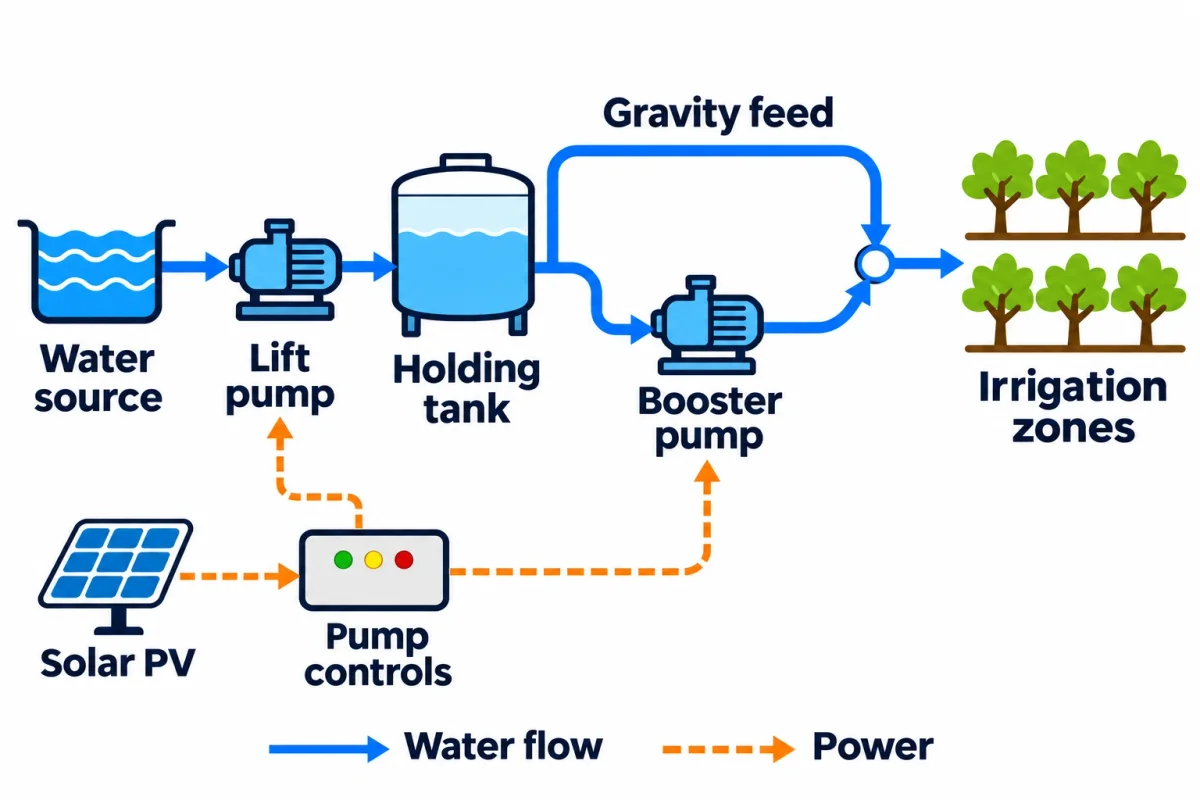
Check pressure while the hardest-to-serve zone is running. That reading helps determine whether it can run by gravity.
Can You Keep Your Existing Irrigation Pump?
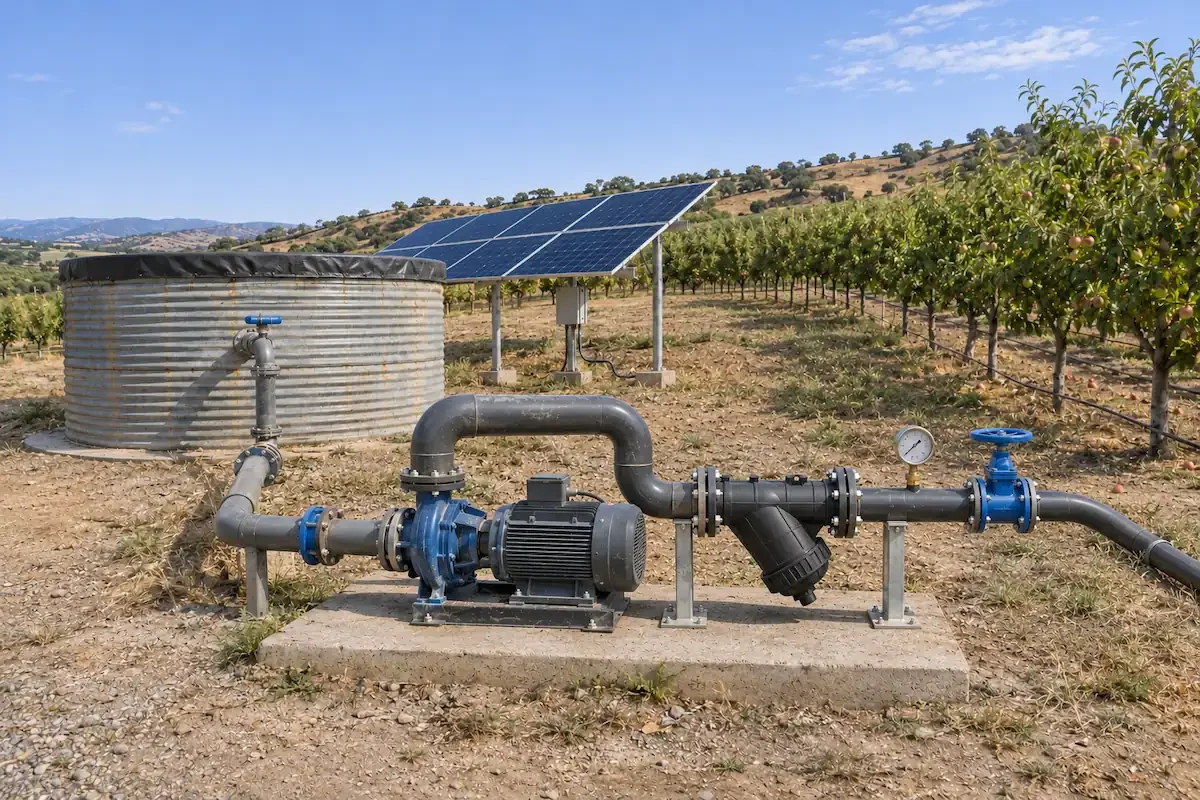
Start with the manufacturer’s pump curve for the solar irrigation pump you plan to use. At the flow you need, check whether the pump can supply the total dynamic head. That includes elevation change, losses along the water route, and the pressure needed at the outlet. Maximum flow and maximum head on a sales sheet usually come from different points on the curve. If you plan to open several zones together, check that setting separately because the flow and pipe losses will change. Utah State University Extension explains how these factors affect pumping power.
If the pump meets those requirements, photograph its motor nameplate. An installer can compare the voltage, phase, and rated current with the proposed drive or inverter and check how the motor will start. Send the model of any existing variable-frequency drive (VFD) too. Whether it can stay depends on the inputs and controls it supports. The USDA NRCS solar pump design note shows how to use pump curves for small systems.
Choose Power Around Your Watering Schedule
Power setup | When it fits | What to check before buying |
Direct solar | You can pump during daylight, or fill a tank by day and water later by gravity. | Check how much the pump can deliver in the peak irrigation season. If you plan to use gravity, check the pressure at the hardest zone to reach. |
Solar with battery storage | A pump, booster, or essential controls need power after sunset or during short periods of low solar output. | List the loads that run together, their run times, and their starting power. Use the running loads and hours to estimate usable battery capacity. |
Solar with grid or generator support | You need to water through longer stretches of low sunlight, or you already have a dependable alternative supply. | Check what the existing supply can run and whether the drive or inverter supports that arrangement. |
If the tank holds enough usable water and the two pumps can run independently, the battery may only need to power the booster and controls in the evening. Include the well pump in the sizing if it has to run then too. Allow for losses and the reserve your farm needs.
What to Send for a Farm Solar Irrigation Quote
Send the farm’s location, a photo of the pump nameplate, and the pump curve if you have it. Include where the water comes from, where the tank sits and its height, and the flow, pressure, and schedule of the zones you run together. If you already have a grid connection or generator, say what it supplies today.
KUNETIC can use those details to discuss the solar panel array, drive or inverter, and battery storage if your schedule calls for it. Ask for an itemized quote that says whether the pump, irrigation pipework, and installation are included. Tell us about your farm irrigation project.