English
Small Commercial Solar
15–30 kW Three-Phase Hybrid Inverter for Commercial Solar
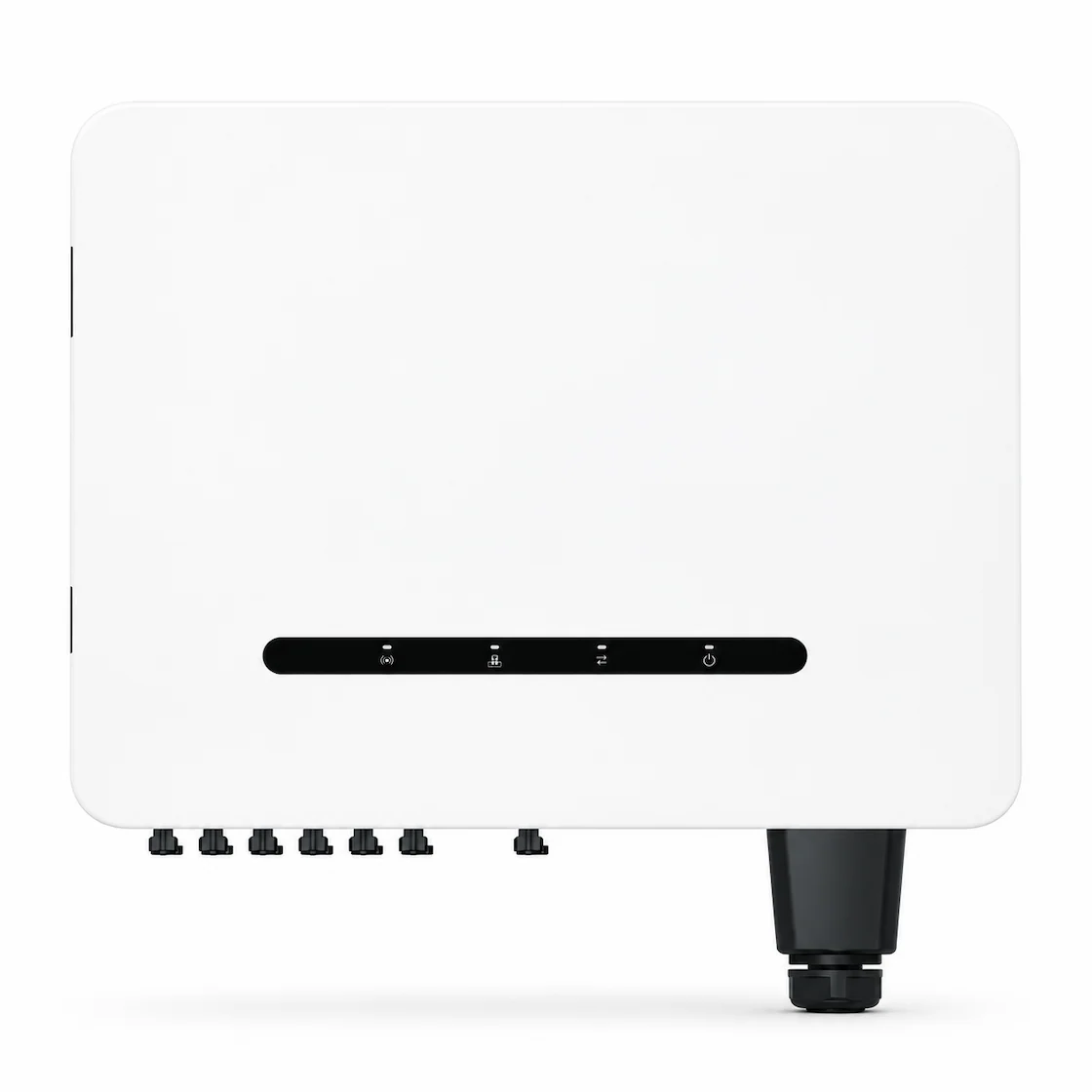
Use rooftop solar to run your shop or workshop during the day. Store surplus energy in a compatible battery for later use. The KUNETIC three-phase hybrid inverter combines a solar inverter, battery charging and a separate backup power output in one wall-mounted unit. Choose from five sizes for a 380, 400 or 415 V three-phase supply. Each model has three independent solar trackers and a 100–800 V DC input for a separate high-voltage lithium-ion battery.
 15–30 kW Five inverter sizes
 380 / 400 / 415 V Three-phase AC
 3 MPPTs Independent solar trackers
 100–800 V DC Battery input
Choose the Right Model for Your Roof and Load

Check the roof's string count
Every model has three MPPTs. The 15 kW model accepts up to four PV strings, and the 30 kW hybrid inverter accepts six. For five strings, compare the 20, 22 and 25 kW models. Each uses a 2 / 2 / 1 string split. Check voltage and current at each tracker.
Size for the site's AC power
Use measured operating demand and check the start-up load of high power equipment. The recommended maximum solar array ranges from 30 to 60 kWp by model. For larger sites, see the 100–120 kW commercial hybrid inverter.
Features
Separate solar strings by roof orientation
Three independent maximum power point trackers let your installer put east- and west-facing strings on separate inputs. Check the voltage and current for each group to make better use of a split roof.

Match the battery to your operating hours
Size your battery for the hours you want to cover. Check its working voltage, charge and discharge limits and BMS protocol. The inverter lists CAN and RS485 communication interfaces.

Keep floor space free with wall mounting
Wall mounting leaves floor space for the battery and other equipment. Use the IP65 enclosure's dimensions to allow room for the bottom connections and service access.

How Solar, Battery and Backup Work Together
Rooftop strings feed the inverter's DC inputs. The inverter converts solar energy to AC power for the site and can use surplus generation to charge a matched battery. When solar output drops, stored energy can help meet demand. A separate backup power output serves the selected circuits during an outage.

Grid-tied operation during a normal working day
In a grid-tied system, the inverter works alongside the building's utility supply. Daytime solar can serve active loads first, then charge the battery with available surplus. The utility can cover any shortfall when the inverter or battery reaches its limit. For sites with an export limit, ask your installer to confirm the metering, control settings and local grid connection requirements before finalising the design. Existing solar systems may need a site survey to determine how the PV strings and AC distribution can be connected to this inverter.
Look at your demand after solar production falls. A shop that uses little power overnight may only need to shift enough energy for refrigeration, lighting and closing work. A workshop with a late shift may need more energy even if the two buildings have similar midday loads. An hourly load profile makes that difference visible and is more useful for sizing storage than the monthly energy bill alone.
Match a high-voltage Li-ion battery to the inverter
A high voltage hybrid inverter needs a battery whose working voltage stays within the inverter's input range while it charges and discharges. Confirm the battery's usable energy, continuous current and BMS protocol with the supplier. Battery charging and discharge also depend on current limits set by the battery and inverter. Ask for both datasheets when selecting components from different product ranges.
On the 25 kW model, the maximum listed discharge current is 50 A. A matched battery delivering 50 A at 400 V would provide about 20 kW on the DC side before conversion losses. At a lower battery voltage, the same current gives less power. This matters when checking whether the battery alone can cover the site's load. A battery with sufficient kWh can still run into a power limit if its discharge current is below what the load requires.
Size backup power for the circuits you want to keep running
List the circuits you want to keep running in an outage and add their sustained demand. Check the starting demand of any equipment with a motor or compressor. The backup output and battery both need to handle that demand at the same time. For example, a 5 kW essential load running for two hours needs 10 kWh delivered to the load. Allow for conversion losses and the battery reserve when choosing a capacity.
The datasheet lists backup switching in under 10 ms. Ask your installer to confirm how sensitive equipment behaves during transfer, especially process controls that cannot tolerate a brief interruption. Keep outage planning focused on dedicated circuits. That lets you size the battery for the work the site needs to finish or the equipment it needs to shut down safely.
Check protection and service access before installation
The inverter has an integrated DC switch on the solar side and Type II AC and DC surge protection. Use the clearances and cable routes in the site design to make those parts accessible for service. Compare the protections listed in the inverter datasheet with the devices your installer specifies for the wider site.
If remote monitoring and control are part of your project, confirm which functions are available with the selected communications equipment. The supplier lists WLAN, CAN and RS485 interfaces. Give the service team a way to identify the inverter, battery and connected circuits so they can trace faults and plan maintenance.
Applications

Retail shops. Use rooftop solar during trading hours and store surplus energy for loads that continue after closing. Check the overnight refrigeration load separately from the daytime peak. If a cold display needs to stay on during an outage, include its compressor start-up demand and the time it needs to run.
Processing workshops. Connect strings from different roof faces and plan backup for selected circuits such as process controls and task lighting. If a production machine has a high starting load, compare that demand with your proposed backup configuration. Controls and safe shutdown circuits may be the priority when the grid fails.
Technical Data
| Parameter | 15 kW | 20 kW | 22 kW | 25 kW | 30 kW |
|---|---|---|---|---|---|
| Rated AC apparent power | 15 kVA | 20 kVA | 22 kVA | 25 kVA | 30 kVA |
| Recommended maximum PV array | 30 kWp | 40 kWp | 44 kWp | 50 kWp | 60 kWp |
| Independent MPPT inputs | 3 | 3 | 3 | 3 | 3 |
| PV strings per MPPT | 2 / 1 / 1 | 2 / 2 / 1 | 2 / 2 / 1 | 2 / 2 / 1 | 2 / 2 / 2 |
| Maximum PV input current per MPPT | 32 / 16 / 16 A | 32 / 32 / 16 A | 32 / 32 / 16 A | 32 / 32 / 16 A | 32 / 32 / 32 A |
| MPPT operating voltage range | 150–950 V DC | 150–950 V DC | 150–950 V DC | 150–950 V DC | 150–950 V DC |
| Maximum PV input voltage | 1,000 V DC | 1,000 V DC | 1,000 V DC | 1,000 V DC | 1,000 V DC |
| Lithium-ion battery voltage range | 100–800 V DC | 100–800 V DC | 100–800 V DC | 100–800 V DC | 100–800 V DC |
| Max. charge / discharge current | 50 / 50 A | 50 / 50 A | 50 / 50 A | 50 / 50 A | 60 / 60 A |
| Rated backup apparent power | 15 kVA | 20 kVA | 22 kVA | 25 kVA | 30 kVA |
| Backup switching time | <10 ms | <10 ms | <10 ms | <10 ms | <10 ms |
| Approximate weight | 34 kg | 36 kg | 36 kg | 36 kg | 37 kg |
All five models are rated for 380 / 400 / 415 V line-to-line AC, 50 / 60 Hz, with neutral and protective earth. The IP65 wall-mounted enclosure measures 615 × 465 × 245 mm (W × H × D). Maximum charge and discharge current depends on the connected battery.
Peak inverter efficiency is 98.1–98.2%, and European efficiency is 97.6–97.8%. Compare the same measurement when evaluating claims of high efficiency.
 Technical Data
Downloads
Three-Phase Hybrid Inverter Datasheet
Request the datasheet for the model you are considering. Send your PV string layout or battery model if you would like help checking the match.
FAQ
Use the rated AC output, number of PV strings and current per tracker to narrow the choice. The 15 kW model supports up to four strings and a recommended maximum array of 30 kWp. The 30 kW model supports up to six strings and a 60 kWp array.
Check that the battery's operating voltage fits inside 100–800 V DC. Then confirm BMS communication and permitted current for the exact model. Share its datasheet with your enquiry so we can review both sets of specifications together.
Yes. Use separate MPPT inputs for groups with different orientations or operating conditions. The table shows the number of strings each input can take.
Ask your installer to size the backup circuit for the equipment that needs to stay on. Include total running demand, starting peaks and expected outage duration. The inverter and battery together determine which loads the system can support.
This series is rated for 380, 400 and 415 V line-to-line with neutral and protective earth. Ask your installer to check the site's three-phase power supply and local grid connection requirements before ordering. Include the measured line-to-line voltage, site location and the intended operating mode when you request a quote.
Request a Project Quote
Share your three-phase supply voltage, proposed solar array size and any battery model you already have in mind. For backup, tell us which circuits need power and for how long. We can help you shortlist an inverter and review the equipment needed for the project.
Request Product Datasheet
15–30 kW Three-Phase Hybrid Inverter for Commercial Solar
Datasheet request
Request received. We will send the datasheet shortly.
Request a Project Quote
15–30 kW Three-Phase Hybrid Inverter for Commercial Solar
Product inquiry
Tell us about your site load, PV capacity, backup requirements, or target project size. Our engineers will help configure the right system for your needs.
Inquiry received. Our team will respond shortly.
OEM / ODM
Sourcing this inverter series for a product range or recurring project? Tell us which models, branding and order quantities you need so we can discuss suitable options.
Discuss Your Project