
 English
 Deutsch
 Español
 Français
 Italiano
 Polski
 Română
 العربية
PV input
Connect solar panels across three independent MPPTs with a 200–850V tracking range, a 250V startup voltage and 900V maximum PV open-circuit voltage.
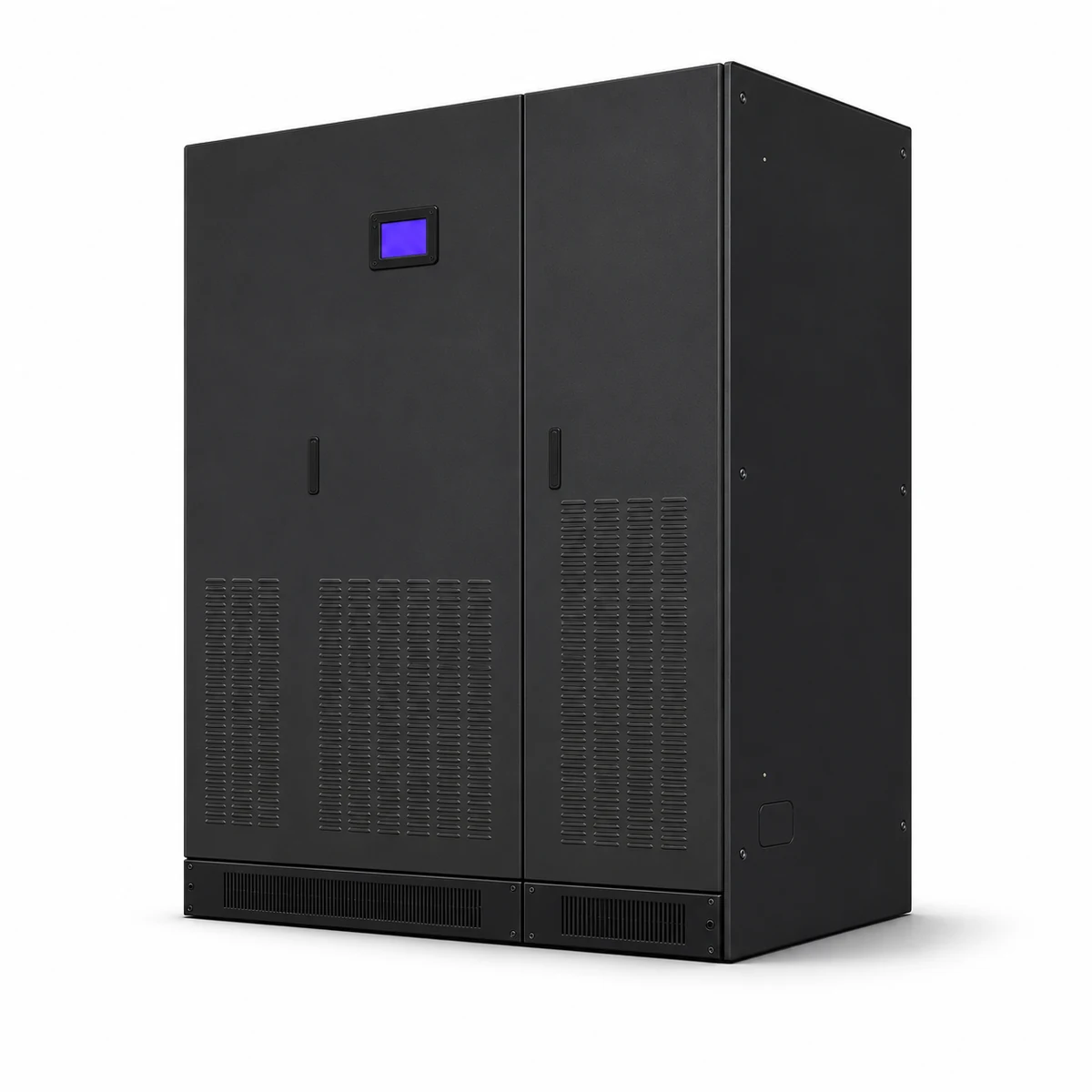
Industrial energy storage inverter
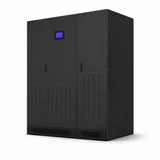
Bring commercial solar and high-voltage battery storage together with a 400V three-phase energy storage inverter. Choose 150kW or 250kW AC output, with a built-in isolation transformer and three independent MPPT channels for direct PV connection. Designed for an indoor industrial energy storage system, this cabinet supports load-priority, battery-priority and peak-shaving operation. Pair it with an external battery sized around your business hours, electricity demand and backup needs.
 150 / 250 kW Rated AC Output
 3 × 60 kW MPPT / PV Input
 486–864 V Battery DC Range
 Built-in Isolation Transformer
Industrial solar + battery storage
Use daytime solar while the site is working, then draw on stored energy for a later shift or a peak-demand period. This 3 phase hybrid inverter connects PV and high-voltage battery storage to the industrial power system, with operating modes you can choose around the business routine.
The system connection
Direct PV connection brings solar into the hybrid power cabinet. A matched high-voltage battery stores energy, while the 400V three-phase output serves the site's electrical distribution. The AC input can be planned around the available grid or generator supply.
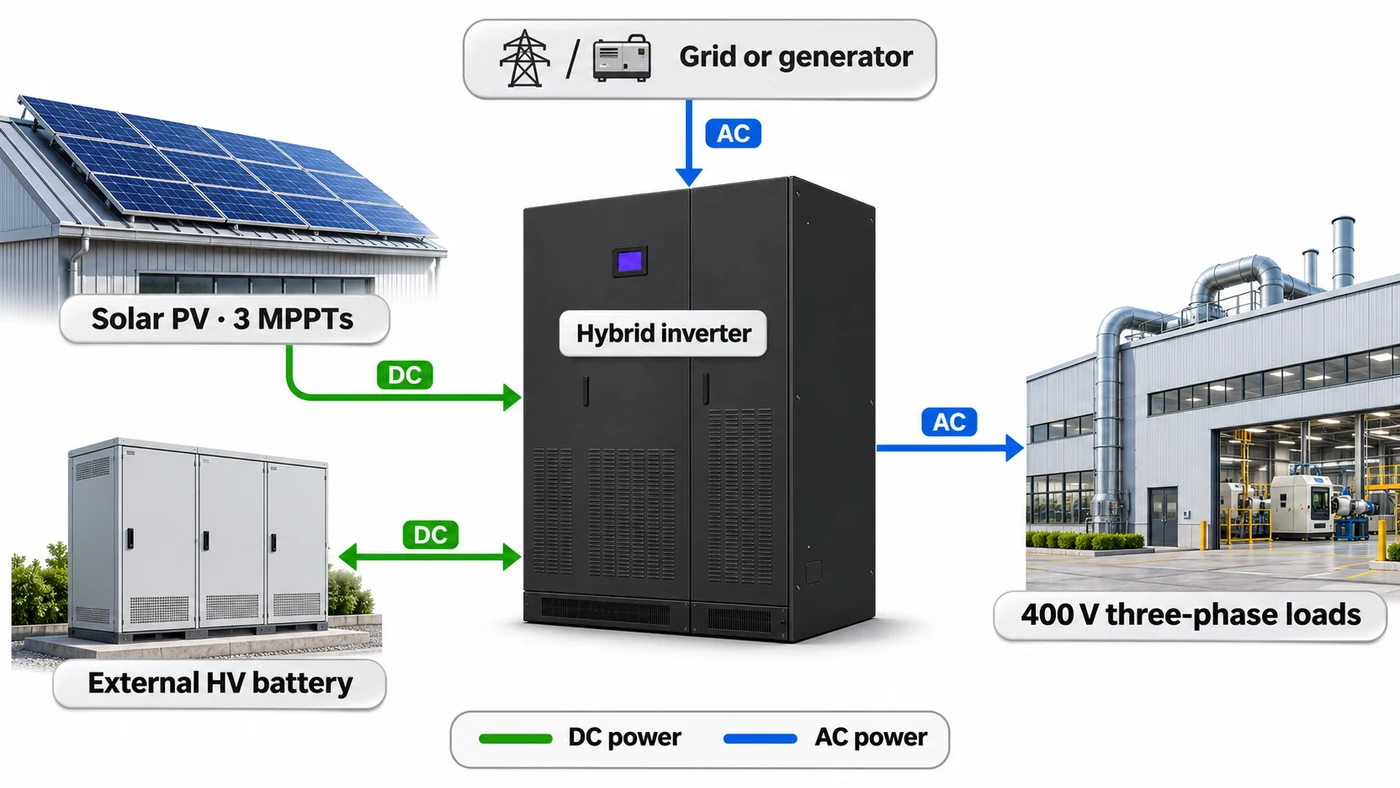
Connect solar panels across three independent MPPTs with a 200–850V tracking range, a 250V startup voltage and 900V maximum PV open-circuit voltage.
The 486–864V DC battery range supports high-voltage storage designs. Match the complete battery operating window, current capability and BMS communication before selecting the pack.
Use the inverter with suitable distribution, protection and site controls. An external battery, PV array and generator are separate system equipment; storage energy is selected for the application.
Built-in isolation transformer
The isolation transformer comes built into the cabinet as standard, bringing the transformer and hybrid power conversion into one floor-standing unit. Plan its electrical isolation, earthing and protection as part of the site's power system.
Independent MPPT tracking lets each connected PV input operate within its own tracking channel. Allocate the array across the three channels rather than treating the PV input as one undivided connection.
Rated output is 400V AC, three-phase five-wire, at 50/60Hz. The series is intended for larger commercial and industrial electrical systems.

Connect through RS232, RS485 or LAN. Choose optional SNMP, Wi-Fi or 4G where the site needs a different monitoring connection.
Operating around your business
Choose the operating approach around your site's daily routine. A workshop with strong daytime demand, a factory with evening production and a site facing peak electricity charges may need different priorities.
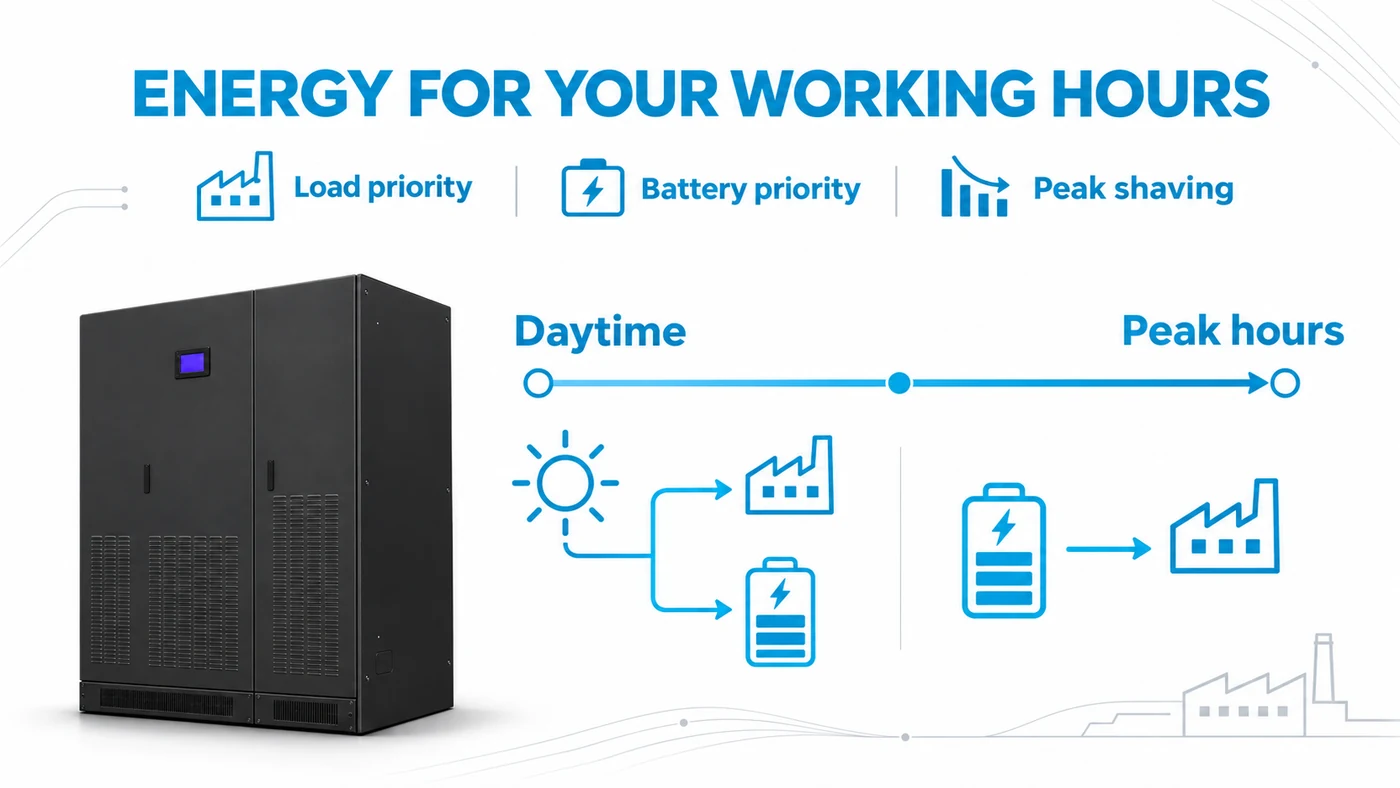
Focus operation on supplying the site's loads and using available solar where it is needed during the working day.
Prioritize battery charging when preparing stored energy for a later operating period. Set the charging limits around the selected battery and available supply.
Charge during suitable lower-demand or lower-tariff periods, then use stored energy during peaks. The benefit depends on your tariff, load profile and usable battery capacity.
Power and energy, selected together
Choose AC power from the loads that run together, then size battery energy for the hours they need to run. Both options share the 400V output, battery voltage window and three-channel PV input; their main difference is rated AC output power.
Select this battery storage inverter together with the external battery capacity your site needs. Share your daily load curve and required working window so we can help size the battery and compare the two inverter options.
Compare the two power options for your site →Indoor installation
The IP20 cabinet is intended for a dry, protected indoor location. At 1400mm wide, 800mm deep and 1800mm high, it fits into a planned electrical-room arrangement with bottom cable entry and access for operation and maintenance.
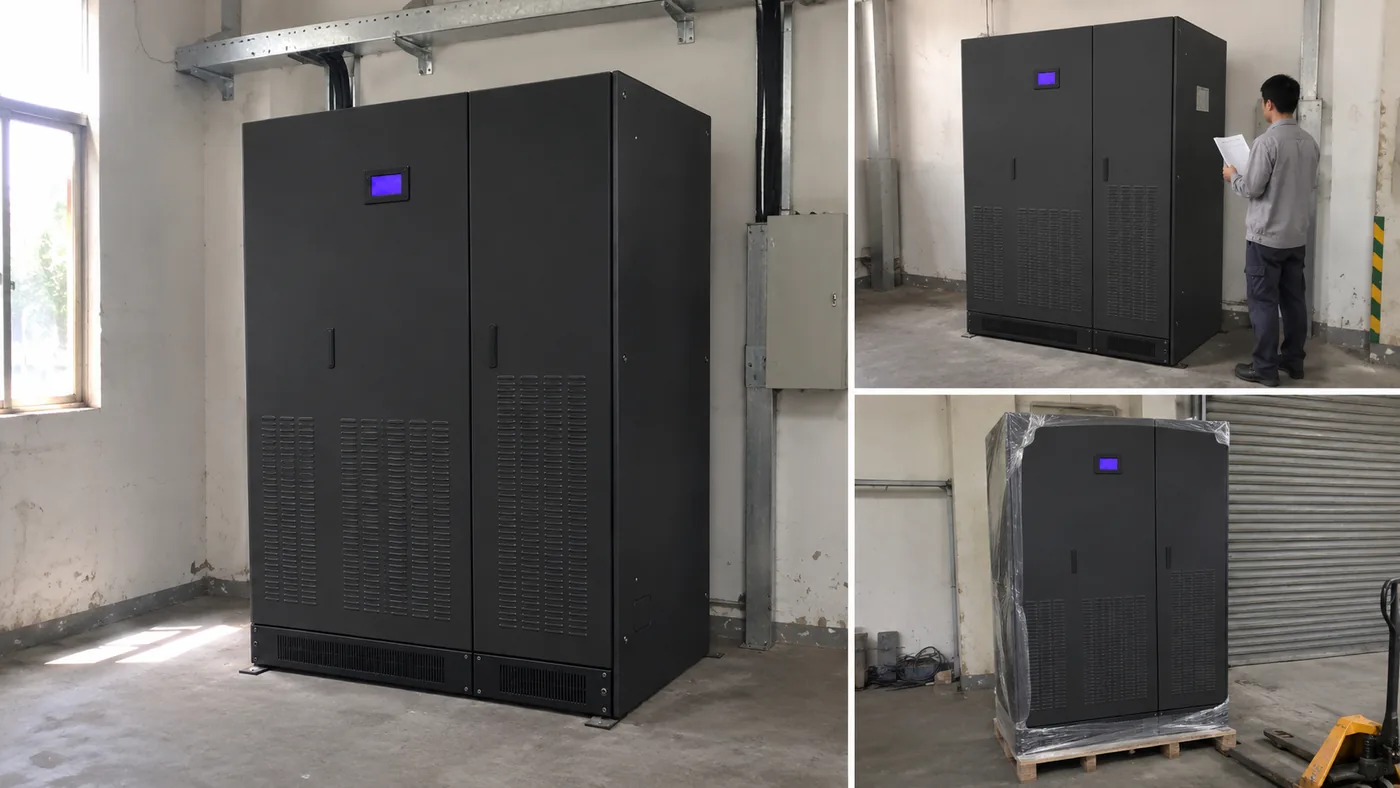
 Plan airflow and access
Forced ventilation requires a suitable room layout. Keep the ventilation paths and working access clear, and plan for the listed 0–40°C operating range.
Keep controls within reachFront-panel access brings routine controls to the equipment-room operator. RS232, RS485 and LAN allow monitoring to be incorporated into the wider project design.
Technical data
Compare AC output, direct PV input, battery connection and installation requirements in one table. Values below follow the confirmed 2026 product specification.
| AC Power and Isolation | ||
|---|---|---|
| Source model | TGH150 | TGH250 |
| Rated AC real power | 150kW | 250kW |
| Rated apparent capacity | 165kVA | 275kVA |
| Rated output | 400V AC, three-phase five-wire (3W+N+PE) | 400V AC, three-phase five-wire (3W+N+PE) |
| Rated frequency | 50/60Hz | 50/60Hz |
| AC input voltage range | 320–460V AC | 320–460V AC |
| Isolation transformer | Built in as standard | Built in as standard |
| Output waveform / THD | Sine wave / ≤3% with linear load | Sine wave / ≤3% with linear load |
| Solar PV Input | ||
| MPPT channels | 3 independent channels | 3 independent channels |
| Maximum PV power | 3 × 60kW / 180kW total | 3 × 60kW / 180kW total |
| Maximum PV open-circuit voltage | 900V DC | 900V DC |
| MPPT operating range | 200–850V DC | 200–850V DC |
| MPPT startup voltage | 250V DC | 250V DC |
| Maximum PV current | 3 × 120A | 3 × 120A |
| External Battery and Operation | ||
| Battery voltage range | 486–864V DC | 486–864V DC |
| Battery energy capacity | Selected separately for the project | Selected separately for the project |
| Operating modes | Load priority; battery priority; peak shaving and valley filling | Load priority; battery priority; peak shaving and valley filling |
| Battery settings | Configurable capacity, discharge cutoff and depth of discharge | Configurable capacity, discharge cutoff and depth of discharge |
| Communication | RS232 / RS485 / LAN | RS232 / RS485 / LAN |
| Optional connectivity | SNMP / Wi-Fi / 4G | SNMP / Wi-Fi / 4G |
| Cabinet and Installation | ||
| Enclosure / installation | IP20 / protected indoor location | IP20 / protected indoor location |
| Dimensions (W × D × H) | 1400 × 800 × 1800mm | 1400 × 800 × 1800mm |
| Cooling | Forced ventilation | Forced ventilation |
| Operating temperature | 0–40°C | 0–40°C |
| Maximum relative humidity | 90%, non-condensing | 90%, non-condensing |
| Altitude | Rated power to 2000m; derating above; maximum 4000m | Rated power to 2000m; derating above; maximum 4000m |
| Cable entry / mounting | Bottom entry / fixed floor-standing cabinet | Bottom entry / fixed floor-standing cabinet |
 Technical Data
Downloads
Get the technical data for your preferred power rating. Include the installation country, site load, PV array and intended battery configuration so we can help you assess the fit for your project.
FAQ
No. This is an inverter cabinet with an integrated isolation transformer and MPPT inputs. The external high-voltage battery is selected separately, allowing storage energy to be sized around the application.
Start with the loads that must run at the same time. Check continuous demand, motor starting requirements and apparent power, then select battery capacity for the hours of operation. Share a load list or load curve for a project comparison.
A conventional grid-tied PV inverter primarily converts solar power for an AC system. This hybrid series also provides a high-voltage battery connection and selectable storage operating modes, bringing solar generation and stored energy into the site power design.
The confirmed specification lists three 60kW MPPT inputs, or 180kW total PV input, for both models. The 250kW figure is the rated AC output, which is a different specification from PV input power.
The listed battery connection range is 486–864V DC. Compatibility also depends on the battery's full operating voltage window, current limits, protection and BMS communication—not nominal voltage alone.
This IP20 version requires a protected indoor equipment-room location. Plan ventilation, cable access and maintenance space within the listed 0–40°C operating conditions.
It can form part of a solar-and-battery backup design. Battery energy, critical-load distribution, protection and the AC supply arrangement determine the resulting backup system. Tell us which loads need support and for how long so we can propose a suitable configuration.
OEM / ODM support
Compare 150kW and 250kW inverter ratings and a suitable external battery configuration for your load and operating hours.
Discuss the communication interfaces, optional connectivity and site control requirements with our team.
Ask about OEM/ODM options, technical documentation and supply arrangements for your market and order.
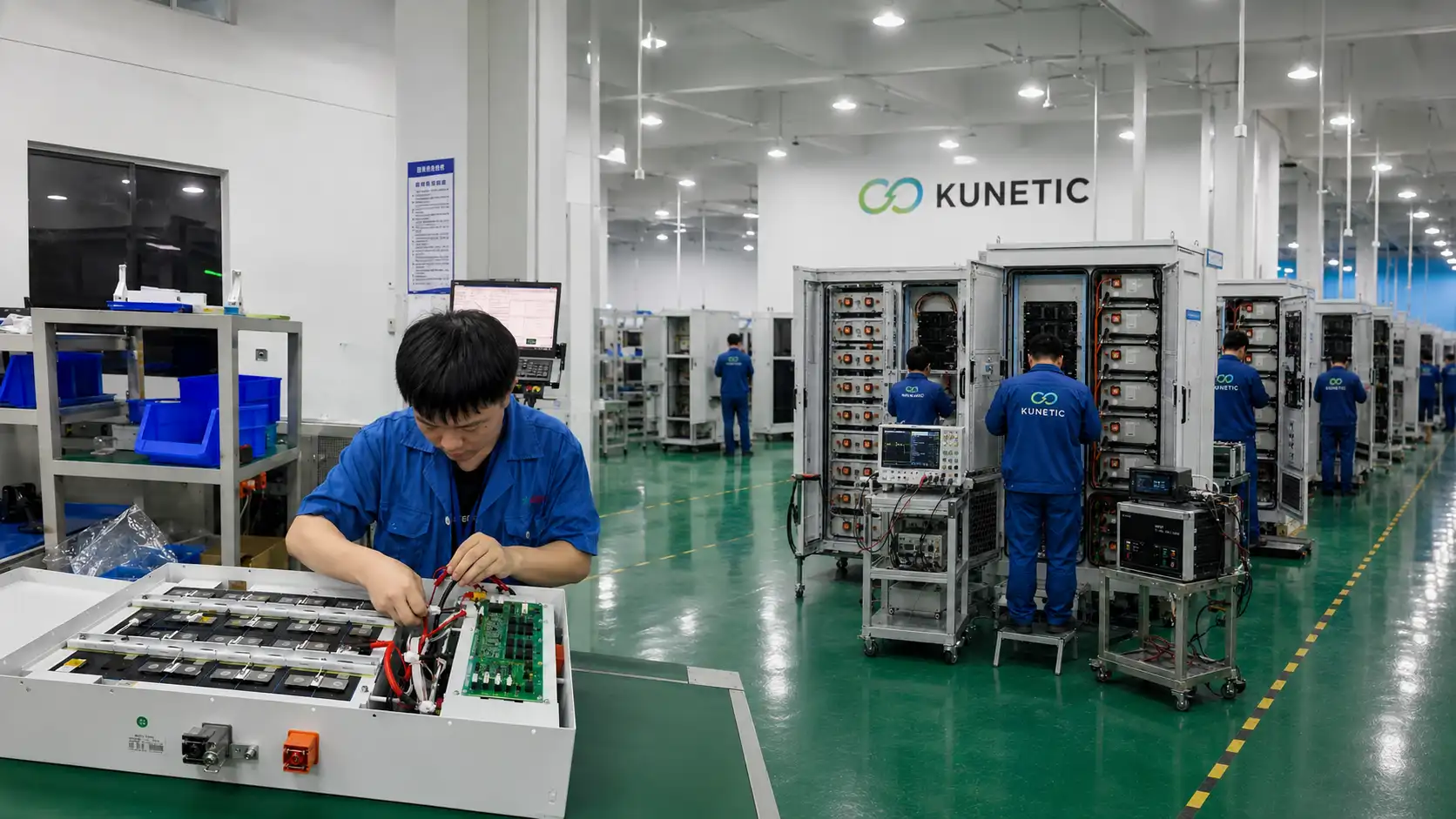
Send your installation country, peak load, daily operating hours and available solar capacity. If you already have a battery specification or single-line diagram, include it so we can review the inverter and storage configuration together.
150kW / 250kW Three-Phase Energy Storage Inverter
Datasheet request
Request received. We will send the datasheet shortly.
150kW / 250kW Three-Phase Energy Storage Inverter
Product inquiry
Tell us about your site load, PV capacity, backup requirements, or target project size. Our engineers will help configure the right system for your needs.
Inquiry received. Our team will respond shortly.