English
 Deutsch
 Español
 Français
 Italiano
 Polski
 Română
 العربية

Table of Contents
A parking area beside a busy road can look like a good place for EV chargers. It has space, passing traffic and perhaps a café nearby. The connection cost and electricity tariff still need checking before you commit to the site.
An EV charging station business can be profitable when charging demand, site costs and electricity supply work together. The EV charging infrastructure needs to fit the site and its drivers. Sales must cover electricity, running costs and the money invested.
Before ordering chargers, work through the lease, power connection and how you will attract paying customers.
Choose a Site That Works for Drivers and the Grid
Find the customers who would actually stop
Passing traffic is useful only if those drivers need your service.
A hotel guest parking overnight has different needs from a delivery driver between routes. A truck operator may value a dependable charging window more than a prominent roadside location.
Look at nearby charging options, their prices and when they are busy. Speak to potential fleet customers. Ask how many vehicles need to charge, how much energy they need and when they must leave. Passing traffic alone does not prove demand.
For public charging, consider the stop itself: easy access, clear signs, lighting, toilets and somewhere to spend the waiting time.
Check available power before committing to the site
Existing buildings and equipment may already use much of the site's electrical capacity. Check how much power charging can use.
Speak to the utility and your electrical designer. How much power can you use? What work would an upgrade need? What rate would you pay? In Great Britain, that discussion may also involve the distribution network operator, or DNO.
The US Department of Energy’s charging infrastructure planning guidance recommends involving the utility early. That conversation can change the equipment choice, budget and opening date.
Make the lease work for the investment
Rent can absorb much of the income left after paying for electricity.
For a leased site, agree on access hours, construction rights, rent increases, electricity arrangements and equipment ownership. Agree what happens when the lease ends or you sell the business.
Check the intended use with the relevant local authority before committing to work. Site permission and electrical approval are separate questions.
EV Charging Station Cost: What to Budget For
The charger quote covers only part of the opening budget. There is no single average cost that fits every site.
Budget area | What to include |
Charging equipment | Chargers, connectors, power-sharing arrangement and required documentation |
Electrical supply | Connection work, metering, distribution, protection and any transformer changes |
Site construction | Cable routes, trenching, foundations, surface repairs, lighting and markings |
Project delivery | Surveys, design, permits, inspections and commissioning |
Opening and operation | Software setup, payment arrangements, staff preparation, support and working capital |
Construction costs depend on the site. A site with enough power and short cable routes may cost less to develop. Major grid work can push the budget up.
Request itemized quotations using the same scope. Keep equipment supply separate from local construction and installation, so a cheaper offer does not hide missing work.
Our commercial EV charging station installation guide covers those installation and quotation details.
Do not choose an EV charging point on its power rating alone. Check the connectors, site voltage and power when several vehicles charge at once. Before you have an EV charger installed, check the local documents needed. Ask who supplies spare parts and handles faults after delivery.
Match the Charging Setup to the Business
Match charging speeds to the time customers can stay. Fast chargers may earn their keep at a short-stop site. In hotel car parks, EV drivers may have hours to charge. Paying more for rapid charging is less useful if guests leave their cars overnight.
Site type | What customers need | Main business question |
Urban public or retail site | Charging during a routine stop | Will enough drivers choose this station over nearby options? |
Hotel or destination | Useful energy during a longer stay | Is charging a paid service, a guest benefit or both? |
Highway or travel corridor | Fast, dependable charging with amenities | Can demand support the connection, equipment and operating costs? |
Heavy-duty truck site | Energy delivered within a demanding operating schedule | Is there a credible fleet requirement before construction? |
Logistics or private depot | Vehicles ready for their next departure | Can charging meet the schedule within the available power? |
Rural or remote location | Reliable access where alternatives are limited | Does expected demand justify the supply and service arrangements? |
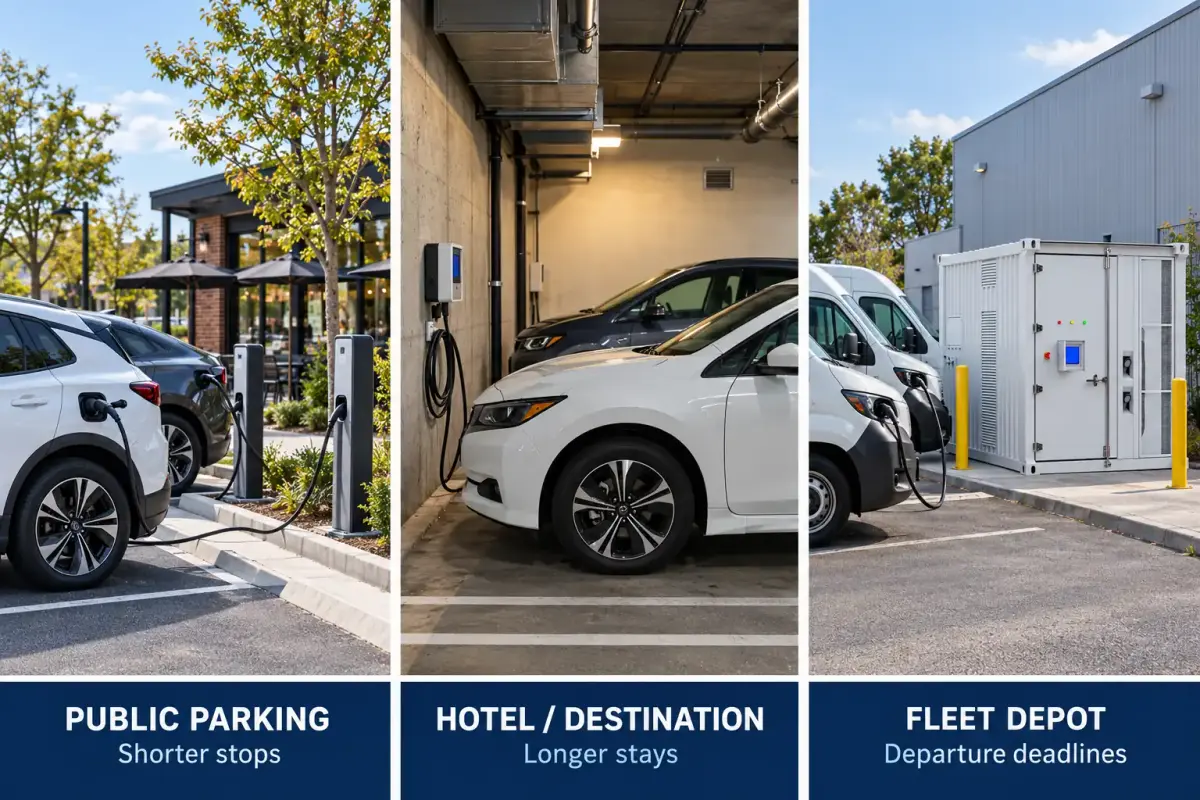
For a hotel, charging may help attract and retain guests. For a public station, charging income may need to carry much more of the investment. Keep those business cases separate.
At a fleet depot, charging supports vehicle operations. Plan around routes and departure deadlines, and assess that benefit separately from selling electricity to passing drivers.
Decide who owns and operates the station
Three arrangements are worth comparing:
- Own and operate: you fund the station and set its prices. You keep the sales income and cover the costs and service.
- Own with a managed service: you own the equipment but contract out agreed operating tasks. Check the fees, access to data and who handles support.
- Host a third-party operator: another company develops or operates the charging service under a site agreement. Review rent, revenue sharing, any limits on using other operators, and contract length.
An operator who takes on more of the daily work may also retain more income or control. Compare those terms alongside the installation offer.
Are EV Charging Stations Profitable?
How much drivers use the station matters
Yes, an EV charging station can be profitable, but it needs enough paying use. Even a high-power charger needs customers to cover its costs.
Start with the energy customers are likely to buy each day. Then consider when they arrive, how long they stay and whether the station can serve them without long queues.
Be careful with “utilization” figures. One figure may measure energy sold against the charger's full output. Another may measure how long a car occupies a bay. These measure different things, so check the basis before comparing sites.
A simple charging station profit example
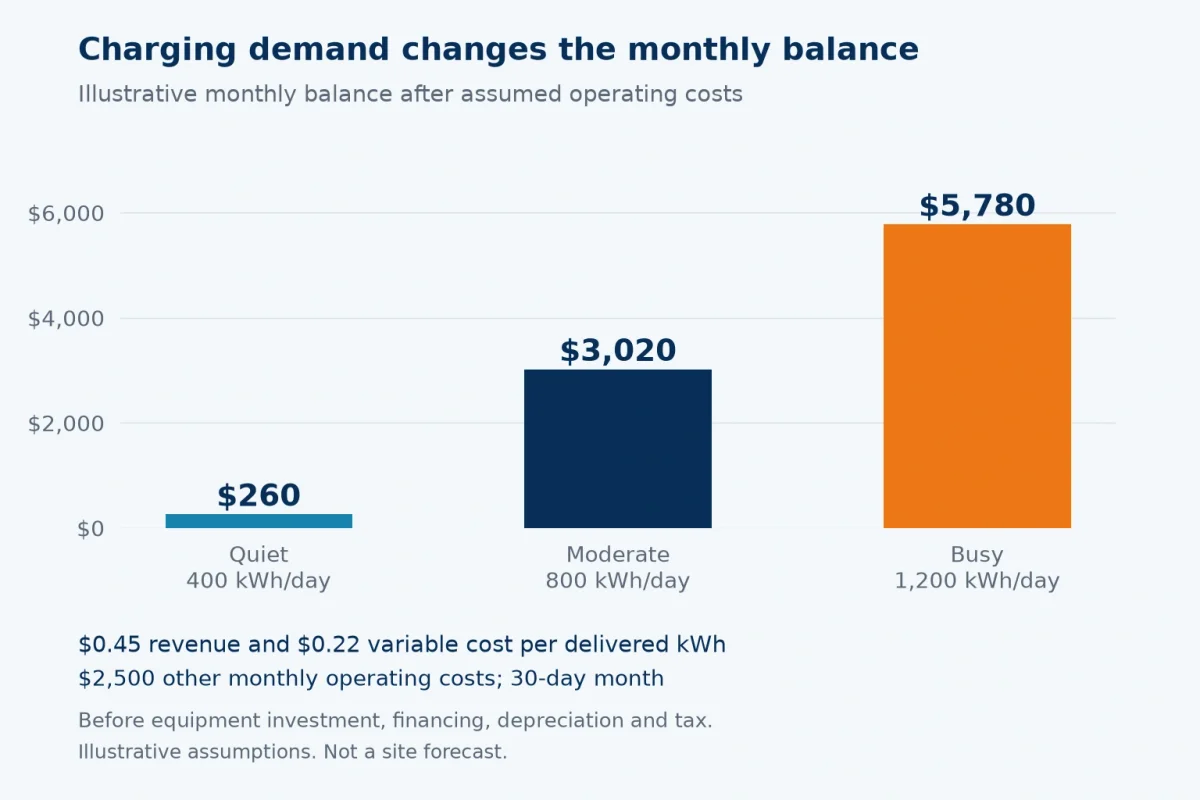
Here is a worked example in US dollars. The inputs are assumptions, rather than current tariffs, a KUNETIC quote or a forecast for your site.
Assume:
- Customers pay $0.45 per delivered kWh.
- Electricity, charging losses and variable transaction fees together cost $0.22 per delivered kWh.
- Other operating expenses total $2,500 per month, including assumed rent, demand charges, software and maintenance.
- Each month has 30 operating days.
That leaves $0.23 per delivered kWh to cover the monthly operating expenses and contribute toward the investment.
Charging demand | Monthly charging revenue | Balance after the assumed variable and monthly operating costs |
Quiet: 400 kWh/day | $5,400 | $260 |
Moderate: 800 kWh/day | $10,800 | $3,020 |
Busy: 1,200 kWh/day | $16,200 | $5,780 |
These balances are before the equipment cost, loan costs, depreciation and tax. They do not show net profit or how soon the project pays for itself.
In the quiet case, $5,400 of monthly sales leaves just $260 before the excluded costs. Revenue alone says little about the station's profit margin.
For your own proposal, replace every input with local quotations, the applicable electricity tariff and a defensible demand estimate. Model quieter months as well as the busy period.
Retail sales, parking income and fleet agreements can add value, but they need their own evidence. Count grants or incentives only after confirming eligibility, availability and payment conditions.
Run a Station Drivers Can Rely On
A station can be well located and still lose customers through failed payments, unavailable chargers or slow support.
Choose the software alongside the hardware. Both affect the cost and service of commercial electric vehicle charging. It should give the responsible team access to charging sessions, faults, payments and energy data.
Before signing, establish:
- Who controls prices and receives customer payments.
- Which fees apply to software, transactions and roaming.
- Who responds when a charger or payment terminal fails. If users need an RFID card or an app, check how guests and new customers can start a session.
- How operating data can be accessed or transferred if you change provider.
Payment and consumer-service requirements vary by market. For UK public charging, review the official public chargepoint guidance. It covers prices, payments, support and service reliability. Check which rules and exceptions apply to your public charging stations.
Once open, follow delivered energy, successful sessions, downtime and the actual electricity bill. These help show whether the problem is demand, pricing, equipment availability or supply cost.
The AFDC operation and maintenance guidance provides a useful starting point for operating costs and utilization data.
When Solar and Battery Storage Make Sense
Evaluate storage against the supply or electricity-cost problem at your site.
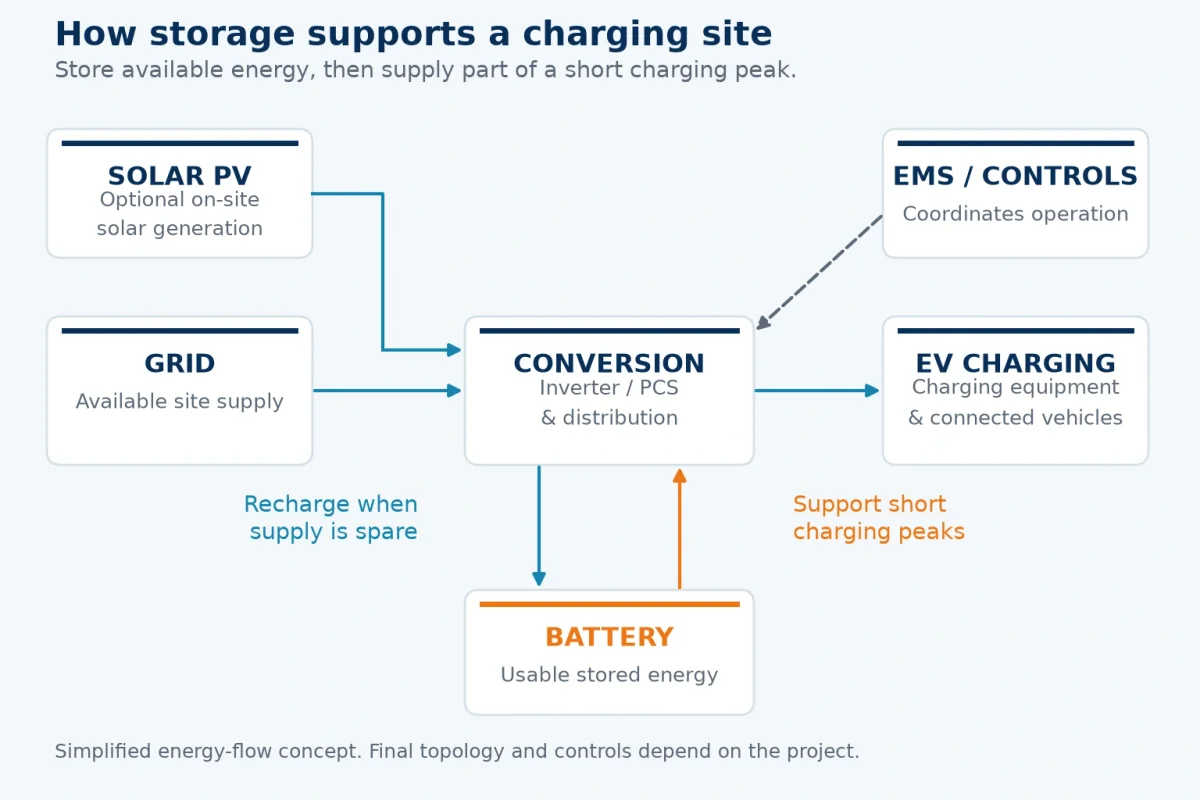
The grid may supply enough energy over a full day but lack power during a charging rush. Brief peaks may also be expensive under the tariff. If you plan solar, check when it generates power. Will vehicles be there to use it?
Compare managed charging, an upgrade and storage
If vehicles stay long enough, managed charging may share the available power while still meeting departure times.
A grid upgrade may suit sites with high demand for many hours. Storage may help when a short charging rush needs more power than the grid can supply. It may also help reduce peak charges under the site's tariff.
The Joint Office’s battery-buffered charging guidance explains where storage can help and where it falls short. It adds cost. A battery that is too small can run low and slow down charging.
Three figures need to work together:
- Power, in kW: how much the system can supply at once.
- Usable energy, in kWh: how long it can support the required load.
- Recharge opportunity: when and how the battery will recover before the next busy period.
Solar can supply energy for electric vehicles (EVs). Check the space available, when the panels generate and when drivers need to charge. Our solar EV charging station guide covers that energy-planning work.
Where KUNETIC equipment fits
For an integrated cabinet option, KUNETIC Titan-215 has about 215 kWh of storage and a 120 kW PCS. Its standard EV charging module delivers 40 kW. The PCS rating is not the charging-module output.
For a larger integrated package, K-ePowerMini-522 has 522 kWh of storage and a 250 kW PCS. It provides 240 kW of total DC charging across two connectors. That is total charging power, not 240 kW at each connector.
Use these options to start a system discussion. Output, connectors, local documents and controls need to fit the project.
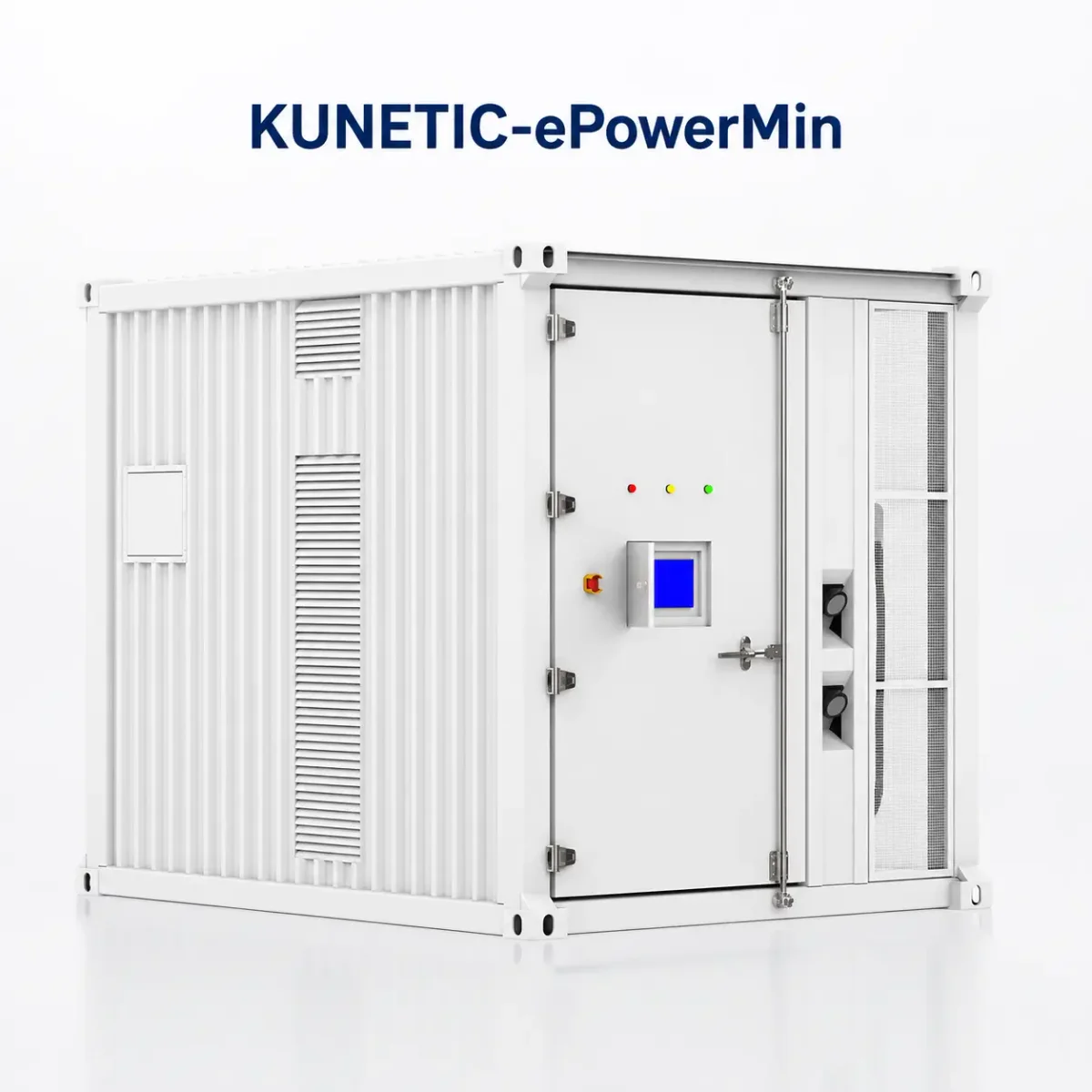
KUNETIC K-ePowerMini-522: 522kWh Battery Storage with Integrated EV Charging
Income from demand response, virtual power plants or vehicle-to-grid services needs its own review. Check local programs, equipment support and contract terms. Leave that income out of the base forecast until the terms are agreed.
Questions Before Starting a Charging Station Business
Can I start on rented land?
Yes, where the lease and local permissions support the intended project. Agree construction rights, access, electricity arrangements, rent changes and equipment removal or transfer before investing.
Can I start small and expand later?
A phased project can make sense. Plan the future layout, cable routes and power needs early. Then check what equipment and approvals you would need to expand.
Do I need solar panels to use battery storage?
No. A battery system designed for grid charging can work without solar. Compare its cost with the savings it could make under your tariff. Allow time to recharge between busy periods. Solar adds another source of energy.
Before You Commit: Eight Questions to Answer
Before paying a deposit, make sure the proposal answers these questions:
- Who will use the station, and how much energy are they likely to buy?
- Are the site permissions, access and lease suitable for the project?
- What charging power is available, and what electricity tariff will apply?
- What is the complete opening budget, including connection and construction work?
- Does the selected equipment fit the vehicles, local requirements and support arrangements?
- Who controls operation, payments, customer data and repairs?
- Would solar or storage justify its added cost, and are any assumed incentives confirmed?
- What happens if you expand, change operator, sell the business or leave the site?
KUNETIC can help you discuss the equipment options while you develop the site plan.
Share your location and site layout. Tell us the power available, the vehicles you want to serve and their charging times. Include the electricity tariff and any solar plans if available. We can compare charging time, grid power and storage size to see which layout may be cost effective.
Through our PV + ESS + EV charging solution, we can discuss suitable equipment and system configurations. Agree local design, construction and approval responsibilities with the project team as the proposal develops.