English
 Deutsch
 Español
 Français
 Italiano
 Polski
 Română
 العربية

Table of Contents
If you’re considering automated demand response, I’d start with your site’s limits. How much can it cut grid demand? How long can it hold that reduction? A battery can supply power to equipment during an event. Check its charge level and controls first. Check its power rating against the response your program requires.
How Does Automated Demand Response Work?
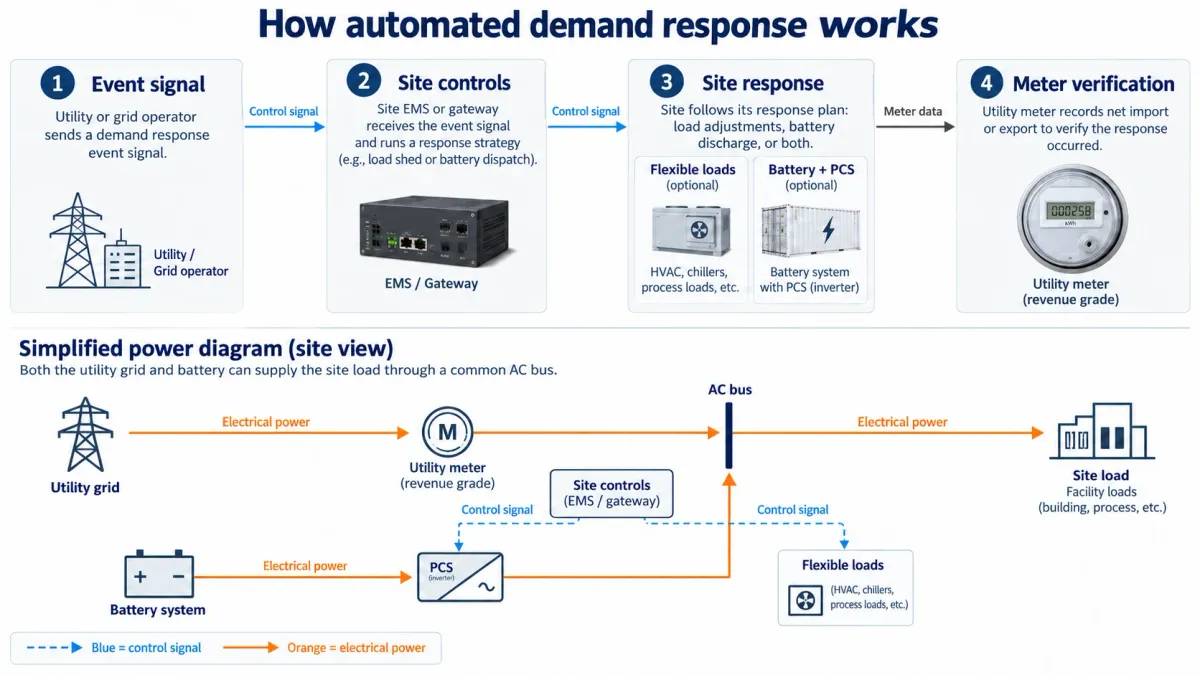
Automated demand response (ADR) uses signals and preset controls to change a site’s power demand. A utility or program operator sends an event signal when the electric grid needs support. The site then follows an agreed response plan, which may involve adjusting loads, dispatching a battery, or both.
A typical sequence looks like this:
- The event notification identifies when a response is needed.
- Site controls check equipment availability and operating settings.
- Selected loads change or the battery supplies part of the site’s power.
- The program provider assesses meter data under the program’s measurement rules.
With a manual arrangement, someone must carry out the response. Automation allows configured actions to run without waiting for staff to operate each device.
For a concrete example, Southern California Edison’s Auto-DR program uses OpenADR signals to communicate with eligible devices or energy management systems. Its requirements include suitable metering and enrollment in a qualifying demand response program.
Where Does Battery Storage Fit?
A battery gives you another way to reduce power drawn from the grid. It can supply part of a facility’s load while equipment continues to operate.
That can be useful where stopping production or changing operating schedules would be difficult. Some sites can use air conditioning or other flexible loads to meet their target without adding storage.
Response approach | What changes during the event? | What needs checking? |
Adjust selected loads | Equipment demand falls or shifts to another time. | Operating limits, comfort and recovery schedules. |
Dispatch a battery | Stored energy supplies part of the site load, reducing grid imports. | Available power, charge level and backup reserve. |
Combine both | Load adjustments and battery output share the response. | Coordinated controls and the total metered result. |
Automated demand response also serves a different purpose from routine battery peak shaving. Peak shaving limits grid power draw during the site’s own peak period. ADR follows external event signals. The same battery may support both, provided its control plan allocates enough energy for each task.
What Should You Check Before Choosing a BESS?
Power and Event Duration
Start with the requested reduction in grid demand and the time it must last.
A 100 kW response for 90 minutes needs a different energy budget from a 100 kW response for four hours. Check the notice period, required response speed and possible event frequency, too.
Battery output and credited demand reduction are separate measurements. Solar output, changing site loads and other equipment can affect the meter reading. Check how the program measures load reduction. A baseline is an estimate of power use without an event. The meter reading just before an event may differ from that baseline. SCE’s 2026 Auto-DR handbook explains how its test calculations compare actual demand with a calculated baseline.
When discussing equipment with a supplier, use the response target at the site meter.
Usable Energy and Backup Reserve
Nominal battery capacity gives you a starting point. Check the charge available at the start of the event. Allow for losses and operating limits, plus the energy kept for backup.
For a simple constant-power response:
Energy delivered (kWh) = Power (kW) × Duration (hours)
Allow for enough usable energy to supply the full event. Use the agreed meter point for that energy calculation. Keep the backup reserve separate.
Set the backup reserve early. The controller should keep that energy available during an event. Then check the recharge time before the next event. Normal site demand can limit charging.
Our commercial battery storage guide covers the wider sizing questions. An ADR calculation needs the energy available during the actual event window.
EMS, Communications and Metering
An energy management system (EMS) controls the equipment. For ADR, it needs a signal it can read and commands the equipment can follow. Confirm which meter data the program needs. Ask whether the controller tracks grid imports in real time.
Ask who supplies the client or gateway that receives the program’s signals. Then confirm how it connects to the site controller and who tests the complete response.
SCE, for example, requires an eligible OpenADR client for its automated event notifications. Other programs have their own requirements. The OpenADR Alliance provides protocol and certified-product resources for checking proposed implementations.
Test what happens if the signal drops or equipment is out of service. Check that the controls respect the reserve limit, too. Write these actions into the control plan and test them before the first event.
A 125 kW / 261 kWh Example
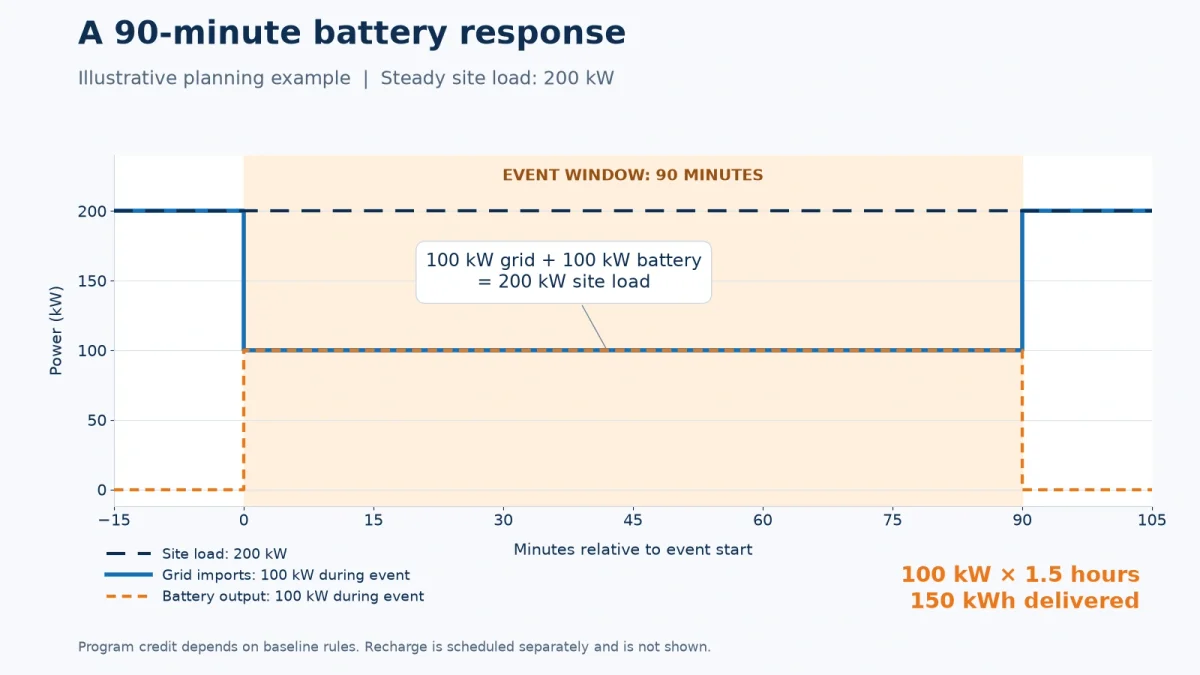
Suppose a site has a steady 200 kW load. It wants to cut grid imports by 100 kW for 90 minutes. The battery would supply that 100 kW share.
The energy delivered during that window would be:
100 kW × 1.5 hours = 150 kWh
Grid imports fall from 200 kW to 100 kW during the example event. The battery supplies the other 100 kW. The program’s baseline and meter rules still determine the credit.
For reference, our KUNETIC K-eBank-261LHYB2 has a rated 125 kW PCS and approximately 261 kWh of nominal battery capacity. It also has liquid cooling and an integrated EMS.
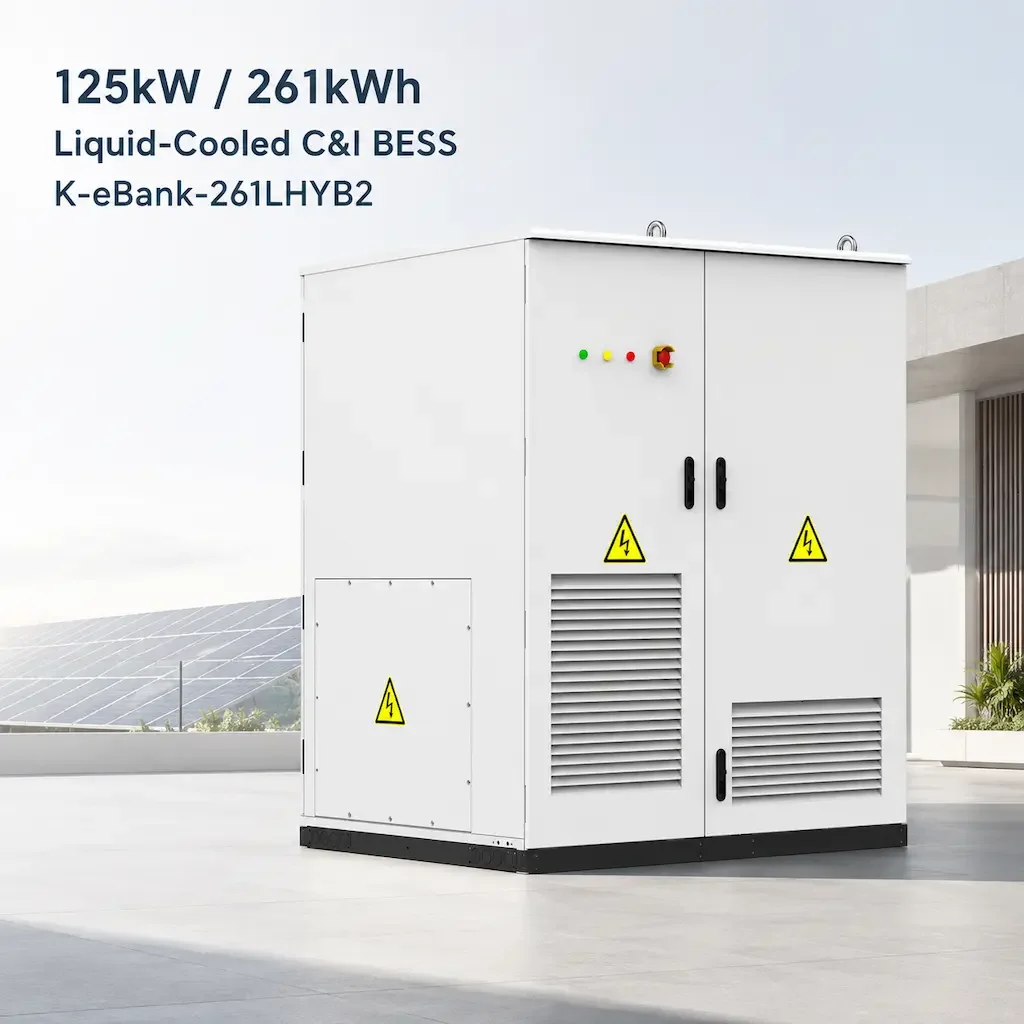
KUNETIC K-eBank-261LHYB2: a 125 kW / 261 kWh liquid-cooled commercial battery energy storage system.
The proposed 100 kW output is below the rated PCS power. Check the full event against the charge at its start and the usable energy. Allow for losses, temperature limits and backup reserve.
This is a planning example. The published AC rating is 380/400 V. For a site in the United States, check electrical compatibility first. Confirm OpenADR integration, required certifications and program eligibility as separate checks.
What Should the Project Proposal Include?
I’d ask the supplier and integrator for one proposal that names who supplies and commissions each part of the system.
Proposal item | What to ask for |
Battery and PCS | Usable event energy, continuous output and operating conditions. |
Controls and gateway | Supported interfaces, program-facing client and dispatch logic. |
Metering and verification | Required meters, data access and performance calculation method. |
Installation and commissioning | Electrical work, approvals and an end-to-end response test. |
Program participation | Enrollment responsibility, fees and performance obligations. |
Recovery and support | Recharge plan, reserve settings, fault handling and service scope. |
For the financial comparison, separate equipment and installation costs from ongoing fees. Ask the program provider to explain its payment method and the effect of missed performance. An earnings estimate needs clear assumptions. Check event frequency, delivered response and eligibility.
Check equipment incentives separately. SCE’s 2026 Auto-DR handbook excludes battery storage projects from its Auto-DR control incentives. A program’s hardware-funding rules and participation rules need separate review.
If you’re assessing a battery option, send KUNETIC your site requirements. Send the load profile, response target and event duration. Include backup needs, electrical supply and the proposed program. We can use those details to discuss a suitable BESS configuration.
Frequently Asked Questions
Does Automated Demand Response Require Exporting Power?
Not necessarily. A battery can serve on-site loads and reduce grid imports while the site remains a net electricity consumer. Export permissions and the response measurement method depend on the project and program.
What Happens if an Event Lasts Longer Than Planned?
The system must stay within its energy and reserve limits. Agree on what happens if the battery runs low. It may need to reduce output. Another permitted resource may respond, or the site may deliver less than requested. Check the consequences with the program provider.
Can a Business Opt Out of an Event?
Some arrangements allow it. Enel North America describes opt-out options for operational or safety constraints. Check your own program’s notice rules and the effect on payments or participation obligations.