
 English
 Deutsch
 Español
 Français
 Italiano
 Polski
 Română
 العربية

Table of Contents
A big roof makes solar look like an obvious choice. But before looking at how many panels will fit, I'd want to know what happens inside the building during the day.
Is the factory running through the afternoon? Does the warehouse close on weekends? Does most of the hotel's electricity use happen after sunset?
Those details change the size of the system—and whether a battery is worth considering. They also help explain why two businesses with similar electricity bills can end up with quite different proposals.
When comparing commercial solar systems, start with the building's electricity use, available space and grid connection. Then look at what storage would add.
What Does a Commercial Solar System Include?
Commercial solar panels are the most visible part of the system. Inverters turn their DC electricity into AC. Mounting structures hold the panels in place. Wiring and other electrical equipment connect the system to the building.
Monitoring shows energy production and helps you spot operating problems. A battery adds storage, power conversion and controls. For power during an outage, the design needs suitable switching. It also needs to specify which loads will stay supplied.
Ask what “complete system” includes in each proposal. Some quotes cover equipment delivered to the site. Others include installation, commissioning and grid-connection work.
Which Setup Fits Your Site?
Walk around the site before settling on a layout. The roof may be the obvious starting point, but its condition and the way the property operates can change the decision.
Rooftop Solar
Rooftop solar uses space that may otherwise sit idle, leaving the surrounding land available.
The roof's remaining life deserves an early conversation. If replacement is approaching, coordinating the work can avoid taking panels off again a few years later.
Check where shade falls and leave room for maintenance access. Ask whether the structure can support the installation. The usable area can be much smaller than the roof.
Ground-Mounted Solar
Ground mounting is an option where suitable land is available near the electrical connection.
The designer has more freedom to arrange the panels, while still accounting for ground conditions, drainage, access and cable routes.
Think about how you might use the land later. You may need that space for storage, vehicle movement or an extension.
Solar Carports
A carport puts solar above parking spaces and provides shade underneath.
The supporting structure needs as much attention as the panels. Check foundations, vehicle clearance and drainage, and plan construction around the people using the parking area.
Setup | Where it may fit | What to check first |
Rooftop | Buildings with suitable roof space | Roof life, structural capacity, shade and access |
Ground-mounted | Sites with available land | Ground conditions, future land use and cable distance |
Solar carport | Parking areas | Foundations, vehicle clearance and construction access |
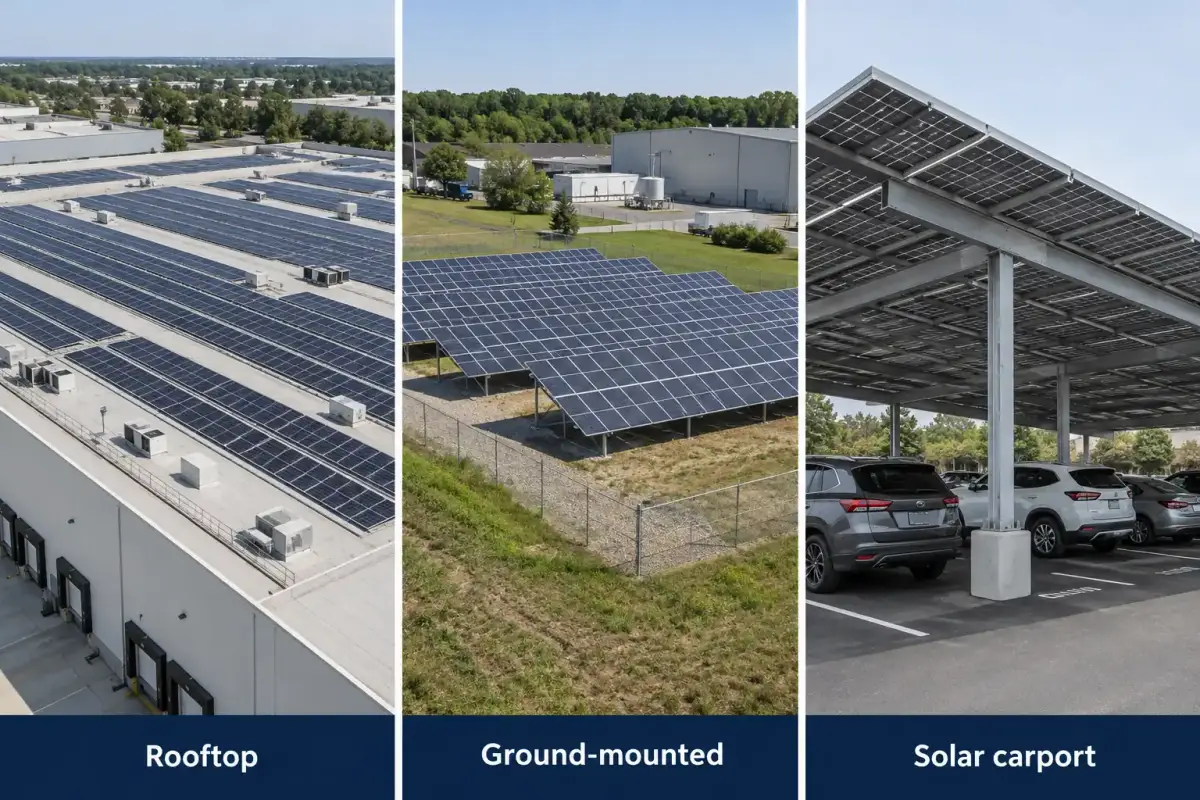
Rooftop, ground-mounted and carport layouts use different parts of a commercial site.
How Do You Size a Commercial Solar System?
Start With Your Electricity Use and When It Happens
A full year of electricity bills is a useful starting point. Interval data, where available, tells you much more about what happens during the day.
Picture a factory running machinery through the afternoon. Much of its demand may coincide with solar production. A hotel could have a different pattern, with substantial demand continuing after sunset.
Weekends matter as well. If a warehouse closes on weekends, its solar panels may still produce power while weekday equipment is off.
The annual total helps establish the scale; the daily pattern shows how the business could use that production.
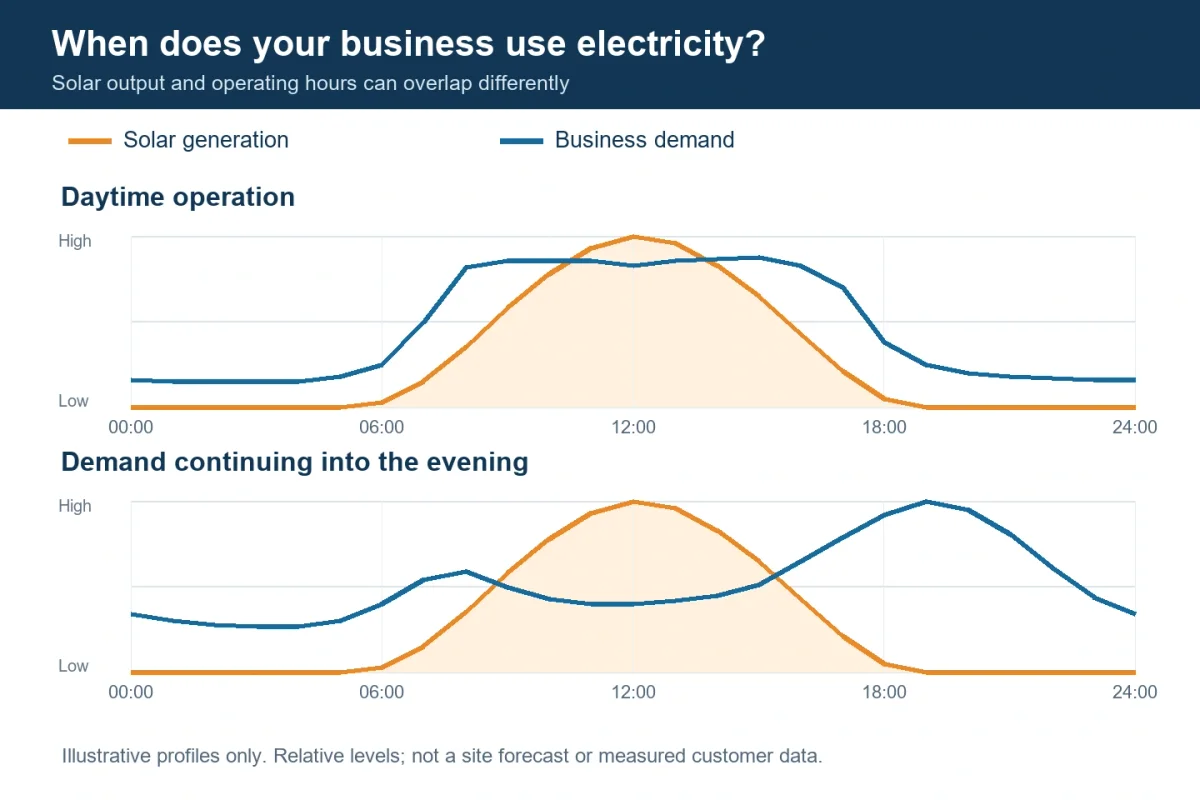
Illustrative daily profiles: operating hours change the overlap between solar production and business demand.
For an initial annual-energy estimate:
PV capacity in kWp = annual solar generation target in kWh ÷ estimated annual yield in kWh per kWp
Suppose the target is 120,000kWh per year, using an assumed yield of 1,200kWh per kWp per year:
120,000 ÷ 1,200 = 100kWp
These figures are hypothetical. A forecast for your site would need location-specific inputs. You still need to work out how much of that electricity the business will use when it is generated.
A location-based tool such as PVWatts can help estimate production. Its monthly or hourly results can then be compared with the site's consumption, while allowing for the model's assumptions and uncertainty.
Check Usable Space and Grid Constraints
Once you have an initial size, check whether it fits the site.
Roof equipment, shade and access routes reduce the usable area. Ask your utility company about the permitted connection size and export limits.
Ask about these constraints before treating the largest possible array as the preferred option.
For a business with quiet weekends, for example, the project assessment should explain what happens to surplus electricity. Can it be exported? Is there a useful reason to store it? Would a smaller array better match the load?
Keep Solar kW, Inverter kW and Battery kWh Separate
A proposal can contain several large numbers that describe different things:
- PV kWp or kWdc describes the combined rated capacity of the modules.
- Inverter kWac describes rated AC output.
- Battery kWh describes stored energy.
- Battery converter kW describes charging or discharging power within the equipment's operating limits.
A 100kWp array and a 100kWh battery therefore need separate sizing decisions.
Our kW vs kWh guide explains these units with examples if you want a closer look.
How Much Do Commercial Solar Systems Cost?
Equipment Prices Are Only Part of the Budget
Commercial solar panel cost is one part of the budget. The full installed price covers the work needed to get a solar panel system running at your building.
Mounting, electrical work and site access affect the budget. So does the condition of the existing installation. The contract should explain who handles each stage of the installation process, from design and approvals to commissioning.
DOE's 2025 Q1 U.S. commercial PV-only benchmark gives a modeled market price of $1.98/Wdc in 2024 dollars. For its representative 250kWdc system, that works out to approximately $495,000, before owner incentives.
That benchmark uses a particular school-rooftop configuration and domestic-content assumptions. It provides context for scale; it is not a current installation quote or a KUNETIC equipment price. The assumptions are available in the DOE benchmark methodology and tables.
For your project, ask for a breakdown you can compare:
Budget item | What the quote should clarify |
Modules and inverters | Models, quantities, ratings and warranty scope |
Mounting and structures | Racking, foundations and any roof work |
Electrical equipment | Cables, protection, switchgear and required upgrades |
Design and approvals | Engineering, permits and interconnection responsibilities |
Installation and commissioning | Labor, access equipment, testing and handover |
Optional storage | Battery, converter, controls and backup-related equipment |
Transport, taxes, maintenance and future replacement assumptions should also be visible somewhere in the budget.
Compare Quotes With the Same Scope
Imagine receiving two proposals with the same solar capacity. One includes installation and electrical upgrades. The other covers equipment supply.
To compare their totals, check that both proposals use the same capacity basis and cover the same work. Ask each provider to identify exclusions and explain the assumptions behind its production and savings estimates.
Compare the upfront cost before looking at finance options. Interest, fees and contract terms change the overall cost. Ask which utility rates the savings estimate uses to calculate electricity costs.
Ask who monitors faults after handover, who responds when production drops, and what service the contract includes.
Should You Add Battery Storage?
When Solar Alone May Be Enough
If the business uses much of its electricity during daylight hours, solar alone may be a sensible starting point.
A daytime factory load, for example, could absorb a useful share of production as it happens. Assess quieter periods and surplus generation as well, then use that baseline to judge what a battery would add.
When Storage Deserves a Closer Look
A hotel with evening demand raises a different question: could some afternoon production be saved for later?
Other sites may be interested in managing selected demand peaks or keeping essential equipment supplied during an outage. These are different jobs, and each affects battery power, capacity and controls.
Our application pages for factories and industrial parks and hotels and resorts show how the discussion changes with the load.
One equipment option is the KUNETIC K-eBank-261LHYB2. It has 125kW rated power conversion. The battery's rated energy is approximately 261kWh. A 120kW MPPT section handles solar input.
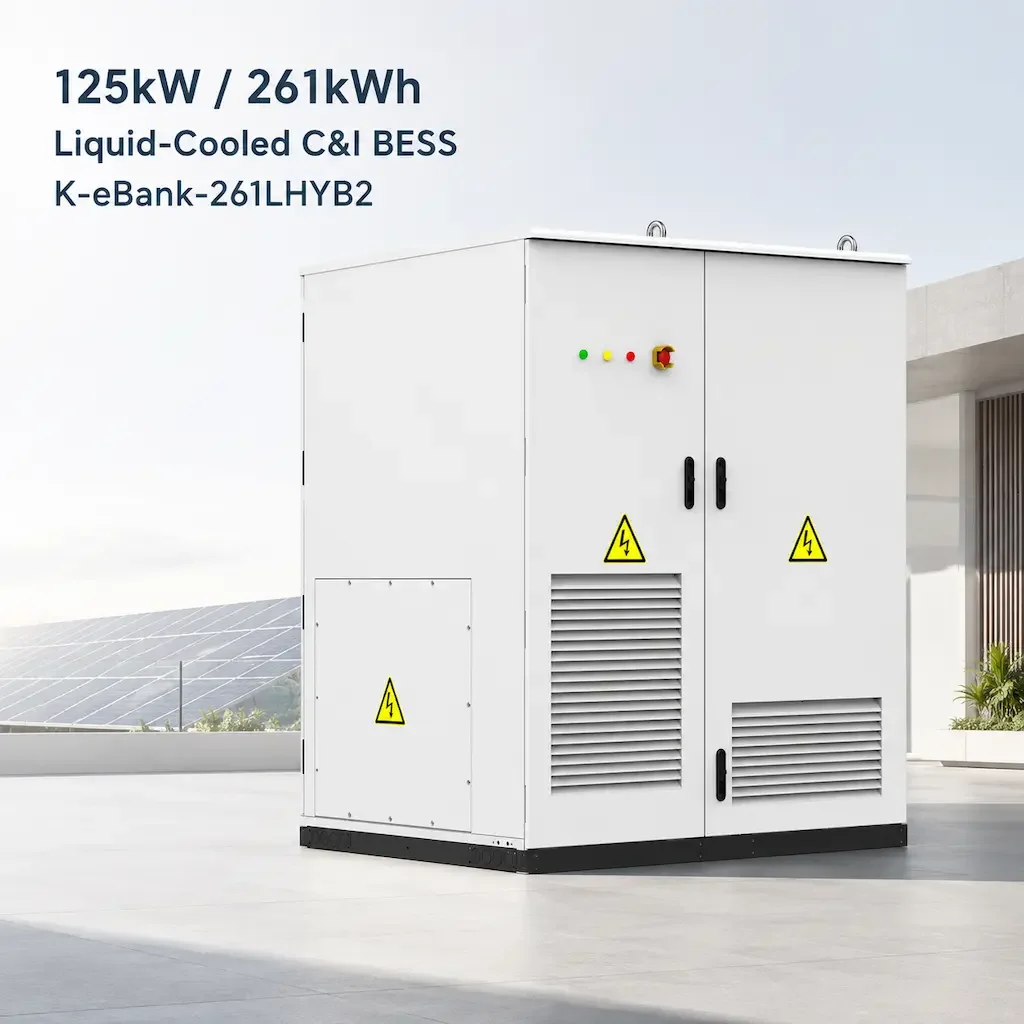
KUNETIC K-eBank-261LHYB2: a 125kW/261kWh commercial battery system with integrated solar-input capability.
The published standard AC rating is 380/400V, so the site's voltage and connection requirements need checking before selection. Required compliance documents also need review for the project location.
Transformer and ATS options depend on the electrical design. The MPPT rating alone does not determine the permitted solar-string configuration.
For a closer look at storage budgeting, see our commercial battery storage cost guide.
What I'd Prepare Before Asking for a Quote
You can ask for a quote before you have a finished design. Bring the records that help explain the site:
- The project location and utility.
- Twelve months of bills, plus interval data if available.
- Working hours, weekend operation and seasonal changes.
- Roof or land drawings and recent site photographs.
- Supply voltage, frequency and existing connection capacity.
- Details of existing solar, generators and relevant switchgear.
- The main goal, such as daytime self-consumption, energy shifting or selected backup.
For backup, name the equipment that needs to keep running and for how long.
To price whole-building backup, the design team needs to know which machines, cooling systems and other loads will run. Give them a short list of priorities.
If solar with storage is part of your plan, you can share those details through the KUNETIC product enquiry page. These details help KUNETIC review the storage configuration and clarify the equipment supply and site-work boundaries.
Frequently Asked Questions
Can a business run entirely on solar?
It depends on the load, solar resource and system design. Producing enough energy over a year does not guarantee supply at night or through poor weather. Independent operation needs an assessment of storage, backup generation and operating limits.
Will commercial solar work during a power outage?
Standard grid-connected PV generally shuts down when the grid fails, as MassCEC explains. Supplying protected loads requires equipment and controls designed for that purpose. Our microgrid systems guide explains the broader arrangement.
Can batteries be added to an existing solar system?
Often, yes. The existing inverter, electrical layout, controls and connection requirements need to be checked. Start with the installed equipment details and what you want the battery to do.
