English
 Deutsch
 Español
 Français
 Italiano
 Polski
 Română
 العربية

Table of Contents
The charger is only one part of the budget. Before comparing quotes, find out how much power your site can supply and who will pay for any upgrades.
For commercial EV charging station installation, plan around the vehicles using the site. Record their energy needs, arrival times and parking time.
The proposal should explain the installed scope, how many vehicles can charge at once, and who runs the station.
How much does commercial EV charging station installation cost?
Level 2 vs. DC fast charging costs
The Department of Energy's AFDC cost guidance lists historical US benchmarks. Its equipment and installation figures come from a 2020 charging-cost study.
Charging type | Equipment reference, per connector | Installation reference, per connector |
Public Level 2 | Approximately $3,500 | Approximately $2,500 for public/workplace installations |
DC fast charging | $38,000–90,000 | $20,000–60,000 |
These historical figures help explain the cost difference between charging types. The DC range depends on charging power and site scale. For a current local price, get an itemized installation quote based on your site.
What changes the total project price?
For commercial EV charger installation, compare the same scope across bids. Price the chargers and other electrical hardware, including cable routes. Allow for trenching, foundations and pavement repairs. The budget may also include design, permits, commissioning and electrical service upgrades.
A charger position farther from the electrical supply can add cable and civil work. Compare that extra work with a position nearer existing power, while keeping vehicle access practical.
Keep ongoing expenses separate from the construction budget: electricity, any demand charges, network subscriptions, transaction fees and maintenance.
Plan the site before choosing charging equipment
Match charging power to vehicle use
Base the choice on energy needed per vehicle, parking time and the number of vehicles arriving together.
Level 2 chargers can suit electric vehicles parked for several hours at workplaces or overnight fleet depots. Consider a DC fast charger for shorter stops or more energy within a fixed turnaround window. The vehicle's own charging limit also affects the result.
For an illustrative fleet, ten vehicles needing 30 kWh each create 300 kWh of daily charging demand before losses. To estimate power needed during the busiest hour, you also need their arrival times and departure deadlines.
Check electrical capacity, layout and network access
During the site assessment, have the electrician check the supply, building loads and charging demand. Discuss electrical upgrades or transformer changes with the utility before ordering hardware.
Map charger positions, cable paths, vehicle movement and lighting. Leave room for long term expansion of EV charging infrastructure. Check network coverage for payments and remote monitoring. The Joint Office's site-selection checklist is a useful planning reference.
Plan accessible routes, controls and cable handling from the start. The US Access Board guidance covers applicable accessibility requirements and extra design recommendations. Your design team needs to confirm which requirements apply to the project.
Commercial EV charging station installation: the main steps
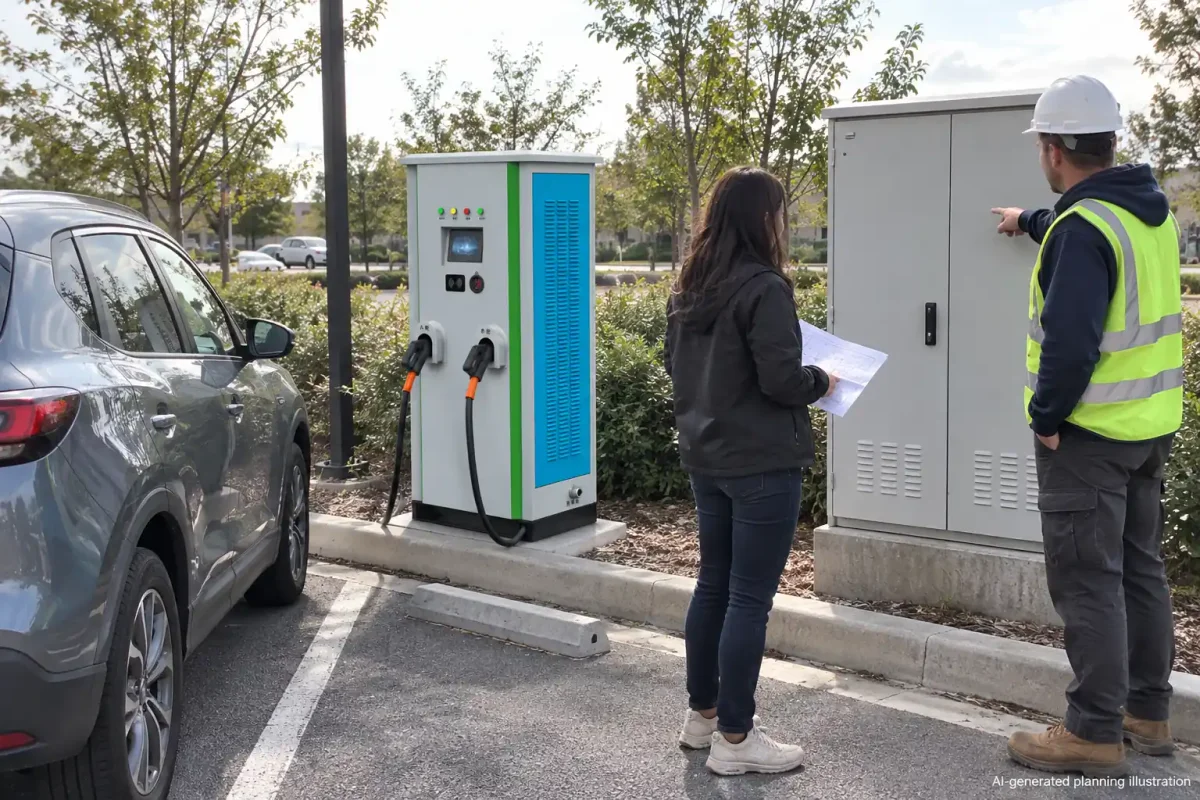
Assign an owner and a deliverable to each stage:
- Define the charging service. Record vehicle types, daily energy needs, arrival patterns, departure times and expansion plans.
- Survey and design the site. Assess the supply, prepare the layout and coordinate with the utility.
- Confirm equipment and approvals. Check the electrical fit, vehicle connectors and network features. Review the required product documents. Assign owners for permits and inspections.
- Complete construction. The responsible contractors install the agreed electrical and civil works. Their scope also includes the chargers and site protections.
- Configure and test. Verify charging operation, load controls, connectivity and payment functions where provided.
- Hand over the station. Collect test records, operating instructions, account access and support contacts.
Tasks can overlap, and teams may need to revisit earlier decisions. The US DOT planning checklist explains this approach.
What determines the installation timeline?
Allow time for utility decisions, equipment delivery, permits, site access and inspections. Ask the contractor which dependency controls the opening date and who follows it up. Equipment delivery covers only part of the schedule.
Choose an installer and compare complete quotes
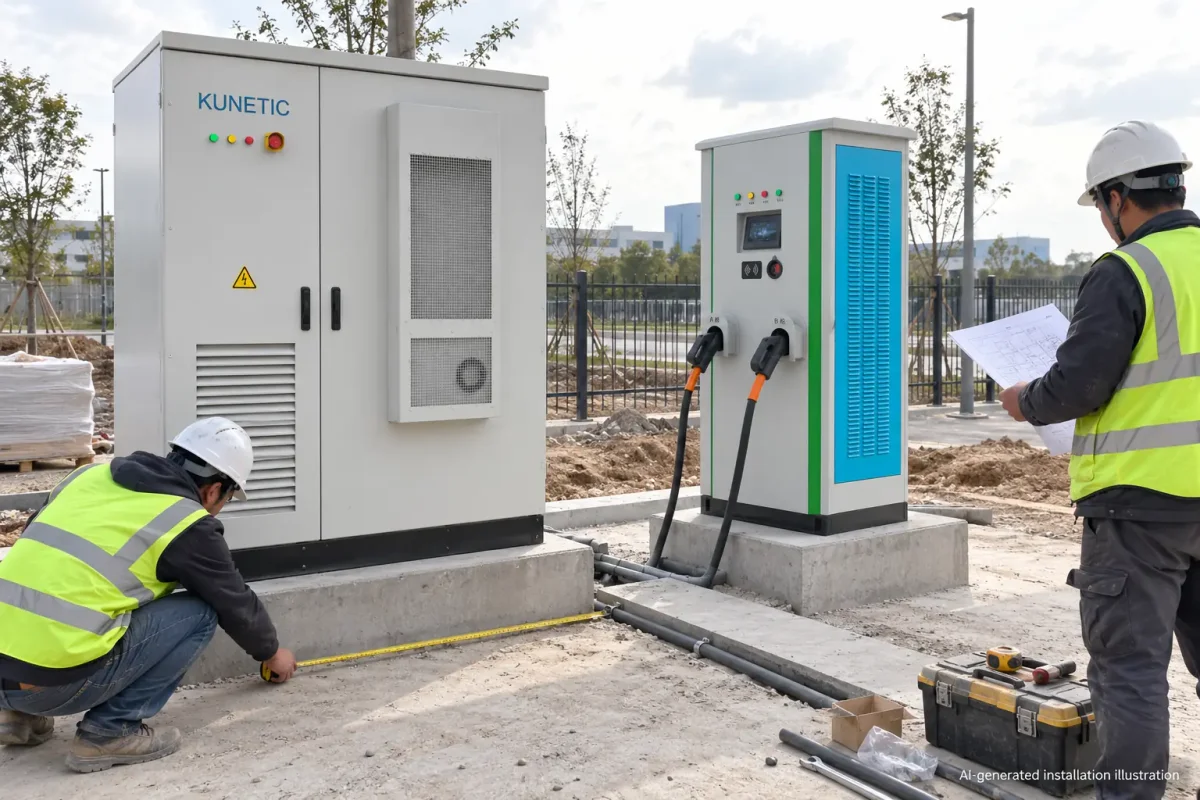
Who handles each part?
The site owner defines the service and approves the budget. The supplier provides the agreed hardware and technical documents.
The installer or EPC manages the design, construction and commissioning in its contract. The utility handles its connection and supply duties. The operator or network provider runs the agreed charging service.
One company may cover several roles. Record who owns each task, including problems that involve hardware, wiring and software together.
What to check before accepting a quote
Give each bidder the same checklist:
- Hardware: model, power, connectors and simultaneous charging capability.
- Electrical work: panels, protection, wiring and responsibility for service upgrades.
- Civil work: trenching, foundations, surface restoration and site markings.
- Delivery: engineering, permits, inspections, commissioning and their exclusions.
- Operation: software, payment functions, account ownership and recurring fees.
- Support: warranty scope, response arrangements, maintenance and expansion options.
Look for relevant installation experience and local qualifications. Compare a supply-only proposal and an installed-station proposal using their respective scope.
When to consider load management, a grid upgrade or battery storage
Can managed charging meet the schedule?
With enough parking time, load management can share power across chargers. Each vehicle still needs to receive its required energy before departure.
If charging cannot meet departure times, assess a grid upgrade. Compare it with a different layout or storage support. More chargers may still face the same power limit.
When battery storage is worth evaluating
A battery can supply part of a short charging peak. It can recharge when demand falls or solar energy is available. Evaluate the load pattern, time to recharge, tariff and total system cost.
Battery energy in kWh and usable output power in kW both need to fit the charging load. A large battery still needs enough power and time to recharge before the next busy period. For solar system planning, see our solar EV charging station guide.
For equipment comparison, KUNETIC Titan-215 has 215.04 kWh of nominal storage. Its PCS is rated at 120 kW. The standard EV charging module is 40 kW. The PCS rating is not the charger rating.
The K-ePowerMini-522 container has 522 kWh of storage and 240 kW total DC charging across two connectors. Before selection, check how the proposed system shares power. Confirm the site voltage, vehicle connectors and required certification documents.
A customer planning example from Côte d'Ivoire
A customer in Côte d'Ivoire planned a fully off-grid charging site. The initial target was 60 EVs per day, with 50 kWh per visit. The site measured 39 × 39 m. That target requires 3,000 kWh a day before conversion losses.
KUNETIC's planning review found that the available solar area could not support that target. The team revised the proposal around 236 kWp of solar and 522 kWh of nominal storage. The daily charging target also needed review.
This example records a design proposal, with no measured operating results. The charging scale needed to fit the daily energy budget. Storage could move available energy from daytime to evening, but could not supply energy the site had not generated.
The following equipment budget bands are rounded from one April 2026 proposal. They use FOB Shenzhen, USD, GB-standard configuration and exclude freight, construction and installation.
Equipment | Quoted configuration or scope | Rounded historical budget band |
Integrated BESS cabinet | 261 kWh; quoted PCS and MPPT included | $40,000–45,000 per cabinet |
Dual-connector charger | 120 kW | $3,000–4,000 per charger |
Solar PV module | 710 Wp | $90–100 per module |
BIPV carport structure | Structure package for this approximately 236 kWp proposal | $40,000–45,000 per project package |
These rounded budget brackets come from one historical quote, which has expired. Get a fresh quote for the required setup. Add local delivery, taxes, approvals and installation costs. For US projects, confirm suitable equipment specifications and installed pricing separately.
The case proposal's 522 kWh storage used two 261 kWh cabinets. The K-ePowerMini-522 container above is a separate equipment option. The cabinet quote already includes its PCS and MPPT, so count each included component once.
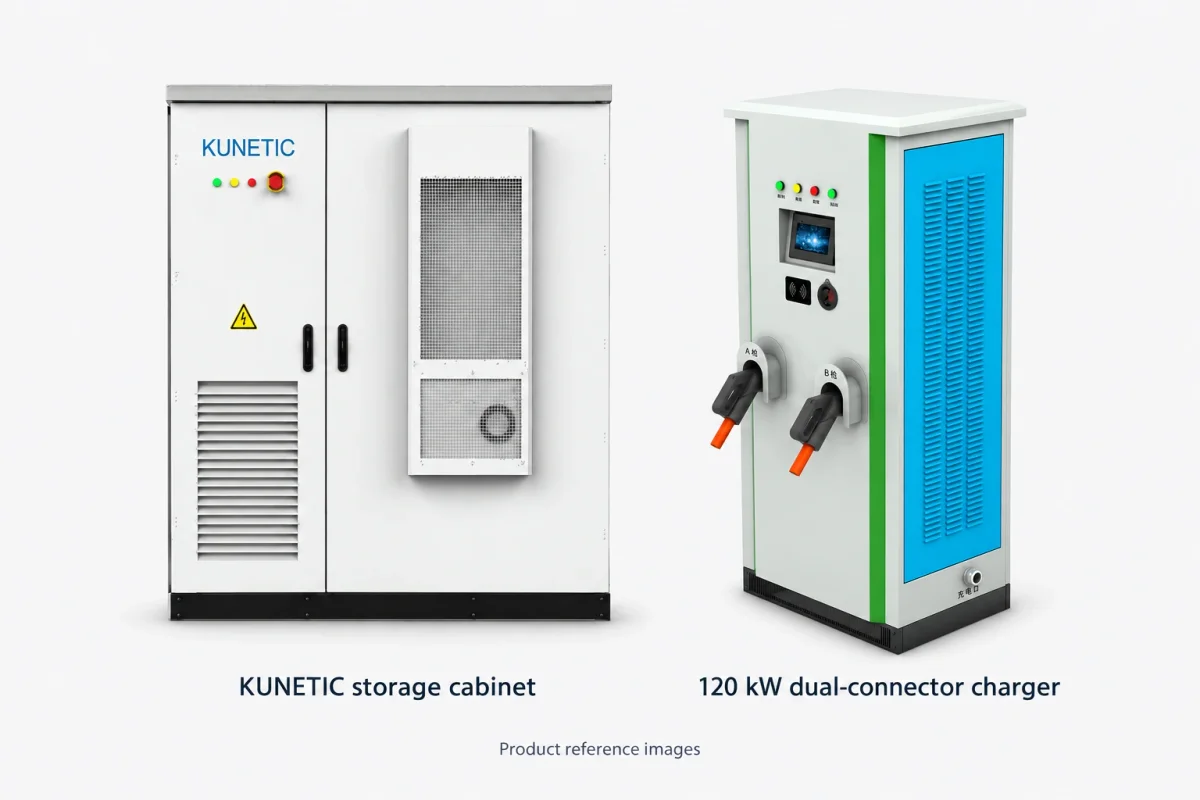
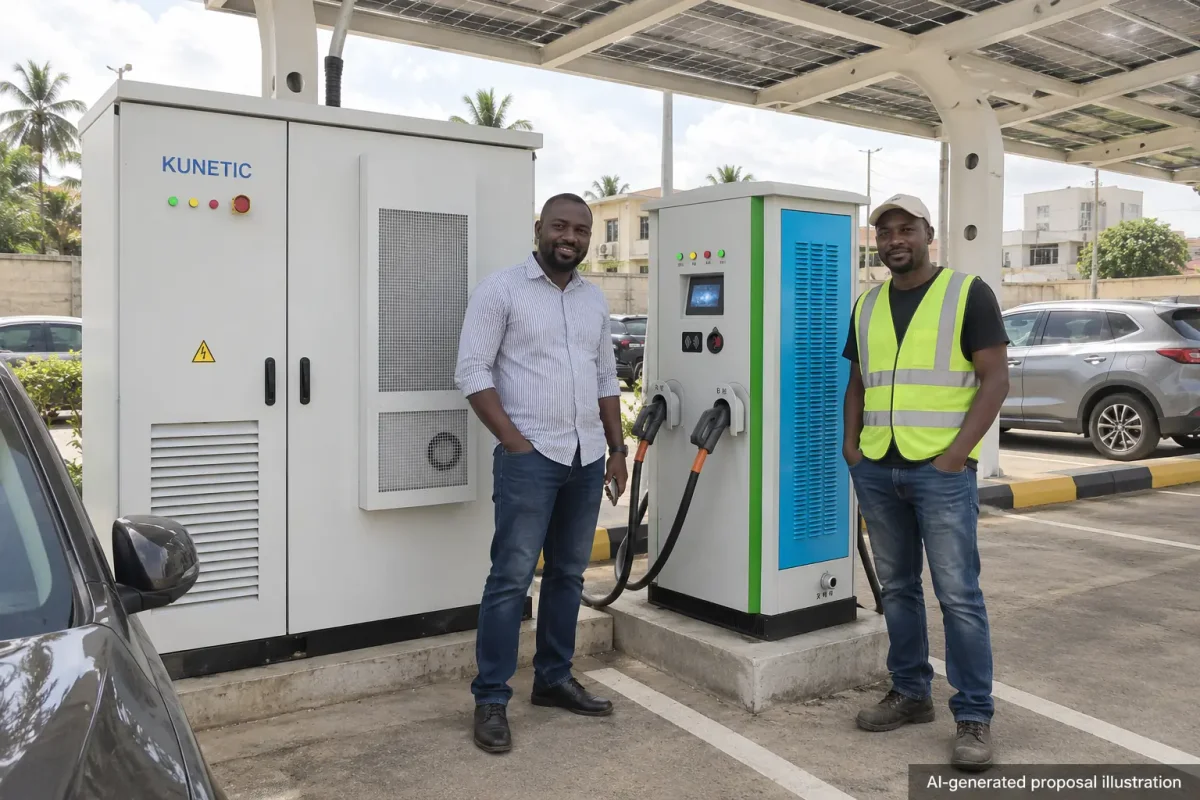
KUNETIC storage-cabinet and dual-connector-charger reference images from the customer proposal. Final configuration is confirmed during project design.
Commissioning, handover and ongoing costs
Before accepting the station, test the agreed simultaneous charging operation, load limits and network functions. For paid charging, include a complete payment session and confirm how users reach support.
At handover, collect test reports, as-built information and operating manuals. Get administrator access and warranty contacts too. Agree who responds to an offline charger. The contract should state who pays for service visits, replacement parts and subscriptions.
Review the electricity tariff against expected use. Utilization and project payback need their own assessment, even when the station has more charging positions.
Frequently asked questions
Can commercial EV chargers be installed in phases?
Yes, where the design allows it. Plan future cable routes, equipment space and electrical capacity in the first phase. Ask which work can be prepared now and which will require later approvals or upgrades.
Does a turnkey quote include software and maintenance?
The contract should list included functions, subscription term, maintenance scope and renewal costs. Suppliers use "turnkey" for different packages, so compare those items directly.
Do two connectors always mean two cars can charge at once?
No. Confirm the number of simultaneous charging ports and how power is shared. Some chargers provide alternative connectors for one charging session; others can serve two vehicles with a shared output limit.
Planning a site with solar or battery support? Share your location, electrical supply and daily charging demand through our PV-ESS-EV charging solution page. Include vehicle parking times and the site layout.
KUNETIC can discuss hardware and system setup. Confirm local construction and approval scope with your project team.