English
 Deutsch
 Español
 Français
 Italiano
 Polski
 Română
 العربية
PROJECT DESIGN · ADDIS ABABA
EV Fleet Charging Depot with Battery Storage in Addis Ababa
Start with the vehicles that leave first
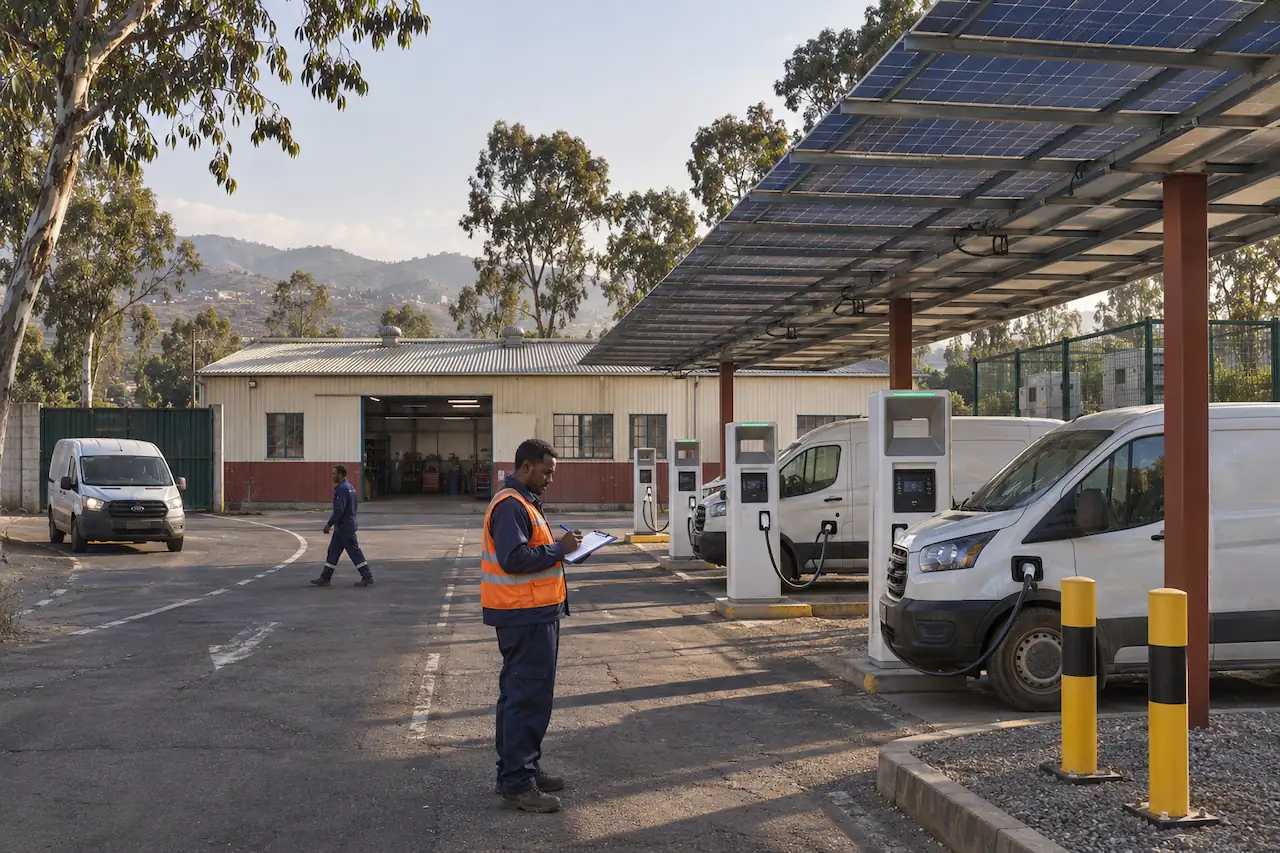
Several electric vehicles can return within minutes of each other at shift change. A van due back on the road in 90 minutes may need a charger before one parked until morning. At this proposed Addis Ababa depot, departure times and the energy each vehicle needs give the dispatcher a starting point.
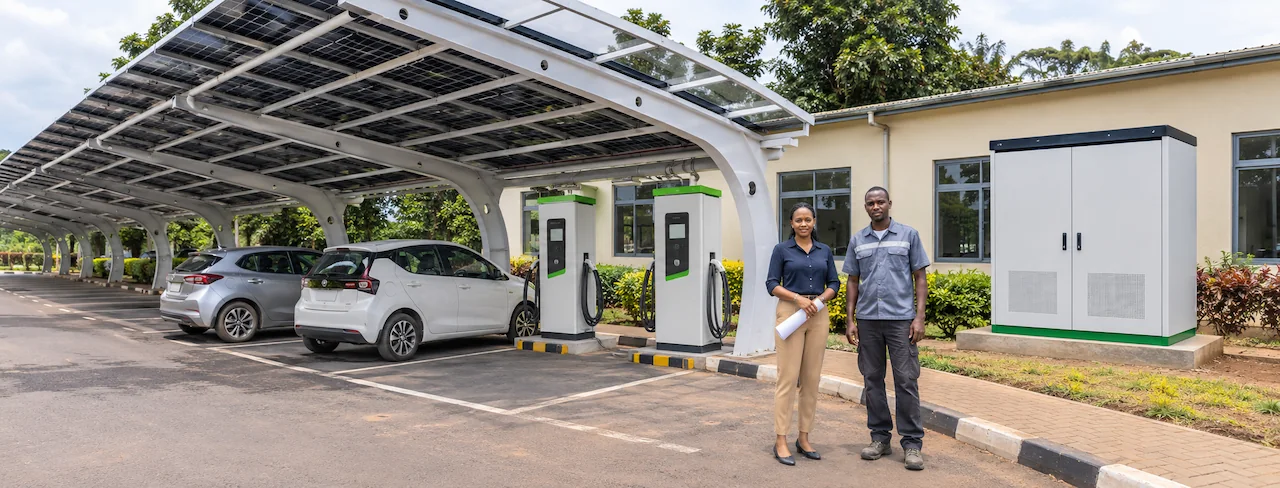
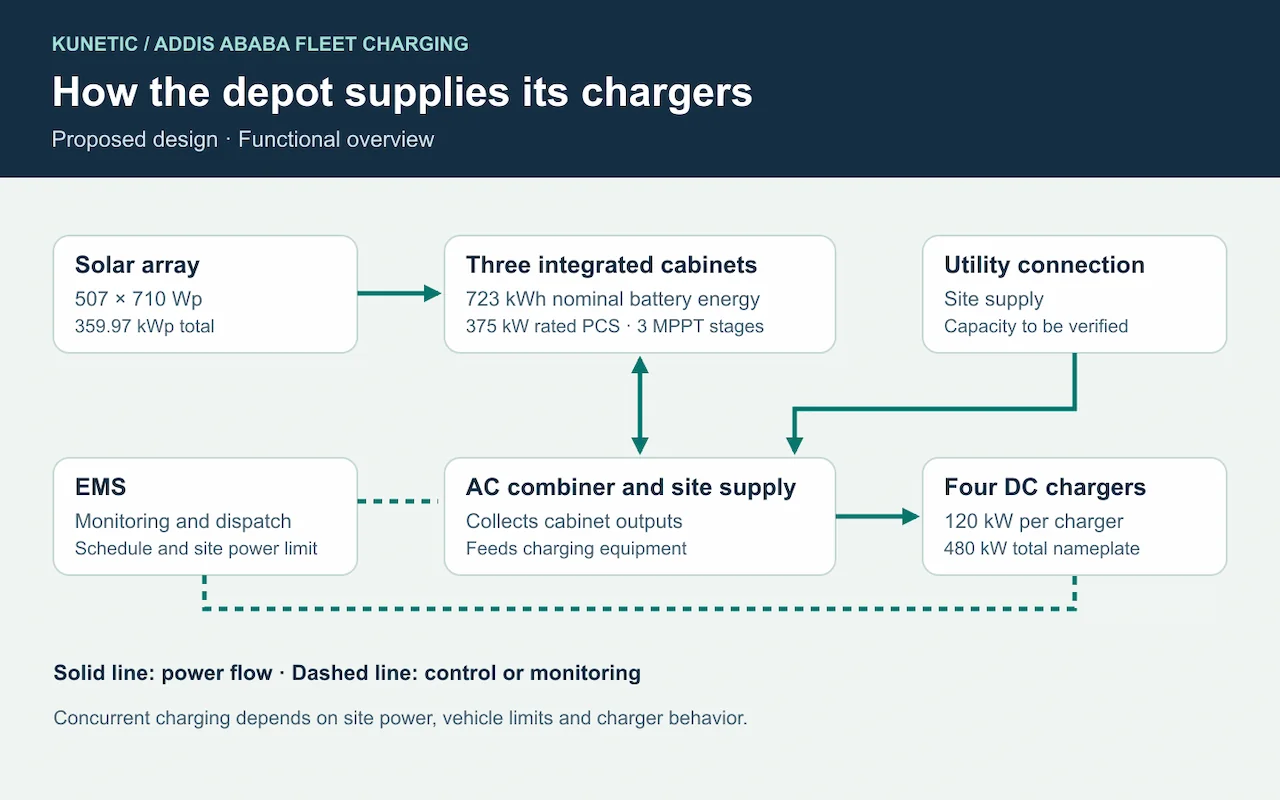
The electric vehicle fleet charging design combines about 360 kWp of solar, 723 kWh of nominal battery storage, 375 kW of rated power conversion capacity, and four 120 kW dual-connector DC chargers.
Say four vehicles each need 35 kWh within 90 minutes. They need 140 kWh altogether, or about 93 kW on average at the vehicles. The site has to supply extra power to cover charging losses. A late arrival leaves less time to add the same energy, so the dispatcher also needs to know how fast that vehicle can charge.
Give returning vehicles room to queue and charge
In the illustrative layout, drivers can pull off the entry lane to wait for a charger. When a vehicle finishes, it can return to the dispatch area without reversing into the queue. Give the site designer the dimensions of the longest vehicle. Check that it can turn and pass a parked van without blocking the exit.
Mark where each vehicle will stop and where its charge inlet sits. Check that the cable reaches without crossing a traffic lane. Give technicians a separate route to the electrical equipment so they can reach it while the yard is in use.
Put solar, storage and charging on one site plan
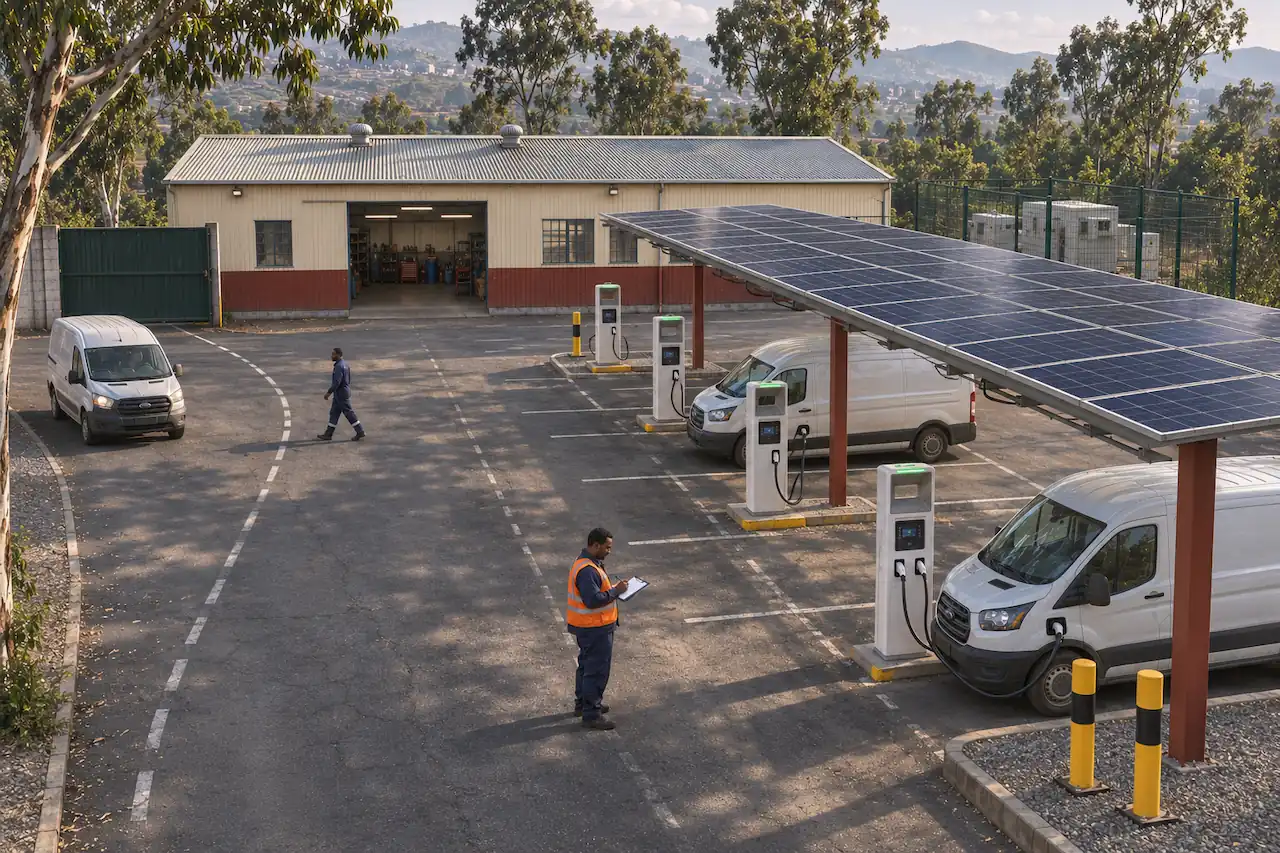
The proposal specifies 507 modules at 710 Wp each, for 359.97 kWp of solar. The site team can compare roof and canopy locations once it knows which areas are large enough, where shade falls and how the cables would reach the equipment.
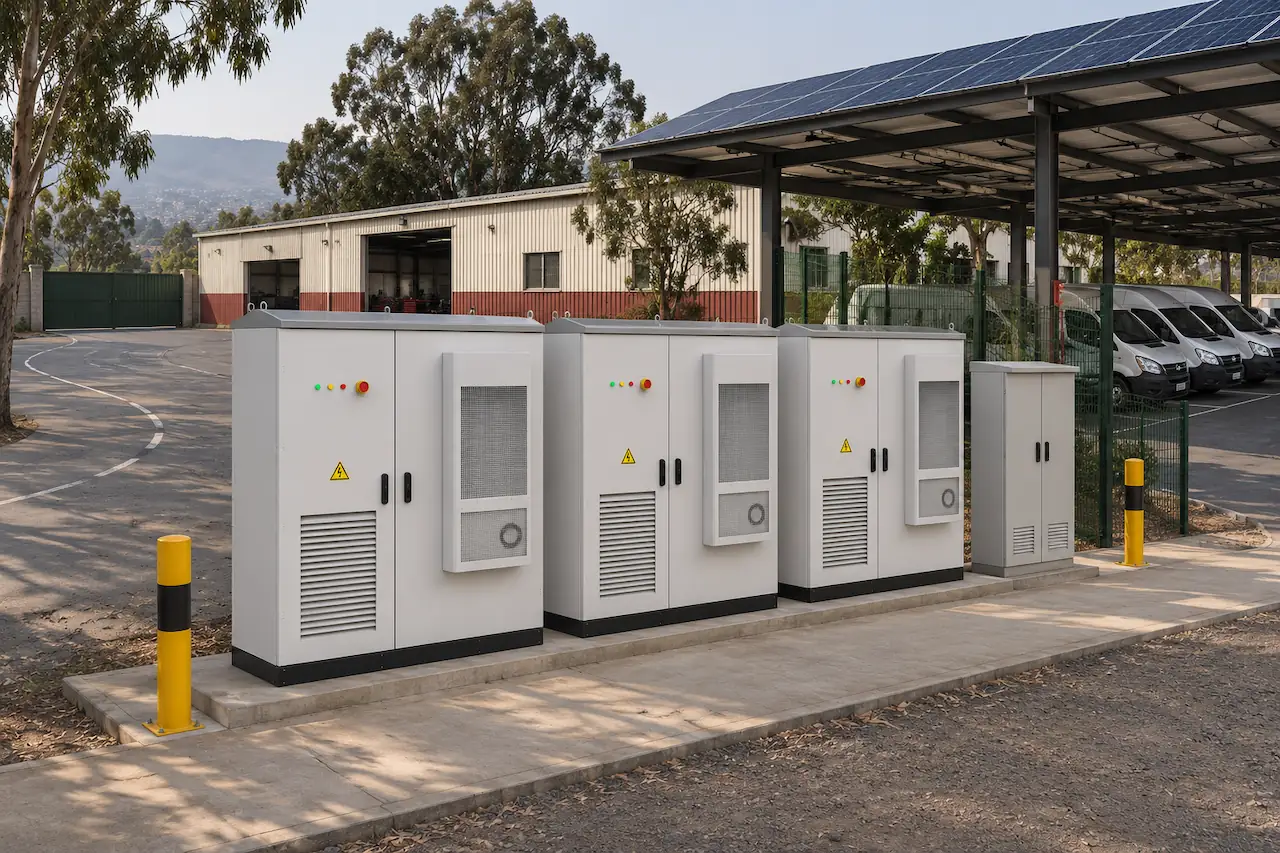
The equipment area contains three integrated cabinets. Each houses a 241 kWh battery, a 125 kW power conversion system (PCS) and a 120 kW solar input stage with maximum power point tracking (MPPT). The AC combiner brings the cabinet connections together, and the energy management system (EMS) monitors and coordinates the equipment. Leave working space and a route for servicing or replacing a cabinet when planning the yard. See KUNETIC's PV, storage and EV charging solution for the broader system options.
Set a power limit for the busy return window
The four DC chargers have a combined nameplate output of 480 kW at their outlets. The three storage cabinets have a combined PCS rating of 375 kW for power conversion. To set a charging limit, the design team needs to know what power is available from the grid, solar and storage and how much the rest of the depot uses.
When several vehicles return just before the next shift, the dispatch team can reserve the first slots for the earliest departures. Vehicles that stay longer can start as other sessions finish. The design team should verify whether the selected chargers and EMS can enforce the site's power limit during that overlap. It should also confirm how a charger shares power when both connectors are in use.
Check what the equipment budget covers
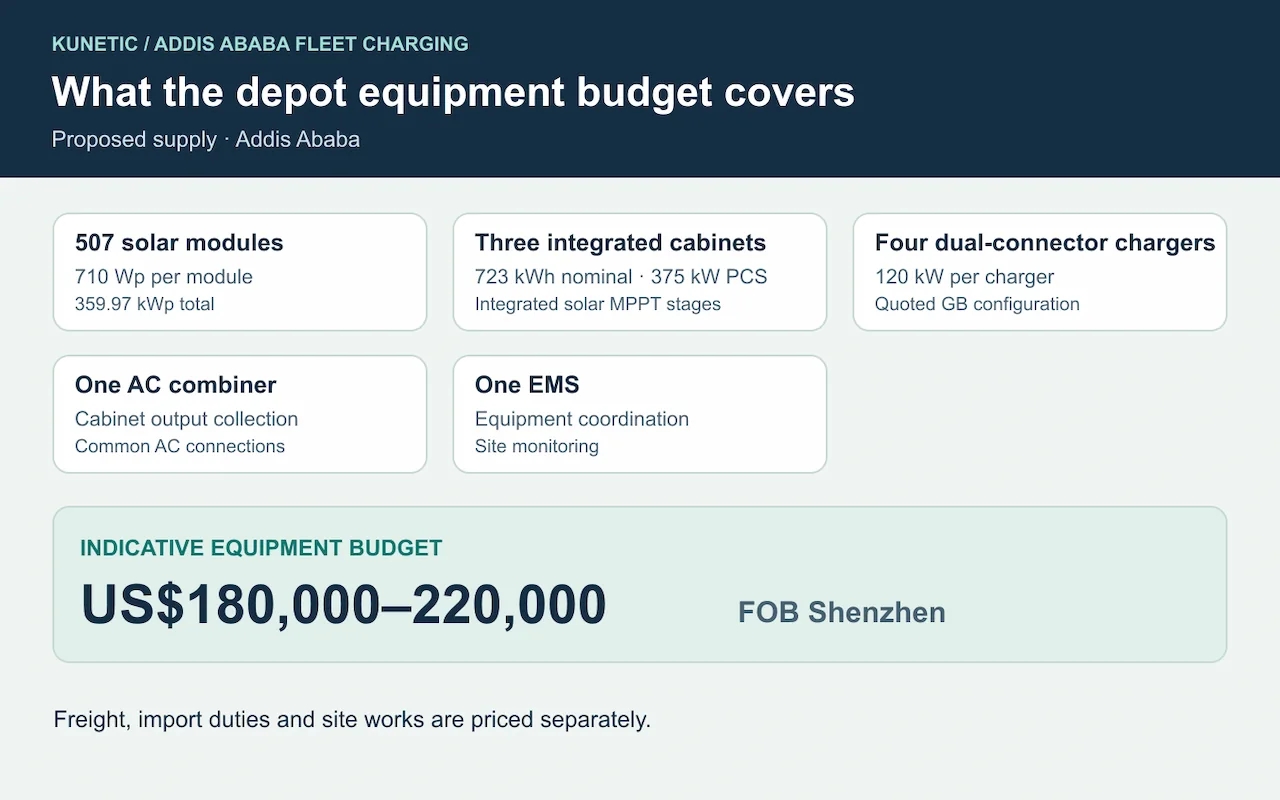
Allow US$180,000–220,000 FOB Shenzhen as an indicative equipment budget for the items below. Ask for separate prices for freight and import duties. The site team can price canopy and mounting structures, field cabling, civil works and installation once it has a layout.
| Item | Quantity | Proposed specification |
|---|---|---|
| PV modules | 507 | 710 Wp each, 359.97 kWp total |
| Integrated ESS cabinets | 3 | 241 kWh battery, 125 kW PCS and 120 kW MPPT per cabinet |
| AC combiner cabinet | 1 | Combines the cabinet connections |
| Energy management system | 1 | Site monitoring and equipment coordination |
| Dual-connector DC chargers | 4 | 120 kW nameplate per charger, quoted GB variant |
Send a fleet schedule for a site power review
Send a roster for a typical day, with extra detail for the busiest return window. For each vehicle, include its model, charging inlet and protocol, arrival and departure times, and how much energy it needs. If you have a site drawing, mark the grid connection and any other loads that share it. The team can use those details to assess how many vehicles can charge together and where to put the equipment.
If the site will also serve visiting vehicles, see the Kigali commercial parking case for a different site layout. Select Plan Your Fleet Charging Depot to send KUNETIC your fleet and site details.
Questions about fleet depot charging
Can eight vehicles charge at 120 kW each?
The four chargers offer eight connector positions and are rated at 120 kW per unit. Confirm whether the quoted model supports concurrent use on both connectors and how it divides power. Each vehicle's own charging limit and the available site power also affect what it receives.
How does battery storage support a busy charging window?
The battery can supplement available site power during overlapping sessions while it has usable energy, within the PCS and site limits. How long it can support a particular load depends on the usable charge at the start of that window, the demand and any reserve the operator wants to keep.
Will the proposed chargers work with my fleet?
The proposal specifies a GB charging interface. Before ordering, check the inlet and communication protocol on each vehicle model, along with its maximum charging power.
What is included in the equipment budget?
The range covers the modules, integrated storage cabinets, AC combiner, EMS and four DC chargers. Request separate prices for freight, duties and work at the site, including the canopy or mounting structures, field cabling and installation.