English

PROJECT DESIGN
Warehouse Battery Backup: An 860 kWh Design
The truck leaves in an hour. The orders are picked, but a few cartons still need labels and a final scan. If the power goes out now, the shipment could be held up by something as small as a label printer that won't reconnect.
This commercial battery backup design is for a distribution warehouse with that kind of dispatch window. Four battery cabinets provide 860 kWh of nominal storage. A 200 kW power conversion system (PCS) and a static transfer switch (STS) would allow the batteries to serve selected warehouse circuits during an outage.
Keep the dispatch window in view
Start at the loading bay and trace an order back through the warehouse. Ask the shift lead what needs to happen before the truck leaves. A staged pallet may only need a final scan and release in the warehouse system. An order still at the packing bench has a few more steps to go.
If the warehouse already has a procedure for moving cartons by hand or pallet jack, the team could finish a few urgent orders while parts of the conveyor are still stopped. Set the backup window around the time the crew needs to finish that work or bring it to a safe pause.
Decide which circuits need backup
At the packing bench, list what the operator needs to finish an order. Start with the label printer, scanner dock and workstation. Follow the network connection too. A powered bench still depends on the network equipment that handles shipment confirmation, even if it sits in another room. The site team can check whether any controls or IT devices need a local UPS to stay on through the transfer.
Check the conveyor separately. Its controls may need time to reset, and the motors may draw more power when they start than while they run. The facilities team can work with the conveyor supplier to confirm how it can restart and whether the order of startup matters. Loads such as forklift chargers can be considered for a later restart, leaving more battery capacity available for dispatch.

From the battery cabinets to the priority panel
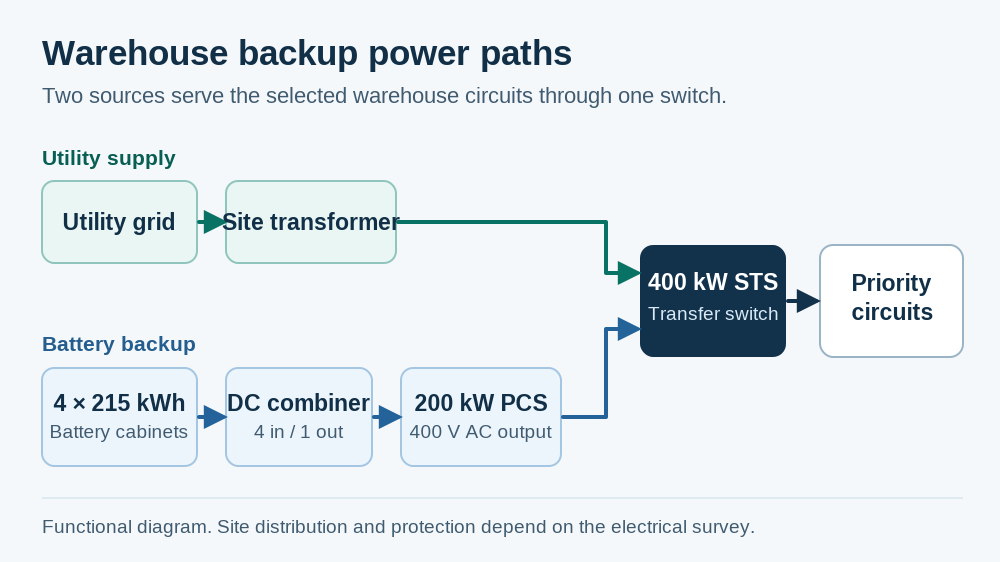
The battery energy storage system connects to the same transfer switch as the utility supply. The four battery cabinets feed a DC combiner, and the PCS converts battery power to 400 V AC. The transfer switch selects the source for the priority circuits. The site's electrical team would confirm which distribution panel serves those circuits and how it connects.
The PCS has a rated AC output of 200 kW. The 400 kW figure is the transfer switch rating. Backup power available to the loads also depends on the batteries' discharge limits and operating conditions. The small UPS in the DC combiner serves that assembly. Equipment that needs to stay on through a transfer should be checked at the load, including during transfer back to utility supply.
Size backup around the work that must continue
Measure demand during a normal dispatch window. Note which loads run together and which need to restart after an outage. First check whether the system can handle those loads and their startup peaks. Then work out how much energy they need over the backup window.
As a sizing example, selected loads averaging 120 kW for three hours would need 360 kWh at the load. The 860 kWh is the total nominal battery energy. To estimate the usable energy at the load, account for the expected state of charge when the outage begins, the agreed reserve, conversion losses and operating limits. A restart peak still needs a separate power check even if there is enough energy for the shift.
Find a service area away from loading traffic
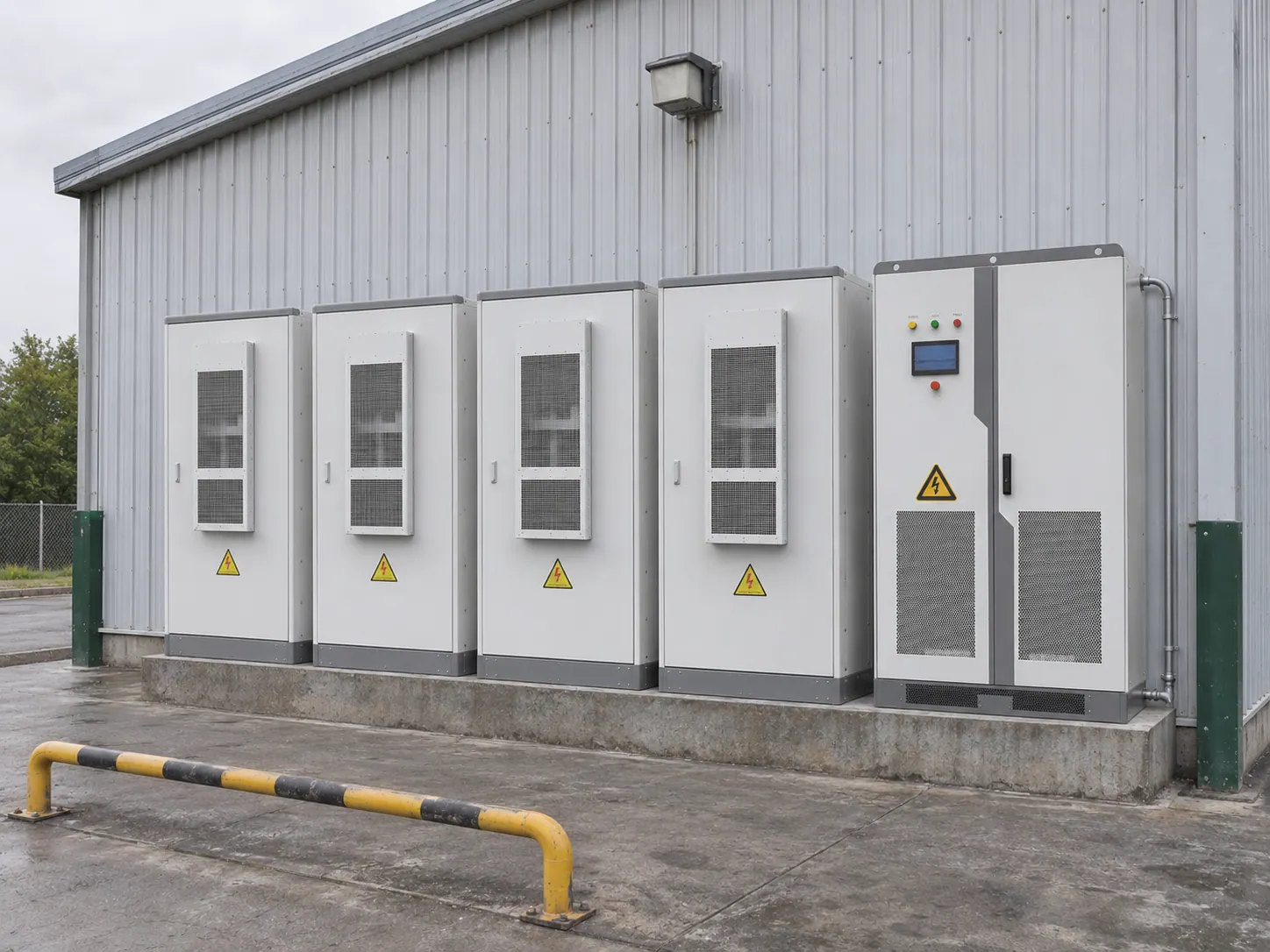
Walk the yard during a delivery. The usual turning path for a truck or forklift will tell you where a cabinet would get in the way. Look for a separate service area for the four battery cabinets, the PCS and transfer switch cabinet, and the DC combiner. Leave room for maintenance staff to reach the doors and for equipment to be brought in or replaced while the loading bays stay in use.
Follow the proposed cable route from that area to the switchboard. The electrical team can use the route and the equipment dimensions to check clearances, foundations, cable lengths and protection from vehicle impact. Those details help turn a cabinet layout into a plan the installation team can price and review.
Equipment scope and quotation
| Proposed supply | Quantity | Included in this design |
|---|---|---|
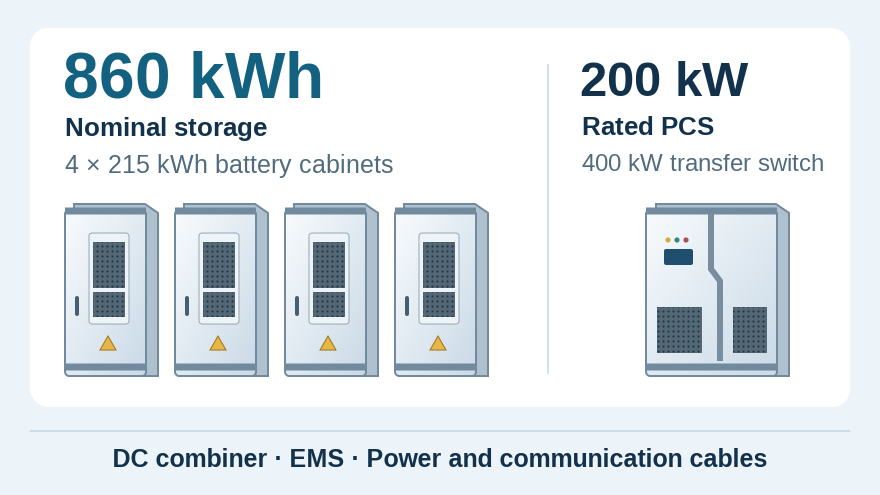
| Battery cabinets | 4 | 215 kWh nominal per cabinet, 860 kWh nominal total |
| PCS and STS cabinet | 1 | Two 100 kW PCS units, 200 kW rated in total, with a 400 V AC interface and a 400 kW STS |
| DC combiner assembly | 1 | Four battery inputs, one output, a BAU and a 1 kVA UPS |
| Energy management system | 1 set | Controller and cloud platform |
| Power and communication cables | 1 lot | Cable scope to be confirmed against the equipment layout and routing |
An indicative equipment budget for the package above is US$135,000–155,000, based on tax-inclusive equipment supply. Freight, import charges, a site transformer, distribution upgrades, installation, and commissioning are scoped separately.
Plan the next site review
Bring a recent single-line diagram, the supply voltage and a list of the circuits you want to keep running. Include measured demand and any conveyor startup data, the backup window your dispatch team needs, and photos or dimensions of the proposed equipment area. Those are the inputs KUNETIC can use to check the power and energy requirements and prepare an equipment quote. For more on backup power for warehouses, explore warehouse and logistics battery storage.
Frequently asked questions
Can this system back up the whole warehouse?
It is sized around selected circuits in this design. To assess wider coverage, check the loads that would run together, their starting demands and the site distribution. The PCS rating provides a starting point for that assessment.
How long can the 860 kWh battery support a shift?
It depends on the work you want to keep going and the battery energy available at the start of the outage. Provide a load profile for the target dispatch window so the system can be assessed with reserve, losses and operating limits included.
Will the conveyors keep running during a power cut?
That depends on how the drive and controls handle a transfer and how the line restarts. Check the acceptable interruption, motor startup demand and restart sequence with the conveyor supplier. The site test should include both transfer and return to utility power.
What affects the equipment quote?
The priority loads, AC connection and equipment layout determine the configuration and cable scope. Site distribution changes, installation and freight depend on the warehouse location and the agreed supply terms.