
 English
 Deutsch
 Español
 Français
 Italiano
 Polski
 Română
 العربية

Use more of your solar power
Store surplus daytime generation for evening lighting, office equipment and other site loads instead of relying on immediate solar production.
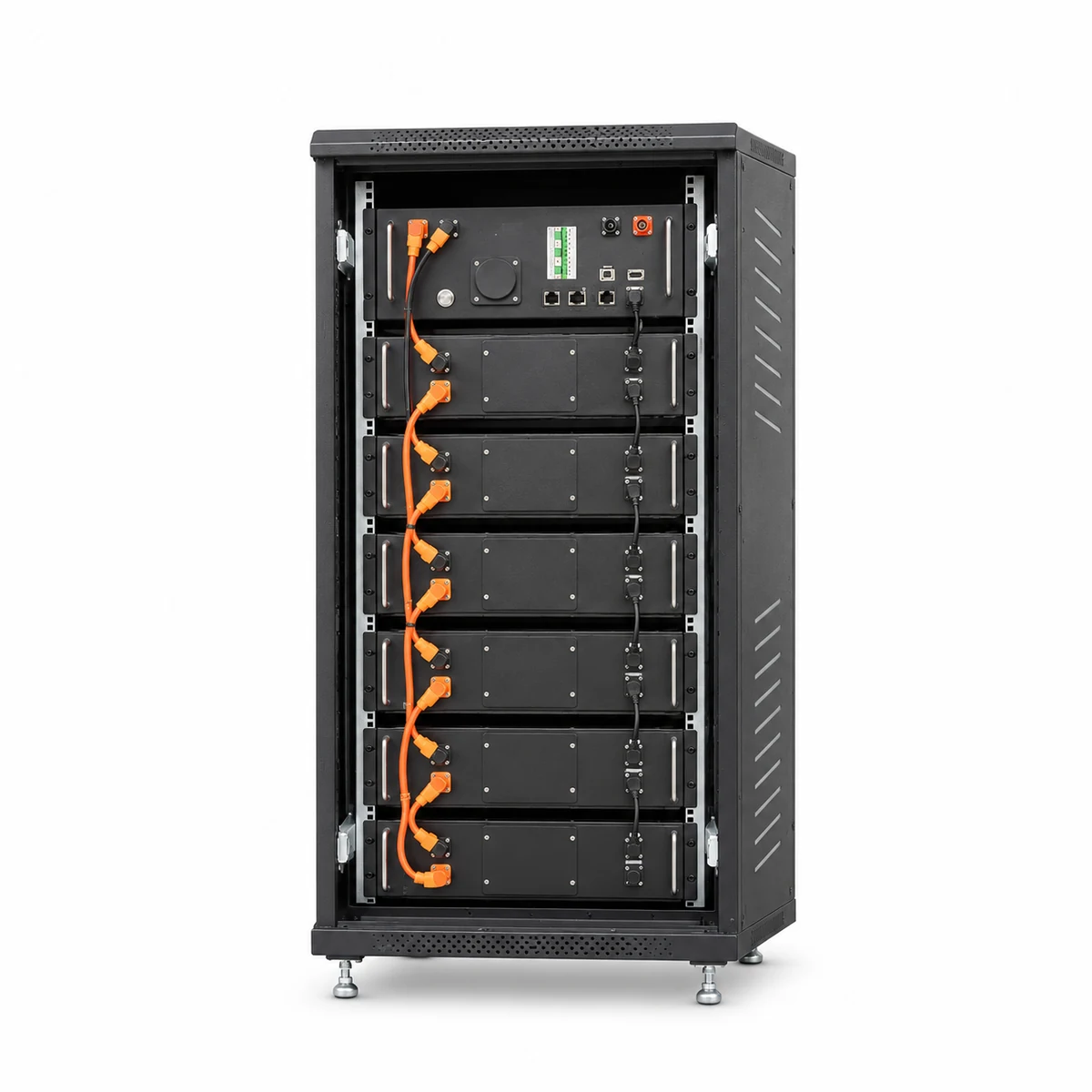
Indoor solar battery storage
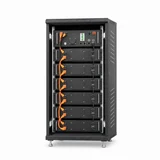
Store solar power for the hours your business needs it. This 30kWh battery has 30.72kWh of nominal LFP energy. Six 5.12kWh modules and a high-voltage control unit fit into one indoor rack. Choose from 20.48 to 51.20kWh across the series. Capacity and voltage change together. Match the rack to a suitable external inverter for a shop, workshop, office or farm building. The 3U modules keep the battery organized and accessible for maintenance.
 30.72 kWh Featured Configuration
 20–51 kWh Nominal Energy Options
 204.8–512 V Nominal DC Options 100 Ah LFP Module Capacity
For your working day
A small commercial battery storage system needs to fit both the working day and the available space. Keep surplus rooftop generation for later use, or plan a battery reserve for selected essential equipment with a suitable backup-capable inverter.
Store surplus daytime generation for evening lighting, office equipment and other site loads instead of relying on immediate solar production.
Seven configurations offer 20.48–51.20kWh of nominal storage. Compare the required energy, battery voltage and cabinet height together.
Rack-mounted modules, a high-voltage control unit and accessible front connections bring the battery side together in one indoor cabinet.
Choose energy and voltage together
The series uses 51.2V, 100Ah LFP modules connected in series. Adding modules increases both stored energy and system voltage. For the 30kWh class, six modules provide 30.72kWh at 307.2V nominal.
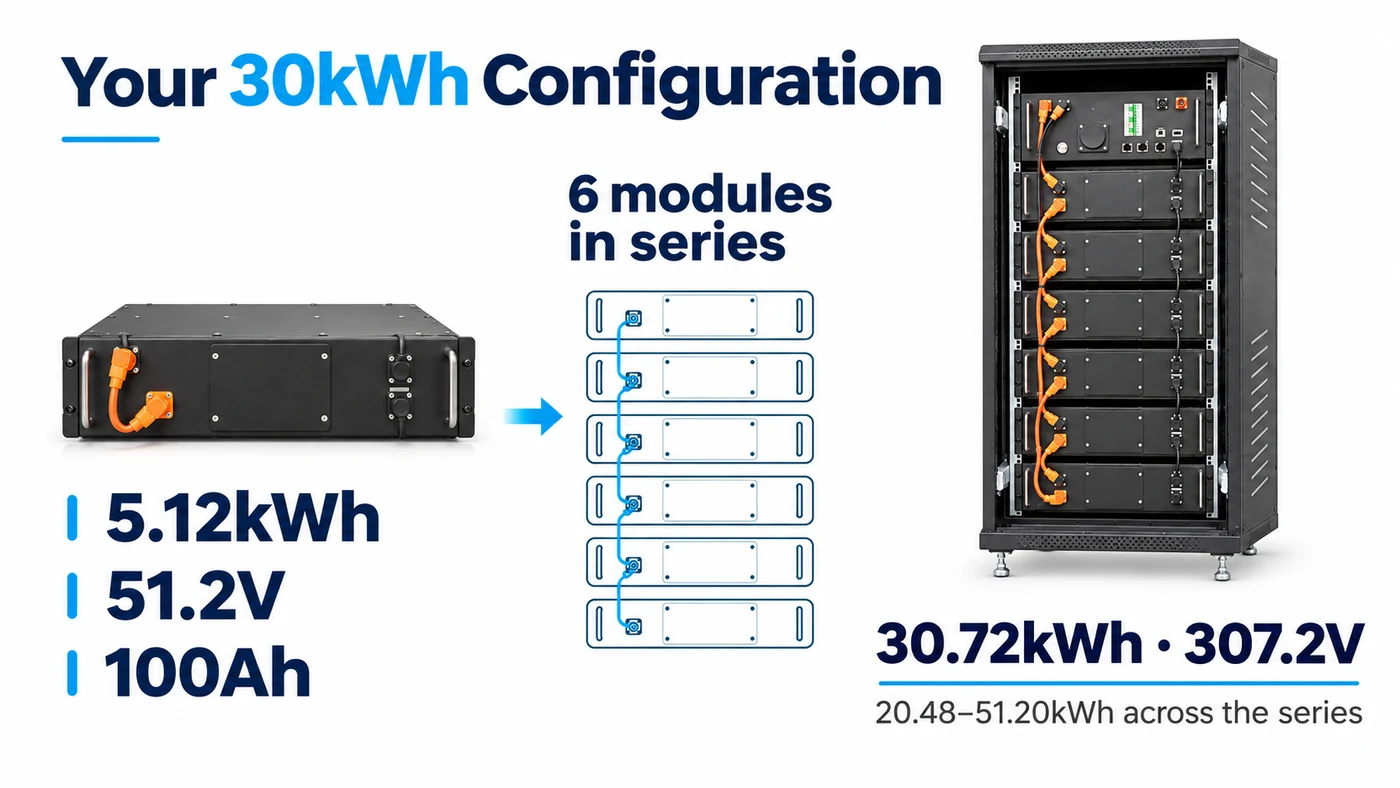
4 modules · 791mm cabinet height
6 modules · 1091mm cabinet height
10 modules · 1691mm cabinet height
The smallest configuration offers 20.48kWh at 204.8V; the largest offers 51.20kWh at 512V. Choose a configuration that matches the inverter’s full battery operating-voltage range, charge/discharge current and communication requirements.
Choose the rack for your expected daily storage needs. If you plan to add modules later, check that the inverter and BMS can support the higher battery voltage.
Accessible by design
The cabinet uses 3U rack-mounted modules in a standard 19-inch arrangement. Front-facing handles, connections and control equipment give service teams direct access for inspection and maintenance.
Each module has a nominal voltage of 51.2V and a capacity of 100Ah. The 30.72kWh configuration uses six modules beneath the high-voltage control unit.
The battery management system (BMS) monitors the battery and manages protection against overcharge, overdischarge, overcurrent and high or low temperature. Cell balancing supports coordinated operation across the series-connected modules.
CAN 2.0 and RS485 provide battery communication interfaces. Match the inverter protocol as well as the electrical ratings for reliable system integration.
Battery + inverter + business loads
Pair the rack with a compatible high-voltage hybrid inverter or power conversion system (PCS) to supply AC power to your site. A hybrid inverter can also use rooftop solar to charge the battery while supplying business loads.
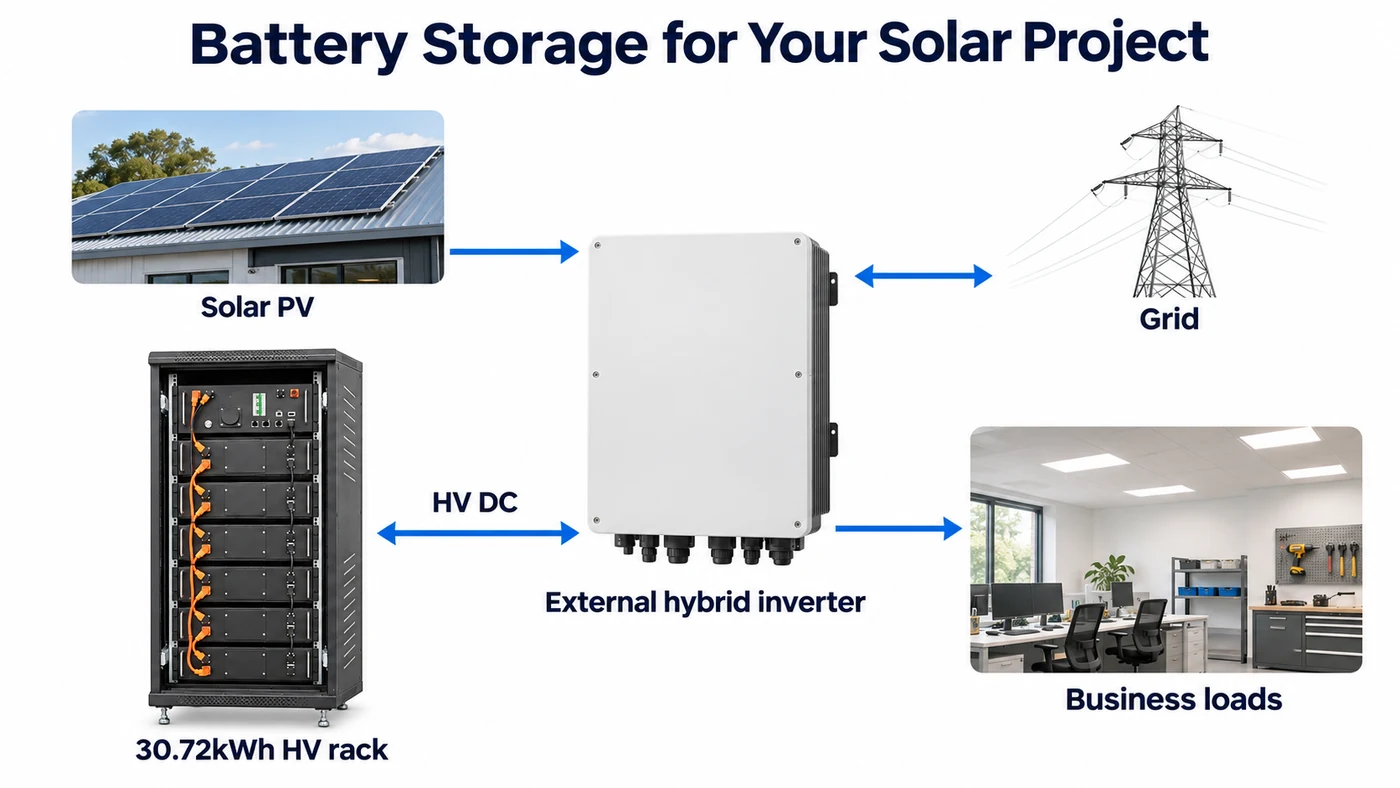
The 30.72kWh / 307.2V configuration operates across a battery range of 278.4–340.8V. Use that complete range when checking inverter compatibility. The same series supports recommended 50A charge/discharge current and a maximum of 100A; the selected inverter and operating conditions also determine available power.
For backup power, plan the critical-load circuits and an appropriate inverter with the required switching equipment. Send your inverter model, installation country and main loads, and KUNETIC can help you select the battery configuration and matching system equipment.
Small commercial applications
This indoor lithium battery cabinet can sit in a suitable utility room close to the building’s electrical equipment. Store rooftop solar for a shop’s evening opening hours, supply office equipment after solar output falls, or plan storage for selected workshop and farm-building loads.
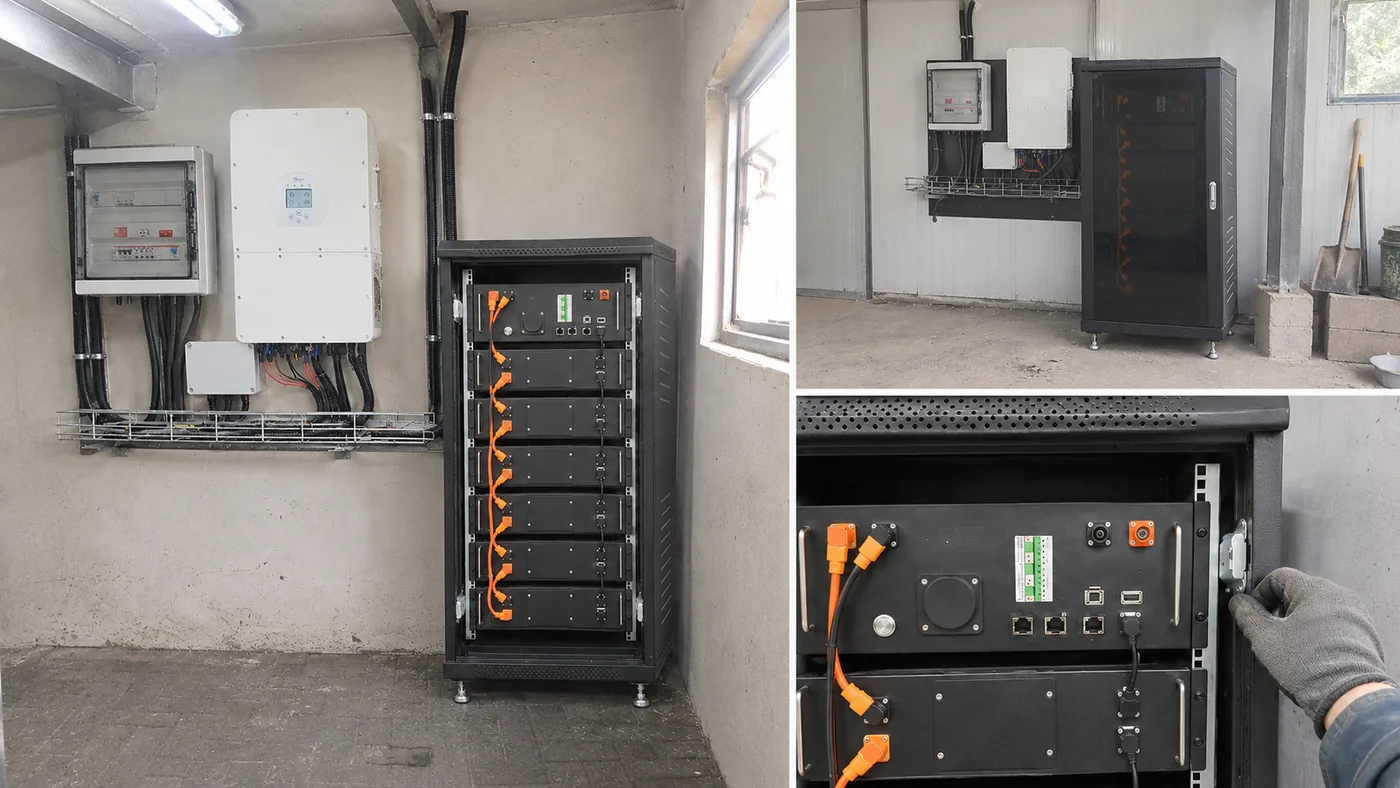
Keep the IP20 cabinet indoors in a dry, protected equipment area, with suitable ventilation and maintenance access. The stated charging range is 0–50°C and the discharging range is −20–55°C.
A useful first calculation
Start with the loads you want to supply and the hours they need to run. A 30.72kWh battery at the recommended 90% depth of discharge represents about 27.65kWh on the battery side, before inverter losses, auxiliary consumption and any reserve you choose to keep.
Nominal battery energy
Recommended depth of discharge
Battery-side energy before losses
At a steady 5kW load, that energy-to-load calculation is about 5.5 hours before those allowances. Actual AC runtime is shorter and changes with the load profile, temperature, inverter efficiency and settings. Battery capacity describes stored energy; it does not mean the system has a 30kW AC output.
Technical data
Compare capacity, voltage and cabinet height across the seven configurations. The module, current and installation data below apply across the series.
| Capacity and voltage configurations | |||
|---|---|---|---|
| Battery modules | Nominal energy | Nominal voltage | Cabinet height |
| 4 | 20.48kWh | 204.8V | 791mm |
| 5 | 25.60kWh | 256V | 941mm |
| 6 | 30.72kWh | 307.2V | 1091mm |
| 7 | 35.84kWh | 358.4V | 1241mm |
| 8 | 40.96kWh | 409.6V | 1391mm |
| 9 | 46.08kWh | 460.8V | 1541mm |
| 10 | 51.20kWh | 512V | 1691mm |
| Module, electrical and installation data | |||
| Battery chemistry | Lithium iron phosphate (LFP) | ||
| Module energy / capacity | 5.12kWh / 100Ah | ||
| Module nominal voltage | 51.2V | ||
| Recommended charge / discharge current | 50A | ||
| Maximum charge / discharge current | 100A | ||
| 30.72kWh battery operating range | 278.4–340.8V | ||
| Communication | CAN 2.0 / RS485; Wi-Fi options on request | ||
| Enclosure / location | IP20 / dry, protected indoor installation | ||
| Charging temperature | 0 to 50°C | ||
| Discharging temperature | −20 to 55°C | ||
| Width × depth | 538 × 492mm | ||
| Recommended depth of discharge | 90% | ||
| Battery modules / installation | 3U / standard 19-inch rack arrangement | ||
| Storage temperature | 0 to 35°C | ||
| Relative humidity / altitude | 5–85% RH / ≤2000m | ||
| Power conversion | Compatible external high-voltage inverter or PCS | ||
 Technical Data
Downloads
Get capacity, battery-voltage, cabinet-dimension and operating data for your preferred configuration. Include your inverter or PCS model if you would like help selecting a matching battery rack.
FAQ
The 30kWh-class rack has 30.72kWh of nominal energy: six 5.12kWh LFP modules in series at 307.2V. The series offers 20.48–51.20kWh options.
The cabinet is a high-voltage battery system. It works with a compatible external hybrid inverter or PCS, selected for the site. Battery capacity and inverter AC output are separate specifications.
Check the inverter’s full battery-voltage range, current limits and communication protocol. For the 30.72kWh rack, the operating range is 278.4–340.8V. Share the inverter model with KUNETIC for a matching review.
This series has an IP20 enclosure and is intended for a dry, protected indoor equipment area. If the project needs outdoor battery placement, ask about an outdoor-rated cabinet or an alternative battery series.
Runtime depends on the loads and usable battery energy. At 90% depth of discharge, the 30.72kWh configuration has about 27.65kWh of battery-side energy before conversion losses and reserve. Divide by the expected load, then allow for the inverter, temperature and operating settings.
The series has four- to ten-module configurations. Changing module count also changes system voltage, so expansion needs a compatible inverter range, BMS arrangement and battery configuration. Plan the required capacity with KUNETIC before ordering additional modules.
Yes, as part of a suitably configured system. The external inverter or site controls manage solar charging and discharge schedules. Backup operation also needs an appropriate inverter, critical-load arrangement and switching equipment.
OEM / ODM support
Work with KUNETIC to select the battery configuration and arrange documentation or packaging for your project. OEM/ODM options are available for installers, distributors and commercial customers.
Choose the rack capacity and battery voltage alongside the intended inverter or PCS and site application.
Discuss private-label requirements, technical documents and packaging for your sales channel.
Share your installation location, electrical requirements and delivery needs to develop a practical supply proposal.
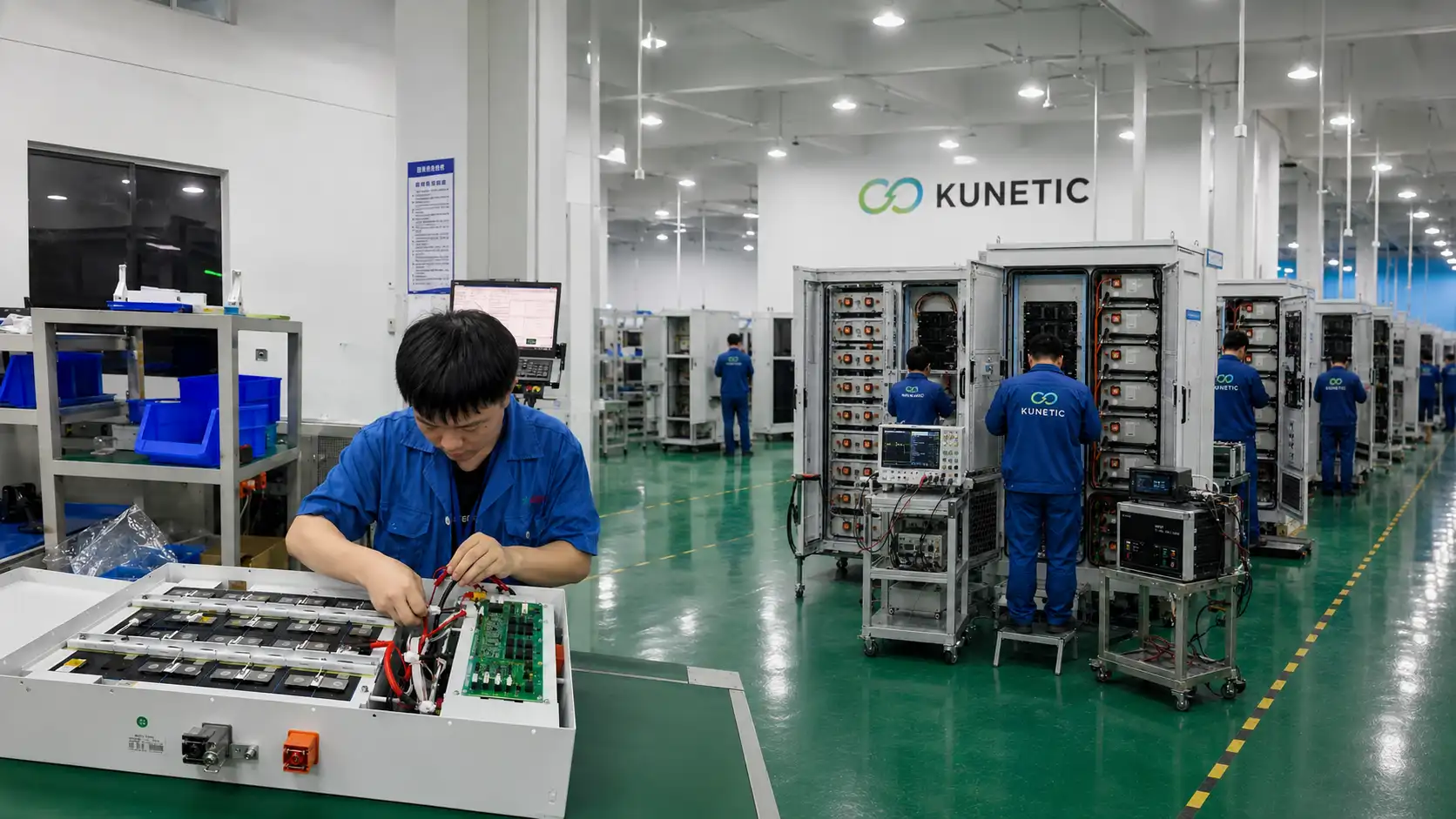
Tell us your daily storage target, essential loads, installation country and inverter model. We can help you compare the 20.48–51.20kWh configurations and select a suitable high-voltage rack for your project.
30kWh Battery for High-Voltage Solar Storage
Datasheet request
Request received. We will send the datasheet shortly.
30kWh Battery for High-Voltage Solar Storage
Product inquiry
Tell us about your site load, PV capacity, backup requirements, or target project size. Our engineers will help configure the right system for your needs.
Inquiry received. Our team will respond shortly.