
 English
 Deutsch
 Español
 Français
 Italiano
 Polski
 Română
 العربية

Module platform
314Ah LFP modules
Build around one 314Ah LFP platform, with approximately 16.08kWh and 51.2V per module. Choose six to fifteen modules to match your target battery capacity and voltage.
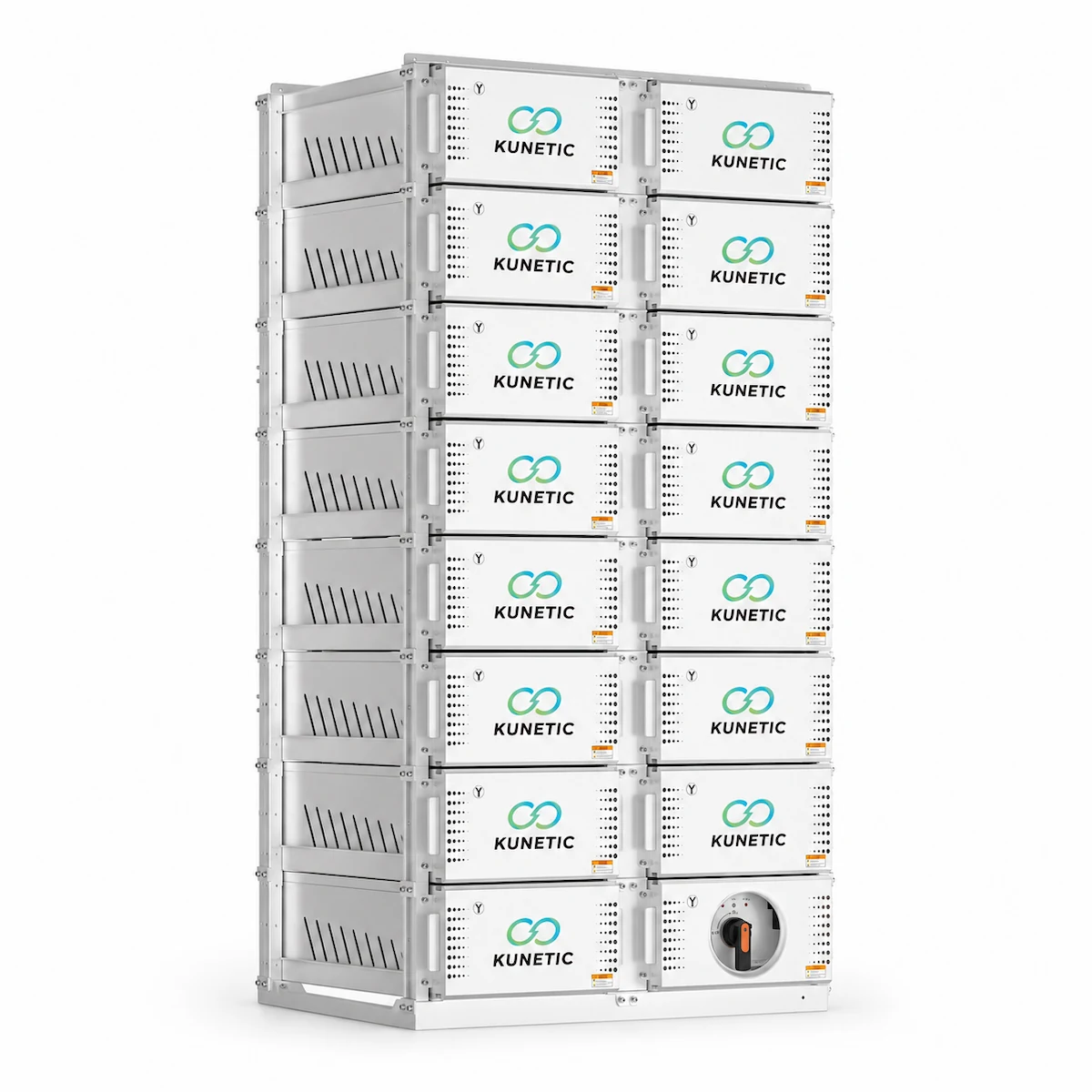
MODULAR COMMERCIAL STORAGE
Store more of your solar energy for the hours your business needs it. This stackable battery offers approximately 96–241kWh of LFP storage, with ten module configurations for factories, warehouses and commercial buildings. Choose a high voltage battery configuration to suit your site, then pair it with a matched inverter or PCS. The 314Ah modular platform brings battery management, fan cooling and CAN communication into one indoor assembly.
96–241 kWh Nominal Battery Energy  307.2–768 V Nominal DC Voltage 314 Ah LFP Platform 6–15 modules Capacity Configurations
Storage capacity, your choice
A workshop shifting midday solar into an evening shift needs a different energy reserve from a warehouse covering a longer operating period. Choose from six to fifteen battery modules, rather than fitting every site to one fixed battery size.
Each configuration uses the same 314Ah LFP platform. Adding modules in series increases both stored energy and DC voltage; the system remains 314Ah. These three examples show the relationship. All ten configurations are listed in the technical table below.
Select usable energy around the load and operating hours you want to cover. The inverter or PCS determines AC power delivery, so a 160kWh battery is not a 160kW power system. KUNETIC can help match both sides using your load profile and existing equipment.
Inside the battery
The stackable construction combines LFP battery modules with a dedicated control unit. Individual module enclosures, ventilation openings and an accessible rotary disconnect give the assembly a clear, practical layout.
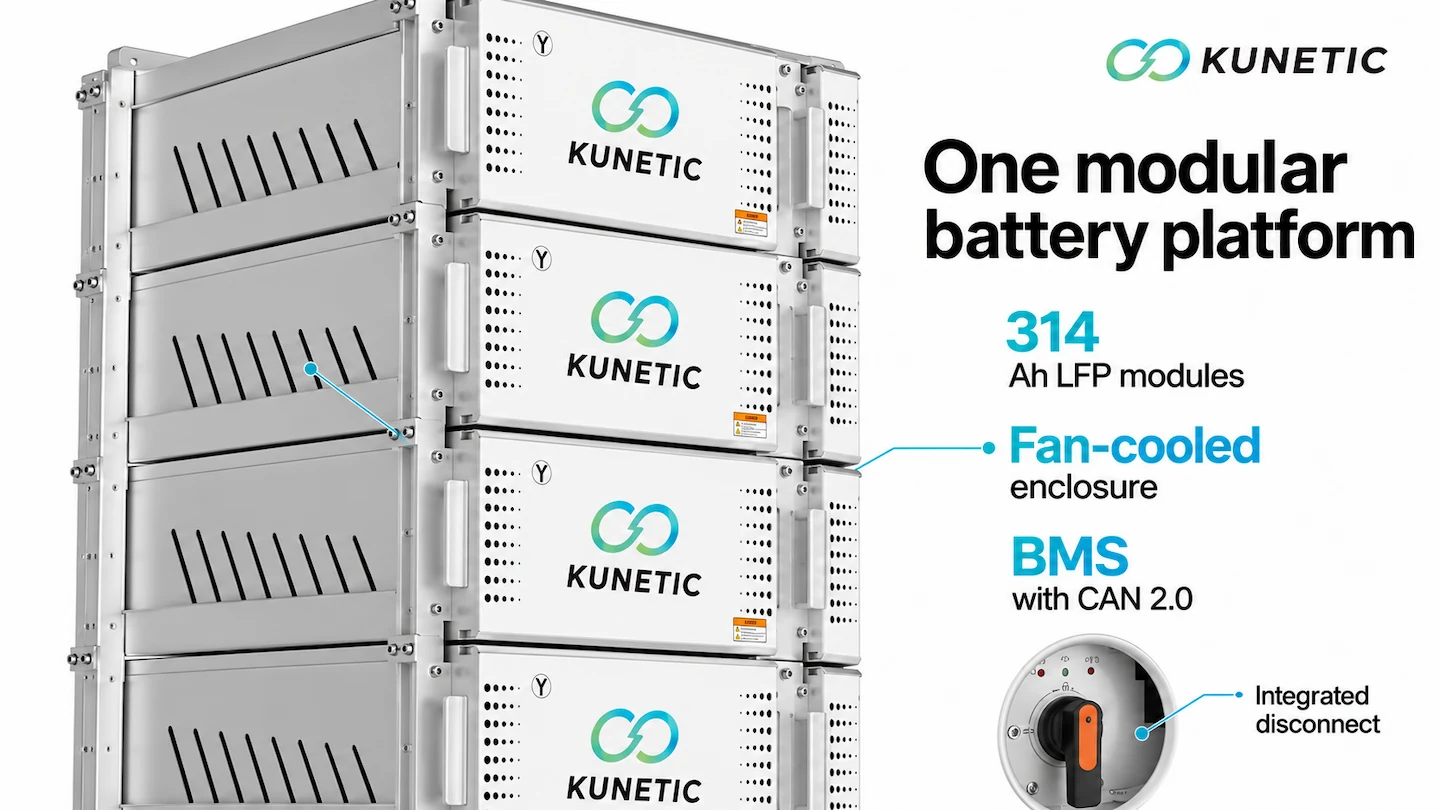
Module platform
Build around one 314Ah LFP platform, with approximately 16.08kWh and 51.2V per module. Choose six to fifteen modules to match your target battery capacity and voltage.

Battery management
The BMS communicates with matched conversion equipment through CAN 2.0. KUNETIC can review the communication match using your inverter or PCS model. Active balancing is available as an option.

Thermal management
Fan cooling and ventilation openings support indoor operation. Position the IP20 assembly in a protected equipment area with clear air paths and enough space for routine access.

Service access
Separate module enclosures and an accessible rotary disconnect give installers a clear equipment layout. Plan the service aisle and control access around the selected assembly.
Commercial solar + storage
For commercial solar battery storage, pair this series with a suitable high-voltage inverter or PCS. Store surplus solar generation for use later in the working day. Where demand charges apply, suitable controls can also discharge stored energy during peak demand. Choose the operating strategy around your tariff and load profile.

The battery is the DC energy-storage part of the system. Power conversion, PV inputs, metering and any backup switching come from the selected system equipment. For an existing solar installation, KUNETIC can review whether an AC-coupled arrangement or a compatible hybrid inverter offers a suitable route.
Store available daytime solar for later working hours. Match battery capacity to your surplus generation and the loads that will use the stored energy.
Choose stored energy and AC power around your operating schedule. Match the inverter or PCS to the battery's full DC voltage window, 157A rated current and BMS communication.
Support selected essential loads with suitable islanding equipment, switching and controls. Use their power, starting demand and required operating hours to size the complete backup system.
Plan the space
Place the two-column assembly in a protected indoor equipment area. A factory electrical annex, warehouse service area or dedicated battery room can keep storage close to the site's electrical infrastructure while leaving space for access and ventilation.
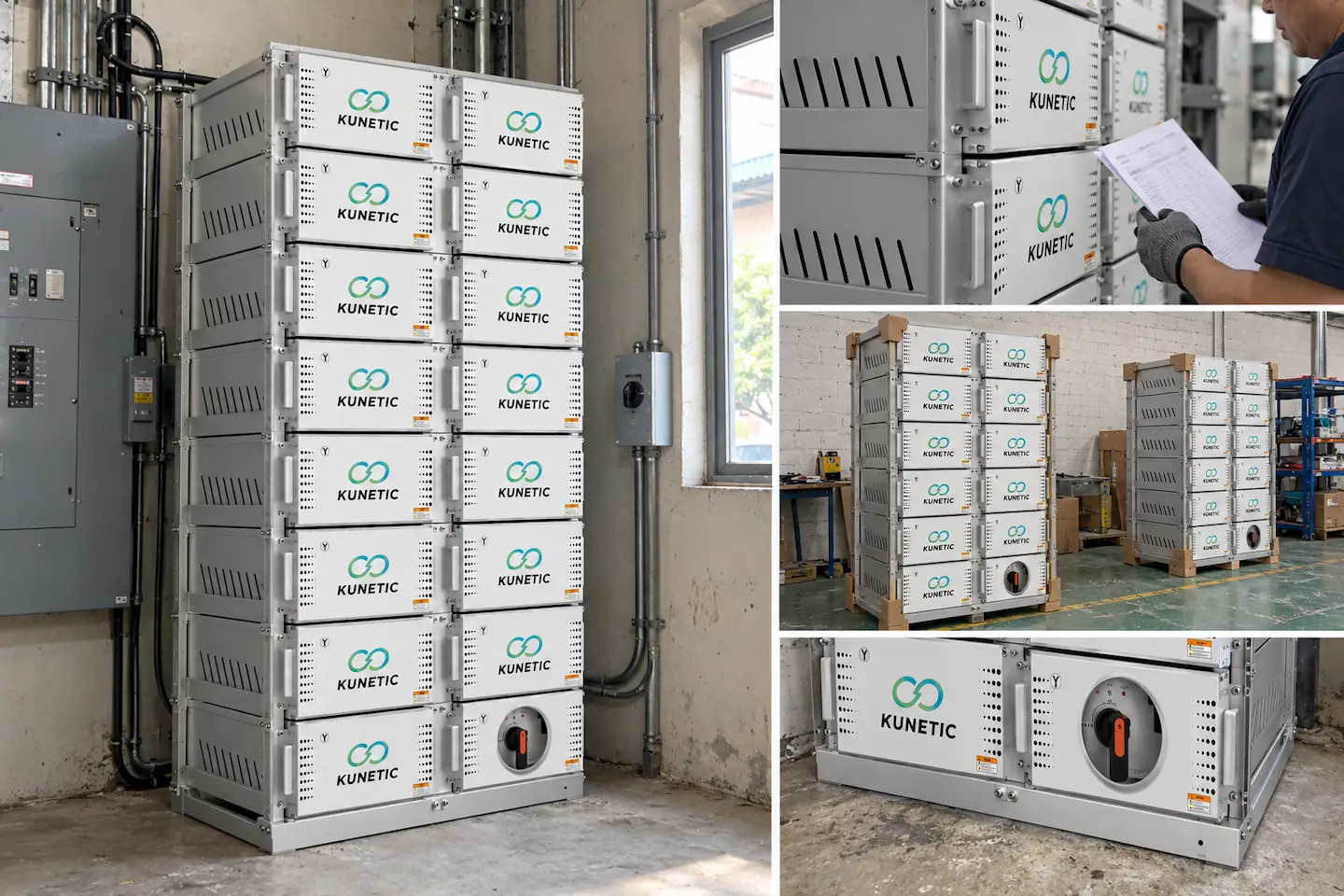
Check the delivery route, floor loading and handling equipment before choosing the final position. Leave working space around the controls and ventilation paths. The largest assembly measures approximately 1050 × 831 × 2070mm. Allow extra space for installation and service access.
Send KUNETIC a room sketch or photographs with your target capacity. We can help develop a configuration and equipment arrangement that suits the available space, access route and power system.
Discuss your installation →OEM / ODM support
Build your commercial battery project around the capacity, site equipment and branding you need. KUNETIC offers configuration and private-label support, from module selection and technical documents to packaging and delivery planning.
Choose from the ten 96–241kWh configurations. Plan the module count, DC voltage window and equipment arrangement around your site's energy requirement.
Review the external inverter or PCS together with the battery voltage, current limits and CAN 2.0 communication. Include the equipment model when requesting a proposal.
Discuss KUNETIC or private-label presentation, module-front branding and project documentation. Align labels, configuration data and technical information with your intended market.
Coordinate packing and handling requirements around the selected assembly and delivery route. Share access constraints early so transport and on-site handling can be planned together.
Technical data
Compare the configuration first, then check the electrical and indoor installation requirements. Energy values below are nominal battery ratings; usable energy depends on the selected operating window.
| Capacity configurations | |||
|---|---|---|---|
| Modules | Nominal energy (kWh) | Nominal DC voltage (V) | DC voltage window (V) |
| 6 | 96.46 | 307.2 | 268.8–345.6 |
| 7 | 112.54 | 358.4 | 313.6–403.2 |
| 8 | 128.62 | 409.6 | 358.4–460.8 |
| 9 | 144.69 | 460.8 | 403.2–518.4 |
| 10 | 160.77 | 512 | 448–576 |
| 11 | 176.84 | 563.2 | 492.8–633.6 |
| 12 | 192.92 | 614.4 | 537.6–691.2 |
| 13 | 209.00 | 665.6 | 582.4–748.8 |
| 14 | 225.08 | 716.8 | 627.2–806.4 |
| 15 | 241.15 | 768 | 672–864 |
| Electrical and battery platform | |||
| Cell chemistry | Lithium iron phosphate (LFP) | ||
| Battery capacity | 314Ah | ||
| Module rating | Approximately 16.08kWh / 51.2V | ||
| Rated charge/discharge current | 157A | ||
| Maximum charge/discharge current | 165A | ||
| Overload capability | 170A for 10 seconds at 25°C | ||
| Recommended depth of discharge | 90% | ||
| Battery communication | CAN 2.0 | ||
| Active balancing | Optional | ||
| Inverter / PCS | Selected separately to match the battery and site | ||
| Indoor installation and environment | |||
| Ingress protection | IP20, indoor installation | ||
| Cooling | Fan cooling | ||
| Operating temperature | −10 to 55°C | ||
| Storage temperature | 0 to 35°C | ||
| Relative humidity | ≤95%, non-condensing | ||
| Installation altitude | ≤2000m | ||
| Largest assembly envelope | Approximately 1050 × 831 × 2070mm; allow additional service space | ||
 Technical Data
Downloads
Get the technical data for your preferred capacity and voltage. Include your inverter or PCS model and installation location so we can help you compare the relevant configuration.
FAQ
It uses repeated battery modules assembled into a high-voltage system. This series offers six to fifteen modules, giving approximately 96–241kWh of nominal storage. Plan professional installation and suitable lifting and handling equipment for the selected assembly.
That depends on the inverter's battery voltage range, current limits and BMS protocol. A conventional grid-tied solar inverter may require a separate battery PCS. Send the inverter model and the target battery capacity to KUNETIC so we can review a suitable integration route.
Begin with the energy your selected loads use during the period you want to cover. A steady 20kW load over four hours needs 80kWh delivered to those loads. Battery sizing must also allow for the usable discharge window, conversion losses, reserve and auxiliary consumption. The PCS must support the load's power and starting demand.
Plan future capacity when selecting the initial system. More series modules change the DC voltage as well as stored energy, so later changes need a review of the inverter or PCS limits, BMS configuration and battery condition. Tell KUNETIC your future target so the initial design can account for it.
This IP20 series is designed for a protected indoor location. Keep it out of rain, condensation and uncontrolled outdoor exposure. If your project needs an outdoor system, ask KUNETIC about a purpose-built outdoor battery cabinet instead.
Tell us your target storage capacity, installation country and the loads you want to support. If you already have solar panels or an inverter, include the equipment model or a system drawing. KUNETIC will help you select a battery configuration and suitable system equipment.
KUNETIC 96–241kWh Commercial High Voltage Stackable Battery
Datasheet request
Request received. We will send the datasheet shortly.
KUNETIC 96–241kWh Commercial High Voltage Stackable Battery
Product inquiry
Tell us about your site load, PV capacity, backup requirements, or target project size. Our engineers will help configure the right system for your needs.
Inquiry received. Our team will respond shortly.