
 English
 Deutsch
 Español
 Français
 Italiano
 Polski
 Română
 العربية

Table of Contents
A 10kW solar system could use 25 panels rated at 400 W each. Your location and roof determine how much electricity those panels produce. If you’re pricing a 10kW solar system with battery backup, list what needs to stay on and for how long before you choose a battery.
How Many Panels Do You Need for a 10kW Solar System?
Divide 10,000 watts by the wattage of one panel. At 400 W per panel, you need 25. At 450 W, 22 panels give you 9.9 kW and 23 give you 10.35 kW. Ask for a roof layout. Check where shade falls and how much space the panels leave around vents and roof edges.
The DC array rating adds up the panel ratings. The AC inverter rating tells you how much AC power the inverter can deliver. An installer may pair a 10 kW array with an inverter rated below 10 kW AC. Compare both ratings when you look at quotes.
How Much Electricity Does a 10kW Solar System Produce?
In a PVWatts example, a 10 kW rooftop array produces about 17,800 kWh per year in Phoenix and 11,000 kWh in Seattle. Both estimates use a south-facing roof at a 25° tilt, 14% system losses and a DC-to-AC ratio of 1.2.
The Seattle example produces about 430 kWh in January and 1,420 kWh in July. That’s why I’d compare the estimate for your address with a full year of bills, month by month. Do you use most of your electricity after sunset? Ask how much solar energy you can use during the day and where the surplus would go.
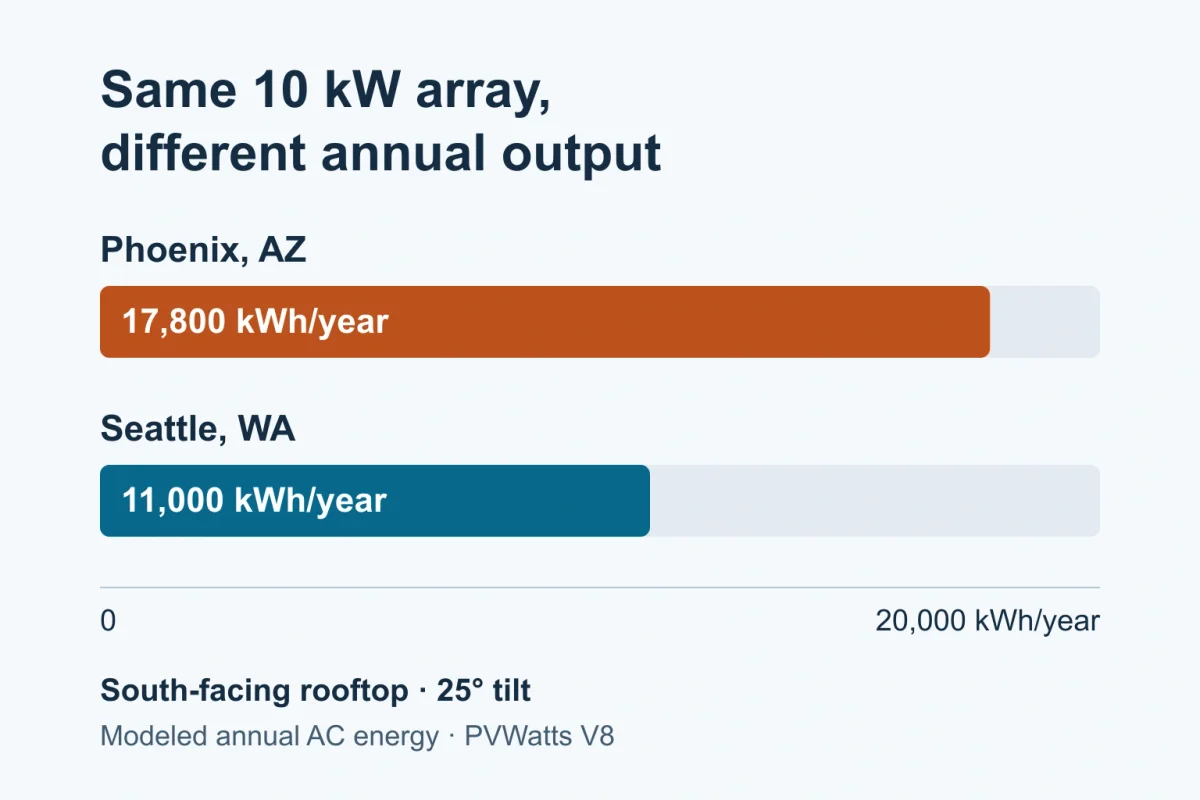
Modeled annual electricity production for the same 10 kW rooftop configuration in two U.S. cities. Source: PVWatts V8.
How Much Does a 10kW Solar System Cost?
For a U.S. reference point, the Department of Energy’s Q1 2025 benchmark modeled an installed 8 kW residential rooftop system at about $23,600 for solar alone and $36,700 with 13.5 kWh of storage, before incentives payable to the owner and in 2024 dollars. Use that example to see how storage changes the scope of a quote. For a 10 kW project, ask for a price based on your roof, equipment and local labor.
Check whether each quote covers racking, electrical work, permits, installation and commissioning. Compare the installed solar price per watt using the DC array rating, then price the battery and related equipment separately.
Compare Three Quotes for the Same Solar Array
Configuration | What the quote should list | What happens during an outage |
Grid-tied solar | Panels, grid-tied inverter, mounting and installation | A standard grid-tied system shuts down when the grid goes out. |
Solar with battery-ready inverter | Panels, compatible hybrid inverter and the equipment included today | Ask which battery, controls and transfer equipment you would need to add for backup. |
Solar with battery backup | Compatible battery, backup-capable inverter, required isolation or transfer equipment, and the circuits covered | The designated circuits can run within the system’s power and energy limits. Ask whether solar can recharge the battery during an outage. |
If you plan to add storage later, ask which battery models work with the hybrid inverter and what the installer would need to add.
How Much Battery Storage Do You Need for Backup?
Say your fridge, lights and other priority loads average 1.2 kW and you want to run them for six hours. They need 7.2 kWh at the loads. Ask how much energy the system can deliver after its reserve setting and conversion losses. Also check its continuous backup output and startup power, especially if you need to run a pump or compressor. Use that load list to compare solar battery backup configurations.
Where a Three-Phase All-in-One System Fits
For a site with compatible three-phase service, the KUNETIC K-ESS-10-3P is one example. It has a 10 kW rated AC inverter and 9.6 or 19.2 kWh of nominal battery energy, depending on the configuration. Have your installer check the local service voltage and phase, then confirm the available backup output and usable energy for your loads.
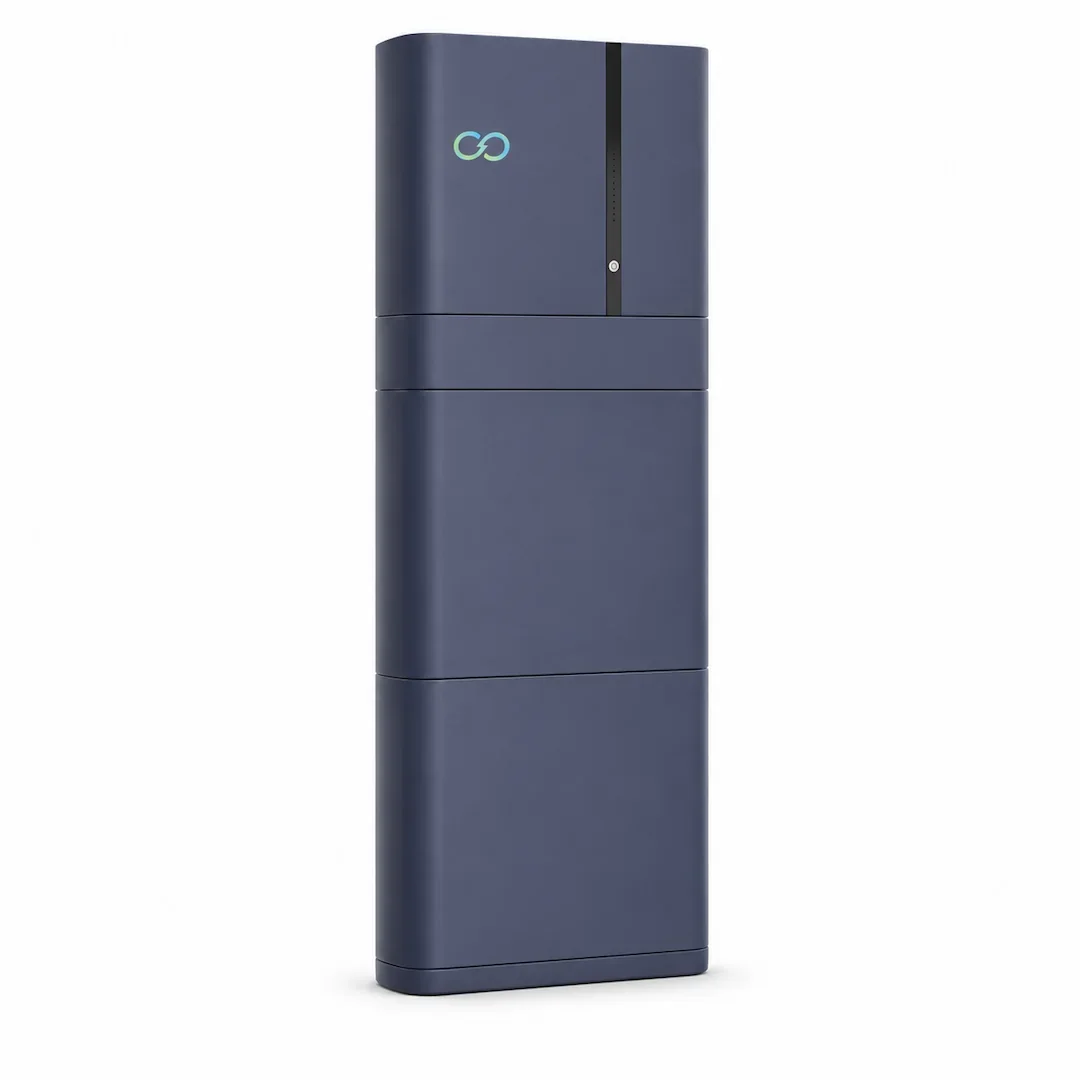
KUNETIC K-ESS-10-3P with two battery boxes, 19.2 kWh nominal.
What to Send for a 10kW Solar Quote
For an itemized equipment quote, gather your location or ZIP code, recent bills, available roof space and service voltage and phase. If you need backup, include the equipment you want to run and for how many hours. Share those details with KUNETIC to discuss a configuration.
10kW Solar System FAQs
Can I Add More Panels Later?
Often, yes. Ask the installer to check available roof space, inverter input limits and any utility approval needed for the larger array. If expansion is likely, discuss it before the first installation.
Can I Keep My Existing Inverter if I Add a Battery?
Sometimes. An AC-coupled battery system may work alongside an existing grid-tied inverter. If you want the existing solar array to keep producing during an outage, have the installer confirm how the two systems will work together in backup mode.
