English
 Deutsch
 Español
 Français
 Italiano
 Polski
 Română
 العربية


Table of Contents
Match an off-grid solar inverter to your equipment’s voltage and the loads you’ll run at the same time. If you have a pump or compressor, check what it draws at startup. Then size the battery for the hours you want those loads to run.
Check the Output Voltage Before You Compare Inverters
Look at the nameplates on the equipment you want to run. The inverter needs to supply the voltage and frequency they specify.
Required output | What to look for |
230 V single-phase | A 230 V single-phase inverter with the frequency your equipment requires. |
120/240 V split-phase | A split-phase inverter or a manufacturer-supported configuration that supplies both 120 V and 240 V circuits. |
If you have 120 V outlets and a 240 V pump, check for both outputs on the datasheet. A 230 V single-phase model leaves the 120 V outlets unaccounted for. The U.S. Department of Energy’s inverter guide explains how inverters supply AC power.
What Size Off-Grid Solar Inverter Do You Need?
Add up the running power of the equipment you expect to use together. For an example cabin, say the fridge draws 150 W, the lights draw 100 W and the water pump draws 900 W while running. That’s 1,150 W of simultaneous running load. Use the ratings or measured draw for your own equipment.
The moment to check is when the pump starts with the fridge and lights already on. Compare that combined demand with the inverter’s surge rating, including how long it can sustain the surge. If you’ll be running on battery power, ask the supplier to confirm that the proposed battery can deliver the required power.
How Much Battery Storage Do You Need After Sunset?
Suppose the same cabin averages 750 W across eight hours after sunset, with loads cycling on and off. That’s 0.75 kW × 8 hours = 6 kWh the equipment needs. Use the 1,150 W running total to check the inverter and the 6 kWh figure to size the battery.
A single 5.12 kWh module falls short of that example even before conversion losses. 10.24 kWh nominal is a configuration worth checking. Ask how much energy reaches the AC loads after conversion losses, the inverter’s own power use and the reserve you want to keep. For a site that runs off-grid year-round, also check whether the solar array can recharge the battery during the months with the least sun.
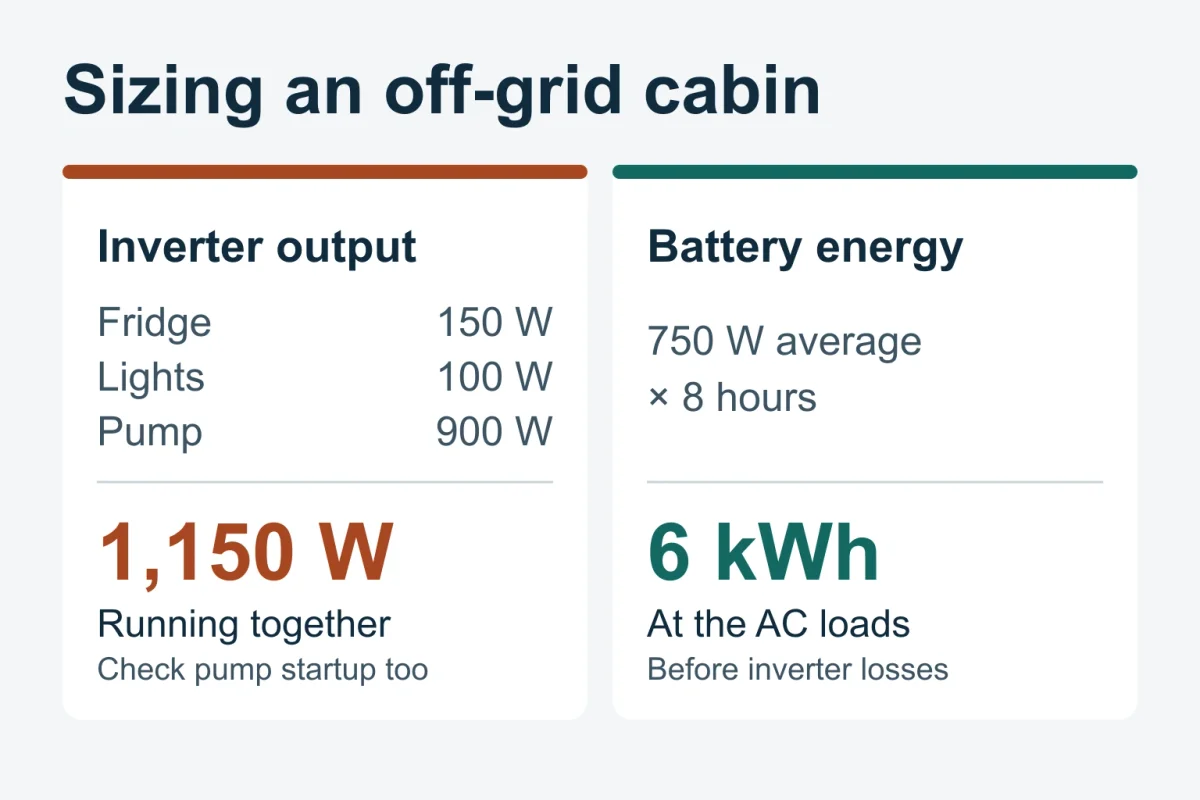
Example cabin load. Check 1,150 W of running power and the pump’s startup draw against the inverter. Use 6 kWh delivered over eight hours as the starting point for battery sizing.
Where a 6.2 kW Inverter with Stackable Batteries Fits
For a cabin or small workshop with 230 V single-phase loads, the KUNETIC K-AIO-62-STACK pairs a 6.2 kW inverter with 5.12, 10.24, 15.36 or 20.48 kWh of nominal LFP storage. Extra modules add stored energy. The inverter’s rated output stays at 6.2 kW across all four configurations.
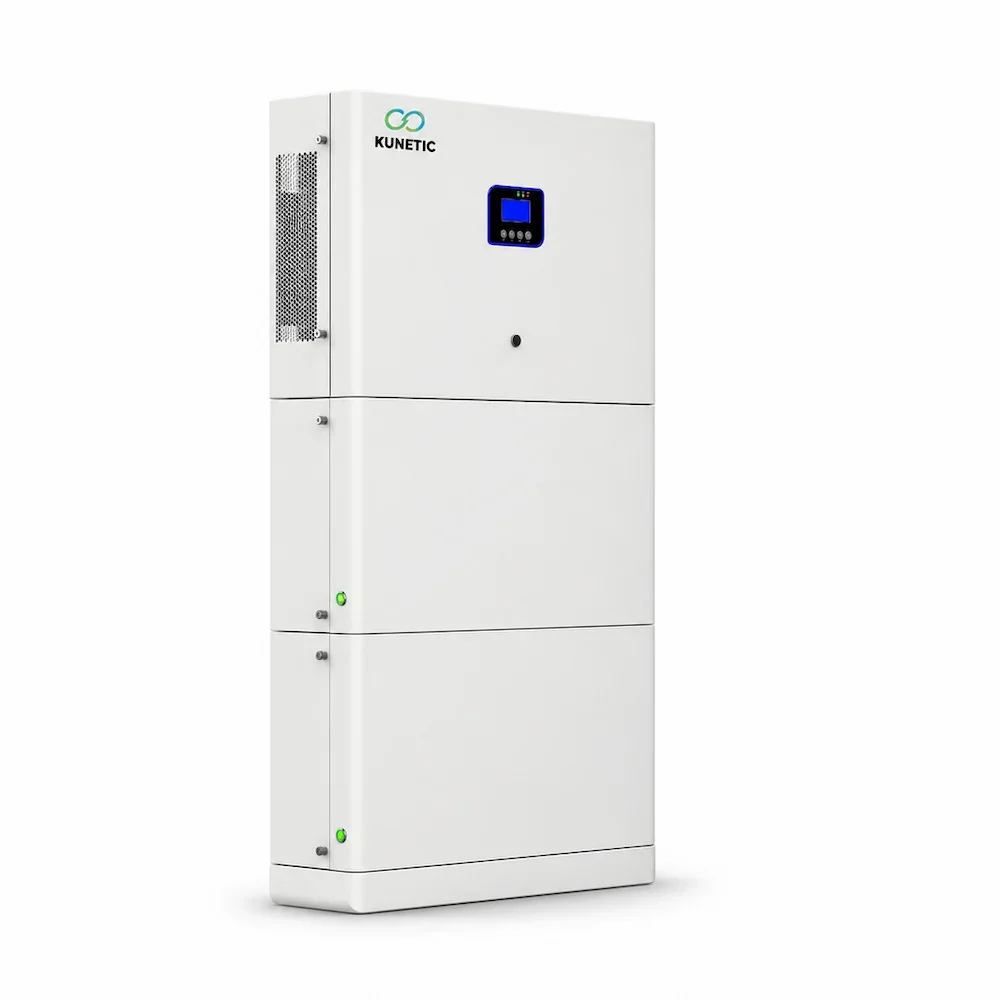
KUNETIC K-AIO-62-STACK with two battery modules, 10.24 kWh nominal.
Before ordering, ask the supplier to check three things:
- Battery. Confirm the battery voltage, battery management system compatibility, and continuous and peak discharge limits for the proposed stack.
- Solar panels. Ask whether your planned panel strings fit the inverter’s solar input voltage and current limits. Include the maximum open-circuit voltage in cold weather.
- Generator. If you plan to use one for charging, share its model and output so the supplier can confirm compatibility and the charging settings it supports.
For panel sizing, installation scope and system costs, see the off-grid solar power systems guide.
What to Send for an Off-Grid Solar Inverter Quote
Tell us where the system will go, what voltage and phase it needs, and which loads will run together. Include how long you need battery power. A nameplate photo helps with pumps and compressors. If you already own panels, batteries or a generator, send their model numbers too. Request a KUNETIC configuration quote so we can check which equipment fits your site.