English
 Deutsch
 Español
 Français
 Italiano
 Polski
 Română
 العربية

Table of Contents
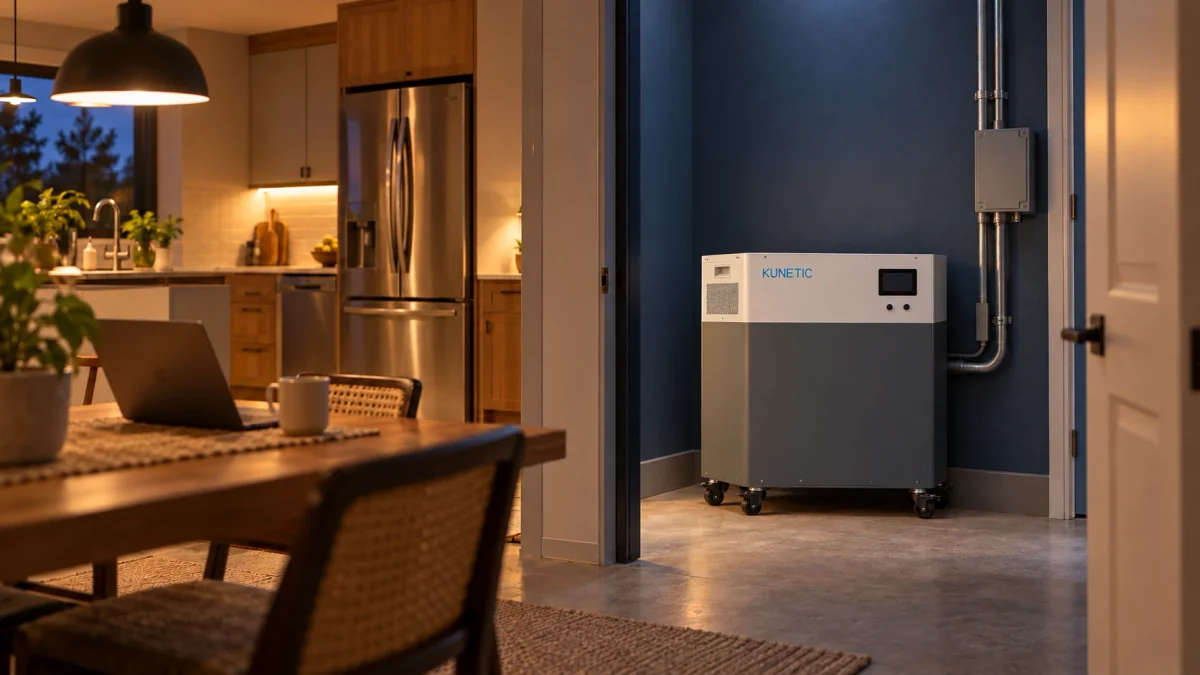
A 16kWh home battery can keep selected household appliances running after sunset or during a power cut. That might mean the fridge, lights, internet and home office, or a broader group of circuits if the system is sized for them. How long it lasts depends on how much power those appliances use and how much stored energy is available.
KUNETIC’s 16kWh system combines the battery, an off-grid inverter and a solar charger in one cabinet. You can use it for evening solar power or home backup. We choose the setup around your appliances.
How a 16kWh home battery fits into everyday life
Using stored solar in the evening
Your roof may produce plenty of electricity while you’re out. By the time you return, switch on the lights and settle down for the evening, solar production is falling.
A home battery helps move some of that daytime energy into the hours when you need it. A suitable solar array can charge the KUNETIC system through its built-in MPPT charger. The stored energy is then available for connected household loads after sunset.
The Energy Saving Trust’s battery-storage guide explains this use of stored solar energy. Whether it reduces your bill enough to justify the purchase depends on your evening consumption, available solar generation and electricity tariff.
Using the battery in the evening leaves less energy for a power cut. If backup matters, agree how much energy to keep in reserve.
Keeping essential loads running during a power cut
During an outage, keeping the fridge cold, the lights on and the internet working makes life at home easier.
Keeping backup to those selected loads lets you save the battery for what you need most. Lower demand also stretches the available energy through a longer outage.
Electric showers, heating, cooking and vehicle charging can draw much more power. Even brief use can change the system size you need.
Your installer needs to connect the chosen circuits and fit the equipment for backup power. Those circuits determine which parts of the house stay on.
Starting with battery backup before adding solar
You can start with home battery backup without solar panels. The KUNETIC unit can charge from the AC mains supply. It stores grid power while the supply is on, ready for suitable loads during an outage. You can add solar later.
If lower overnight electricity rates are part of your plan, discuss the charging controls and tariff first. The difference between charging and daytime rates needs to cover energy losses as well as contribute towards the system’s cost.
What can it power, and for how long?
kWh tells you how much energy is stored; kW tells you how quickly appliances use it.
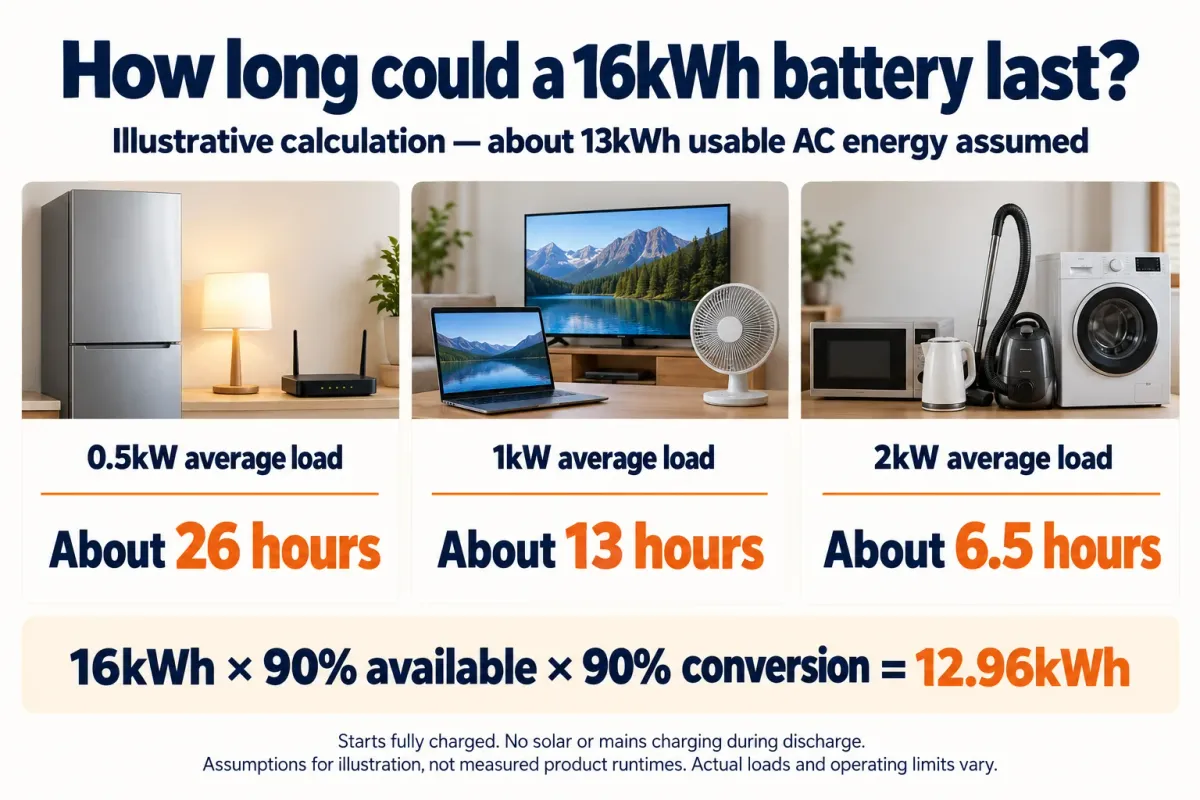
For this example, start with a fully charged 16kWh battery. Assume you can draw 90% of its nominal energy before reaching a reserve. Then assume 90% of that energy reaches the appliances after conversion losses.
That gives approximately 13kWh of usable AC energy:
16kWh × 90% × 90% = 12.96kWh
Both percentages are assumptions for this calculation. They are not verified operating specifications for the product.
Household use | Illustrative equipment combination | Assumed average load | Estimated runtime | Practical note |
Essential-load backup | Fridge, selected lights, router and a laptop | 0.5kW | About 26 hours | Assumes their combined demand averages 500W |
A more active evening | Essential loads plus television, fans and home-office equipment | 1kW | About 13 hours | Actual demand rises and falls as appliances switch on |
Broader household use | More selected circuits and additional suitable appliances | 2kW | About 6.5 hours | Higher sustained consumption uses the stored energy faster |
These are possible appliance combinations with assumed average loads. The figures are not measured appliance totals or guaranteed runtimes for your home.
An evening with an average load of 1kW over five hours uses 5kWh. Compare that with the hours you want to cover, whether that means an evening, overnight essentials or a longer outage.
Actual runtime also changes with the starting charge, reserve setting, temperature, battery condition and system losses.
Check appliance starting demand as well as runtime. A motor or compressor may briefly need more power than it uses once running. Both the inverter and the battery’s discharge capability need to suit that demand.
Using the KUNETIC 16kWh system at home
The KUNETIC 16kWh all-in-one system brings three functions together: an LFP battery stores energy, an inverter supplies AC power, and an MPPT charger manages input from a suitable external solar array.
It comes with 6, 8, 10 or 12kW inverter options, each paired with the same nominal 16kWh battery.
A larger inverter has a higher power rating, but the nominal stored energy stays the same. The battery’s discharge limits also need to suit the appliances you want to run.
When comparing home energy storage systems, check which appliances each can support. A setup for lights, the fridge and internet has different demands from one with larger pumps. Send us your appliance list before choosing an inverter.
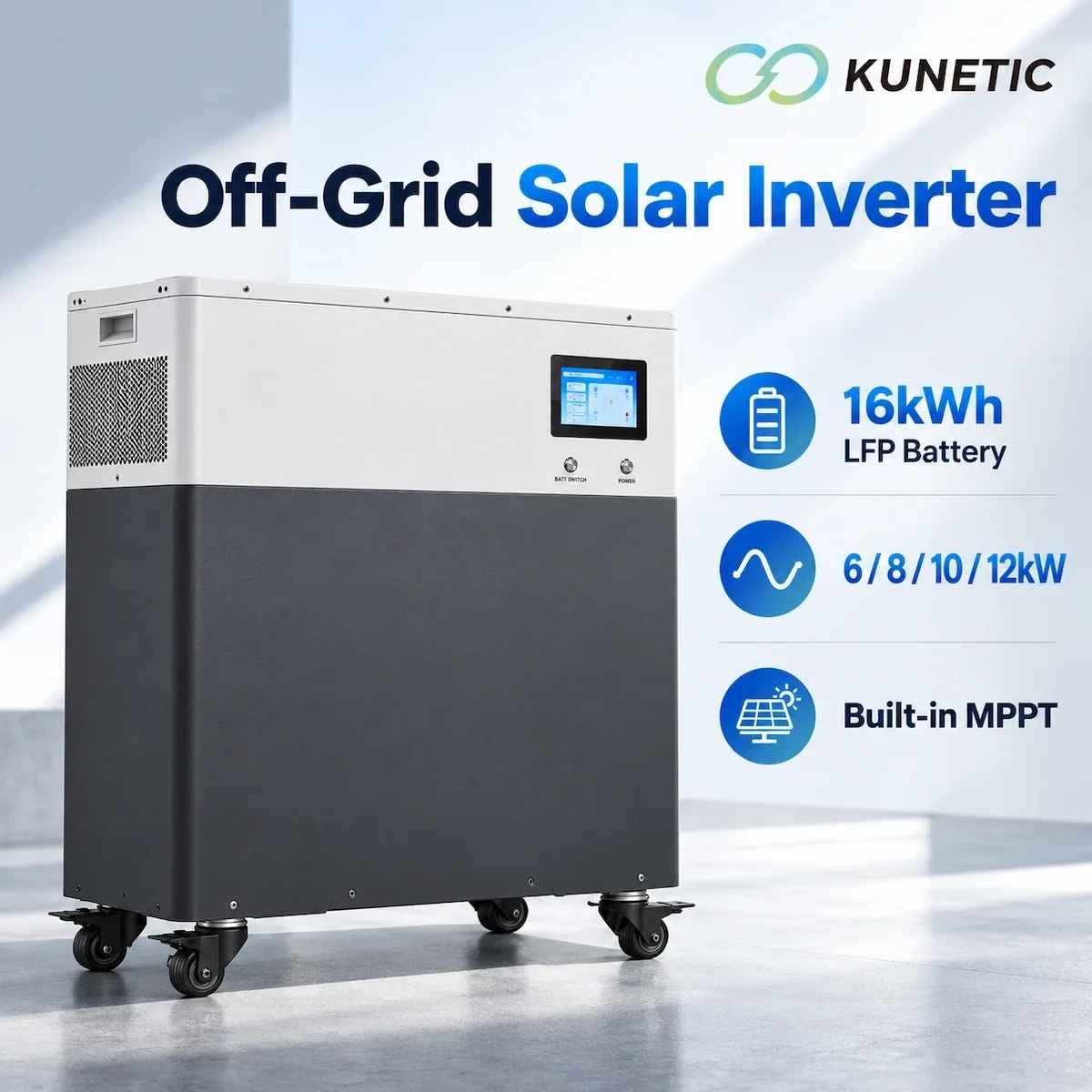
KUNETIC 16kWh LFP all-in-one inverter and battery.
The system’s 5-inch colour display shows energy flow and operating status, with WiFi monitoring available for checking information from a phone.
The floor-standing cabinet has casters to help position it during installation. Keep it in a fixed position while connected, with suitable access and ventilation. Disconnect it safely before moving it.
The output is 230V single-phase AC at 50/60Hz. Before you order, check your home’s supply and which circuits need backup. Your installer also needs to confirm the local installation requirements.
For a broader look at how storage fits into a property, see our residential energy-storage solutions.
Plan your home battery setup with KUNETIC
You may want to use more solar energy at night. Or you may need the fridge, lights and home office to keep working through repeated outages. Tell us your priorities so we can discuss a home battery setup that fits your routine.
To discuss a suitable 16kWh setup, send us:
- Your country and household electrical supply.
- Any existing solar panels or inverter, including model details.
- The appliances you want to keep running.
- The backup hours you would like to cover.
A recent electricity bill is useful too, especially if evening use and running costs are part of the decision.
We can then discuss the inverter option, charging arrangement and backup scope, and give you a quotation that lists the equipment included. Our solar battery cost guide also explains why a complete system quotation can differ from a battery-only price.
Contact KUNETIC to discuss your home battery setup.
16kWh home battery FAQs
Can a 16kWh battery power my whole house?
It may, if the loads are suitable. Check which appliances will run together and how much power they need to start. The battery must handle that demand and store enough energy for the hours you want to cover. Keeping backup to priority circuits can extend runtime during an outage.
Can I use my existing solar panels?
Possibly. Your panels need to meet the selected model’s solar-input limits. If you have a solar inverter, we need to check how it would work with the new system. Send the panel and inverter details so we can review the connection.
Can solar recharge the battery during a power cut?
The KUNETIC unit can operate with a suitable connected solar array without a utility connection. Available sunlight, household demand and the charging configuration determine how much energy is left to recharge the battery. An existing grid-connected solar installation needs its own compatibility review; the Energy Saving Trust explains why outage operation depends on the equipment and installation configuration.