
 English
 Deutsch
 Español
 Français
 Italiano
 Polski
 Română
 العربية

Table of Contents
How much does a solar battery cost?
A useful US benchmark puts the extra solar battery storage cost at about $13,100 for 13.5 kWh when installed with new solar. That figure is the difference between the US Department of Energy's residential solar-only and solar-plus-storage benchmarks.
What is being priced? | Reference configuration | Modeled installed cost |
New rooftop solar | 8 kW solar, without storage | $23,600 |
New rooftop solar with battery storage | 8 kW solar plus 13.5 kWh storage | $36,720 |
These are 2025 first-quarter benchmarks in 2024 US dollars, before homeowner incentives. The $13,120 difference is the extra cost of storage in that modeled project, rather than a standalone retrofit quote or a current KUNETIC price. Source: US Department of Energy cost benchmarks.
When you compare offers, check which price you are looking at:
- Battery supply covers the battery equipment and its specified accessories.
- A matched storage package includes the battery, compatible inverter and agreed protection or backup equipment.
- A locally installed system adds the electrical work, approvals and commissioning listed in the quotation.
New solar panels, a switchboard upgrade or changes to back up particular circuits can add to the project cost. A low battery-module price may leave all of that work out.
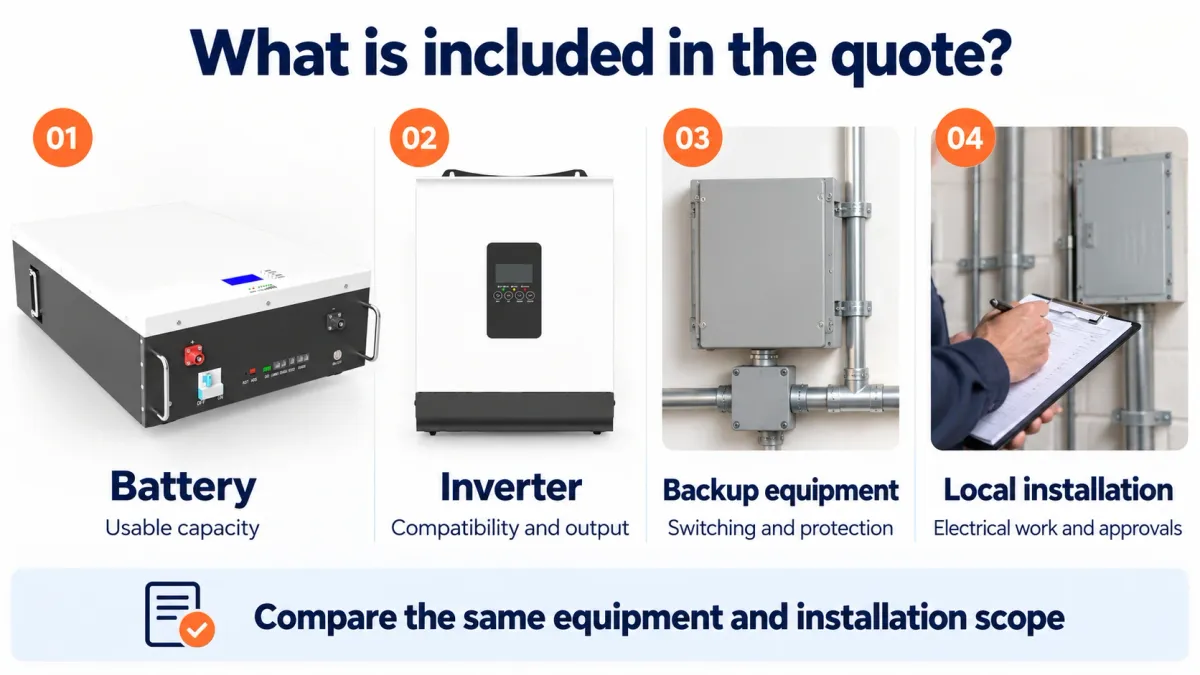
Compare battery supply, a matched equipment package and a locally installed system on the same scope.
Why do solar battery quotes vary so much?
Two systems with the same advertised capacity can have different prices and support different appliances.
Compare usable storage capacities: how much energy you can actually draw from each battery. A battery's headline capacity may be larger than the amount its settings allow you to use. Keeping a reserve for outages also leaves less energy for everyday bill savings.
Then look at power output. Capacity, measured in kWh, tells you how much energy the battery stores. Output, measured in kW, helps determine which appliances it can run together. Air conditioning, cooking and pumps can put quite different demands on the system.
Check whether the price includes an inverter. An integrated system already contains equipment that a battery-only offer leaves out. Your existing solar inverter may also need extra equipment to work with storage.
Your home battery backup cost also depends on which circuits you want to keep running. Keeping the refrigerator, lights and internet running needs a different design from supporting a large house with several air conditioners. The switching equipment, circuit arrangements and available battery power need to suit those loads.
The property also affects the price of battery installation. Cable routes, the mounting location, electrical upgrades and local requirements can change the installation budget.
To compare solar battery cost per kWh fairly, use usable capacity and the same quotation scope. Dividing a battery-only price by nominal capacity gives a misleading comparison with a complete installed system.
Which setup fits your home?
Adding storage to existing solar
Your panels may produce plenty of electricity around lunchtime, while most of your household's demand arrives after work.
A battery lets you keep more of that daytime solar power for the evening, instead of exporting it and buying electricity back later.
Your existing inverter helps determine how to add storage. Depending on the model and design, you may use a separate battery inverter or change to a suitable hybrid arrangement.
I would check compatibility before choosing a battery size. Keeping equipment that still works well makes sense if the finished system can provide the charging, monitoring and backup functions you want.
For example, one KUNETIC residential proposal pairs a 10.24 kWh LFP battery with a separate 5.5 kW inverter. The battery's usable energy, discharge limits and inverter compatibility still need to match the home.
Ask whether the quotation includes the battery inverter, metering, protection and any backup-circuit work.
Installing solar and backup together
A new solar project gives you more freedom to choose the panels, inverter and battery as one system.
A matched hybrid configuration can support evening solar use and selected loads during outages. Decide which appliances you want to keep running when the grid goes down.
You might start with the refrigerator, lighting, internet and selected sockets. Adding air conditioning, an electric cooker or a water pump changes both the power requirement and the energy needed.
Another KUNETIC residential proposal pairs rooftop solar with an approximately 16 kWh integrated storage unit with a 6.2 kW inverter rating. This arrangement can suit a homeowner who prefers a more compact equipment layout.
The final specification also needs to confirm battery limits, supported loads and the backup arrangement. The inverter rating alone does not establish the system's battery-only output.
Our guide to hybrid solar systems explains how solar, storage and the grid can work together.
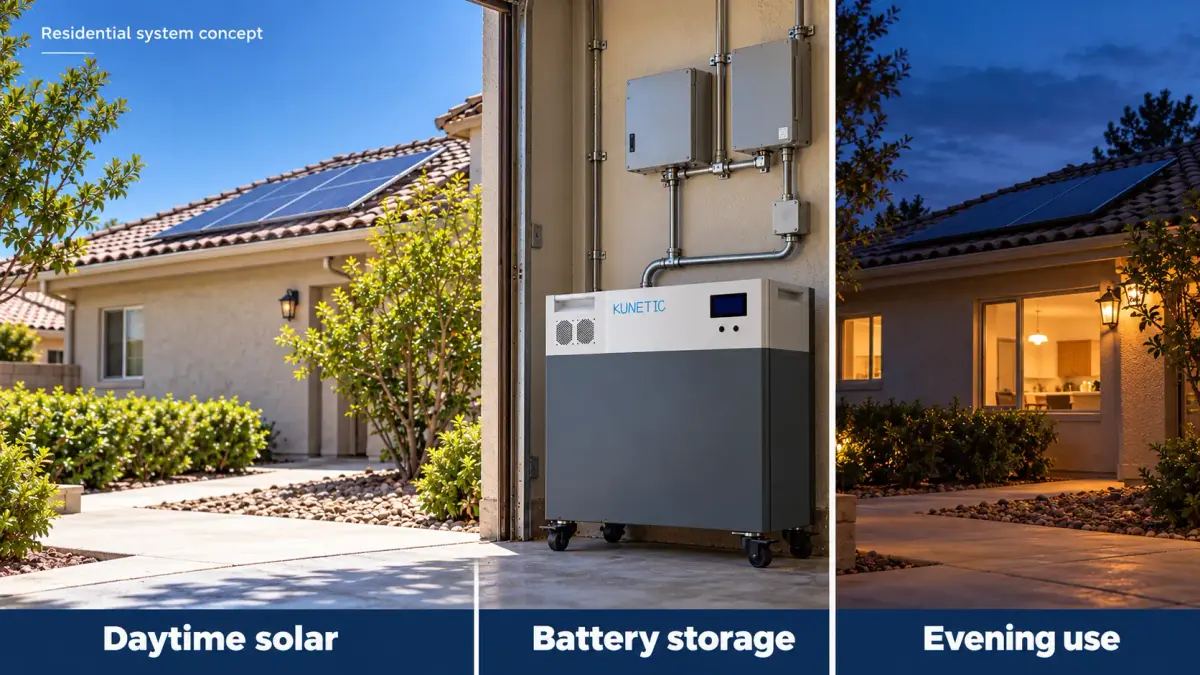
Residential solar and storage design concept showing daytime generation, battery placement and evening use.
Planning for a higher-use home
Several air conditioners, electric water heating and a pool can push a larger home toward a different configuration from one focused on essential circuits.
A bigger battery stores more energy, but the system still needs enough power output to run the appliances you choose together.
For example, you may schedule the pool pump during sunny hours and use stored energy for the household in the evening. During an outage, selected air-conditioning circuits might stay available while other large loads remain off. Those choices can improve how you use the system without simply adding battery capacity.
For a higher-use home, KUNETIC can review a larger or expandable residential configuration alongside inverter output and backup priorities. The quotation should explain what stays powered and what needs a larger configuration. If you expect to expand later, plan around compatible modules, installation space and the combinations the equipment supports.
When is the extra cost worth it?
A battery is easier to justify financially when you can charge it cheaply and avoid buying more expensive electricity later.
That might mean storing surplus solar that receives a low export payment, or shifting eligible grid charging away from expensive hours.
For example, shifting 8 kWh with a $0.15 per kWh net cost advantage, after charging costs and losses, saves $1.20 for that day. Your result depends on electricity rates and how much energy you shift.
If exported solar receives almost the same value as imported electricity, storage may offer less bill-saving value.
Backup may matter to you even when the bill savings alone do not justify the purchase. Think about keeping refrigeration, home-office equipment or selected household circuits available during outages.
For a wider look at reducing household costs, see our guide on how to save on your electric bill.
For a new US project, do not automatically subtract the old 30% federal residential credit from the price. The IRS states that the Residential Clean Energy Credit is unavailable for property placed in service after December 31, 2025. Check any applicable local incentives separately. Source: IRS Residential Clean Energy Credit.
Getting a KUNETIC solar battery quotation
Through our residential energy storage solutions, we can discuss a matched battery and inverter configuration, the protection and backup equipment required, and the agreed supply scope.
Send us:
- Your country and location, so we can check the proposed equipment against the electrical supply and local requirements.
- Your existing solar and inverter details, if you already have a system.
- A recent electricity bill and your priorities, such as evening solar use or keeping particular appliances running during outages.
If you are planning a new property, a list of the main appliances is useful too.
Your quotation should list battery capacity, inverter output, included accessories and the intended backup scope. It should also show whether freight, duties, local installation, approvals and site upgrades are included or priced separately.
Contact KUNETIC to discuss a configuration for your home, with the equipment and delivery scope set out in your quotation.
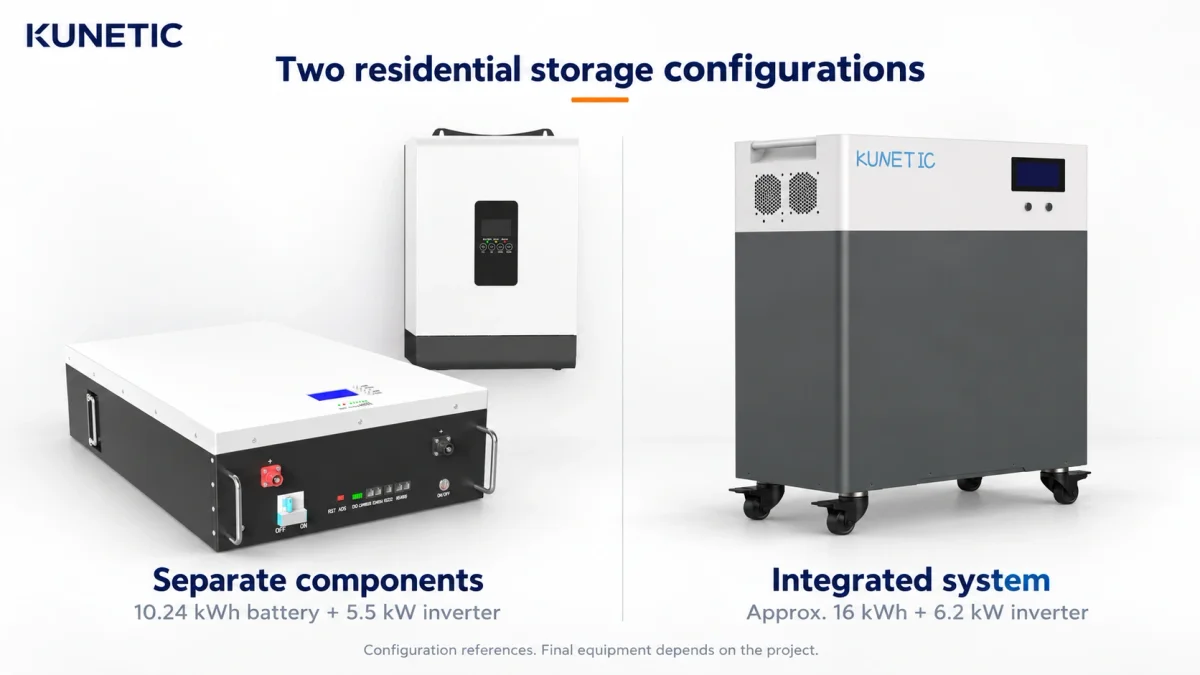
KUNETIC residential configuration references: separate battery and inverter equipment, or an integrated storage unit.
Solar battery cost FAQs
Can I keep my existing solar inverter?
Sometimes. A suitable AC-coupled storage system may work alongside an existing solar inverter. Other designs use a compatible hybrid inverter.
The inverter model, electrical supply and required backup functions determine your options. Send the existing equipment details so we can review whether to keep it, add equipment or replace it.
Can I add more battery capacity later?
Some systems support additional compatible modules, but expansion has limits.
Check the supported module count, battery compatibility, inverter limits and any restrictions on mixing batteries of different ages. If expansion is likely, include it in the original design so the layout and equipment can accommodate it.
What ongoing costs should I budget for?
Allow for any inspections or maintenance required by the selected equipment and local rules, possible monitoring charges, and eventual component replacement outside warranty coverage.
Review the battery warranty's years, energy-throughput conditions and retained-capacity terms. Also check who handles service and whether replacement labour, travel or freight is included. These service costs belong in your ownership budget too.
