
 English
 Deutsch
 Español
 Français
 Italiano
 Polski
 Română
 العربية

Table of Contents
A solar battery installation lets you store daytime solar power for use in the evening. With the right setup, it can also keep key equipment on during a power cut or help manage costly demand peaks. The equipment and site work depend on how you plan to use it.
At home, you might want the fridge, lights and internet to stay on. At a business, the priority could be refrigeration, production equipment or making better use of rooftop solar. Before comparing prices, decide what the battery will support, how it will connect and what the installation quote covers.
New solar or existing panels: which installation route fits?
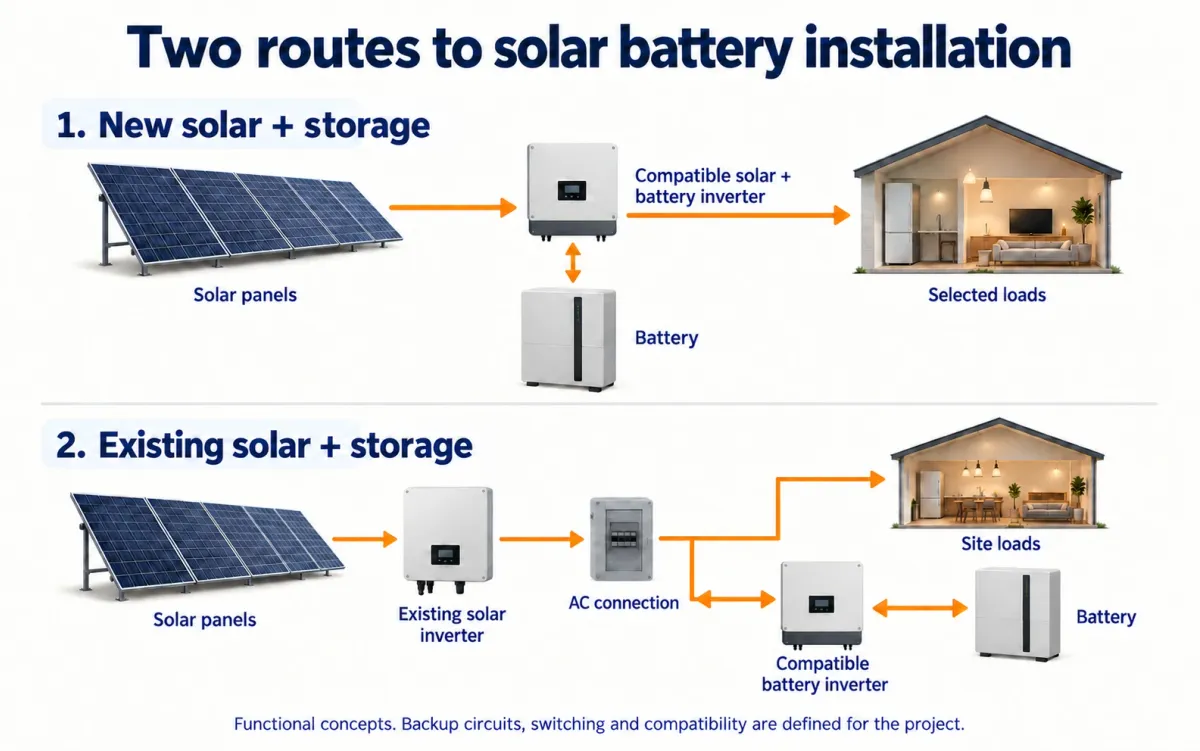
Installing solar panels and batteries together
With a new solar panel installation, you can plan the panels, energy storage, inverter and wiring together. Start with how much power you use and which circuits need backup. Allow for changes too, such as another work shift or more home appliances.
An integrated system has several components in one enclosure; a separate battery and inverter may suit other sites. The space you have, the loads and how the parts work together will help narrow the choice.
Adding a battery to existing solar
If you already have solar panels, start with the inverter model.
Some systems can accept a compatible battery. Others need a separate battery inverter or a replacement inverter. An AC-coupled system may let you keep a working solar inverter. A suitable hybrid inverter can manage both the solar panels and battery.
Australia’s government-backed YourHome battery guide explains these connection options. The right choice still depends on the actual equipment and site.
Send a photograph of the inverter label and any available system diagram when asking for a proposal.
Planning for power cuts
Using stored energy every evening and supplying electricity during an outage are different operating requirements.
Backup needs suitable switching, protection and circuit connections. The design and quote should name the loads that will stay on and how long they need power. Also check whether solar can recharge the battery during an outage.
Homes and businesses need different battery setups
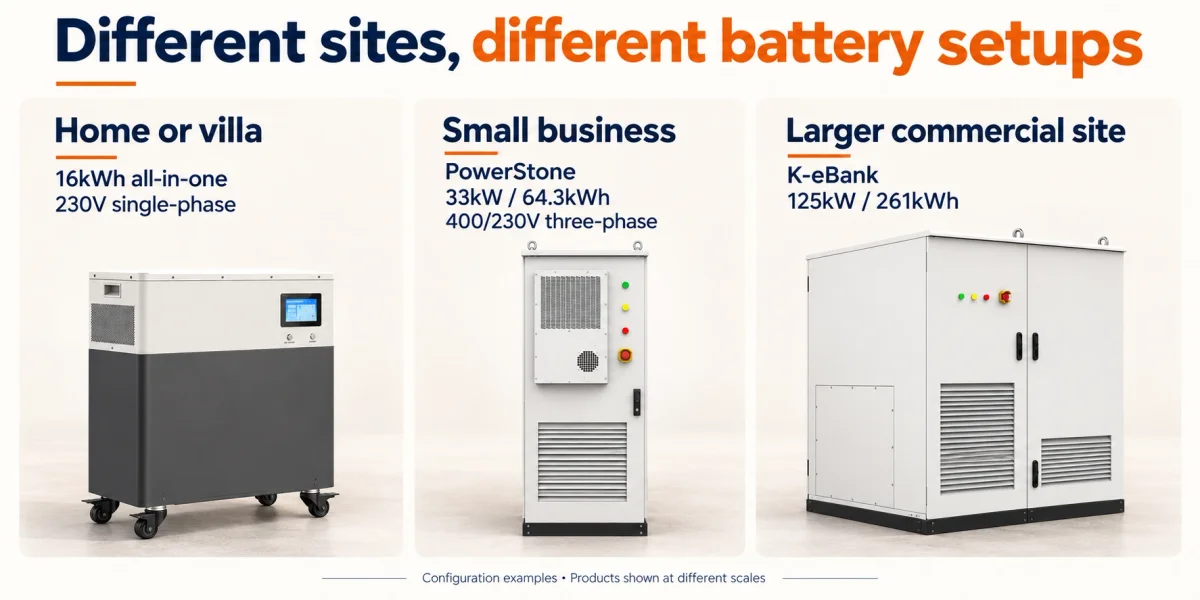
The same battery capacity can serve different needs from one property to the next. A household may spread its use across the evening. A workshop may have several machines starting together. A hotel may need its fridges and key services to stay on all night.
Application | What the installation needs to address | KUNETIC example to consider |
Home or villa | Evening use, selected backup circuits and the available single-phase supply | 16kWh all-in-one inverter and battery |
Shop, workshop or farm premises | Three-phase loads, equipment starting demand and operating hours | PowerStone 33kW / 64.3kWh |
Factory, hotel or larger commercial site | Site distribution, load peaks, solar integration and essential-load backup | K-eBank 125kW / 261kWh |
These are setup examples. The loads, power supply and site needs determine which system fits.
Homes and villas: decide what stays powered
For a household, keeping selected circuits running can be more useful than trying to support every appliance.
The KUNETIC 16kWh all-in-one system combines an LFP battery, off-grid inverter and MPPT solar charger. It supports solar and utility charging, with different inverter options paired with the same nominal battery energy.
Its output is 230V single-phase. The connection must suit your power supply and chosen loads. Before adding it to a grid-connected solar system, check how the equipment will work together.
Our 16kWh home battery guide explains appliance demand and illustrative runtime in more detail.
Small businesses: look at the loads on each phase
A shop or workshop may need lights, communications, fridges and other equipment at the same time. Motors and compressors can draw extra power when they start.
PowerStone combines 33kW rated AC power with 64.3kWh nominal battery energy. It brings battery storage, power conversion, solar charging, switching and energy management into one compact system.
Its AC supply is 400/230V three-phase. The installer needs to review the demand on each phase; the total 33kW rating is not 33kW available on any one phase.
Ask which machines can run together. Can the system handle a motor or compressor starting while other equipment is on?
Factories and hotels: plan the site connection
A factory may want to store surplus rooftop solar and reduce short demand peaks. A hotel may want to keep its fridges, communications, lights and key services on during an outage. These needs guide the choice of battery power and stored energy, where it connects and how it is controlled.
The K-eBank 125kW / 261kWh system has the battery, PCS and solar MPPT in one outdoor cabinet. It also includes transfer equipment, BMS, EMS and liquid cooling.
Plan how the cabinet will reach the site and how it will be unloaded. Check the foundation, cable routes and connection to the site power system. Include any generator connection, transformer or additional switching equipment in the design and quotation.
Check what is inside the cabinet
A battery cabinet is not always a complete AC power system.
For example, eBlock provides DC battery storage and requires an external PCS. Backup operation also needs suitable switching and controls.
Compare the cost and installation work for the complete system, including any separate conversion equipment and controls.
Where should the battery be installed?
Choose a place that meets the battery’s operating limits. Leave room to fit the unit and reach it for service.
For a home, a garage or utility room may suit the battery. An outdoor site is another option if the model is rated for it. The Energy Saving Trust’s battery-storage guidance recommends discussing installation with an experienced professional.
For commercial cabinets, check the delivery route as carefully as the final position. Gates, corners, overhead obstructions and unloading space can affect the job before the cabinet reaches its foundation.
Ask the installer to confirm:
- Whether the model is rated for indoor or outdoor use.
- Temperature, weather exposure and flood conditions.
- The required foundation or mounting arrangement.
- Door opening, ventilation and maintenance access.
- Cable routes and protection from vehicles.
- Applicable site and local installation requirements.
The K-eBank 125kW / 261kWh unit, for example, weighs approximately 2.9 tonnes. Include the right unloading equipment and a foundation that can support this weight in your budget.
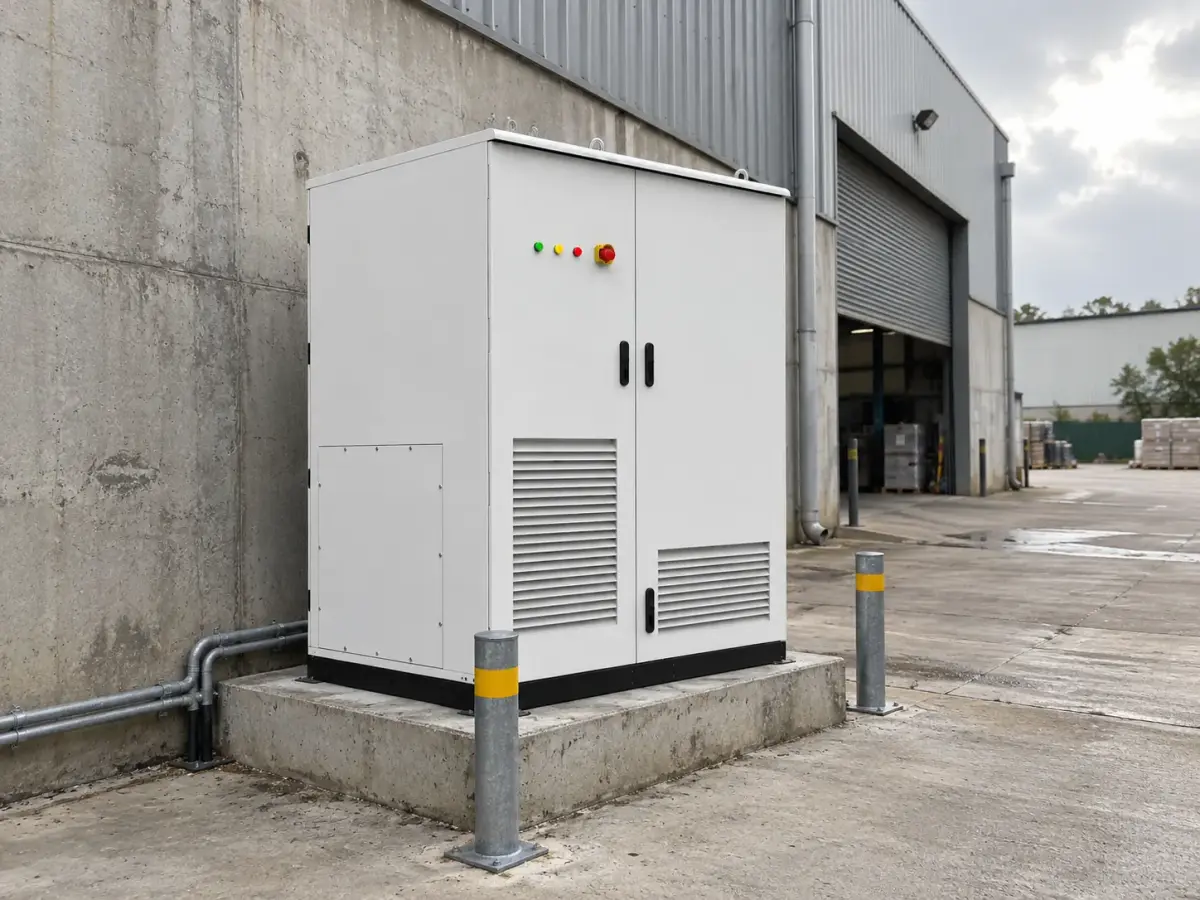
K-eBank installation concept; final positioning and access are designed for the site.
What happens during installation?
Ask solar battery installers who will handle the design, site work and after-sales support. They should be able to explain the installation process and the loads your system will serve.
The work usually follows these stages:
- Site review. The project team checks the electrical supply, solar equipment, loads and proposed battery location.
- Design and approvals. The team agrees on the connection, protection and backup circuits, and gets any required local approvals before site work.
- Delivery and installation. Qualified personnel place, secure and connect the equipment.
- Testing and commissioning. The installer checks charging, discharge, controls and the agreed operating modes. Backup projects also need the relevant outage and transfer checks.
- Handover. The owner receives operating instructions, monitoring access, documentation and a clear support contact.
For a business, agree any planned supply interruption before work starts. It may need to fit around production, opening hours or guest services.
At handover, ask to see the functions you paid for. That could include the backup circuits operating, a charging schedule or the monitoring display showing energy flow.
What should your installation quote include?
Solar battery installation cost depends on the equipment and the work needed to make it useful at your property.
Short cable runs and easy access can keep installation costs lower. An inverter change, work on the distribution board or a new outdoor foundation adds to the job.
For UK context, the Energy Saving Trust gives an approximate cost of £4,600 for a 5kWh battery system. This reference applies to that size and market; a 16kWh system or commercial project needs its own quotation. Its battery guide also notes that installing storage alongside new solar can reduce duplicated site work.
When comparing quotations, use the same scope:
Quotation item | What to clarify |
Battery and power conversion | Battery energy, inverter or PCS rating, and who supplies the conversion equipment |
Solar connection | Existing-inverter compatibility, new MPPT or inverter work, and any changes to the array |
Backup equipment | Switching, protection and the specific circuits or loads covered |
Site works | Cabling, distribution changes, mounting or foundation work |
Delivery and handling | Freight, unloading equipment and positioning |
Installation and commissioning | Local labour, testing, configuration and owner handover |
Approvals and support | Applicable paperwork, equipment warranty, installation warranty and support responsibilities |
For a commercial project, check which EMS functions the quote covers. Settings for using your own solar, managing peaks and backup need to match how the site runs.
Our solar battery cost guide explains why a complete-system quotation can differ from a battery-only price.
Plan your solar battery installation with KUNETIC
You do not need a finished electrical design to start a conversation.
Tell us what you want the system to do and share what you already know:
- Your country and electrical supply.
- A recent electricity bill or available load profile.
- Existing or planned solar capacity and inverter details.
- Equipment you want to support during a power cut.
- Required backup hours and any space restrictions.
- Photographs of the proposed installation area.
We can use those details to suggest a KUNETIC system and check how it would connect to your existing equipment. Your quote will set out what we supply.
For homes, that may start with a residential storage solution. For a business, the options include a three-phase all-in-one system. A battery cabinet with a separate power converter may also fit.
Your local installer can confirm the site work and connection requirements for the agreed equipment.
Talk to KUNETIC about your solar battery installation.
Solar battery installation FAQs
Can I add a battery to solar panels I already have?
Often, yes. The connection route depends on the existing inverter, battery compatibility and desired operating mode. Share the equipment models before choosing a battery.
Will my battery work during a power cut?
Backup power is available for the loads covered by the system’s backup design. Confirm the switching equipment, circuit arrangement and available power. Having a battery installed does not automatically provide whole-property backup.
How long does installation take?
Ask for a schedule based on the site survey. A home with easy access needs a different schedule from a business site with foundation work or heavy lifting. Changes to site distribution can take more time too. Equipment delivery, approvals and commissioning also affect the overall schedule.
Can I expand the battery system later?
Some systems support expansion within defined limits. Discuss expansion early. The plan needs to cover the inverter or PCS, controls, protection and space for more batteries. Confirm the supported configuration before purchasing additional batteries.
