
 English
 Deutsch
 Español
 Français
 Italiano
 Polski
 Română
 العربية

Table of Contents
When a battery without solar makes sense
Not every home has a roof that works for solar. Shade or shared roof space may rule out panels. You may simply prefer to add them later. That need not stop you considering a home battery.
Home battery storage without solar in the UK can charge from the grid during cheaper hours and supply your home during more expensive ones. Whether it is worth buying depends on your tariff, how much stored electricity you can use, and the complete system cost.
A battery-only system is worth comparing if:
- You use much of your electricity after work, when your tariff charges more.
- You want to install a battery now and keep the option of adding solar later.
- You want to reduce peak-rate purchases and also keep selected appliances running during outages.
The saving comes from changing when you buy electricity. On a flat-rate tariff, charging and discharging add losses without creating a cheaper buying window. With a time-of-use tariff, you can buy electricity at a lower rate and use stored power when the rate is higher. The price gap still needs to cover the losses and the cost of owning the battery.
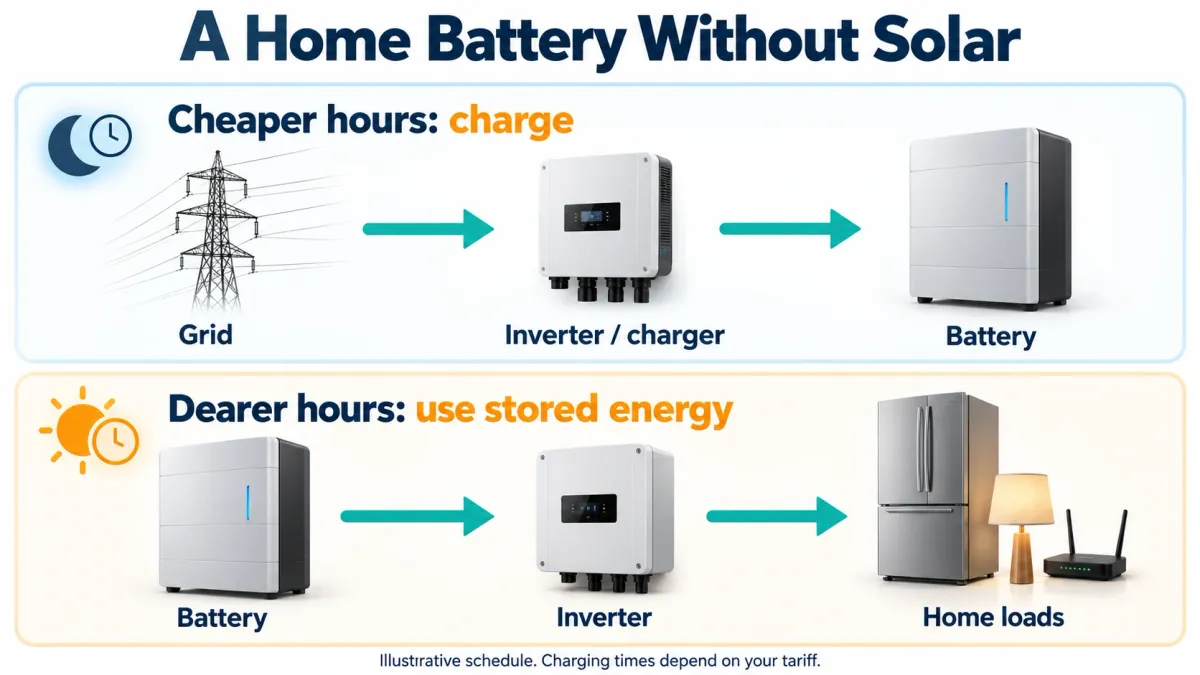
Illustrative battery-only operation: charge during cheaper hours and use stored energy when electricity costs more. Charging times depend on your tariff.
Which battery setup fits your home?
Lower bills, essential backup, or solar later?
These goals can lead to different quotations. Decide what you want the system to do before comparing the capacity printed on the battery.
What you want | System to discuss | What the quotation should explain |
Buy less peak-rate electricity | Battery and matched inverter/charger. Metering and charge controls. | Usable energy. Charging power. Tariff scheduling. |
Lower bills and keep essential appliances on during a power cut | Battery system. Backup switching. Selected circuits. | Loads kept on. Transfer method. Energy reserve. |
Install storage now and add solar later | Battery and inverter with a planned solar connection. | What equipment stays. What is added with the panels. |
A fridge, lights and internet need less backup power than electric heating and every socket in the house. Ask for the essential-load option alongside whole-home backup if both interest you. You can then see what the extra coverage costs.
For a KUNETIC home storage plan, we can help match the battery with a suitable inverter and controls. Tell us how you use electricity, whether you plan to add solar, and what you want kept running during an outage.
Match battery capacity and inverter power to the job
Battery capacity, measured in kWh, tells you how much energy is stored. Ask how much of that is usable, because the headline capacity is not all available at your sockets.
The inverter's kW rating tells you how much equipment it can supply at once. A large battery may run small loads for longer. A small inverter can still limit how many powerful appliances you use at once.
Check the charging limit too. The system needs enough charging power to replenish the energy you expect to use within the cheaper tariff window.
If you expect to add storage later, compare modular batteries and ask which inverter they work with. An all-in-one package can make buying simpler. Its charging, backup and connection functions still need to fit your home. Ask for the actual battery and inverter model numbers in the quote.
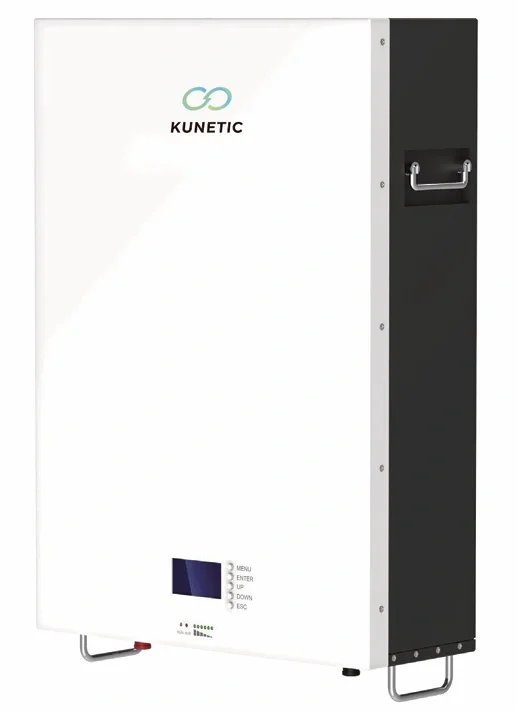
KUNETIC wall-mounted LFP battery, shown as an equipment reference. The project needs a matched inverter, controls and installation.
How much does home battery storage cost without solar?
The price on a battery listing is only part of the buying decision. You also need the equipment that charges it, supplies the house and connects it to your electrical installation.
The Energy Saving Trust's battery-storage guidance gives around £4,600 for a 5 kWh battery system. Costs vary by type and size. Use that as a general UK market reference. Your KUNETIC quotation will depend on the chosen equipment and supply scope; check the installation inclusions separately.
Ask each quotation to show:
- Battery model, nominal capacity and usable energy.
- Inverter/charger, metering, controls and protection equipment.
- Any backup switching and changes to household circuits.
- Delivery, installation, commissioning and applicable documentation.
- Taxes, warranty responsibilities and any exclusions.
An equipment-supply quote and a fully installed quote will cover different work. Put them on the same basis before choosing the cheaper offer. In particular, check who will install the equipment, commission the controls and provide support afterwards.
What could you save on your electricity tariff?
The price difference is easier to judge with an example. The figures here are assumptions, not a current supplier tariff or a forecast for your home.
Suppose the battery supplies 10 kWh to your home during a 30p/kWh period. It charges at 10p/kWh, with an assumed round-trip efficiency of 90%.
Item | Illustrative calculation |
Grid electricity needed to deliver 10 kWh | 10 ÷ 0.90 = about 11.11 kWh |
Cost of charging | 11.11 × £0.10 = about £1.11 |
Cost of buying those 10 kWh at the peak rate | 10 × £0.30 = £3.00 |
Operating difference for that day | £3.00 − £1.11 = about £1.89 |
That £1.89 excludes the purchase price, installation, battery wear and maintenance. It also leaves standing charges in place. This example covers one day's use, without predicting annual savings or payback.
Your own comparison should use electricity you would otherwise buy at the dearer rate. If an appliance can already run directly during cheap hours, moving that use into a battery adds less value.
Before buying, ask your supplier whether your household qualifies for the tariff. Confirm its meter requirements and check that the proposed controls can follow the charging schedule.
What needs checking before installation?
Ask the installer to show the equipment location and protection. Agree how it will charge and which circuits will have backup.
In Great Britain, the installer should also establish the relevant Distribution Network Operator, or DNO, process. GOV.UK's device-registration guidance explains why some connections can be notified after installation while others need approval first. For Northern Ireland, confirm the applicable process with the local network operator and installer.
For a UK grid-connected installation, verify the exact inverter and connection arrangement. A 230 V rating and mains charging alone do not confirm that the equipment fits this connection.
Our solar battery installation guide covers more of the equipment and site questions to discuss with your installer.
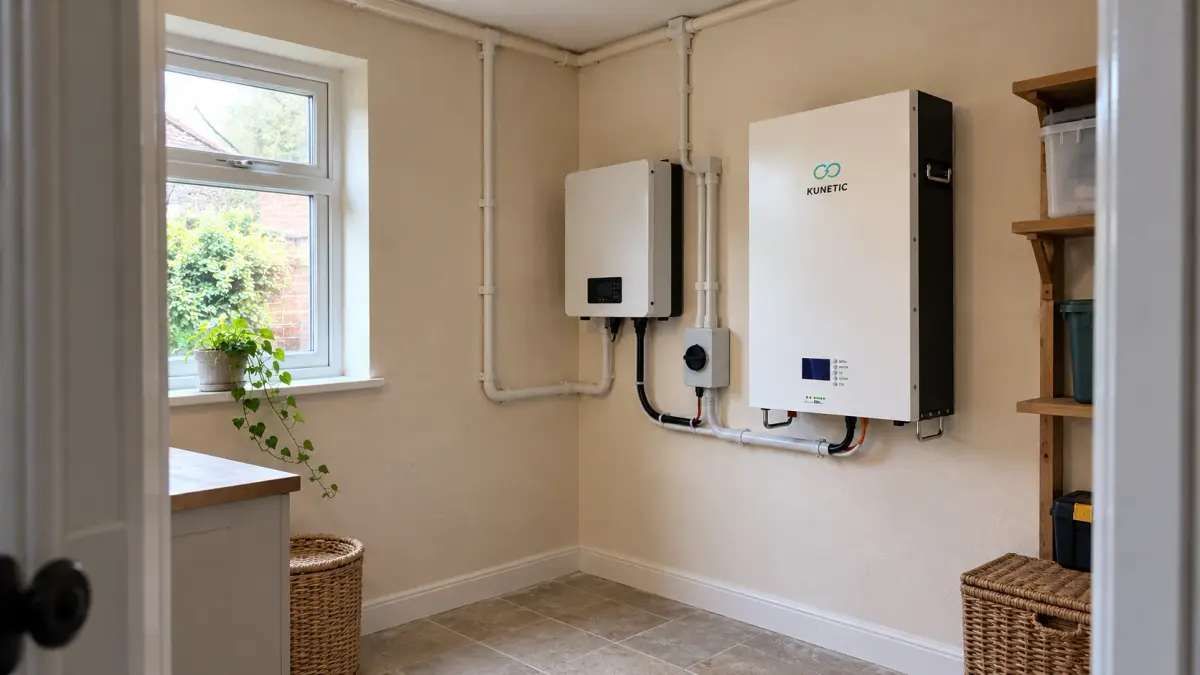
Battery-only home storage layout concept, showing equipment space and a separate inverter arrangement.
Questions homeowners ask before buying
Can I use a home battery on a standard flat-rate tariff?
Yes, if the equipment supports the arrangement. But buying and using electricity at the same price gives no price-spread saving, and storage adds losses. Backup may still be valuable to you, but it is a separate reason for the purchase.
Can I add solar panels later?
Often, yes. Tell the supplier now so the proposed inverter, controls and battery are selected with that future connection in mind. Ask what you would retain and what extra equipment would be needed.
Will the system keep working during a power cut?
Only with the right backup configuration. Agree which circuits will be supported, how switching is handled and how much battery energy is reserved. A system installed for daily bill savings should not be assumed to provide outage power.
Can it supply a heat pump or other high-power appliances?
Check how much power the inverter and battery can supply at once. Include the appliances' starting demand. Share the equipment details before choosing a system.
Our 16 kWh home battery guide gives load-and-runtime examples. It features off-grid equipment, which needs a different connection assessment from a UK grid-connected home system.
Plan a battery-only home system with KUNETIC
You do not need to choose a battery size before speaking to us. Tell us what you want to change. Is it the evening bill, backup for key appliances, or a battery before adding solar?
Send KUNETIC:
- Your location and electricity tariff, with a recent bill if available.
- Typical evening use and any large appliances you want the system to supply.
- Your backup priorities and any future solar plans.
- Whether you need equipment supply or are working with an installer on a complete project.
We can help choose the battery size and compatible equipment, then explain our supply scope. Agree local installation and connection work for your project.
