English
 Deutsch
 Español
 Français
 Italiano
 Polski
 Română
 العربية

Table of Contents
Your rooftop solar may already be doing its job. Now you want to store some of that power for the evening shift, or keep selected equipment running during a power cut.
One supplier proposes adding a battery system alongside the existing solar installation. Another includes a replacement inverter. Why are they offering different equipment?
AC coupling and DC coupling describe how the solar installation and battery connect. That affects which equipment you can keep and what needs adding. Two quotations with similar battery capacity may therefore include different work.
For existing solar, AC-coupled battery storage often allows the PV inverter to stay. For a new solar-and-storage project, DC coupling may offer a useful shared conversion path. The better fit depends on your equipment, operating needs and complete project cost.
AC-Coupled vs DC-Coupled Solar: The Practical Difference
Solar power and battery power meet at different points in the two layouts. In an AC-coupled system, a solar inverter converts DC power from the PV array into AC electricity. The battery has its own inverter or power conversion system, usually called a PCS. The two converters connect on the AC side of the site. The battery converter may sit inside the cabinet or be a separate unit.
In a DC-coupled system, solar and battery power connect on the DC side before conversion to AC for the site's loads. This may use a hybrid inverter or a combination of power conversion and DC/DC equipment. The US Department of Energy's solar-plus-storage explanation describes the two arrangements.
With AC coupling, solar power is converted from DC to AC before it reaches the battery PCS. The PCS converts it back to DC to charge the battery. DC coupling avoids that AC step. The actual efficiency difference depends on the equipment and how it operates.
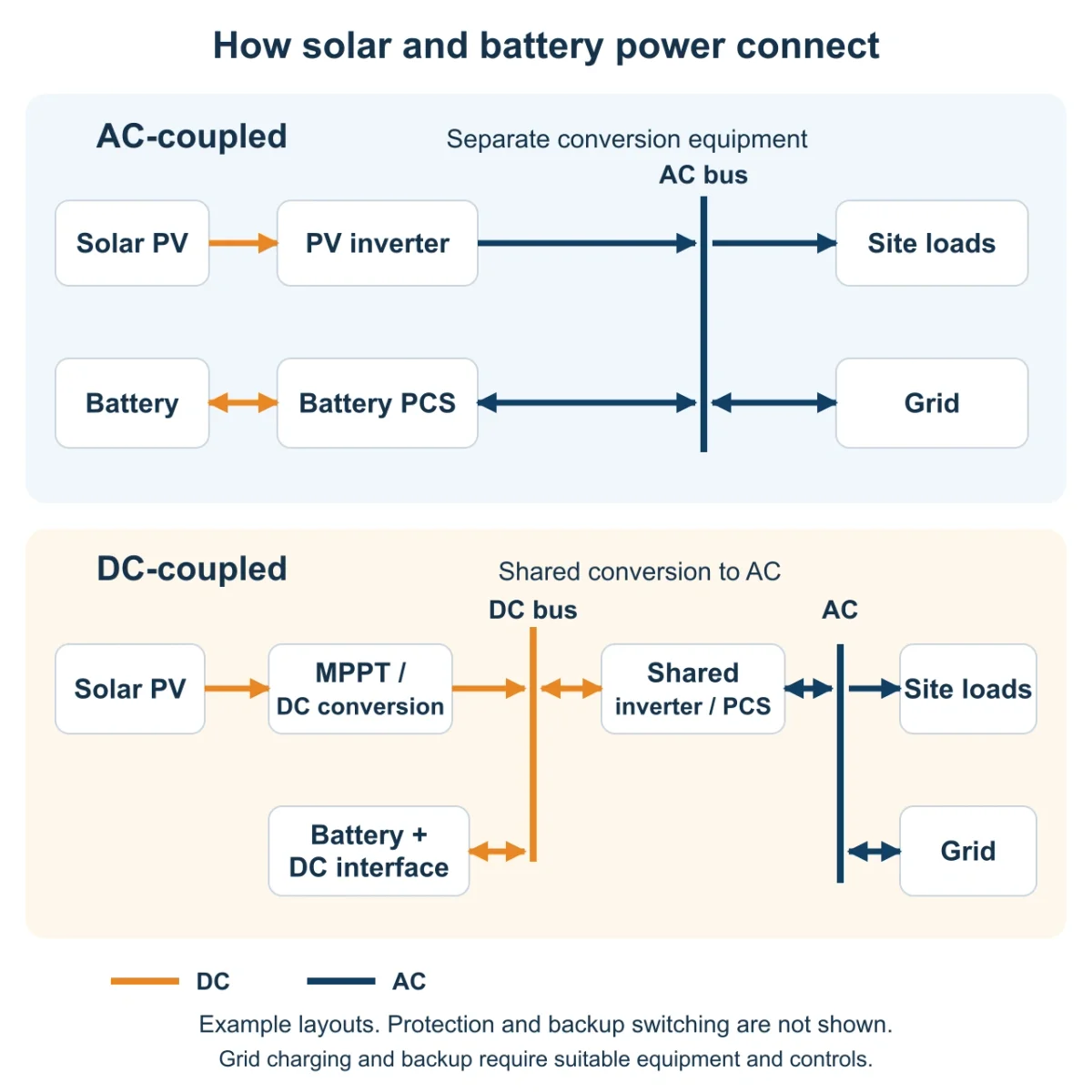
The diagram shows a simplified connection layout. Backup switching and protection are additional design choices.
Already Have Solar? What Can Stay, and What Must Change?
Keeping an existing PV inverter
Consider a factory with a working rooftop solar installation and an evening production shift. Some solar generation is available before the factory needs it. The owner wants to store that surplus without replacing useful equipment.
The existing PV inverter can continue serving the solar array. A separate battery PCS connects storage to the site's AC network. An AC-coupled battery system is therefore an option to compare for this factory.
Keeping the inverter may reduce equipment replacement costs. The battery still needs metering, switchgear and controls. Cable routes and site connection limits also affect the work. Agree any planned supply interruption around production.
A battery and PV inverter need coordinated controls even when both connect to the same AC network. The proposed controls need to manage charging, discharge and any export limit.
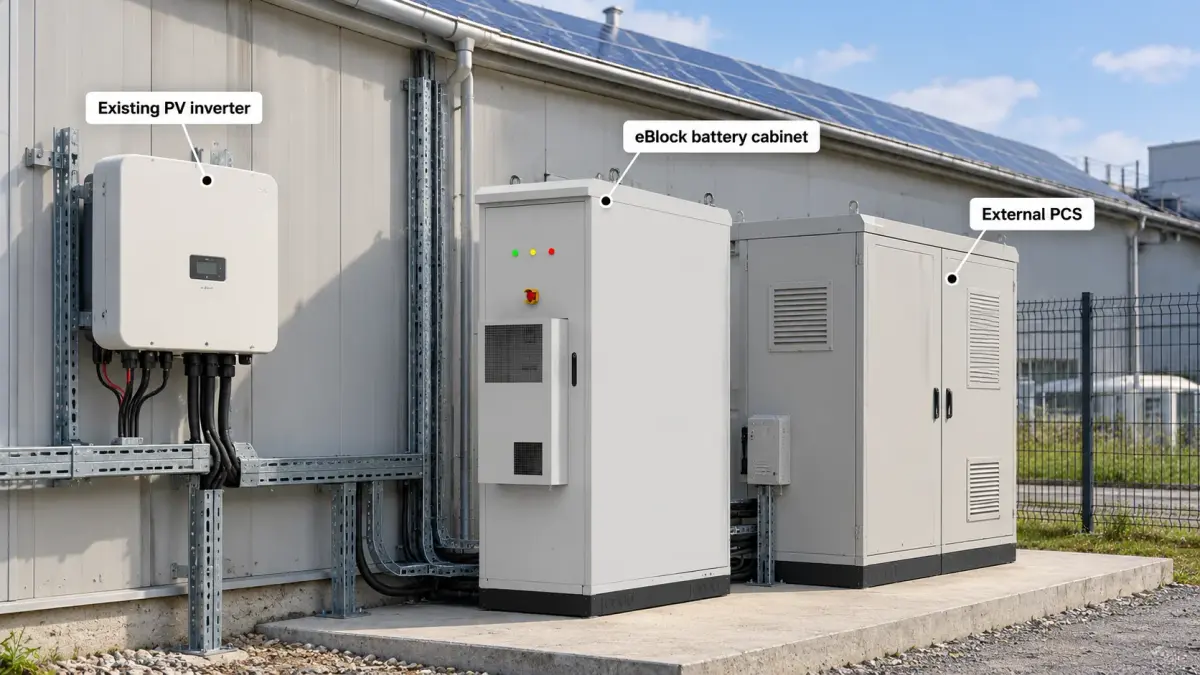
Factory solar retrofit concept: retained PV equipment with added battery conversion and controls.
When an inverter change may make sense
An ageing inverter, an expanded solar array or a change in operating requirements may make a redesign worth considering. There may be a good reason to replace some existing equipment.
Ask each supplier to show which equipment stays and what the replacements let you do. Extra conversion equipment and site work can outweigh a lower battery price.
Our solar battery installation guide covers the wider installation scope, including positioning, delivery and handover.
Building Solar and Storage Together? Compare the Complete Setup
Planning a shared conversion path
For a new workshop or factory building, you can plan the solar array, battery and power conversion together. You have no existing PV inverter to preserve.
A DC-coupled arrangement can charge the battery from solar without first converting the power to AC. It may need less separate conversion equipment. Compare the complete equipment and installation costs to see whether that saves money at your site.
If solar and battery share an inverter, its rating and controls determine how much power can reach the AC side at once. More battery capacity does not automatically increase that output.
DC coupling can also offer a route to store solar energy that would otherwise exceed an inverter's output limit. How much energy you can recover depends on the array, conversion equipment and available battery charging capacity.
Leaving room for a later phase
If another building or production line is planned, include it in the first discussion. Separate PV and battery conversion can make phased changes easier to arrange. A shared system may also support expansion within its equipment limits.
Ask what a later phase would require: more battery modules, another converter, extra switchgear, or a change to the site connection. An expansion plan should identify that work.
Compare the Whole Proposal, Not Just the Battery
Give both suppliers the same site information, then compare what their prices include.
Item | What to compare |
Existing solar equipment | Which inverter and other components remain, and what gets replaced? |
Battery and power conversion | Battery energy, usable energy, converter power and any shared solar/battery output limit. |
Controls | Metering, charging schedules, export control and monitoring included in the proposal. |
Site work | Cabling, protection, distribution changes, foundations and delivery arrangements. |
Backup operation | The loads covered, switching equipment, expected operating time and solar recharging during an outage. |
Future changes | Equipment limits, space and electrical work needed for the next phase. |
If power cuts are part of the reason you are buying
Discuss backup before selecting the equipment. Neither AC coupling nor DC coupling alone tells you whether a factory can keep running when the grid fails.
The proposal needs to identify the loads that will stay powered and how the system will separate from the grid. Also ask whether the existing solar can keep operating and recharge the battery during an outage. Australia's Solar Consumer Guide explains why this depends on the system's configuration.
For sensitive controls or equipment that cannot tolerate an interruption, see our commercial battery backup guide for the separate roles of a UPS and a backup-capable BESS.
What a KUNETIC Configuration Could Look Like at Your Site
The KUNETIC eBlock outdoor battery cabinet provides up to 120kWh of installed battery capacity and needs an external PCS to connect to an AC site system. A factory retaining its existing solar can consider this separate-equipment arrangement. We select the PCS and controls to suit the battery, site supply and operating goals.
Although eBlock is a DC battery cabinet, it can form part of an AC-coupled solar-and-storage system. The cabinet's DC terminals describe its battery connection; the complete layout determines how it couples with solar.
For a project planning solar input and storage together, the K-eBank 125kW/261kWh system brings battery storage, a PCS and solar MPPT into one outdoor cabinet. Its published configuration includes 125kW rated PCS power, 261.248kWh rated battery energy and a 120kW MPPT. Its rated AC voltage is 380/400V.
When reviewing this configuration for a combined solar-and-storage project, we need to show the actual solar and battery connection paths, power limits and backup scope. Supply voltage and local connection requirements also need to match the site.
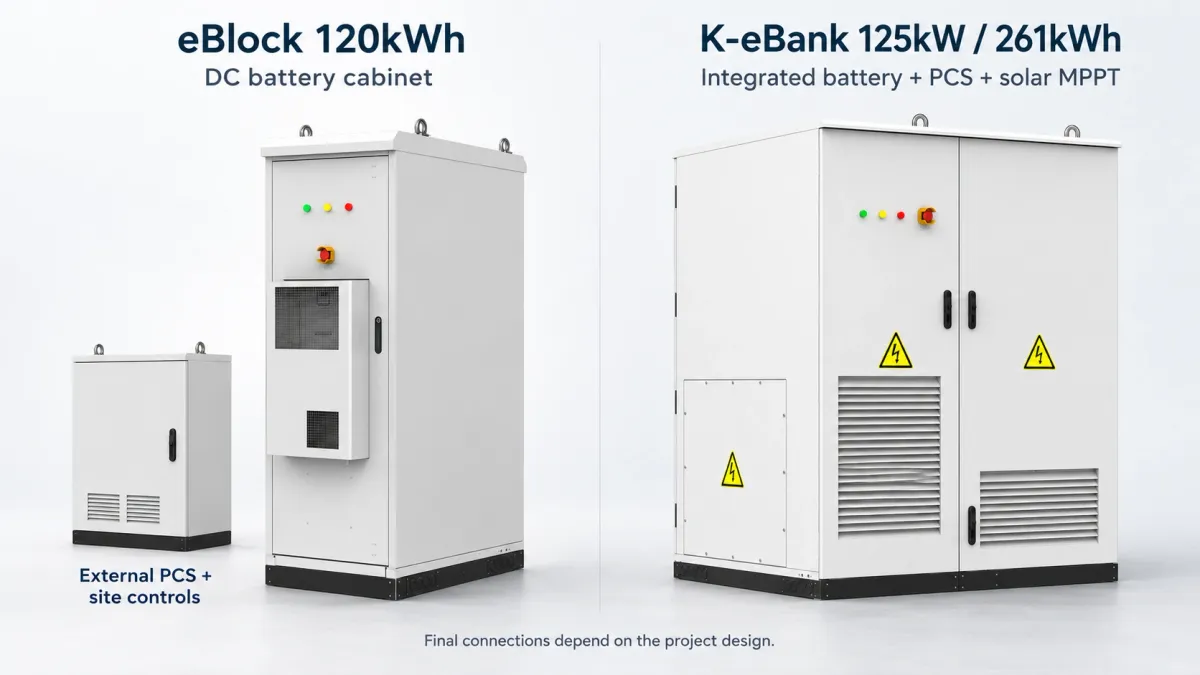
KUNETIC eBlock DC battery cabinet and K-eBank integrated storage system.
A clear photo of your existing inverter label is a useful start. Share your country and electrical supply, solar capacity, operating hours, and what you want the battery to do. If backup is important, tell us which equipment must stay on and for how long. An electricity bill or available load data will help with the comparison.
Send KUNETIC your site details to discuss a configuration and quotation built around your existing or planned solar system.
FAQs
Can I keep my existing solar inverter?
Often, an AC-coupled arrangement lets it remain. The project team still needs to check the inverter, site connection and controls. Outage operation needs particular attention.
Can both arrangements charge from the grid?
Both arrangements can support grid charging with suitable conversion equipment and controls. Ask the supplier to confirm this function for the proposed system. The coupling label alone does not establish it.
Does either arrangement automatically provide backup?
No. Backup requires a design that covers grid isolation, switching, controls and the selected loads. Confirm the operating sequence and solar recharging capability before ordering.