English
 Deutsch
 Español
 Français
 Italiano
 Polski
 Română
 العربية

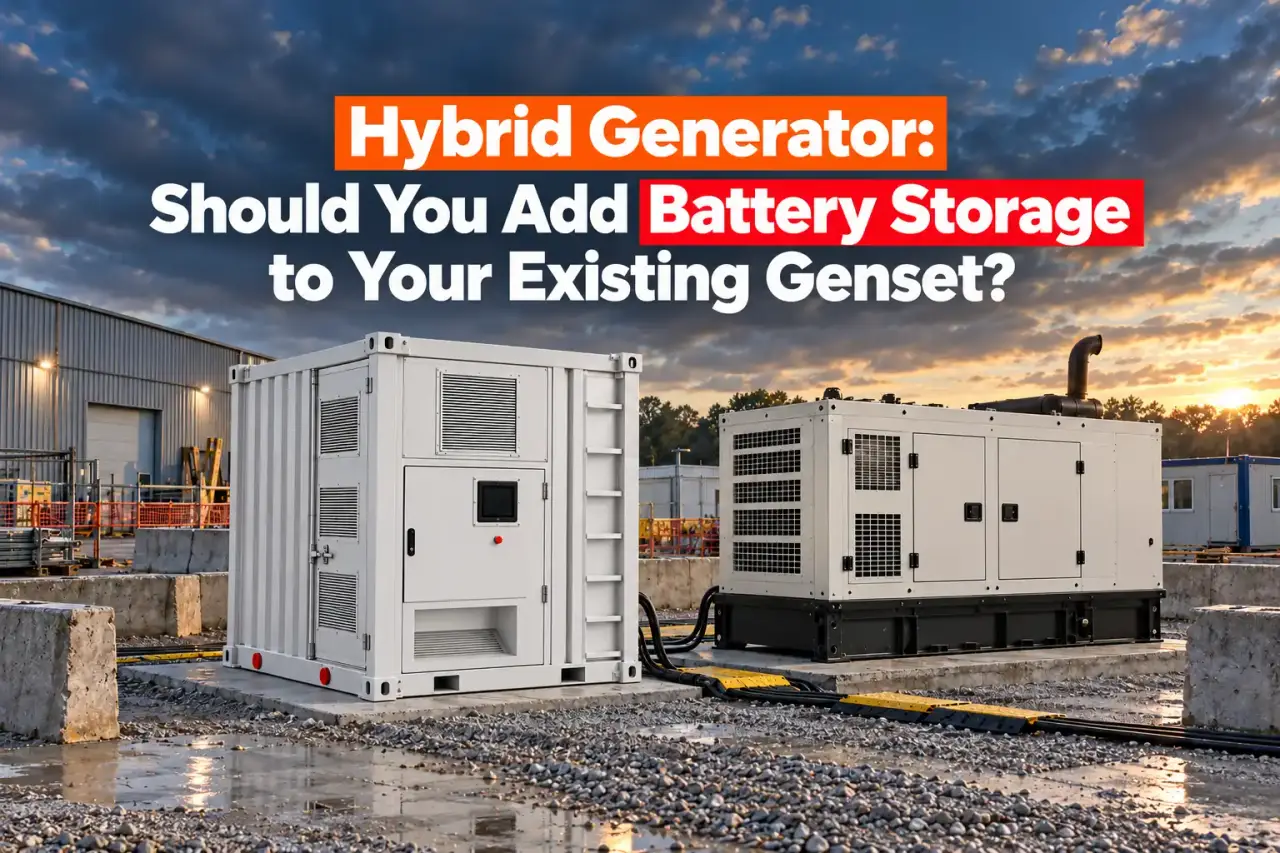
Table of Contents
A diesel generator can be essential during a busy working day. Overnight, the situation may look very different: machinery stops, staff leave, and only lighting, refrigeration, security equipment and a few other loads remain. The engine keeps running through those lighter hours.
If that sounds familiar, battery storage is worth a closer look. You may be able to keep your existing generator and run it less often. Whether the purchase makes sense depends on how much of that lighter-load period the battery can cover.
Why Add a Battery When You Already Have a Generator?
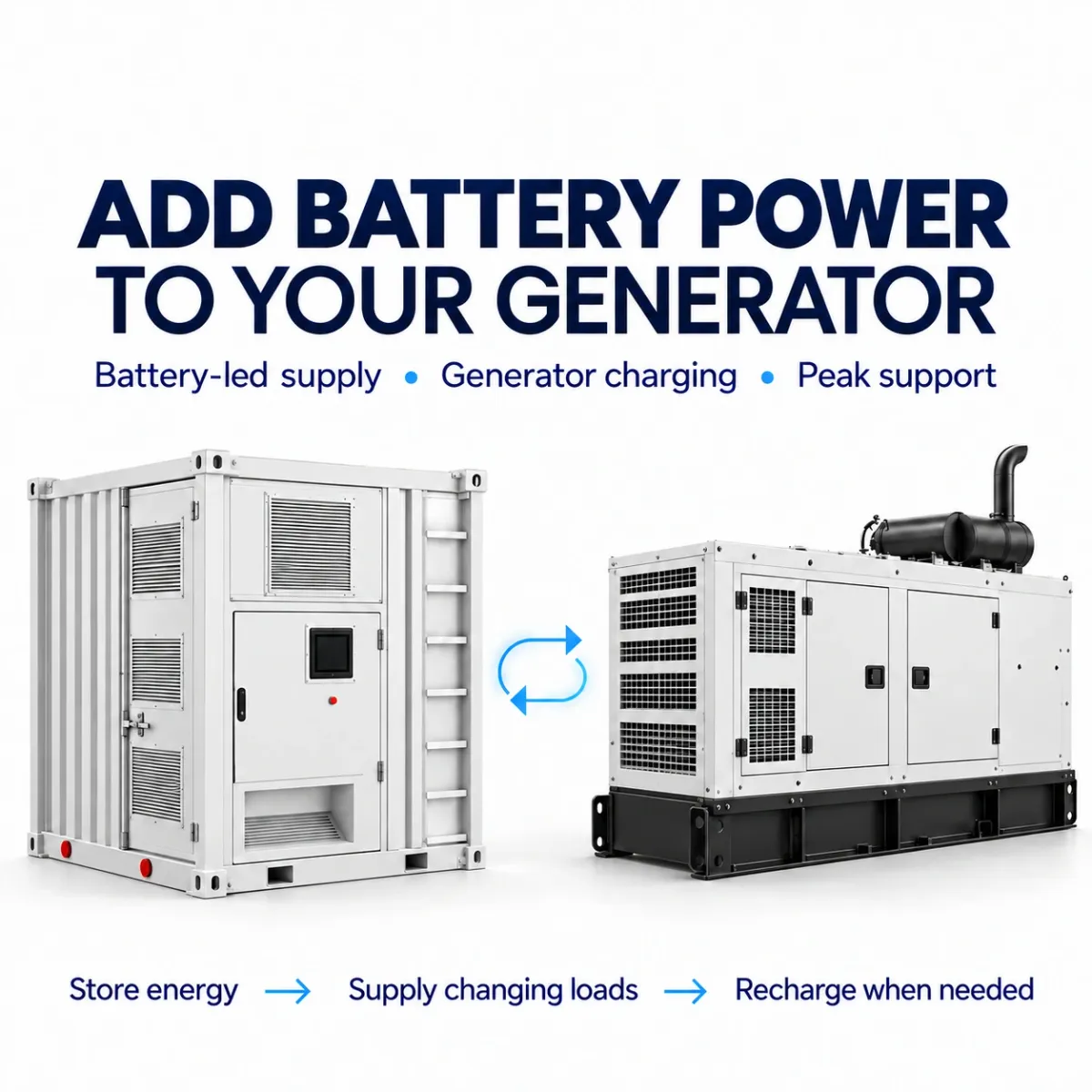
A commercial hybrid generator system combines a diesel generator with battery storage, power conversion and coordinated controls. The battery supplies suitable loads while the engine is stopped. The generator runs when charging, site demand or reserve requirements call for it.
The battery does not produce energy. It stores electricity from the generator, optional solar panels or another available supply. It changes when and how the generator runs.
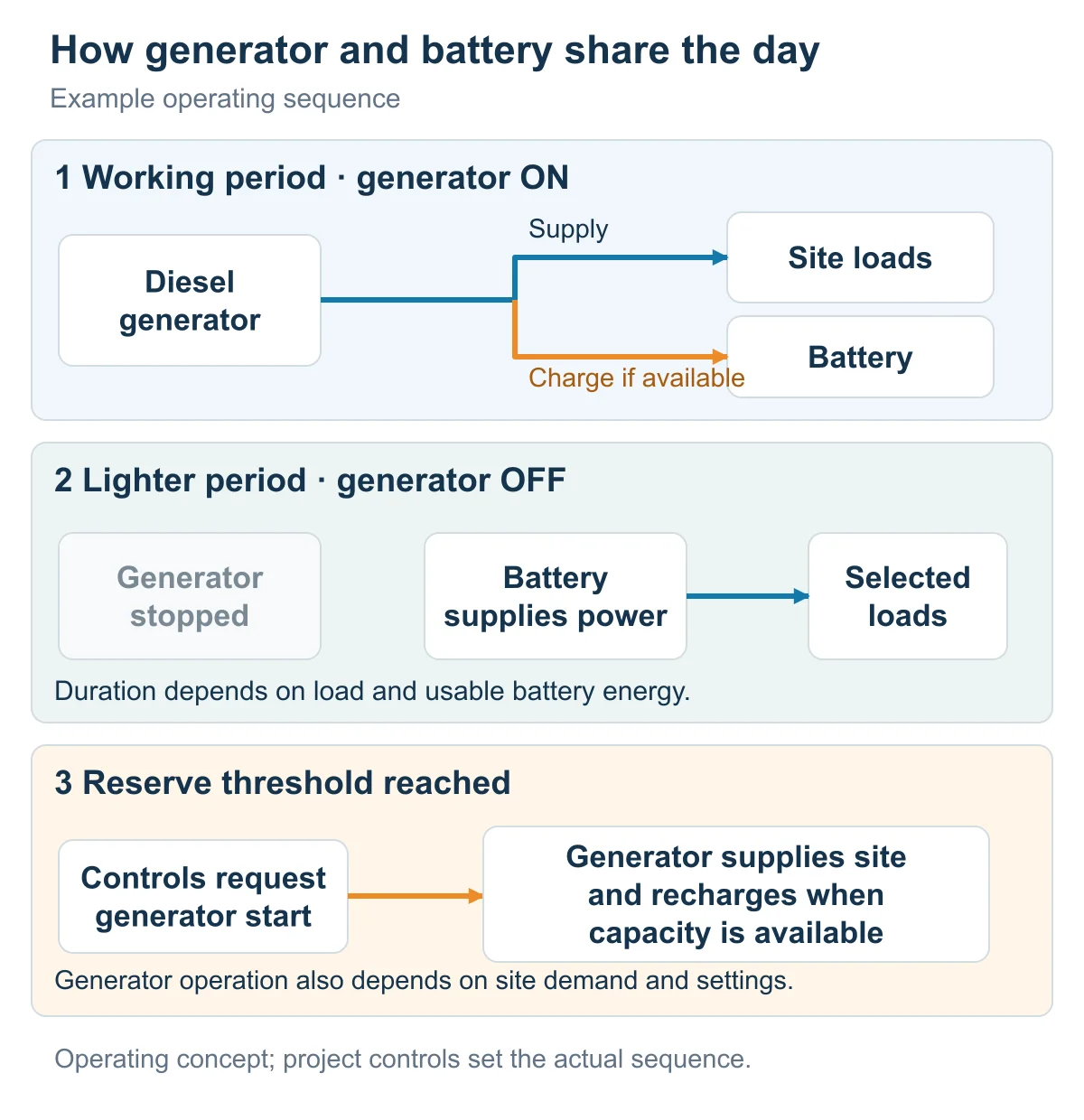
A typical operating pattern could be:
- During a busy period, the generator supplies site demand and charges the battery where capacity allows.
- During a lighter period, the battery supplies the connected loads with the engine stopped.
- When battery charge reaches the configured threshold, the controls request generator operation.
That can create quieter overnight periods and reduce engine hours. Fuel savings depend on the complete operating cycle, including battery charging and conversion losses.
When a Hybrid Generator Setup Makes Sense
Your daytime and nighttime loads are very different
Consider a construction site where daytime work needs machinery, pumps and temporary offices. After the shift, only security, lighting and staff accommodation need power.
A generator selected for daytime demand may be much larger than those overnight loads require. Battery storage can be sized around that lighter period, while the generator remains available for the next working day.
A resort or remote commercial property may have a similar pattern. In either case, decide which loads must remain on and how many hours they need to run.
Noise limits when you can run the engine
At a property with guest accommodation, nearby homes or overnight staff, engine noise can become an operating problem.
Battery supply offers periods without the diesel engine running. Cooling fans and other equipment may still make noise, so placement remains important.
The Producers Guild of America's power-source guidance also identifies lighter loads as a useful application for battery-generator hybrids, while noting that heavier demand can shorten battery operation.
Fuel deliveries and servicing are a recurring burden
At a remote site, the cost of diesel includes getting it there. Fewer engine hours may also reduce servicing linked to running time.
Compare the proposal with your site's current fuel use and servicing. Long overnight periods with light loads give the battery a different job from heavy demand that continues around the clock, where the benefit may be smaller.
If your generator runs only occasionally during short outages, keeping the existing arrangement may be the more sensible purchase decision.
Add Battery Storage or Buy an Integrated Hybrid System?
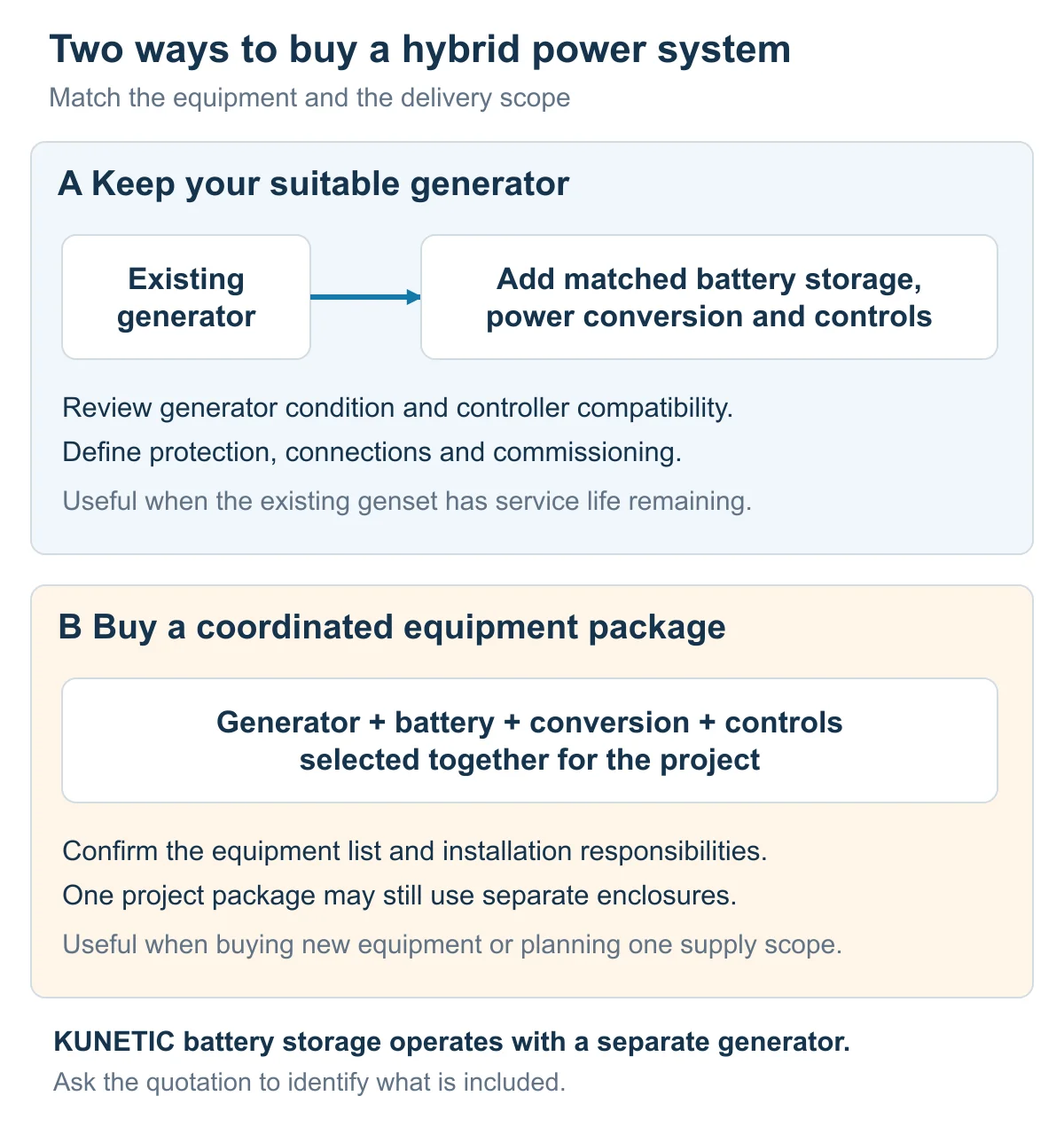
There are two common buying routes. You can retain a suitable generator and add a matched storage system, or purchase a coordinated generator-and-battery package.
Buying question | Keep the generator and add storage | Buy a coordinated hybrid package |
What happens to existing equipment? | A suitable generator stays in service | Generator and storage are selected together |
Main advantage | Reuses an asset you already own | One defined equipment and integration scope |
Main consideration | Generator condition, controller compatibility and integration work | Whether the package fits your actual loads and installation |
What should the quotation clarify? | Storage, controls, protection, connections and commissioning | Which equipment is included, plus installation and commissioning responsibilities |
When is it worth considering? | Your existing generator is suitable and has useful life remaining | You need new equipment or prefer a coordinated supply package |
An integrated package does not necessarily mean everything sits inside one enclosure. Ask for an equipment list and a system drawing.
I'd ask each supplier to spell out what the quotation covers. Check who supplies the controls and switching, and who handles installation and commissioning. Those costs can sit outside the battery price.
What Needs to Match Before You Buy?
Power and battery capacity answer different questions
Power, measured in kW, determines what the battery system can supply at one time. Energy, measured in kWh, determines how long it can supply those loads.
For a simple planning example, suppose selected nighttime loads average 30kW for four hours:
30kW × 4 hours = 120kWh delivered to the loads.
The nominal battery capacity needs to allow for the usable discharge window, conversion losses, reserve and auxiliary consumption as well as that 120kWh delivered to the loads.
Starting a motor can also require more power than keeping it running. Both the sustained load and the largest starting events belong in the equipment selection.
Site voltage and generator controls matter
The storage system must suit the site's voltage, frequency and phase arrangement. The generator controller must also support the required coordination.
Having the same communication connector is only part of that check. The controls need to exchange the right information and carry out the intended start, stop and charging sequence.
Send the generator and controller models early. That is more useful than choosing a battery first and discovering an integration problem later.
The battery needs a practical charging window
The generator may need to supply the site and recharge the battery during the same period.
If most of its available power is already serving the loads, charging may take longer than expected. The proposal should show how the battery will recover enough energy before the next planned engine-off period.
For a closer look at the financial comparison, see our BESS and diesel generator cost guide. Use your operating schedule to check which arrangement fits the site.
How a KUNETIC Hybrid Storage Solution Could Fit Your Site
KUNETIC's hybrid generator battery storage system pairs LFP battery storage and controls with a separate diesel generator.
The series offers three AC power classes:
Rated AC output | Listed battery energy configurations |
150kW | 150 to 300kWh |
250kW | 200 to 400kWh |
500kW | 400 to 600kWh |
Choose within these ranges around your loads. A site with short demand peaks may need substantial power and a more modest overnight energy reserve. Lower demand that continues for many hours calls for a different balance of power and battery capacity.
The listed series uses 400V three-phase output, with generator communication through RS485 or Ethernet. Site voltage, generator controls and the proposed operating modes need to be reviewed together.
Optional solar input can contribute energy during daylight. For a broader project involving PV, storage and diesel generation, explore our solar, battery and diesel hybrid solution.
KUNETIC 150 to 500kW hybrid generator battery storage system, designed to operate with a separate diesel generator.
What to Send Us for a Matched Proposal
You can start the discussion before you have a finished system design. Send us:
- A photograph of the generator nameplate and its controller model.
- Installation country, site voltage and frequency.
- Typical daytime and nighttime loads.
- Equipment with large starting demand, such as pumps or compressors.
- The hours you would like to cover with the engine stopped.
- Existing solar equipment, if any.
If available, include recent fuel use and generator running hours. These help compare the proposed operation with what happens on site today.
Send your site details to KUNETIC so we can review a suitable storage configuration, generator pairing and supply scope.
Frequently Asked Questions
Do I need solar panels for a hybrid generator system?
No. A diesel-and-battery system can operate without solar panels. The generator charges the battery as part of the planned operating cycle. Solar can be considered where space, generation conditions and project economics support it.
Can I use the generator I already own?
Possibly. Its condition, electrical ratings, controller and available charging capacity all matter. Share the generator and controller models before choosing storage equipment.
What happens when the battery charge gets low?
In a suitably configured system, the controls request generator operation before the battery reaches its operating limit. The start sequence, reserve level and response to a failed start should be agreed during system design and commissioning.
How much diesel can I save?
There is no single percentage that fits every site. The estimate should compare your present fuel use with a proposed operating schedule, accounting for site loads, generator charging, battery losses and any solar contribution. Longer engine-off periods alone do not prove a particular fuel saving.