English
 Deutsch
 Español
 Français
 Italiano
 Polski
 Română
 العربية

Table of Contents
What Is Peak Shaving Energy Storage?
Peak shaving energy storage uses a battery to reduce a site's grid demand during high-load periods. Battery power determines how many kilowatts it can cover. Usable energy determines how long it can keep doing so. Demand-charge savings depend on the utility's billing rules and which peaks the battery reduces.
For battery peak shaving, the system tracks site demand. It discharges as grid power nears the chosen limit. An energy management system (EMS) controls discharge, charging and backup priorities.
The battery supplies part of the site load while reducing the demand recorded by the meter. For a factory or warehouse, start with the electricity bill and load profile. Monthly energy use alone does not show the size or length of demand peaks. Our commercial battery storage sizing guide covers the wider equipment-selection process.
Peak Shaving vs Load Shifting
Peak shaving and load shifting can use the same battery, but they solve different billing problems.
Question | Peak shaving | Load shifting |
Main goal | Reduce billed peak demand in kW | Move grid energy use between times |
Control basis | Site demand and a grid-power limit | Schedules, energy prices or solar availability |
Can they work together? | Yes, if enough power and energy remain available | Yes, if the schedule allows for peak-control needs |
If the battery discharges to save on energy costs, it may have little charge left when the site's biggest demand peak arrives. Decide which service takes priority before estimating savings from both.
Will Peak Shaving Reduce Your Demand Charges?
Find the demand-charge line on your bill, then check the tariff's measurement interval and the hours when demand charges apply. The billed peak may be an average over an interval, so a brief spike does not necessarily set the charge. HelioScope's peak-demand guidance lists intervals of 15 minutes, 30 minutes or 60 minutes. Check which rule your utility uses.
Check minimum billed demand and any rules that use earlier peaks. These can limit the bill reduction even when the battery lowers today's grid demand. A tariff without demand charges offers no demand-charge saving, though other battery uses may still have value.
Compare a full billing period with and without storage. Include charging costs, losses and the cost of owning the system. Research on behind-the-meter storage examines how load profiles and tariffs affect the economics. For the broader budget, see our commercial battery storage cost guide.
How to Size a Peak Shaving Battery
Size peak shaving battery storage by power and usable energy. Use load data that matches the utility's billing interval. Check seasonal changes before choosing a target.
Set the Required Battery Power
Consider an example site with a steady 220kW demand during a peak. The target grid demand is 140kW.
Required battery output = 220kW − 140kW = 80kW.
The battery must deliver at least 80kW during this example's peak. Check the inverter's output rating and the battery's discharge limits for your site conditions. Energy capacity alone does not tell you the available power.
The target must also fit the rest of the load profile. An 80kW reduction is not enough if another interval reaches a higher demand.
Check Peak Duration and Usable Energy
If that 80kW reduction is needed for 30 minutes:
Required discharge energy = 80kW × 0.5h = 40kWh.
The same reduction over two hours needs 160kWh. If the load varies, add the energy needed above the target in each interval.
These figures describe energy delivered to the site. The battery's rated capacity must also cover losses, state-of-charge (SOC) limits, aging and backup reserve. Check repeated peaks too. The battery needs enough charge for the next peak or time to refill.
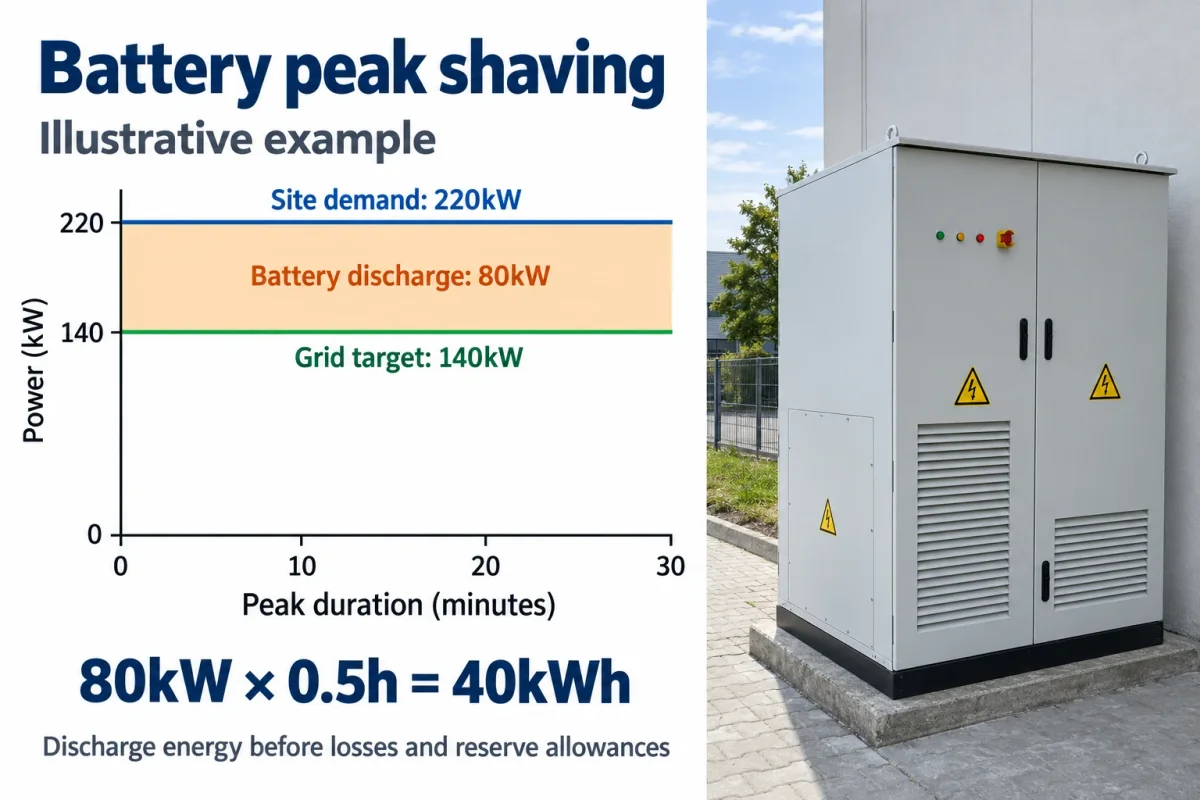
Illustrative example: reducing grid demand by 80kW for 30 minutes needs 40kWh of discharge energy. Allow for losses and reserve when sizing. The chart uses example figures.
Set Charging and Backup Priorities
Set the EMS charging limits and backup reserve alongside the discharge target.
Charging adds to site demand and can create a new peak. Set charging limits around the grid-demand target, and confirm that the site's arrangements permit grid charging.
Review the time between peaks to see when the battery can refill. Solar surplus can charge it, but cloudy days and changing production loads affect the available energy. Check any fixed schedule against these conditions.
Keep the agreed backup reserve available for an outage. Routine peak shaving cannot use that reserve. Decide which service takes priority when charge is low. Our commercial battery backup guide explains how supported loads and runtime affect that reserve.
Confirm meter placement, controller response and commissioning settings with the project team. Test the control strategy against the load data before relying on a savings estimate.
What to Send Your BESS Supplier
For a site assessment, send your supplier:
- Electricity bills and the applicable tariff, including demand-charge rules.
- Interval load records covering seasonal and operating changes.
- Target grid demand and known equipment-starting or production peaks.
- Solar production data, if available.
- Backup loads, reserve requirements, site voltage and grid-connection requirements.
KUNETIC's 125kW / 261kWh commercial BESS has rated PCS power of 125kW and rated battery energy of 261.248kWh. This battery energy storage system supports peak-demand management. Set its controls around the site's load profile, tariff and target limit.
Confirm usable energy, voltage compatibility and project controls for your site. Send KUNETIC your tariff, interval load data and backup requirements through the product page's project inquiry form to assess the configuration.
FAQs
Can peak shaving work without solar?
Yes. A battery can charge from the grid where permitted and discharge during demand peaks. Include charging costs and charging demand in the assessment.
Does peak shaving reduce kWh consumption?
Not necessarily. It lowers grid power during peak periods. Charging and discharging involve losses. A lower demand charge does not mean lower total energy consumption.
Can the same battery provide peak shaving and backup?
Yes, with suitable system design and controls. Reserve energy for the agreed backup loads, then assess peak shaving using the power and energy still available.