
 English
 Deutsch
 Español
 Français
 Italiano
 Polski
 Română
 العربية

Table of Contents
Commercial solar battery storage lets your business save surplus daytime solar for use later. Already have solar panels? You may be able to keep your existing PV equipment and add a battery system. The right setup depends on when you need power and how the new storage connects.
When Your Existing Solar Leaves a Gap
Your solar panels may produce more power than you need at lunchtime. Yet your factory, shop or warehouse still buys electricity later in the day. A battery can store that surplus for a later shift, a cold room or evening operations.
But surplus generation alone is not a reason to buy a large battery. There also needs to be a useful time to discharge it.
What happens at your site? | What storage could do | What should shape the proposal? |
Solar exceeds daytime demand, with a busy late shift | Move available surplus into later working hours | The surplus available to charge and the load that can use it later |
Solar exceeds daytime demand, but the business closes early | Serve any remaining evening loads | Whether there is enough later demand to justify the investment |
The business wants daily savings and power-cut protection | Shift solar energy while keeping a backup reserve | Which loads need backup and how much energy must stay available |
An export limit can make storage worth investigating too. However, once the battery is full, the system still needs a way to stay within that limit.
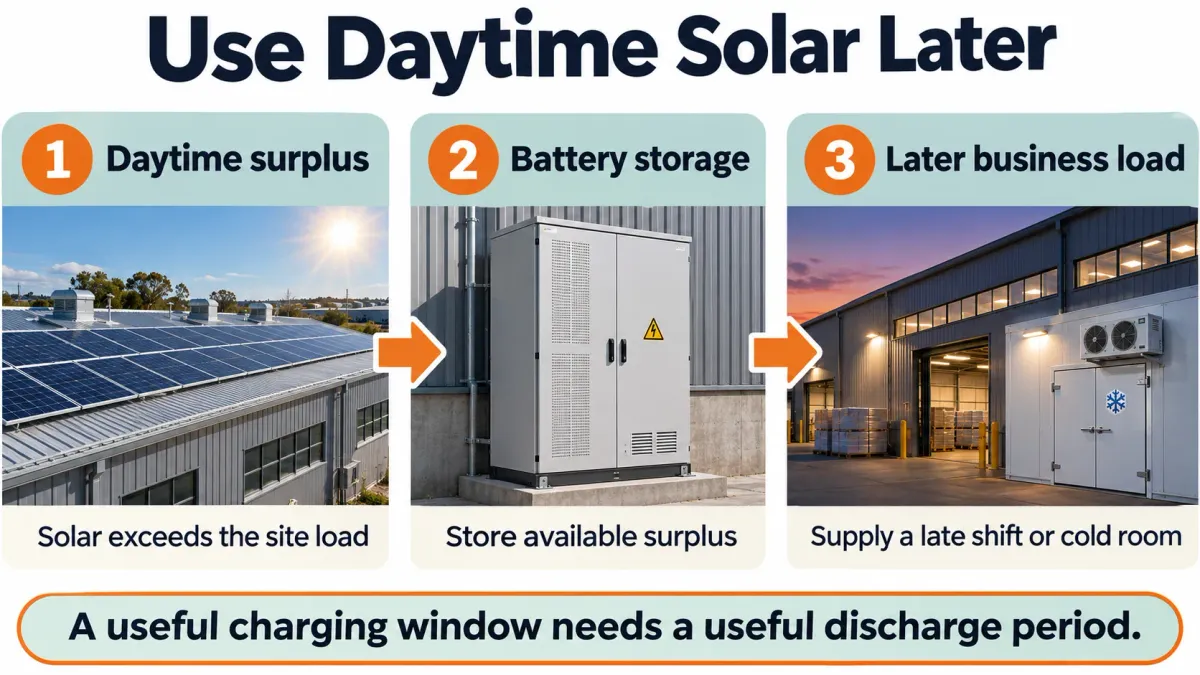
Store available daytime surplus for later business demand. The usable opportunity depends on the site’s load and operating hours.
What Can Stay and What Needs to Be Added
Adding battery storage to existing solar does not automatically mean replacing your panels or PV inverter.
With AC coupling, a battery connects through a suitable battery inverter or power conversion system (PCS). It joins the site's AC electrical system alongside the existing solar inverter. Meters, controls and protection allow the equipment to work together.
Ask the supplier how the proposed equipment will work with your current inverter and electricity supply. Our AC-coupled and DC-coupled solar guide explains the connection options in more detail.
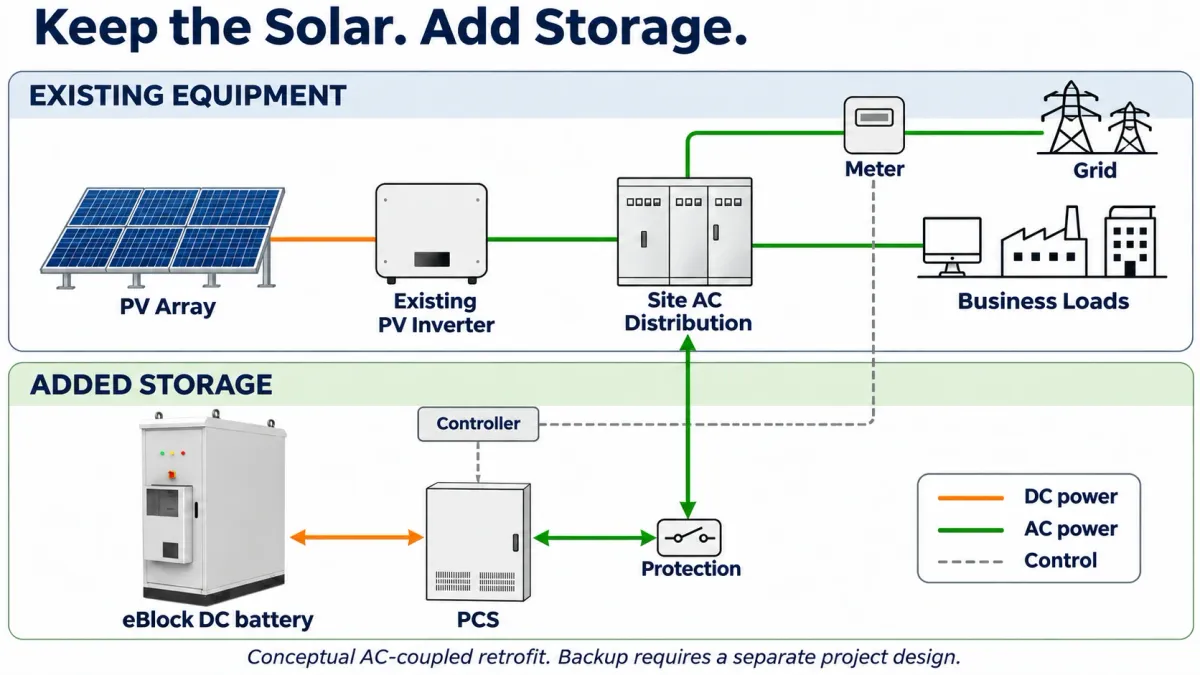
Conceptual AC-coupled retrofit using a DC battery cabinet and separate PCS. Final protection, controls and backup arrangements depend on the project.
A battery cabinet with separate power conversion
The KUNETIC eBlock outdoor battery cabinet provides up to 120kWh of installed battery capacity. This DC battery cabinet needs an external PCS to connect to the site's AC system.
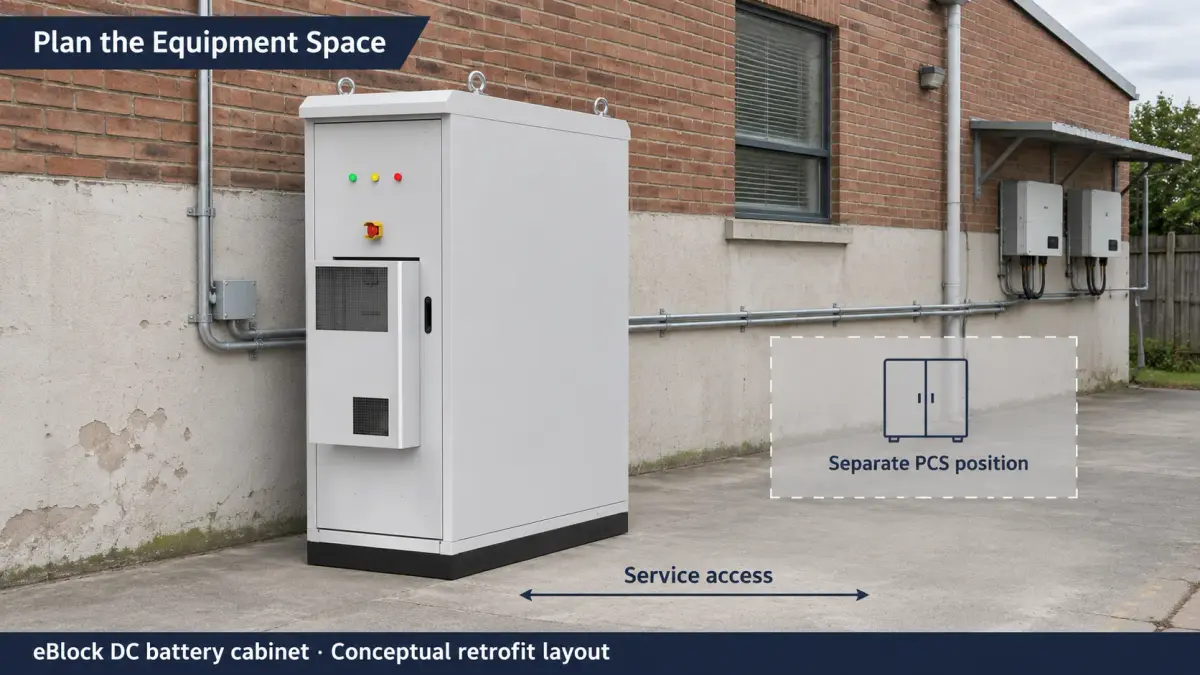
Your quote should name the matched PCS and include the controls and protection. It should also allow space for both units and maintenance access. The cabinet's kWh rating alone does not tell you its AC output power or backup capability.
An integrated commercial storage system
The KUNETIC K-eBank 125kW/261kWh system combines energy storage, power conversion, solar input, transfer equipment and controls in an outdoor cabinet.
This can suit a project that needs an integrated package. Before ordering, confirm how the existing solar will connect and which built-in functions you need. The supplier must check the site voltage, inverter compatibility and local connection rules. An all-in-one cabinet still needs a site-specific design.
Match the Battery to the Energy You Can Actually Use
Commercial battery storage systems need a useful charging and discharge schedule. For a solar battery retrofit, check:
- How much surplus is available, and for how long? A brief midday spike is different from several hours of steady surplus.
- What will use the stored energy later? A late production shift, cold room or evening trading period creates a different requirement from an empty building.
- How much energy must remain for backup? That reserve reduces the energy available for everyday bill savings.
Power, measured in kW, determines how quickly the system can charge or supply loads. Energy capacity, measured in kWh, determines how much it can store. Both must fit the job.
This is why two businesses with the same solar capacity may need different batteries. The official REopt approach to onsite energy planning considers load, electricity rates, equipment costs and operating schedules together. Our commercial battery storage sizing guide explains the equipment choices.
KUNETIC's Philippines commercial solar and battery proposal pairs 50kWp of PV with 120kWh of nominal battery energy and a separate 50kW hybrid inverter. This proposal shows how the battery, inverter and site layout fit together. Its capacities are a design example, not a sizing rule for every 50kWp array or measured retrofit results.
Compare the Complete Retrofit Quote
The battery price is only one part of a storage upgrade. Ask each supplier to show what the proposed system includes and what your local installer must provide.
Part of the proposal | What you should be able to see |
Battery and power conversion | Battery capacity, usable-energy assumptions, charge/discharge power and matched equipment |
Metering and controls | How existing PV, site demand, export limits and any backup reserve will be managed |
Electrical and site work | Required protection, switching, cabling, equipment base and installation space |
Commissioning | Who configures and tests the system, and whether the connection work needs a planned shutdown |
Delivery and support | Supply scope, transport responsibilities, warranty terms and service arrangements |
Check what the savings estimate counts. Storing solar may avoid buying electricity later, but it can also mean giving up export income. Allow for energy losses, battery wear and operating costs too. The savings estimate should follow your site's expected use; capacity alone cannot predict the bill reduction.
For budget detail, use our commercial battery storage cost guide. KUNETIC's system supply overview explains the factory and site-work boundary.
If another company owns the PV system or sells you its electricity, check who can approve changes before ordering.
Plan a Storage Upgrade for Your Site
To discuss a commercial solar PV upgrade with KUNETIC, send:
- Your site location, solar capacity and existing inverter model.
- A recent electricity bill and your usual operating hours; generation, import/export or interval-load data is helpful if available.
- What you want storage to achieve, including any loads that need power during an outage.
Photos of your existing equipment and the proposed battery area help us review the layout. Send what you have, and we can identify any missing details.
Discuss your existing solar and storage requirements with KUNETIC. We can review the equipment package and what the supply includes. Local installation and grid connection requirements are checked for your project.
Questions About Adding Storage to Existing Solar
Can I keep my existing solar inverter?
Often, yes. An AC-coupled system may let you keep it. Your project team must check the inverter model, electrical connections and controls before confirming the design.
Will the added battery keep the site running during a power cut?
Only if the system is designed for backup. It needs suitable power conversion, safe isolation from the grid, switching and controls. It also needs enough stored energy for the loads you want to keep running. A grid-connected battery alone does not guarantee backup.
Is storage still useful if we export very little solar?
Possibly. Charging at cheaper times and discharging at peak times may lower your energy bill. Peak shaving can reduce billed demand where that charge applies. Backup may also matter. Assess each use against your tariff and site needs; none requires spare solar energy.
