
 English
 Deutsch
 Español
 Français
 Italiano
 Polski
 Română
 العربية

Table of Contents
If your home or site uses 80 kWh a day, start with the hours you want the battery to cover. You might need power through the evening, backup power for a few essential loads, or enough stored energy for a full-day outage.
Our full-day example needs about 103 kWh of rated battery capacity. That means eleven 10 kWh units to supply an 80 kWh day. If the battery covers only part of the day, the required storage capacity can be much smaller.
The calculation below includes losses and an allowance for extra use. Your load readings and the equipment specs will shape the final setup. That includes how you recharge the battery.
How many solar batteries do I need for an 80 kWh day?
We assume 90% depth of discharge (DoD). We also use 95% efficiency from the battery to the loads. On top of that, we add 10% to the expected energy demand. The battery starts charged, and there is no recharge during the period shown.
What the battery needs to cover | Energy delivered to loads | Calculated rated capacity | Example 10 kWh units |
Selected essential loads for one day | 20 kWh | 25.7 kWh | 3 |
Evening and overnight use | 40 kWh | 51.5 kWh | 6 |
All loads for one full day | 80 kWh | 102.9 kWh | 11 |
All loads for two days, without recharge | 160 kWh | 205.8 kWh | 21 |
We have assumed 20 kWh for selected loads and 40 kWh for overnight use. Check your own readings before using either figure. The 10 kWh units illustrate the arithmetic; the equipment must also support that battery count and those connections.
Decide how much energy the battery needs to supply
How much battery storage do I need for overnight use?
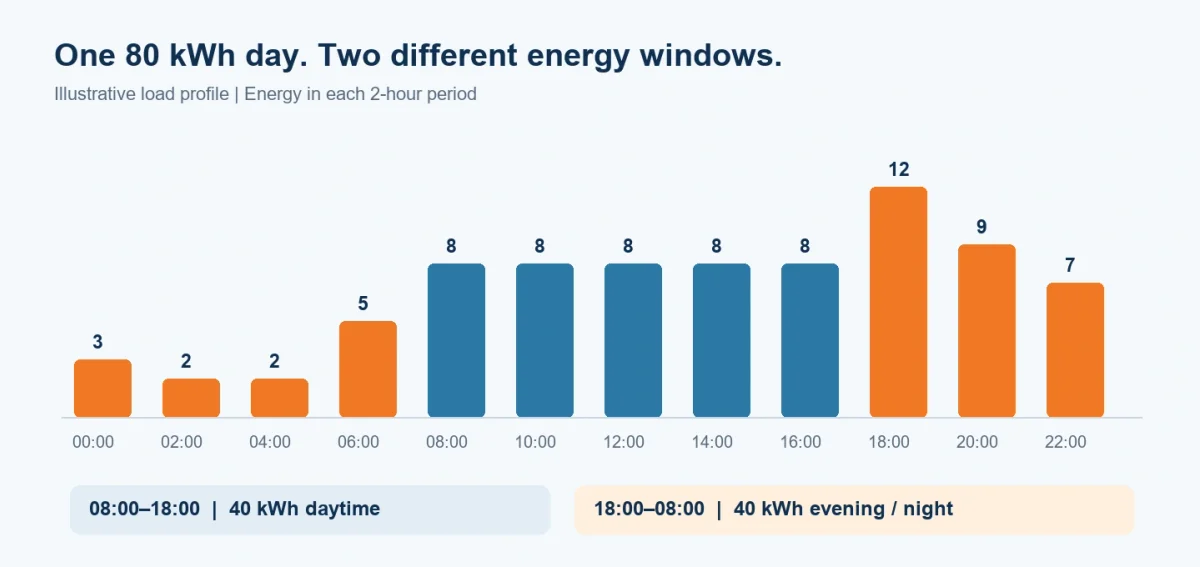
Look at when you use electricity. Daytime air conditioning, workshop machinery or EV charging may take solar power directly. The battery may then need to cover the remaining evening and overnight demand.
Our example uses 40 kWh from 8 a.m. to 6 p.m. and 40 kWh during the remaining hours. Your power provider's readings across the day or an energy monitor will show whether that split fits your home or site.
Backing up the whole home or site
For a full-day outage with no solar or other recharge, use the energy demand for that entire day. Heating and cooling loads change with the season. That day's use may be well above the yearly daily average.
Check high-demand days alongside typical ones. Also check how much charge you expect when an outage starts. Daily energy shifting may have already used some of the battery's charge.
Keeping only essential loads running
You may want to keep the fridge, lights, internet and a water pump on. EV charging and other loads may be able to wait. Add the energy used by that selected group over the backup period.
Berkeley Lab's household backup research examines how selected loads, outage conditions and solar generation affect storage needs. It does not prescribe one battery size for every home.
Solar battery sizing: usable capacity and battery count
From rated capacity to energy delivered
The basic calculation is:
Required rated capacity = load energy × planning allowance ÷ (usable fraction × discharge-path efficiency)
For our full-day example:
80 × 1.10 ÷ (0.90 × 0.95) = 102.9 kWh
Here, 1.10 adds 10% to the expected load. It is a simple planning allowance, not another 10% state-of-charge reserve. The 90% usable fraction already limits the discharge window. The 95% figure represents the discharge path in this example, not round-trip efficiency.
Check what the manufacturer means by usable capacity. If it already describes energy delivered on the AC side, do not deduct the same losses again. Heat, cold and battery age may change the margin you need. Allow for power used by support equipment and check the system settings too.
Turning the estimate into a battery count
Divide 102.9 kWh by 10 kWh per unit and round up. Eleven units give you 110 kWh of nominal capacity. Before choosing that setup, check the module limit and battery voltage. Make sure the inverter and batteries work together.
When comparing a cabinet or integrated system, use its usable energy figure. You may not need to count individual modules. Our kW versus kWh guide explains how the energy and power ratings differ.
Check power output and the next recharge
Can the system run your simultaneous loads?
An 80 kWh day averages about 3.3 kW over 24 hours. Several appliances or machines running together can demand much more than that. Pumps, compressors and other motors can also have brief starting requirements.
Check which loads will run together, then compare their demand with the inverter's continuous output and starting capability. Stored energy alone cannot tell you whether it will run that equipment.
Can solar or the grid recharge it in time?
The next day's solar output needs to cover daytime use and refill the battery. Allow for charging losses too. A large battery paired with insufficient generation can gradually run down over several days.
For a solar system, estimate how much power the panels will produce at your site. Include the weaker season.
For grid or generator charging, check the available power and charging window.
For backup power, check that the whole storage system can run without the grid. It also needs the right switches and controls.
How we would configure a system around your loads
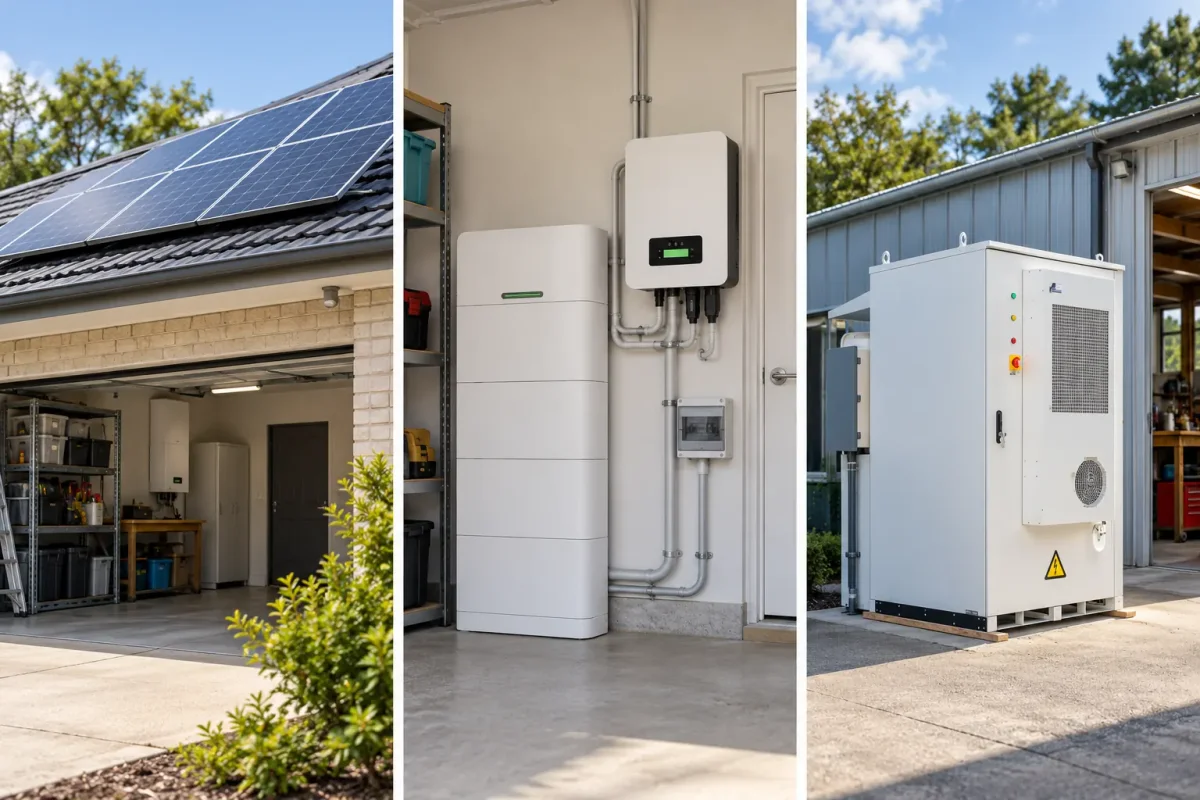
We can prepare a configuration with modular batteries, a separate inverter and solar equipment, or an integrated cabinet. The KUNETIC proposals below cover different loads. The smaller systems would supply only part of an 80 kWh day.
Home solar storage for a smaller backup window
One household proposal combines 5 kWp of solar, 20.48 kWh of LFP storage and a 6.5 kW inverter. We would assess this setup for daytime solar use and selected loads after sunset.
At a property using 80 kWh daily, we would check the night load first. We would also ask which appliances can wait. A 20.48 kWh battery would cover only part of that daily demand. A larger night load needs a larger battery arrangement and enough generation to refill it.
Villa backup built around specific equipment
For a villa elevator, a separate proposal pairs a 19.2 kWh high-voltage battery with a 15 kW inverter. Here, we need to check the motor load and its starting behaviour when choosing the inverter and backup arrangement.
Two properties with the same daily use can need different equipment. Longer runtime for modest loads calls for a different arrangement from stronger short-duration output. For the elevator, check the motor and electrical supply alongside the required operating time.
A larger battery bank or an integrated cabinet
We have also prepared a larger proposal: 160 kWh of storage paired with a 30 kW inverter. We would check whether its usable capacity meets the backup time you need. We would also check peak load and how it will recharge.
An all-in-one outdoor option is the KUNETIC K-eBank. It has 120.5 kWh rated energy and 50 kW AC output. Its standard AC connection is 230/400 V, three phase. For a US home, we would need to check whether it can match the site's electrical supply.
The equipment on our website is a starting point. We can also review arrangements with separate battery and inverter equipment to suit the loads you need to serve. Our battery cabinet guide explains the difference.
What could a lower electricity bill look like?
Consider a villa using 80 kWh per day, bought entirely from the grid before the project. Suppose a solar-and-storage arrangement reduces grid purchases to 40 kWh per day. At an assumed flat energy rate of $0.25 per kWh over 30 days, the comparison is:
Before: 80 × 30 × $0.25 = $600 in energy charges
After: 40 × 30 × $0.25 = $300 in energy charges
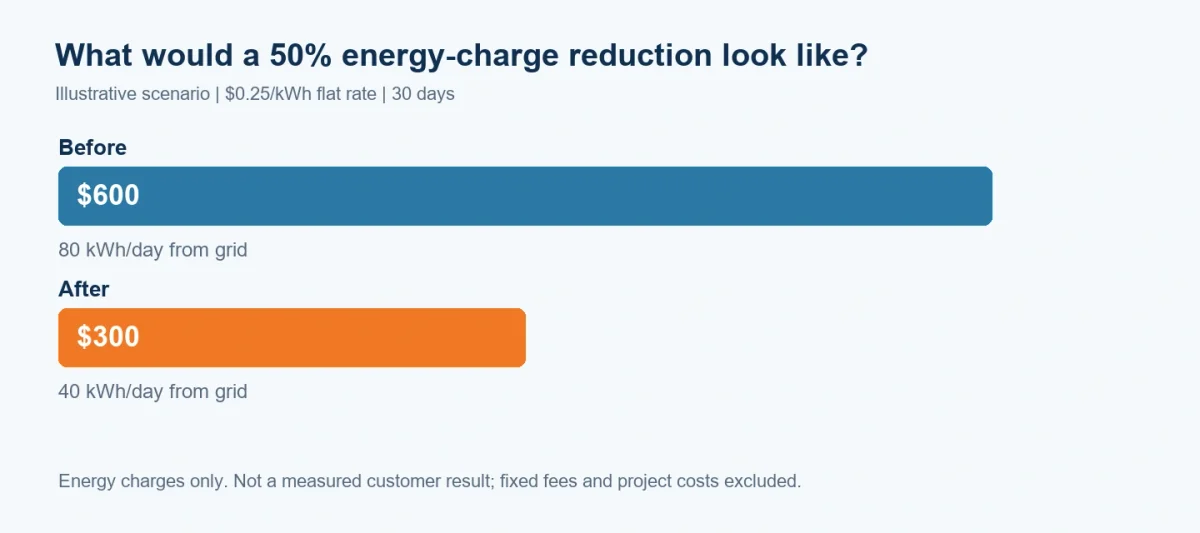
That is a 50% reduction in the energy-charge component under these assumptions. This is a worked example. It is not a measured customer result or a promise to halve the whole bill.
Your bill may also include fixed fees and peak-demand charges. Rates that vary by time of day and credits for exported power can change the saving too. Equipment costs and financing are separate from this comparison.
To assess that saving, we would use the property's bill, interval readings and solar estimate. The cut in grid purchases must match direct solar use plus energy from storage, after losses. The battery does not generate energy.
Frequently asked questions
Can a 100 kWh battery cover an 80 kWh day?
It depends on whether 100 kWh means rated capacity or usable energy, and on the operating conditions. With our example's 90% usable fraction and 95% discharge efficiency, a nominal 100 kWh system delivers about 85.5 kWh before the extra planning allowance. It falls short of the 88 kWh budget used here.
How does winter affect battery sizing?
Winter can change heating demand, solar generation and the battery's permitted operating conditions. Use load and solar-output figures for that season. Check the battery maker's limits for heat, cold and charging. Increasing storage alone will not solve a recurring shortage of charging energy.
Can I expand the battery system later?
Choose an arrangement that explicitly supports expansion. Check which modules work together, the inverter limits and the controls. Ask the supplier how to add batteries later. Units that look alike may not work together.
Tell us what you need the battery to cover
Send us a recent electricity bill or a daily load profile. Tell us which equipment must stay on, for how long, and the site's voltage. If you already have solar, include its capacity and inverter details.
We can help size the battery and check the inverter and solar arrangement with you. That may lead to a modular system or an integrated cabinet. Contact KUNETIC to discuss your configuration.
