
 English
 Deutsch
 Español
 Français
 Italiano
 Polski
 Română
 العربية

Table of Contents
A hybrid solar system lets you store some of today's solar power for later while keeping your grid connection. Your configuration sets how much stored energy you can use after sunset. It also determines which loads can stay on during power outages.
The package needs to match your daily electricity use and the loads you want during an outage. Battery capacity, power output and the equipment that handles backup all affect the cost.
What does a hybrid solar system include?
A typical hybrid solar power system combines solar panels and battery storage. An inverter and controls manage power between these parts, the grid and your loads.
The panels generate electricity, and an inverter converts it for your appliances. Depending on the design, the inverter handles battery charging too. The battery's management system monitors and protects its cells. Metering and controls decide when the system charges, discharges or uses the grid.
For backup power, you also need suitable grid isolation and switching equipment. The design must identify which circuits it will supply.
On a sunny afternoon, solar can power the building and charge the battery. Stored energy can then cover some of the evening demand. If the grid fails, a properly configured backup system disconnects from it and supplies the designated loads. Equipment and settings determine the operating sequence.
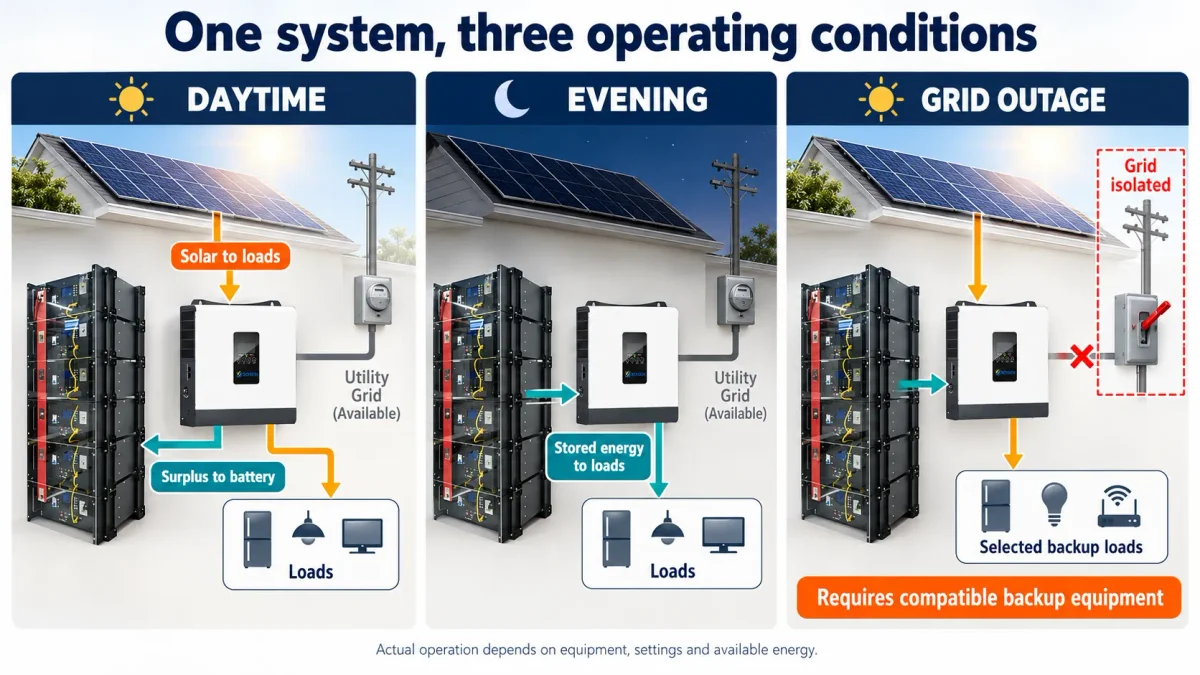
Typical energy flows. Outage operation depends on the equipment, controls and designated backup circuits.
If you're still deciding between system types, our on-grid versus off-grid solar guide covers that comparison.
What do you want the battery to cover?
Use more solar after sunset
If your panels produce surplus energy at midday but your household or business stays busy into the evening, storage can move some of that energy into those later hours.
Your usage readings across the day will help here. A monthly total hides the daily pattern. Check how much spare solar you have and how much energy you use in the evening. Import and export rates affect what you save. Where available, net metering can also change the value of storing your own solar energy.
Keep selected loads running during an outage
For backup, make a separate list of the equipment you want to keep running. At home, that might be refrigeration, lights, internet and a pump. At a small business, it might be refrigeration, payment equipment and essential lighting.
Name any heating, cooling or other large loads you want included. They can substantially increase the battery capacity and power output you need.
You can plan for daily solar use and backup together. If the controls support a backup reserve, they can hold some energy for outages. Raising that reserve leaves less for everyday use. The setting should reflect which need matters most to you.
Match solar, battery storage and power output
Battery capacity sets the energy budget
Battery capacity is measured in kilowatt-hours, or kWh. The usable storage capacity depends on operating limits and backup reserve settings. Some energy is also lost during conversion.
Take an average backup load of 2 kW for six hours. It needs 12 kWh delivered to the loads. At 90% depth of discharge and 95% conversion efficiency, you need about 14 kWh of rated capacity. This assumes a fully charged battery, no recharge and no extra design margin. Actual equipment limits and starting charge will change the result.
Our battery sizing guide explains the calculation in more detail.
Power output determines what can run together
Power, measured in kW, tells you how much demand the system can support at once. Even with a large battery bank, the inverter may be too small to run all your appliances together.
Pumps, compressors and other motors may draw extra power when they start. Check the inverter's peak power rating as well as its continuous output. The battery, inverter and backup equipment must all support those loads. Extra battery modules add energy within the manufacturer's supported configuration, but they do not automatically increase AC output.
Then look at the next recharge. Solar generation needs to cover daytime demand as well as replenishing the battery. A large storage bank with little surplus solar may spend much of its time partly charged.
Check what happens when the grid goes down
I'd ask the supplier to name the backup circuits and explain how the proposed equipment handles changeover.
Before accepting the design, ask:
- Which loads remain connected during an outage?
- Can solar continue supplying those loads and charging the battery?
- What happens after low battery charge or an overload?
The U.S. Department of Energy explains how solar and storage can support resilience. For your installation, the inverter, controls and grid-isolation arrangement determine how that capability works.
For longer outages, consider how much solar is likely to be available during poor weather. If you need a generator, include its interface and controls in the design from the start.
How KUNETIC can configure the complete system
A modular setup for smaller properties
One KUNETIC reference proposal combines 5 kWp of solar, 20.48 kWh of LFP battery storage and a 6.5 kW inverter. The storage uses two 10.24 kWh battery packs.
We would assess this combination against your solar production, evening use and chosen backup loads. Check the 20.48 kWh rating alongside power output and the appliances you want to run.
For a smaller property, we can put together the battery modules, inverter and protection, including a plan for the backup circuits, as part of a residential storage solution.
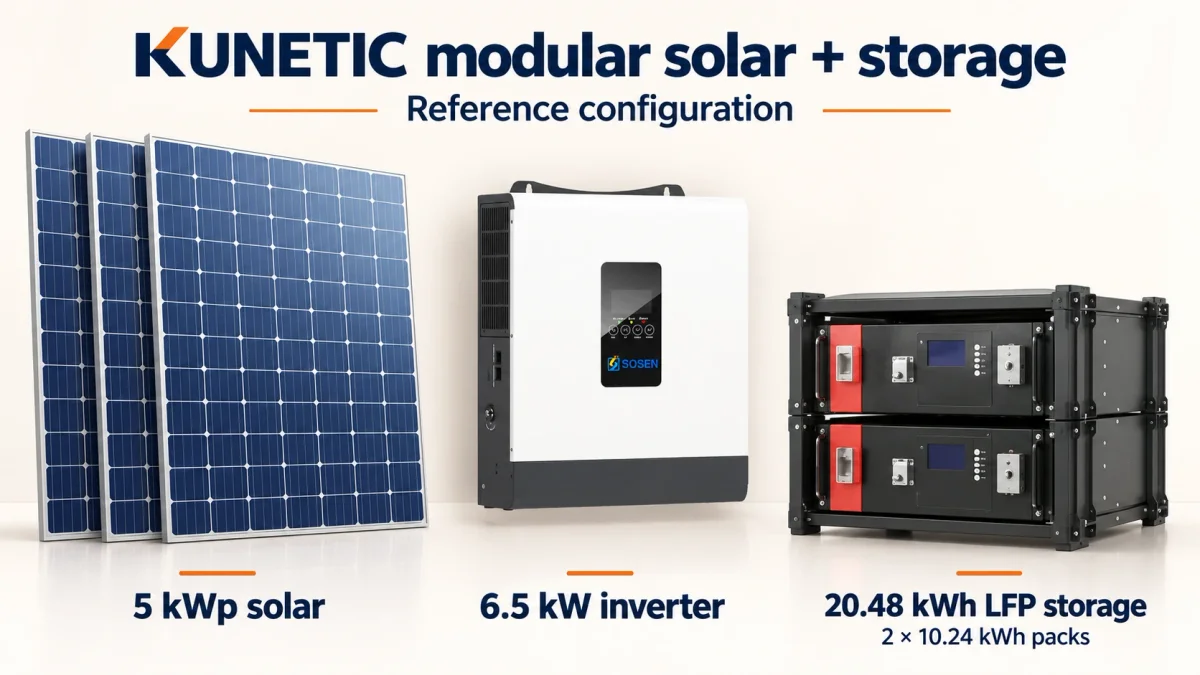
KUNETIC configuration reference: 5 kWp solar, 20.48 kWh LFP storage and a 6.5 kW inverter.
An integrated cabinet for commercial loads
An integrated cabinet can bring more of the equipment together for larger loads. The KUNETIC K-eBank 50 kW / 120.5 kWh combines LFP battery storage, power conversion, solar input and system controls in an outdoor cabinet.
The 50 kW output describes its power capacity; 120.5 kWh describes its rated stored energy. We would assess the site's loads and PV arrangement, then confirm the grid interface and backup operation.
Configuration reference | Main equipment | What we would assess for your site |
Smaller-property modular system | 5 kWp PV, 6.5 kW inverter and 20.48 kWh LFP storage | Evening demand, motor starts, selected backup circuits and recharge |
Commercial integrated system | K-eBank cabinet with 50 kW AC output and 120.5 kWh rated storage | Load profile, solar integration, electrical interface and backup scope |
The home proposal uses a 220 to 240 V AC inverter. The published K-eBank model is 230/400 V three-phase. For a U.S. project, we would first select the voltage and phase arrangement. We would then verify the required equipment documentation before confirming the configuration.
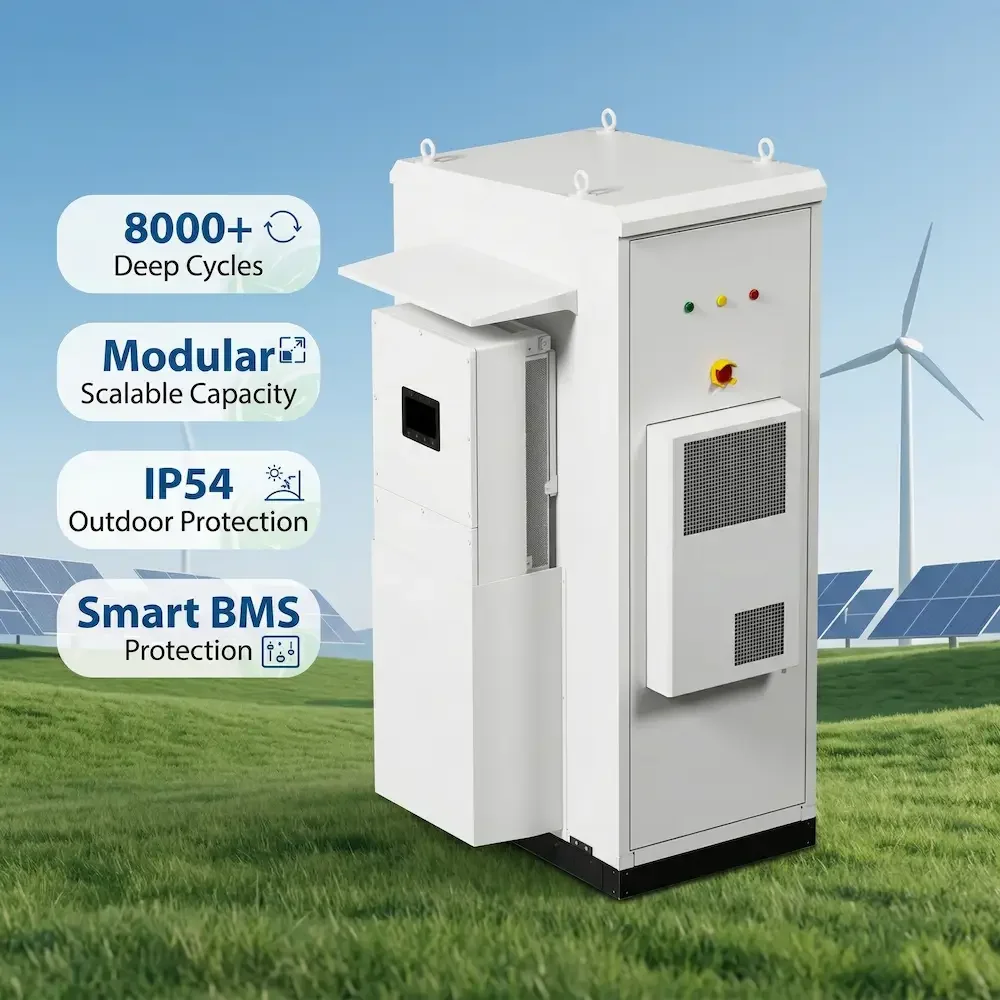
KUNETIC K-eBank: 50 kW AC output and 120.5 kWh rated LFP battery storage.
What should a complete system quote include?
I find quotes easier to compare when the equipment and installation scope are written out. Two offers with the same battery capacity can include quite different work.
Look for:
- Solar panels, mounting and the agreed PV capacity, if included.
- Battery models and usable capacity, the inverter or PCS, and supported expansion.
- Switching, protection and metering, with the circuits to be supplied identified.
- Installation, commissioning and any required connection or approval work.
- Freight, warranty terms and responsibility for after-sales service.
A battery-and-inverter price covers only part of the job. The site, electrical work and backup requirements affect the final installed cost. Give suppliers the same load list and installation scope when you request prices.
Questions worth clearing up
Can I add battery storage to my existing solar system?
Often, yes. The suitable approach depends on the existing inverter, whether storage is AC- or DC-coupled, and the required backup behavior. Send the inverter model and system details before choosing a battery package.
Can a hybrid solar system run without batteries?
Some hybrid inverters support operation without a battery in certain modes. That capability is model-specific. Without stored energy, the system cannot provide battery-backed power after sunset, and daytime outage operation also depends on its design.
Can a generator work with the system?
Yes, with equipment and controls designed for the combination. Confirm whether it can supply loads, charge the battery, or both. Our solar, storage and diesel solution covers arrangements for weak-grid and remote applications.
If you're planning a hybrid solar system, send us your location, main loads, required backup hours and any existing solar equipment. Contact KUNETIC to discuss a complete configuration. We can help match the battery, inverter and backup arrangement to the way your property uses power.
