English
 Deutsch
 Español
 Français
 Italiano
 Polski
 Română
 العربية

Table of Contents
Off-grid solar power systems supply a property without a utility grid connection. They still need to work after sunset and when solar output falls short.
Solar panels generate electricity during daylight. The battery stores energy for later use. The panels, battery and inverter need to suit your loads, with enough solar to recharge between uses.
Whether you are buying for a cabin, a home or a small business, start with how you use electricity. The equipment needs to fit that routine, including a plan for charging when the weather changes.
Which off-grid solar setup fits your property?
A weekend cabin may need lights, refrigeration, internet and a water pump. A full-time home adds daily cooking, laundry and perhaps air conditioning. A farm or workshop may have short, heavy loads alongside equipment that runs for hours.
KUNETIC proposal materials include the following configurations. Each combines a different solar array, inverter and battery capacity.
Configuration reference | Solar array | Inverter or conversion unit | Nominal battery storage |
Separate battery and inverter | 5.95 kWp: ten 595 W panels | 5.5 kW inverter | 10.24 kWh LFP battery |
Home all-in-one arrangement | 6 kWp: ten 600 W panels | 6.2 kW integrated unit | Approximately 16 kWh LFP battery |
Larger farm or workshop arrangement | 15 kWp: twenty-four 625 W panels | 30 kW three-phase inverter | 35.84 kWh high-voltage battery system |
Each proposal lists mounting separately. To choose one for your property, we would check its loads, local solar conditions and the equipment match. We would also check the battery's power limits against the loads and inverter rating.
If you only visit occasionally, I'd first check what stays on while you are away. Can you check the battery level before you arrive? At a full-time home, the system has to run the house each day and cover the night. The panels also need to recharge the battery for the next evening.
For a farm or workshop, list motor starts and simultaneous loads early. Moving suitable pumping or processing work into solar hours may reduce the energy the battery needs to supply later.
These are regional configurations. For a US project, check the voltage and phase arrangement. That includes 120/240 V split-phase where required. Ask for the equipment documents needed for your location.
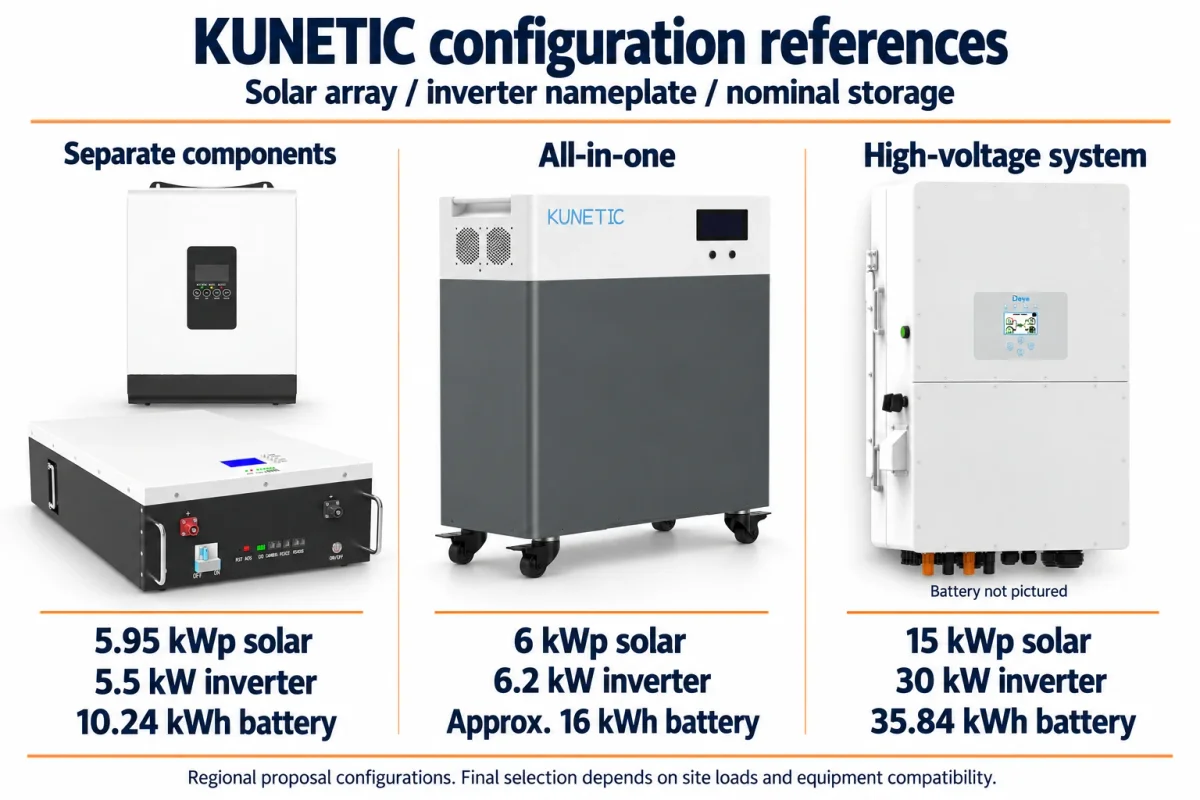
KUNETIC proposal references: separate-component, all-in-one and high-voltage storage arrangements.
What should a complete off-grid solar system include?
Most off-grid solar power systems combine these parts:
- Solar panels and mounting: sized for the location, available space and seasonal energy needs.
- An inverter and solar charging equipment: an inverter/charger may include MPPT solar charging. Other designs use separate controllers.
- Battery storage and its management system: matched to the inverter's voltage, power limits and supported communications.
- Protection, distribution and controls: the specified switches, breakers, cables, earthing, metering and monitoring.
- Optional generator support: the charging connection and controls required by the selected equipment.
Read the included-equipment list before comparing prices. An inverter-and-battery bundle may still need panels, mounting, protection equipment and installation. A panel kit may contain no battery at all.
Also check that the selected inverter supports the intended standalone operation. Our on-grid versus off-grid solar guide explains each system type. Use it if you are still deciding whether to keep an electrical grid connection.
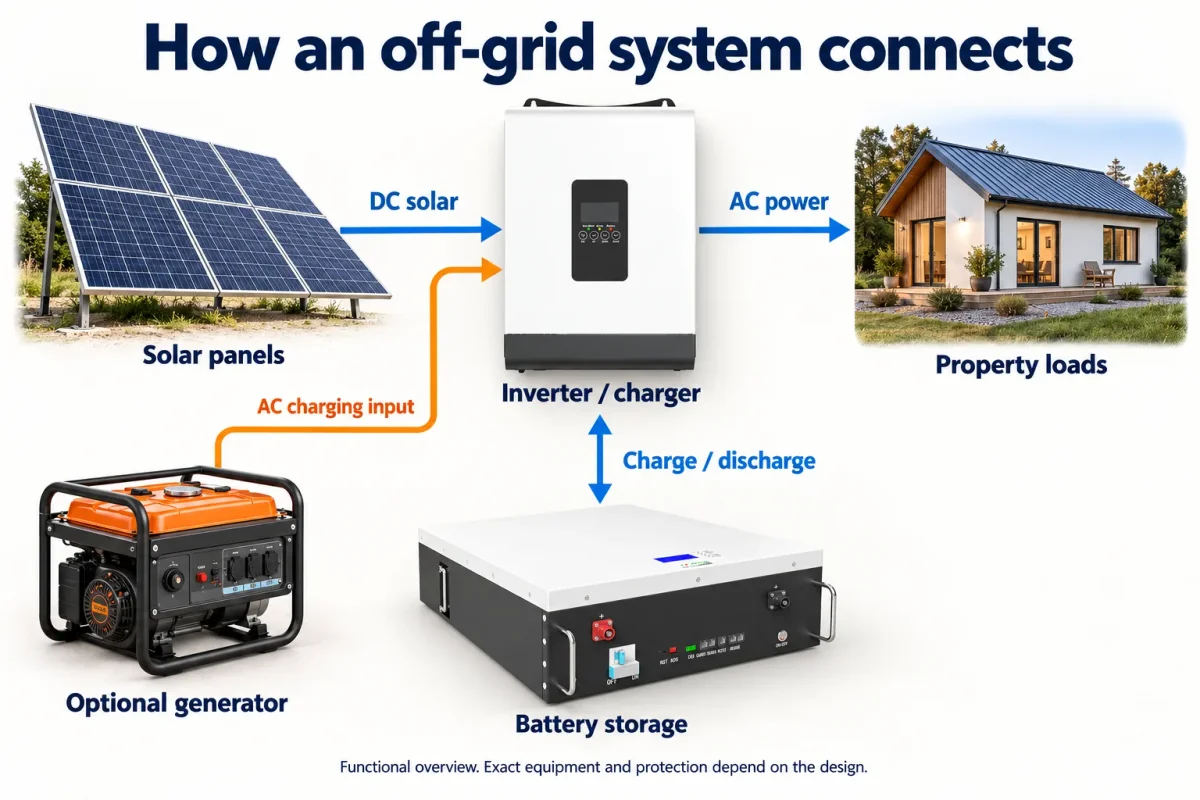
A functional overview of an off-grid solar and storage arrangement with optional generator support.
How do you choose the right system size?
Match the inverter to the loads that run together
Write down which appliances may operate at the same time. A pump may start while the refrigerator and workshop equipment are on. That calls for more power than a few lights and a laptop.
A properly designed off-grid system can run air conditioning. Check how much power the unit draws while running and starting, how long you will use it, and what else will be on. Give the supplier its exact model; "one air conditioner" leaves too much to guess.
Ask for both the continuous output and the supported starting load of the complete system. A larger inverter cannot make a battery deliver more power than its cells, BMS and connections allow.
Match battery storage to the hours without solar
Work out how much stored energy, in kWh, the battery needs to supply. Separate daytime use from the evening and overnight loads.
For a simple illustration, suppose the loads average 1.5 kW for eight hours without useful solar. They need 12 kWh delivered to the appliances. If the calculation assumes 90% of nominal battery capacity is available and 92% conversion efficiency, the starting estimate is:
12 ÷ (0.90 × 0.92) ≈ 14.5 kWh of nominal battery capacity.
Those percentages are example assumptions, not specifications for every battery. Allow for temperature and aging, too. Standby use and any extra reserve also affect the storage capacity you need. See the full method in our battery-sizing guide.
Check how the battery will recharge, too. Tomorrow's solar must run the daytime loads and replace the energy used from storage. Compare the expected solar output in the site's more difficult months with when you use electricity. The US Department of Energy explains how seasons, clouds and other conditions affect solar production.
What happens during several cloudy days?
When daily solar production stays below consumption, the battery level falls. Adding storage gives you more time, but the system still needs a way to replace that energy.
Before buying, decide which loads can wait. You may be able to move water heating, laundry or some pumping work to a sunnier day. Refrigeration, communications and an essential water supply need a plan for the cloudy period.
For a remote property, I'd settle the generator question before ordering the battery. Can the proposed equipment charge from it? What limits apply to charging?
Decide whether you will start it manually or need automatic starting. Automatic operation needs compatible starting controls and settings.
KUNETIC's solar, battery and diesel configurations are a starting point for this combination. We would choose the arrangement around your loads and the length of low-solar periods.
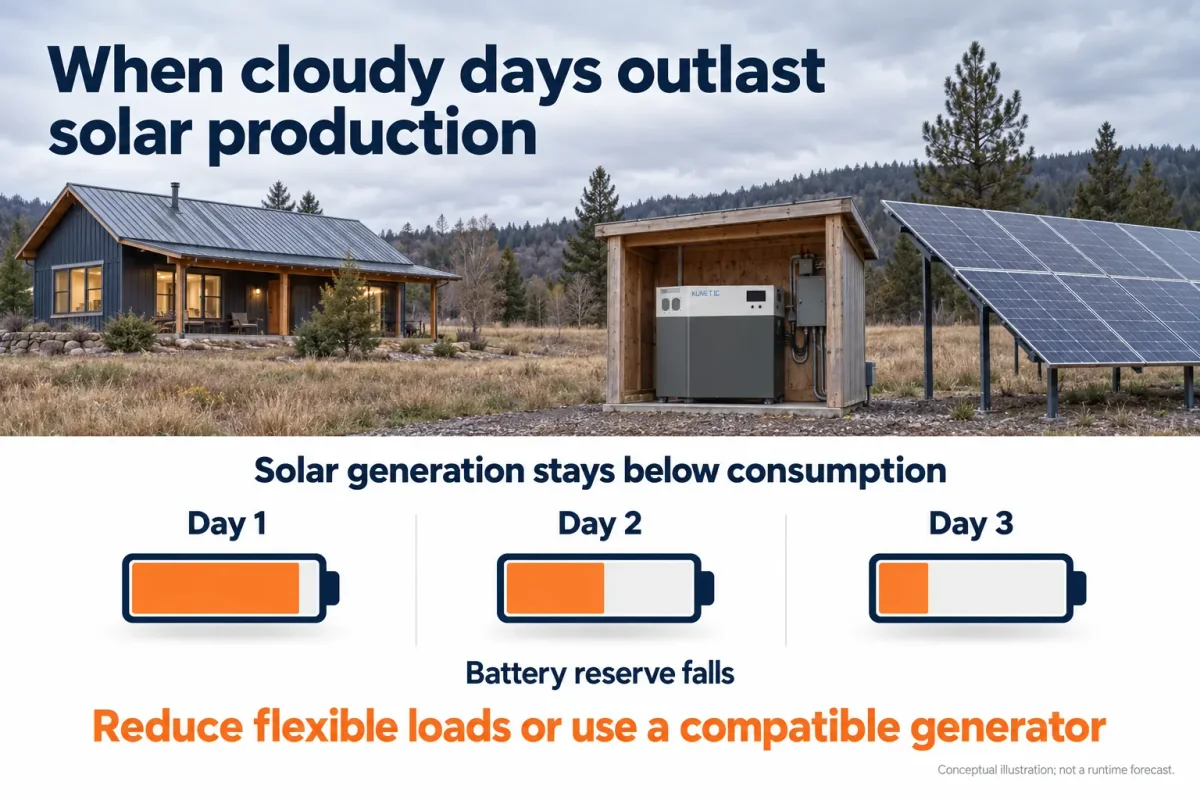
Battery reserve falls when daily solar generation remains below consumption.
What does an off-grid solar system cost?
Compare equipment packages on the same basis
Public equipment prices help put the budget in perspective. These SunGoldPower kits were checked on October 22, 2026:
An 8 kW inverter package started at about $5,500 for the listed base option. Battery options ranged from 10.24 to 16.07 kWh.
A 20 kW inverter package started at about $16,000, with 30.72 to 32.14 kWh battery options. These were the starting prices for the listed base configurations.
Other combinations can cost considerably more. GoGreenSolar listed an 8 kW solar and inverter package with 16.2 kWh of storage at approximately $31,000. These supplier examples have different components and scopes. They are equipment-price references, not a general installed-price range or a KUNETIC quotation.
Compare solar kWp and inverter output alongside the price. Check nominal and usable battery capacity, then the included hardware and support. The output voltage and phase must suit your property too.
Check what sits outside the equipment price
Quotation item | What to make explicit |
Solar array and mounting | Panel quantity and rating, roof or ground mounting, structural work |
Battery and inverter | Exact models, usable energy, available power and supported operating modes |
Electrical equipment | Protection, distribution, cabling, earthing and any switching equipment |
Generator connection | Included hardware, charging capability and starting controls |
Delivery and site access | Freight, taxes or duties where applicable, unloading and transport to the property |
Installation and commissioning | Who installs, configures and tests the complete system |
Warranty and support | Coverage for each component and who handles a system-level problem |
Ask each supplier to quote against the same equipment list and site requirements.
Putting together your KUNETIC off-grid system
We can put together the battery, inverter and supporting components for your property. KUNETIC offers separate-component and integrated arrangements. We would choose between them based on your power and storage needs. Space and access for servicing matter too.
For smaller properties, our residential energy-storage solutions are a useful starting point. For farms and workplaces, the assessment also needs equipment schedules, motor starting requirements and any existing generator.
For a first proposal, send us:
- The installation location and required voltage, frequency and phase.
- An equipment list, including pump, motor and air-conditioner nameplates where possible.
- Typical daily operating hours and which loads run together.
- How long essential loads should operate without useful solar.
- Details of existing panels, batteries, inverters or generators, plus installation photos if available.
Ask KUNETIC for a system configuration and quotation. We can then propose an equipment combination, explain the sizing assumptions and list what is included in the supply.
Questions worth asking before you buy
Can an off-grid solar system power an entire house?
Yes, when it is designed for the house's energy use, simultaneous loads and local solar conditions. Heating, cooling and electric cooking can change the required equipment substantially. A whole-house proposal should show what happens in the difficult season as well as on a sunny day.
Can I keep my existing generator?
It may be possible. The generator's voltage, phase, output quality and available power must suit the inverter or charger. If automatic starting is wanted, its control interface also needs to be compatible.
Can I add more batteries later?
Check the exact models before buying. Check which batteries can work together and their age and condition. Inverter limits, communications and space also affect expansion. The inverter may limit how much extra solar or output power you can add.