
 English
 Deutsch
 Español
 Français
 Italiano
 Polski
 Română
 العربية

Table of Contents
Two inverters may share the “hybrid” label and do different jobs. One may suit a single-phase home. Another may suit a three-phase business site. Their battery and backup requirements can differ.
Think about the equipment you run and what must stay on during a power cut. Your existing or planned solar system also affects the choice.
What does a hybrid solar inverter do?
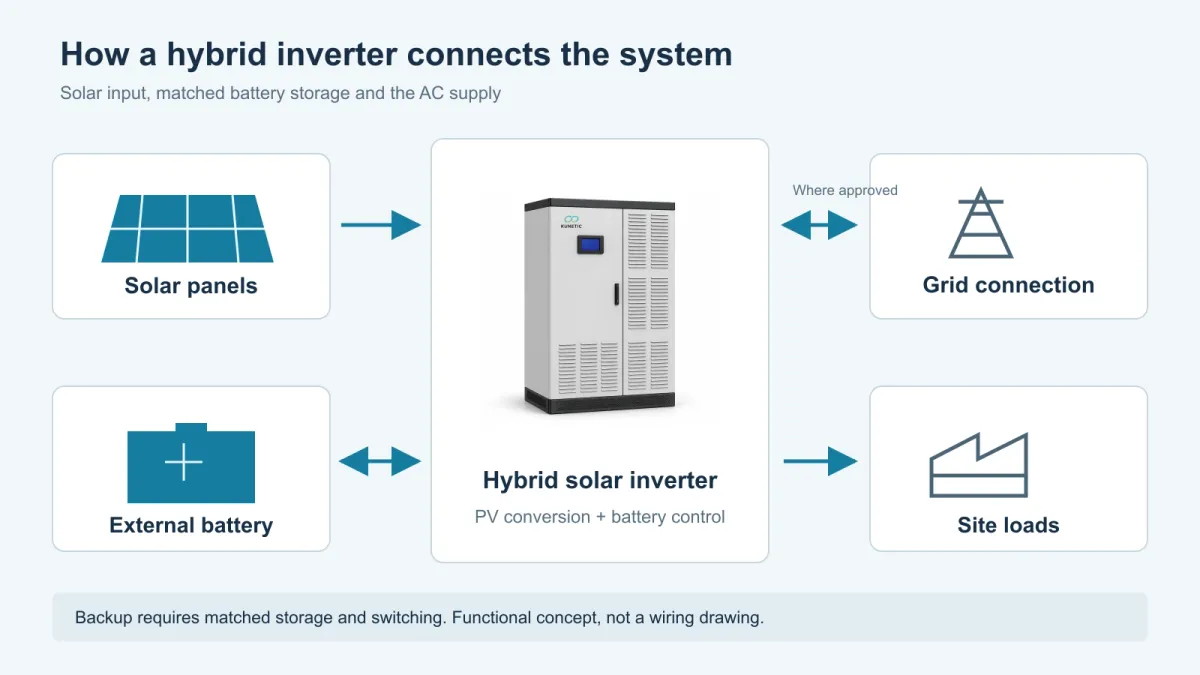
A hybrid solar inverter turns solar power into AC power for your equipment. It also controls how a matched battery charges and supplies stored energy. You may also see it listed as a solar hybrid inverter.
The inverter itself does not necessarily include that battery. Solar panels, battery storage, distribution equipment and installation may all be separate parts of the proposal.
The U.S. Department of Energy explains that a solar-plus-storage system needs a backup design to run during an outage. Check the loads it can supply and how it switches over. The “hybrid” label does not answer those questions.
Is a hybrid inverter the right fit for your site?
Start with the situation at your property. A new installation gives you different choices from a site with working solar equipment already in place.
Your situation | A sensible route to consider | What matters most |
New solar and battery installation. | Choose a matched inverter and battery. | Match solar inputs, storage and AC output. |
Existing working solar system. | Compare keeping or replacing the PV inverter. | Check fit, equipment condition and the cost of changes. |
Power cuts are your main concern. | Design backup for selected loads. | Check backup output, switching and usable battery energy. |
For a new project, choose the inverter and battery together so the equipment matches from the start.
If you already have solar, your working PV inverter may still have useful life left. An AC-coupled battery arrangement could allow you to retain it, depending on the equipment and backup requirements. Our AC-coupled versus DC-coupled guide explains that choice in more detail.
A business using stored solar later in the shift needs battery capacity and a charging schedule that suit its working hours. If outages are frequent, keeping a smaller group of important loads supplied may take priority.
What should you compare before choosing a model?
Match the site’s voltage, phase and load
A home, hotel and factory can have very different electrical supplies. Confirm the supply voltage, phase arrangement and local connection requirements before comparing inverter sizes.
A 400V three-phase commercial inverter, for example, is not directly interchangeable with equipment intended for a typical U.S. 120/240V split-phase home.
Size the output for the equipment that runs at the same time.
Requirement | What it means for the buyer |
Supply voltage and phase. | The inverter must suit the site’s electrical system. |
Continuous output, in kW. | Determines how much equipment it can support at once. |
Starting loads. | Motors, pumps and compressors may need extra power when starting. |
Usable battery energy, in kWh. | Helps determine how long stored energy can supply the selected loads. |
A larger battery can extend running time, but it cannot remove the inverter’s output limit. The battery must also be able to deliver the required power.
Send the supplier an equipment list and a photo of the electrical supply information. These help identify a suitable inverter size.
Check the battery and solar input requirements
A lithium battery needs to match the particular inverter.
Check the battery’s working voltage and its charge and discharge limits. Its control system must communicate with the inverter. Ask the supplier to confirm the pair, even when both products come from the same brand.
Solar inputs matter too. The proposed panel arrangement must fit the inverter’s input voltage and current limits.
Have the supplier confirm the inverter, battery and solar configuration in the quotation, so you can compare the proposed combinations.
Be specific about backup power
A power cut may interrupt different equipment at each site. At home, that might be refrigeration, lighting and communications. At a commercial site, it could be controls, security equipment, pumps or selected production loads.
Use that list to plan backup. Confirm which circuits receive power, how much they can draw and how the system switches over.
For sensitive equipment, ask how long it can cope without power. Then confirm that the backup switching meets that limit. The inverter’s normal AC rating cannot tell you this.
A commercial example: KUNETIC’s 100kW / 120kW hybrid inverter
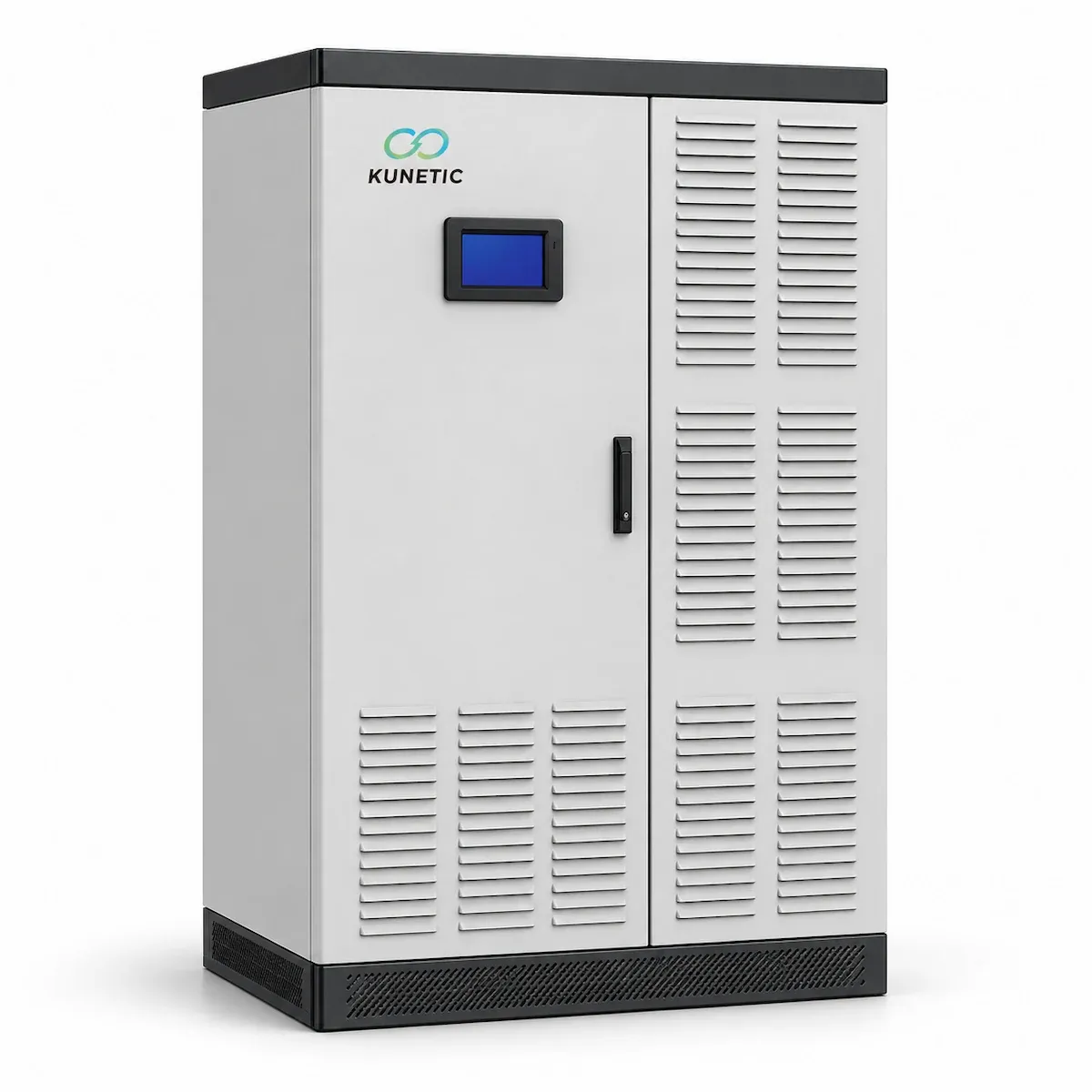
The KUNETIC K-HPS-100-120 hybrid solar inverter is a commercial option for a three-phase solar-and-storage project.
The two versions provide 100kW or 120kW of AC power, with a 400V three-phase output. One floor-standing cabinet contains the solar-input control and power conversion equipment. It also houses static transfer switching and an isolation transformer.
The battery and solar array are external. An energy management system, or EMS, is available as an option.
Consider a factory whose solar production is strongest around midday, while part of its electricity demand continues into the evening shift. A suitable battery configuration could store some of that daytime generation for later use.
If the factory also needs reserve power, the design must decide how much stored energy to keep available and which equipment should receive it. Using the battery for evening consumption and keeping it ready for an outage are connected decisions.
The K-HPS-100-120 accepts a battery input of 292-430Vdc. Check the battery’s full voltage range and power output. Its communications must also match the inverter. Confirm these alongside its energy capacity in kilowatt-hours.
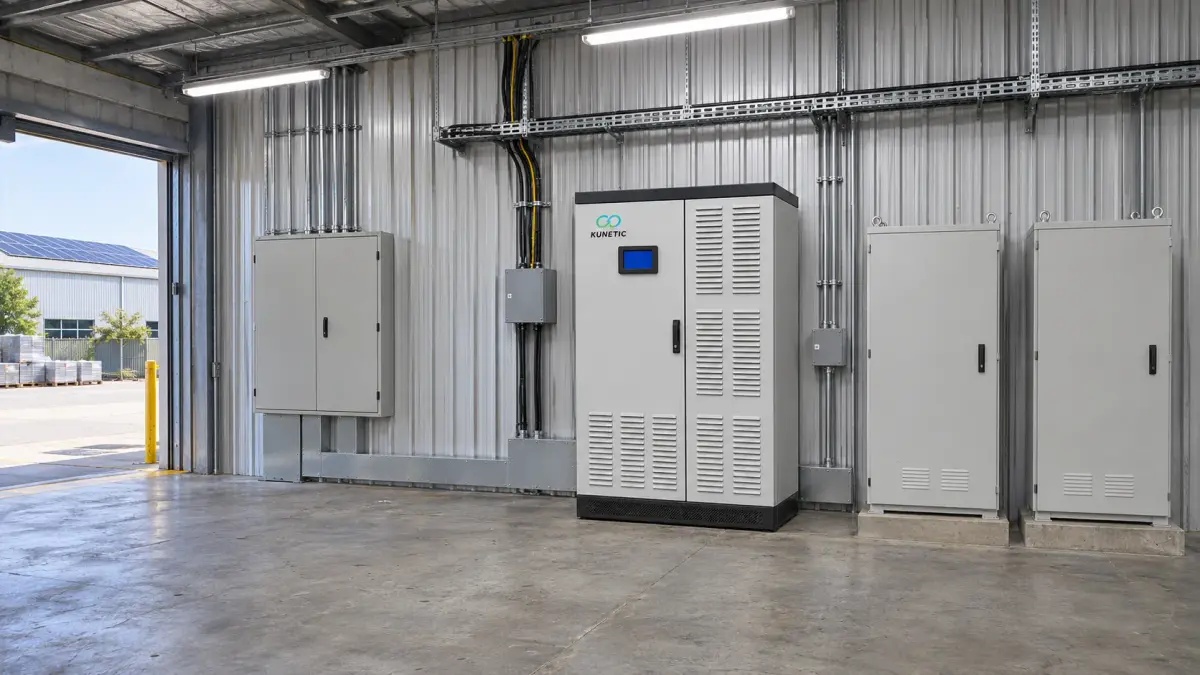
Concept layout for a commercial solar-and-storage project.
The proposal should explain how solar generation and working hours affect storage capacity, and which equipment will receive power during an interruption. Our hybrid solar system guide covers the wider system arrangement.
Compare the complete proposal and price
An inverter price is only one part of a working installation.
Check what the price includes. A lower equipment price may cover a different battery scope, fewer controls or no switching equipment. A larger quote may include items that another supplier leaves to the installer.
Before comparing totals, make sure the proposals identify:
- The inverter model and matched battery configuration.
- Solar equipment included, or the existing array being retained.
- Backup switching, protection and distribution work.
- Metering, monitoring and any optional EMS.
- Installation, commissioning and the applicable warranty terms.
Buying less grid power depends on your solar output and when your site uses energy. Battery schedules matter too. For backup, check the protected loads and the energy available when an outage starts. Ask how the proposal meets each goal.
For a closer look at package contents, see our inverter with battery buying guide.
Frequently asked questions
Can a hybrid solar inverter work without a battery?
The model and operating mode decide this. Check that the inverter can run with PV and the grid before planning to add a battery later. Confirm outage support separately; operation without a battery does not establish backup capability.
Will a hybrid inverter keep everything running during an outage?
That depends on the complete backup design. The supported circuits, inverter output, battery power and available stored energy all affect what can run. Ask for those loads to be identified in the proposal.
Can I add one to an existing solar system?
Possibly. Compare replacing the existing inverter with retaining it and adding compatible battery equipment. The better route depends on the existing installation and the functions you want to add.
Can I use any lithium battery with it?
No. The operating voltage, charge and discharge limits, battery-management communication and supported configuration must match. Have the supplier confirm the exact pairing.
For help choosing a configuration, contact KUNETIC. Send your country, supply voltage and phase, main equipment and any existing solar details. Tell us whether saving on electricity or backup is your priority. We can help assess a suitable inverter-and-battery configuration for the site.
