
 English
 Deutsch
 Español
 Français
 Italiano
 Polski
 Română
 العربية

Table of Contents
When the power goes out, a dark room is only part of the problem. The fridge stops, the Wi-Fi drops and, in some homes, the water pump stops too.
When choosing power backup for home, think about what you want to keep using during an outage. A few plug-in appliances need a different setup from a home that also needs air conditioning or a pump.
A portable power station may cover a few devices. Fixed home battery backup systems pair a battery with an inverter to supply essential circuits. For longer outages, you also need a way to recharge the battery or obtain fuel for a generator.
What should stay on when the power goes out?
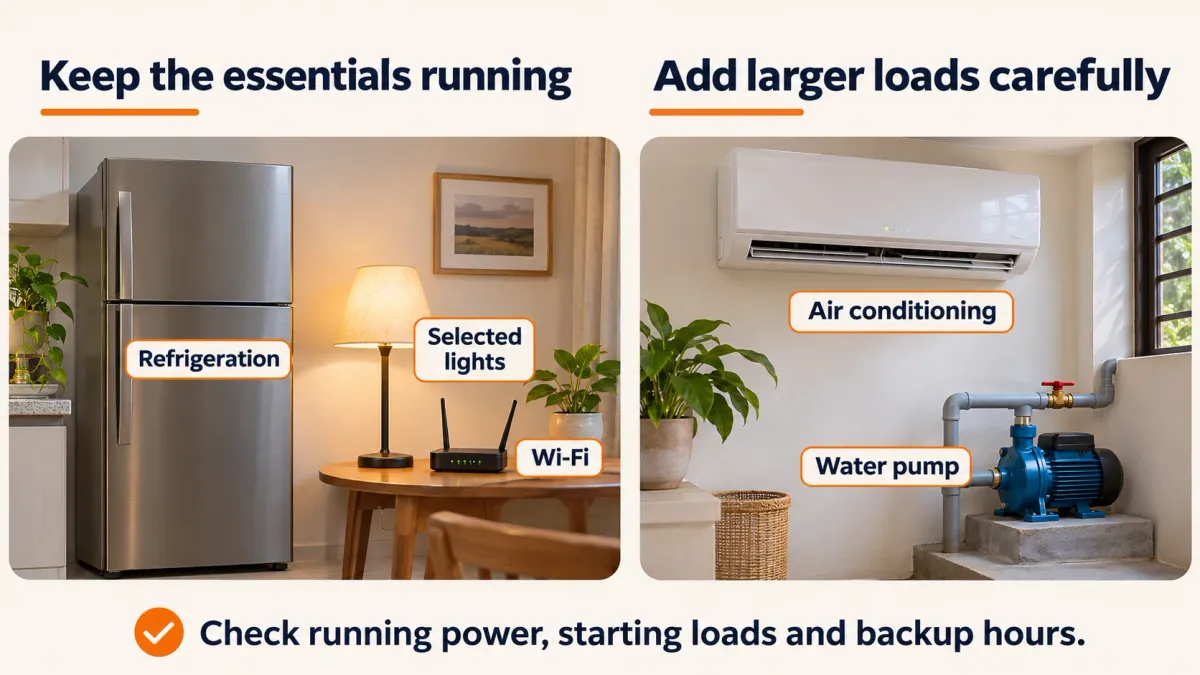
For some homes, keeping food cold, a few rooms lit and the Wi-Fi working makes an outage manageable. In others, a water pump or air conditioning is just as hard to do without.
Supporting fewer circuits helps the stored energy last longer. Broader coverage takes more power when appliances run together. It also needs enough battery energy to keep them going.
List the essential appliances you want to keep running. Mention any larger equipment too, so your supplier can include it in the proposal.
Compare your options for power backup at home
Option | When it may suit your home | What to confirm before buying |
Portable power station | A few plug-in devices; movable equipment | Power output, starting loads, usable energy and charging |
Fixed battery-and-inverter system | Regular outages; selected home circuits | Battery and inverter match, circuits, switching and installation |
Generator or a matched battery-generator system | Longer outages with a fuel supply | Output, fuel, noise, outdoor space, upkeep and equipment match |
A portable station is worth considering when you can plug the appliances directly into it. For household circuits or equipment without a suitable plug, ask how the backup system connects to the house.
With a fixed battery system, the installer plans which circuits receive backup power and how to isolate them from the grid during an outage.
A generator needs fuel and maintenance, as well as a place for safe operation. For portable units, CPSC generator guidance calls for outdoor operation at least 20 feet from homes, with exhaust directed away. Check whether your property has room for that arrangement.
You can also combine a battery and generator if the inverter, charging equipment and controls support it. Ask the supplier to confirm the combination in the proposal.
Match power, runtime and recharging to your home
Power output and starting loads
The inverter's output limits how much equipment can run at once. Pumps, compressors and some air conditioners may need extra power when starting.
A home with a pump can need a different setup from one supporting mainly lights, refrigeration and electronics. Share your appliance list and the rating labels on larger equipment. Your supplier can then check the running and starting loads.
Check how much power the battery can supply too. A larger inverter rating alone does not mean the battery can sustain that output.
Battery capacity and outage duration
Battery energy, measured in kWh, helps determine how long your chosen loads can run.
For scale, an average load of 1kW uses 6kWh over six hours. The battery must hold more than that to allow for conversion losses, operating limits and the reserve you want to retain. Your actual runtime depends on what runs and for how long.
For a closer look at one storage size, see our 16kWh home battery runtime guide.
Recharging during a longer outage
A battery charged with grid electricity can supply power until its stored energy runs out. If the outage lasts longer, you need another available charging source.
Solar energy can help recharge storage when sunlight and your system allow it. Existing panels alone do not guarantee backup during an outage. The U.S. Department of Energy explains why the right inverter and storage equipment are needed.
Ask whether the proposed home backup system supports solar charging while the grid is down. Check how much energy it must reserve for backup. If you already use solar power, include the existing inverter details in your inquiry.
What could a KUNETIC home backup setup look like?
An integrated unit for selected household loads
For a home with a suitable 230V single-phase supply, the KUNETIC 16kWh off-grid inverter-and-battery unit combines a lithium iron phosphate (LFP) battery, inverter and MPPT solar charger in one wheeled cabinet.
The range has 6, 8, 10 and 12kW inverter options, all with the same nominal battery energy. Choose a version that suits your loads, the battery's power limit and the planned connection. A typical U.S. home uses 120/240V split-phase power. It needs equipment matched to that supply; this 230V unit is not a direct substitute.
Keeping the main equipment in one cabinet simplifies the layout. If your priorities are refrigeration, lighting and communications, we can plan around those circuits and the hours you need them to keep running.
Our Mauritius home solar-and-battery design shows this type of layout. The proposal pairs 6kWp of rooftop solar with 16kWh of nominal storage and places the integrated equipment in a dedicated utility area beside the home.
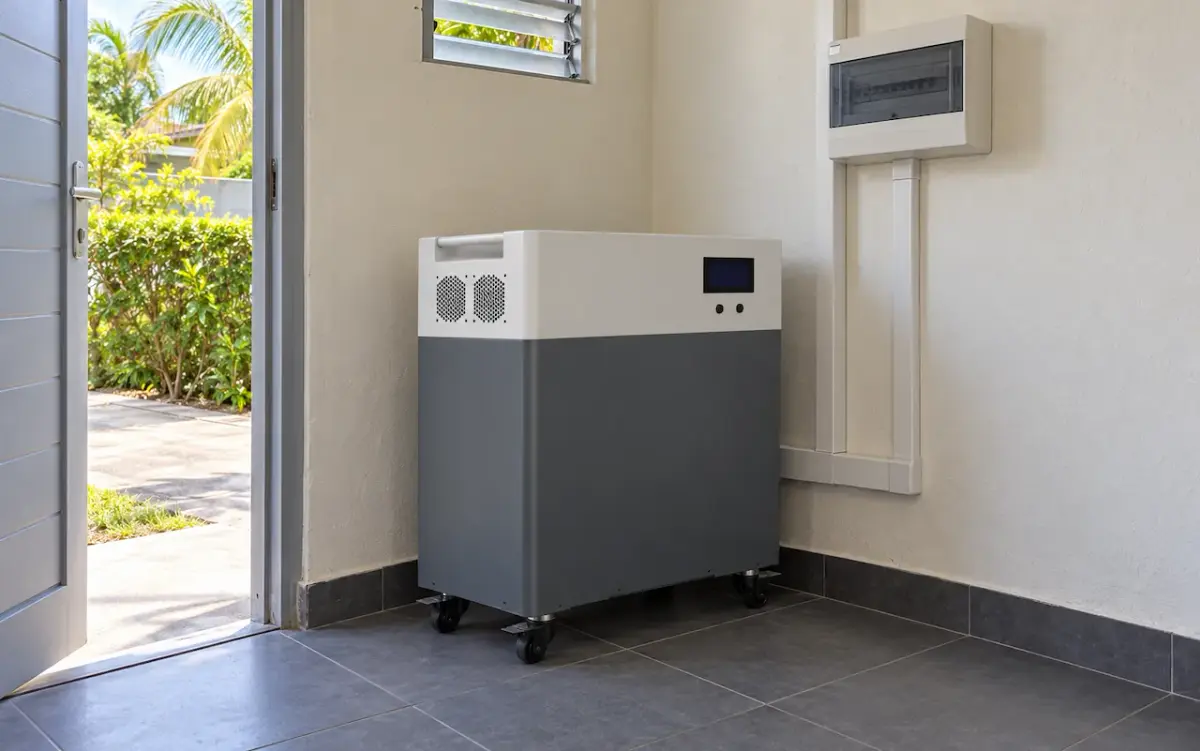
Proposed utility-area layout in the Mauritius home solar-and-battery design.
A separately matched battery and inverter
Separate equipment gives you another way to fit the system around your home's layout, storage needs or existing solar installation. Choose a battery and inverter that work together. They must also suit your electrical supply, loads and available space.
The Saudi home solar battery design illustrates this route: 5kWp of solar, 20.48kWh of nominal battery storage and a separate 6.5kW inverter. The design includes a protected service area and a plan for selected household circuits.
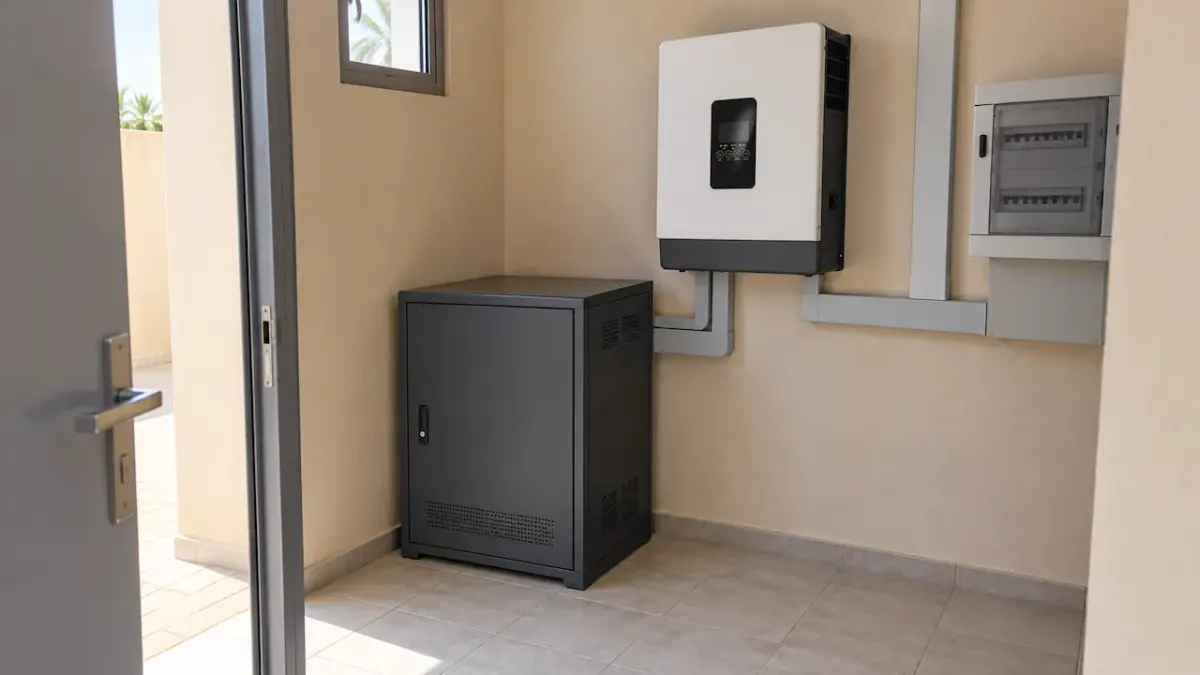
Separate battery and inverter arrangement in the Saudi home solar battery design.
For your own home, we would use the appliances you want to support, the available space and the charging options to work out a suitable arrangement.
Frequently asked questions
Can I have home backup power without solar panels?
Yes, with a suitable system that can charge from the grid. Backup duration then depends on the stored energy available when the outage begins. Our guide to home battery storage without solar discusses the battery-only route in a UK context.
Can a backup battery run air conditioning or a well pump?
Some configurations can. The inverter and battery must support the appliance's running and starting requirements, along with other simultaneous loads. Send the equipment ratings and intended operating hours for a configuration review.
Will the backup switch on automatically?
That depends on the inverter, the transfer switch or other switching equipment, and the supported circuits. Confirm which loads receive power and the stated transfer time before choosing a system.
Can I add more battery capacity later?
Some systems allow expansion, but the supported battery combinations, inverter limits and available space need checking first. If you expect to support more rooms or appliances later, include that plan in your first inquiry.
If you are comparing power backup for home, tell KUNETIC about your property. Share your country, electrical supply, the appliances you want to keep running, your target backup hours and any existing solar equipment. We can help assess a battery-and-inverter backup solution for the way your home uses power.
