
 English
 Deutsch
 Español
 Français
 Italiano
 Polski
 Română
 العربية

Table of Contents
Start your liquid-cooled BESS 0.5C vs 1C cycle life comparison with the site load. How much power does it need, and for how long? Ask suppliers to meet the same load profile, then compare their cycle-life evidence and warranty terms.
The higher C-rate is worth considering when the project needs that current capability. It does not, on its own, establish which offer will last longer or cost less to operate.
0.5C vs 1C: Which fits your project?
C-rate describes battery current relative to rated amp-hour capacity. For a 100Ah battery, 0.5C is 50A and 1C is 100A. The quotation should state continuous charge and discharge limits separately.
Buying question | 0.5C offer | 1C offer |
Continuous current for a 100Ah battery | 50A | 100A |
Ideal full-capacity discharge time at that constant current | About two hours | About one hour |
What must the system quotation confirm? | Usable energy and AC power throughout the required period | Higher current capability, plus sufficient usable energy |
Can the label establish cycle life? | No; request the test conditions | No; request the test conditions |
These times explain the current ratings. Site runtime depends on usable capacity, voltage limits and operating conditions.
Specify the AC output power and AC energy your load needs. A site requiring 100kW for two hours needs 200kWh delivered to the load. Allow for conversion losses and an operating reserve. Also account for capacity loss over the design period.
Another site might need 180kW for 15 minutes, or 45kWh delivered. Its energy requirement is smaller, but its power requirement is higher. A low-power cabinet could still fall short.
The supplier may use a higher-rate battery to meet the peak. More parallel capacity or another system design may also work. A brief peak alone does not mean you must buy 1C.
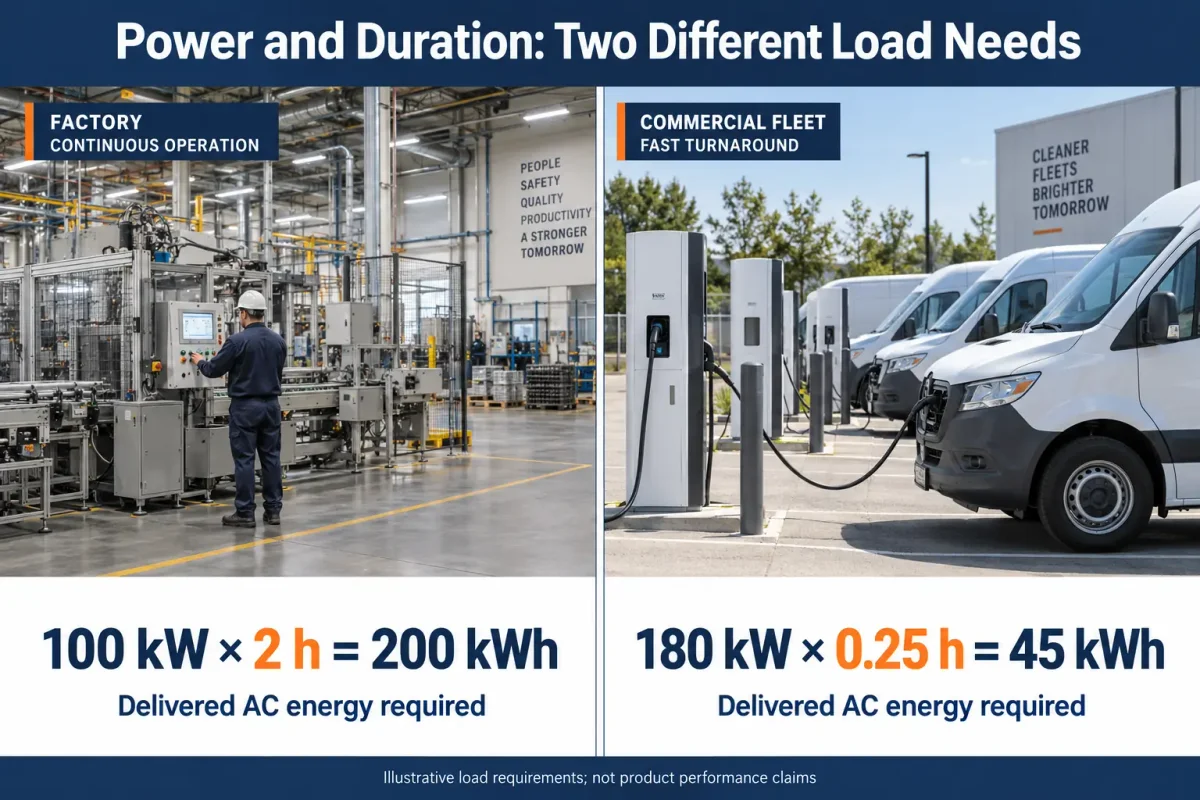
Illustrative load requirements: 100kW for two hours versus 180kW for 15 minutes. These are sizing examples, not KUNETIC performance claims.
For either job, request continuous AC ratings, temperature derating and available power across the agreed state-of-charge range. Our kW vs kWh guide explains the units if a quotation mixes them.
Compare cycle life under the same conditions
"8,000 cycles" is incomplete without the cell model, test conditions and remaining capacity at the end of the test.
Check the test conditions
Request the original cycle-life report or datasheet and check:
- The exact cell model and chemistry used in the proposed system.
- Charge and discharge rates. A result measured at 0.5C does not establish the same result at 1C.
- Controlled test temperature and the temperature limits expected in service.
- Depth of discharge (DoD), meaning the capacity used in each cycle.
- The retained-capacity percentage that defines the test's end-of-life threshold.
- Whether the count means full cycles, partial cycles or equivalent full cycles.
When these conditions differ, the larger cycle count cannot settle the purchase decision. Ask for data covering your intended operating profile or a documented basis for the supplier's prediction.
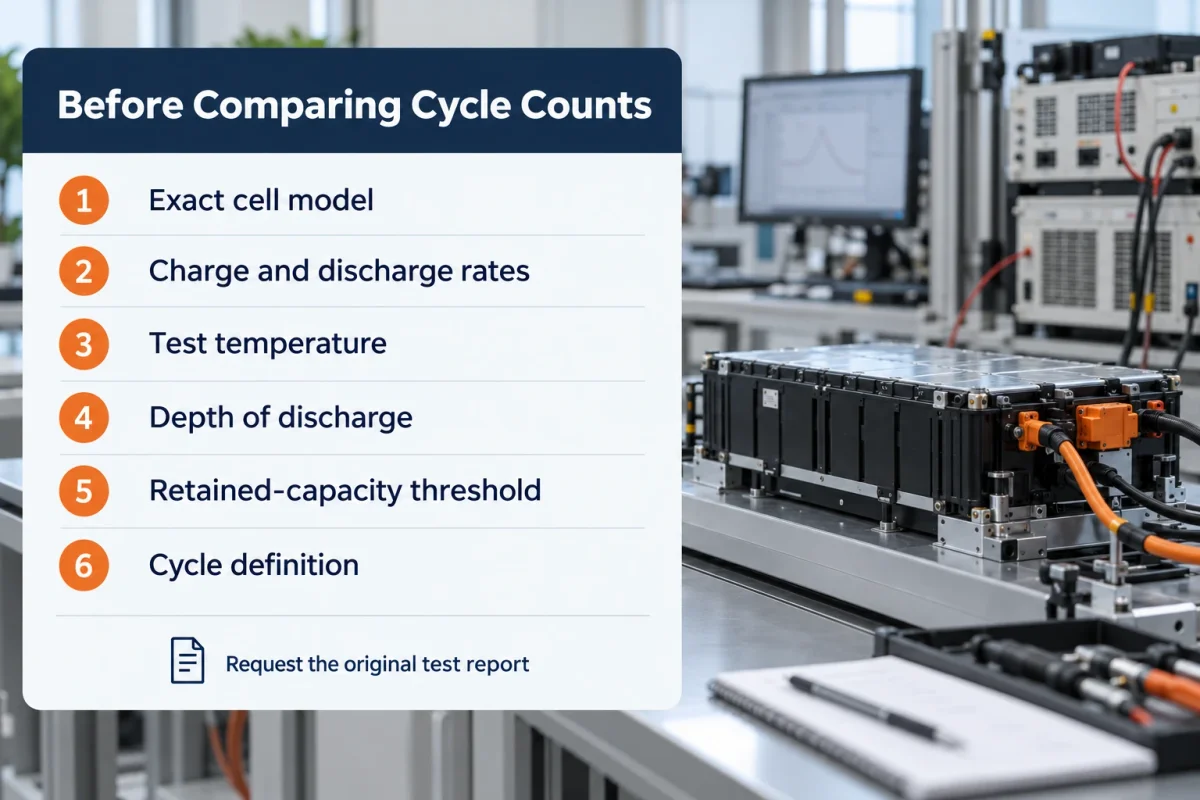
Compare test conditions before comparing cycle counts. This checklist shows what to request, not measured degradation results.
A fixed claim that every 1C system lasts half as long as every 0.5C system is also unsupported. CATL's EnerOne announcement describes cells with 1C discharge capability. It also states a life of up to 10,000 cycles.
It does not establish that the life test ran at 1C or provide a matched 0.5C comparison. Obtain the underlying report before using those figures in a purchase decision.
Separate cell data from system guarantees
Cell test results describe the tested cells and conditions. The BESS warranty defines the supplier's obligations for the equipment you buy.
Read what it guarantees: battery capacity, AC energy delivered, equipment defects or system availability. Check the measurement method and the operating conditions required to claim it.
Batteries also age while they sit. SAM's battery-life documentation distinguishes calendar degradation from cycle degradation. A headline cycle count divided by daily cycles cannot establish service life in years.
Liquid cooling helps control temperature. It does not prove a specific cycle life. It also does not let you run the battery beyond its stated limits.
A real product example: KUNETIC's liquid-cooled cabinet
The KUNETIC K-eBank-261LHYB2 shows how these figures appear in a product specification:
- Rated battery energy: 261.248kWh.
- Rated PCS power: 125kW.
- Cell capacity: 314Ah.
- Maximum continuous battery charge and discharge current: 157A.
- Cooling: liquid cooling.
Its published battery configuration is 260S1P. The continuous-current ratio is 157A ÷ 314Ah = 0.5C.
The separate system calculation, 125kW ÷ 261.248kWh ≈ 0.48 per hour, is a power-to-energy ratio. This ratio is not a direct cell C-rate measurement. Battery voltage and AC conversion also affect the relationship.
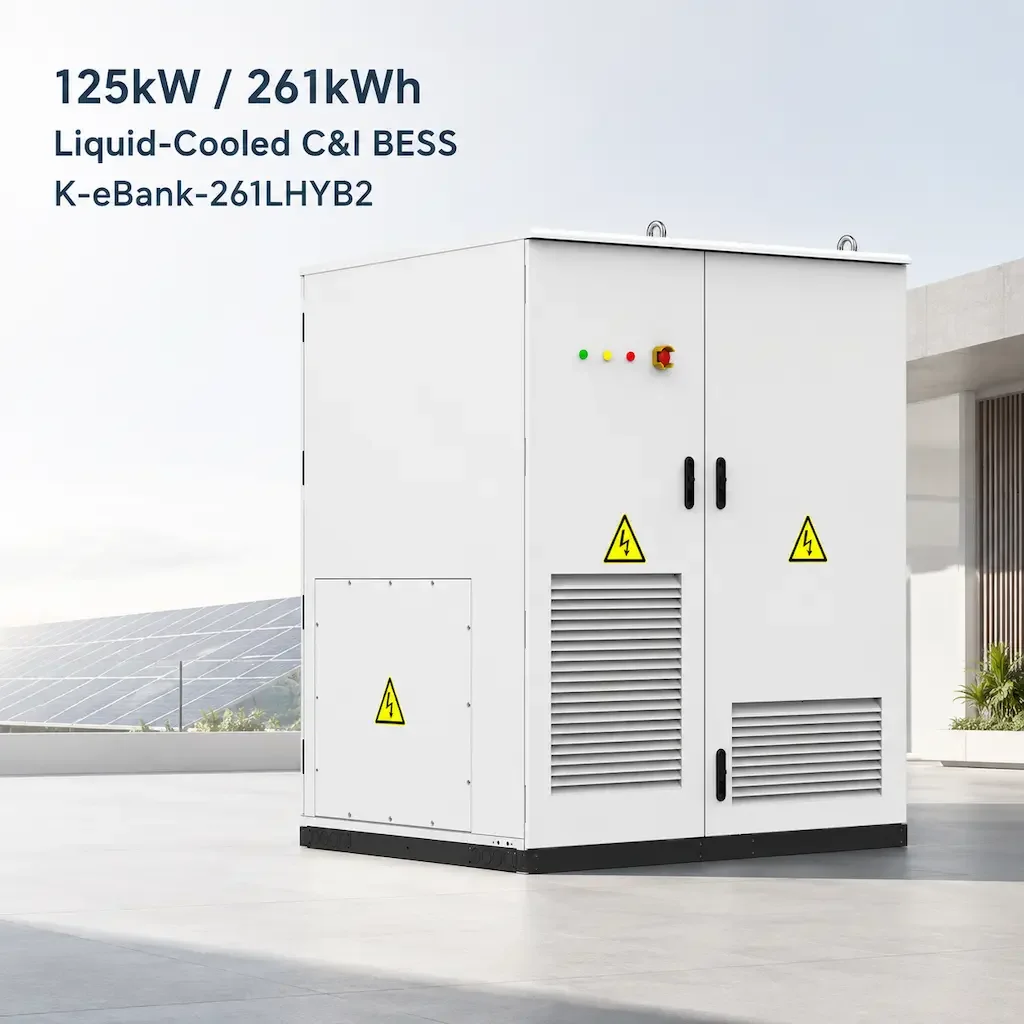
KUNETIC K-eBank-261LHYB2: a 125kW / 261kWh liquid-cooled commercial battery energy storage system.
These ratings support an initial engineering review, not a cycle-life warranty or guaranteed site runtime. Other power configurations need confirmation; do not assume a standard 1C version.
The published AC rating is 380/400V, 50/60Hz. US project buyers should confirm the electrical interface and required system compliance before selecting the configuration.
What to ask before accepting a BESS quote
Equipment and performance scope
Give every bidder the same requirements and request:
- Continuous AC output and usable energy at commissioning and at the agreed end-of-life design point.
- Charge/discharge current limits, SOC window, ambient-temperature limits and derating curves.
- A clear equipment list covering the battery, PCS, EMS, cooling, protection, switchgear and any required transformer or transfer equipment.
- Responsibilities for installation, grid connection, commissioning, monitoring and maintenance, with exclusions stated.
The K-eBank-261LHYB2's isolation transformer and ATS are optional. Include them when the electrical design requires them.
Compare the same equipment scope before comparing prices. An offer that excludes necessary items can look cheaper than a complete one. Our commercial battery storage cost guide provides broader cost context.
Warranty and operating limits
Get the warranty document before comparing guarantees. Check the term in years, any energy-throughput limit, the retained-capacity commitment and the claim assessment method. If either a time limit or a throughput limit can end coverage, model both against your operating schedule.
Also confirm permitted dispatch, inspection requirements, exclusions and service responsibilities. Ask what the supplier will do if the system misses its guarantee. Check whether it promises replacement or repair only, and what each would mean for downtime.
Use the KUNETIC project quotation form to request a proposal. Share your load curve, continuous kW, discharge duration and daily schedule. Add the PV capacity, grid voltage and frequency, and site conditions.
Include your backup priorities and local requirements. Ask the supplier to check that the proposed system meets them.
FAQs
Is 1C always shorter-lived than 0.5C?
The rating alone cannot answer that. Compare the exact cell designs, test conditions and intended duty profile. Request matched evidence before accepting a fixed cycle-life penalty.
Does liquid cooling guarantee a longer cycle life?
The cooling method alone does not establish a specific life figure. Check tested operating conditions, temperature-control performance and warranty terms for the proposed system.
What should I prepare before asking for a quote?
Prepare the load profile, continuous power requirement, discharge duration, daily dispatch pattern and site/grid details. Suppliers can then show whether their proposed 0.5C or 1C configuration meets the same project requirements.
