
 English
 Deutsch
 Español
 Français
 Italiano
 Polski
 Română
 العربية

Table of Contents
A microgrid is a local power system. It links power sources, site loads and, where needed, battery storage. It can run separately from the utility grid. The U.S. Department of Energy describes the same core idea: local loads and energy resources, with clear boundaries and shared control.
If you're considering one for your business, I'd start with a practical question: what needs to keep running when the grid goes down?
A cold-storage warehouse needs to protect temperature-sensitive stock. An office may be able to pause some activities during an outage. Those differences shape the equipment you need and the budget you should compare.
What does a microgrid system actually include?
Commercial microgrid systems bring several parts together:
- Power sources: solar panels, a diesel or gas generator, or other local generation.
- Battery storage, where included: stores energy for later use and supports the project's operating strategy.
- Power conversion: inverters or power conversion systems that connect the selected sources and storage to the site.
- Distribution and protection: switchgear, cables, protective devices and transformers where required.
- Control and monitoring: a microgrid controller coordinates equipment and manages the chosen loads.
A battery container is one part of the project. You also need an electrical design and controls that work with the selected equipment. The operating plan ties these parts together.
Why the controller and switching matter
During an outage, the system must separate safely from the utility and supply the selected loads. It also needs a safe way to reconnect when utility power returns, following the approved design.
If you have sensitive equipment, find out how much interruption it can tolerate. Ask who will test the switching sequence. Which equipment sets voltage and frequency in island mode? Can the system restart without utility power?
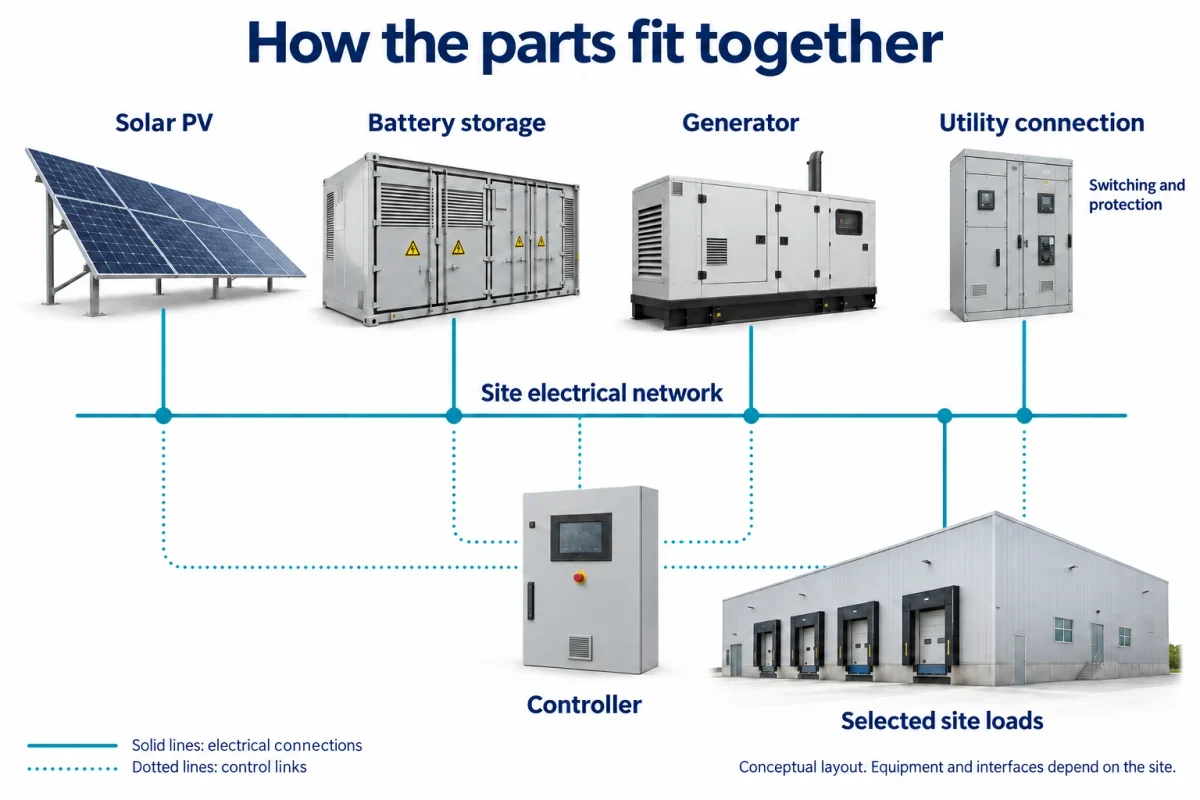
Conceptual microgrid layout. Equipment and interfaces depend on the site design.
Start with what your site needs to keep running
Imagine a cold store with refrigeration, lighting, offices and vehicle charging. You may want refrigeration to keep running while vehicle charging waits. Decide which loads are essential before asking someone to size the system.
How long those loads need backup power matters too. Covering a short interruption takes a different plan from keeping a remote site running through several cloudy days.
Information to prepare | Why it matters |
Essential loads and their operating schedule | Defines what the system must supply |
Peak demand and motor starting requirements | Helps assess power capacity and short-duration demands |
Required backup duration | Guides energy and fuel planning |
Existing solar, generator and electrical equipment | Identifies integration work |
Site location and expected load growth | Informs site conditions, electrical requirements and expansion |
A monthly electricity bill gives you a total. A load profile shows when demand rises, which equipment runs together and what happens overnight.
For example, a steady 30kW load uses 120kWh over four hours. To size the battery, you also need to allow for conversion losses, reserve settings and the usable operating range. Our kW vs kWh guide explains the distinction.
How solar, batteries and a generator work together
On a sunny day, solar panels generate power. In a solar microgrid, that power may serve the site. Any surplus may charge the battery. As solar output falls, the battery may cover part of the demand. A generator can run when the control plan calls for it. That might be when stored energy reaches a reserve level or demand exceeds the available supply.
The operating sequence depends on solar conditions, battery reserves, available fuel and the generator you have.
Keeping your existing generator may make sense. I'd ask the designer to check its controls and electrical interface. The generator's operating limits matter too. These checks help show how it can work with the other equipment.
For a closer look at energy costs, see our BESS and diesel generator cost comparison.
Grid-connected and remote sites need different plans
A grid-connected site may use utility power in normal operation and island during an outage. A continuously off-grid site must meet its needs from local generation, storage and available fuel.
For either arrangement, ask the supplier to explain the operating modes included in the proposal. "Supports off-grid operation" should lead to a discussion about the loads, controls, switching and tests required for your site.
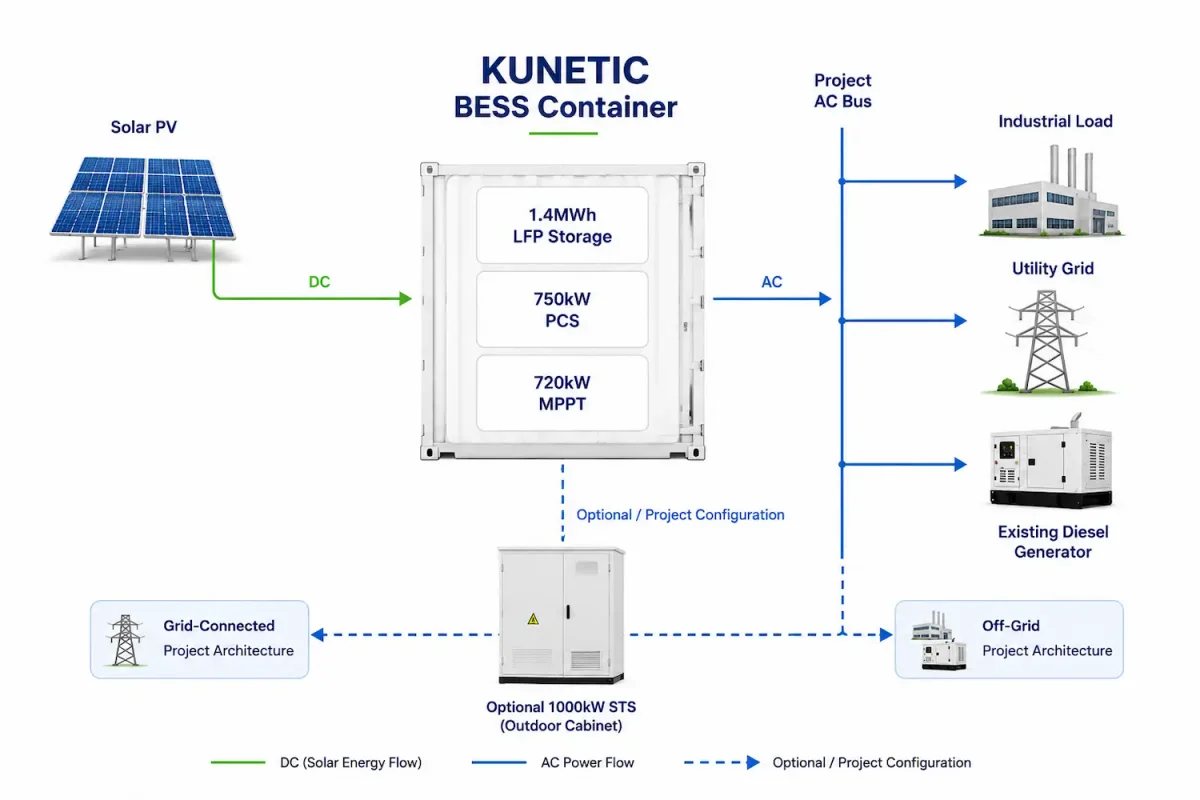
KUNETIC K-ePowerMax-C1440: a storage and conversion platform for solar-diesel hybrid projects.
What will your microgrid cost?
Ask the supplier to split its budget by what it covers. The price depends on project size, existing equipment, the required operating modes and the work needed on site.
Equipment price and installed project cost
The equipment package may cover batteries, power conversion and some controls. Check the scope for switchgear, protection, transformers and generator integration.
The full project budget can include engineering, transport, foundations, cables, installation, utility coordination where needed, commissioning and ongoing support. Your local EPC may handle some of that work. Establish what it will do and what the equipment supplier will do.
I'd want those responsibilities in writing before comparing prices.
Why one price per kWh can be misleading
A cost per kWh can help compare similarly scoped battery packages. A complete microgrid includes work and equipment that serve other purposes, including power delivery, control and protection.
Two projects with the same battery capacity can have different power requirements, switching arrangements and installation costs. A larger battery also will not resolve every issue with motor starting or equipment integration.
For storage-specific budgeting, see our commercial battery storage cost guide. Use it alongside a site-specific scope when planning the wider project.
How I'd compare two microgrid quotes
Give both suppliers the same load information and operating goals. I'd want each proposal to answer these questions:
Item to compare | What the proposal should make clear |
Power and energy | Rated power, usable energy assumptions, reserves and site derating |
Equipment supplied | Included hardware, options and equipment supplied by others |
Operating modes | Grid-connected, islanded or continuous off-grid operation |
Integration responsibilities | Who handles controls, switching, protection and existing equipment |
Testing and acceptance | How the agreed functions will be demonstrated |
Warranty and support | Coverage, exclusions, maintenance responsibilities and service arrangements |
A lower quote may leave more work to you or your EPC. It could also be a better fit for the site. Compare the included scope before deciding.
For a larger solar-diesel project, take a look at the KUNETIC K-ePowerMax-C1440. This prefabricated storage and conversion platform has 1.4MWh rated storage, a 750kW PCS and up to 720kW PV input.
Its configurable 1000kW STS is a separate outdoor cabinet. Project engineering confirms the generator interfaces, operating modes, switching and protection. Start with that equipment package, then establish what else your site requires. Our BESS container guide explains the equipment format in more detail.
For a temporary or relocatable site, the K-M-150K mobile off-grid solar system is another format to evaluate. Confirm the electrical configuration, deployment requirements and applicable certification for the destination market.
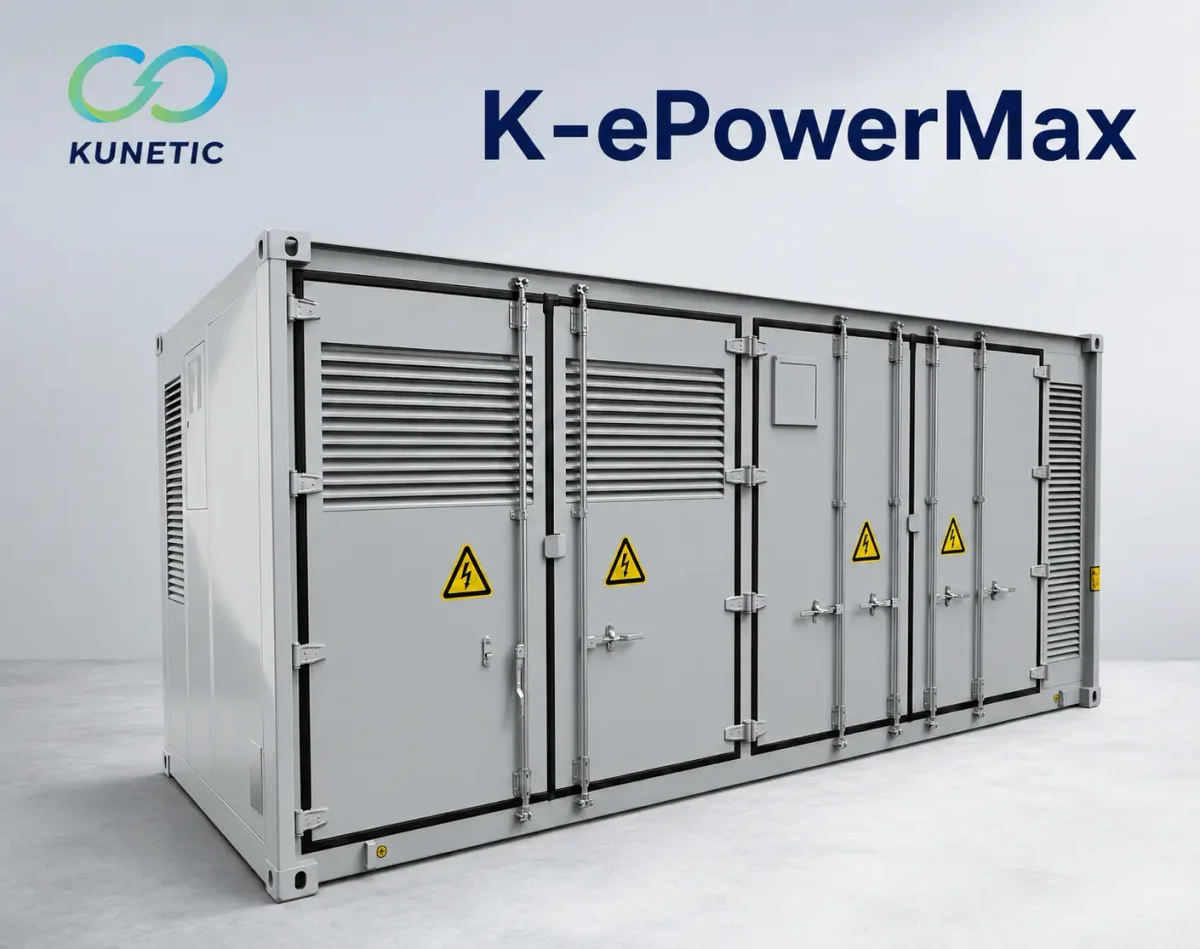
KUNETIC K-ePowerMax-C1440 with 750kW PCS and 1.4MWh rated storage. Optional switching equipment is configured for the project.
A few questions worth clearing up
Can a microgrid work without solar?
Yes. Microgrids can use other local generation sources. The choice depends on the site's resources, operating objectives and electrical design.
Does every microgrid need batteries?
No. Some use generation and controls without battery storage. Batteries are useful where the operating plan calls for stored energy or coordinated charging and discharge.
Will it keep every load running during an outage?
It depends on the loads and operating modes included in the design. Specify which equipment must stay powered, for how long and with what interruption tolerance. Ask for those requirements to appear in the acceptance tests.
If you're exploring a project, start with your site location and load profile. Include the backup time you need, plus details of any existing solar panels or generator. Send these to KUNETIC when you request a quote. We can help review the equipment setup and explain the proposed supply scope.
