
 English
 Deutsch
 Español
 Français
 Italiano
 Polski
 Română
 العربية

Table of Contents
When Does the Pump Need to Run?
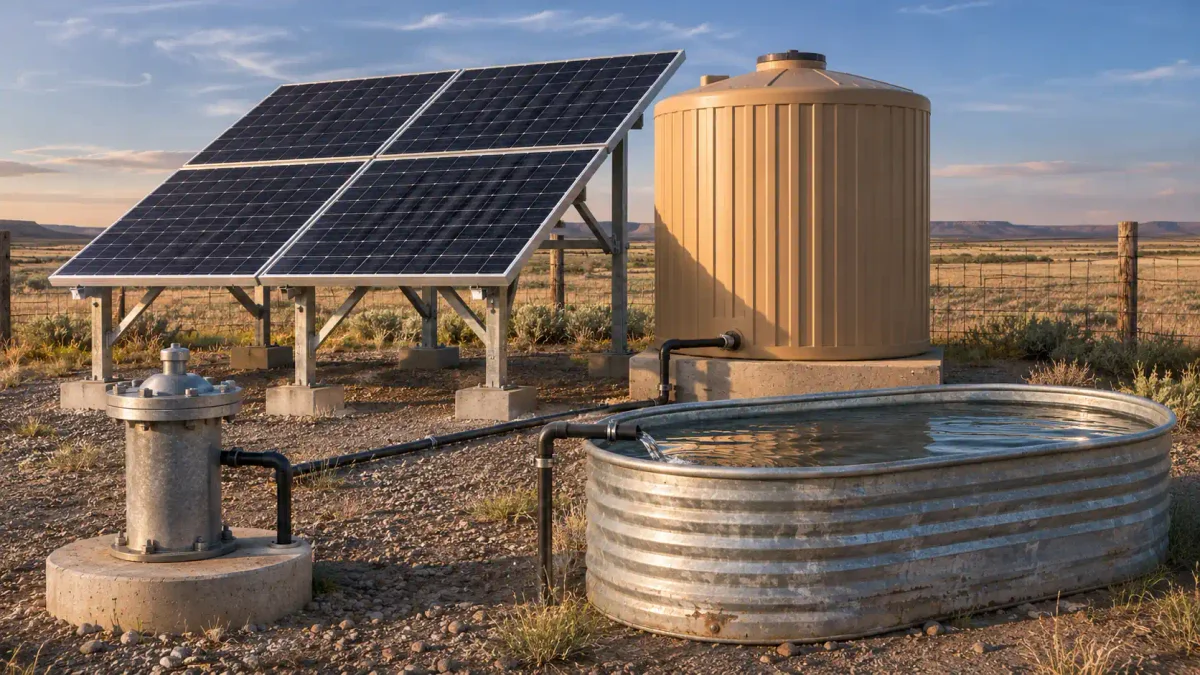
Picture a livestock trough that still needs water after sunset. If a solar powered well pump filled the tank during the day, the trough can keep drawing from it while the pump is off. The tank needs to hold enough water and deliver it at the right pressure.
Consider a battery if the pump itself has to run after dark, or if other equipment needs power then. Before you shop for a new kit or plan to keep your old pump, figure out when you need the water and how it'll get there.
Start With the Water You Need Each Day
Start with a busy day. How many gallons do you use, and when? A trough that refills a little at a time and an irrigation zone that needs a steady flow for two hours ask different things of the same well.
Say you need 1,200 gallons a day and plan around five effective pumping hours. That works out to an average of 4 gallons per minute (GPM) during those hours. You still need a pump that can deliver that flow at your site's total dynamic head. That's the lift from the water level while the pump is running, plus the resistance in the pipe and any pressure required at the outlet.
Check the pump curve for its flow at that head. The maximum flow and maximum lift on a product listing usually describe different operating points. Your well also needs to sustain the flow you plan to draw. See the Colorado State University Extension guide to solar groundwater pumping.
When Daytime Pumping and a Water Tank Are Enough
A solar well pump kit with a matched pump and controller can fill a tank during useful solar hours. For livestock troughs, check how much water you can actually draw between refills and whether it'll reach the trough at the flow and pressure you need.
Think about a few cloudy days. How long would the water in the tank last if the well pumped less than usual? If gravity can't provide enough pressure and you use a booster at night, budget power for the booster too.
When Battery Backup Is Worth Considering
Say you irrigate in the evening and need the pump to hold pressure for a full cycle. A battery and a compatible inverter can supply power for that run. If a cold room or a ventilation fan also runs overnight, count those loads too.
Already have a generator? Work out when you'd use it and how it would connect before you decide how much battery capacity to buy.
Can You Keep Your Existing AC Well Pump?
Often, that comes down to what the motor needs when it starts. Send the pump and motor nameplates and the model of any starter or drive. Ask the supplier to check voltage, phase and starting current against the proposed inverter and battery.
Then use the pump's running draw and hours to estimate energy use. A battery can hold enough energy for the whole run and the system can still fall short at startup. KUNETIC guide to power and energy
Approach | Where it fits | What to confirm |
Solar direct with a water tank | The well can pump in daylight and stored water covers later use | Well yield, usable tank volume and delivery pressure |
Solar with battery backup | The pump or another essential load needs power outside solar hours | Running demand, starting power, usable battery energy and backup plan |
Keep the existing AC pump | The installed pump suits the well and you'd like to change how it's powered | Voltage, phase, starter or drive, and how the selected power sources will work together |
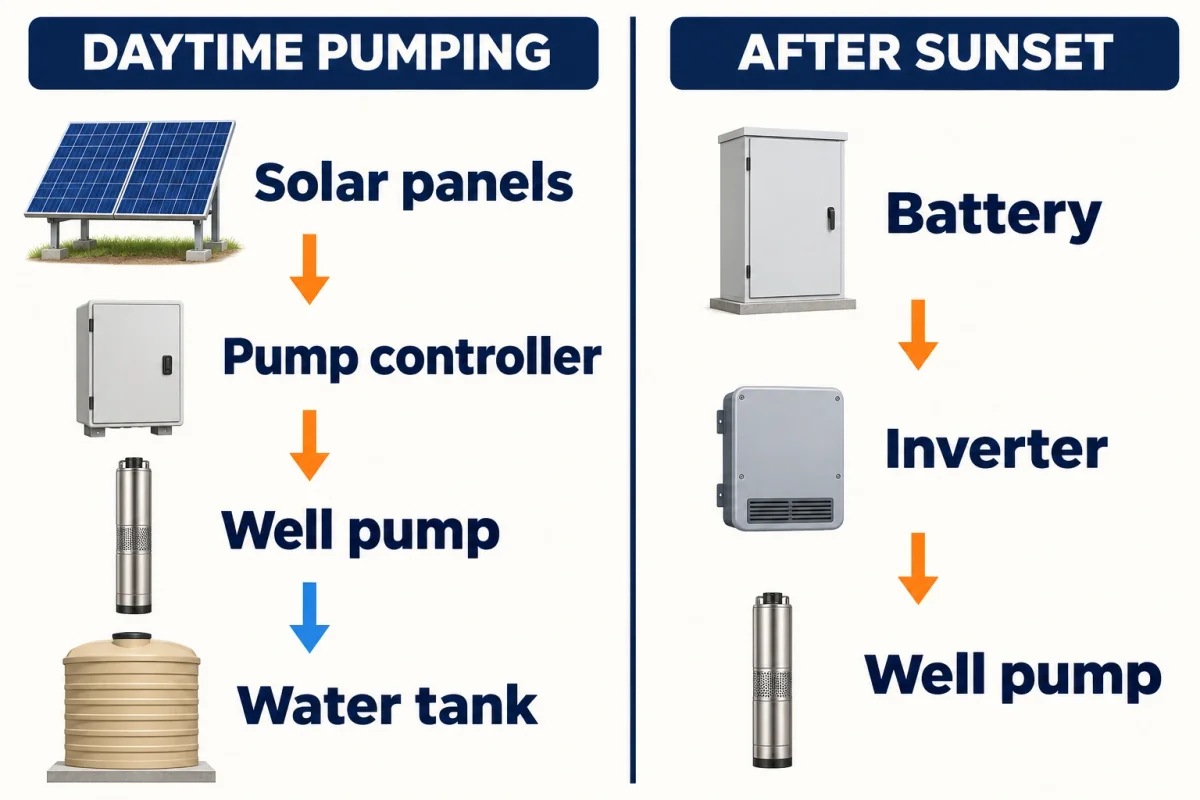
Two examples of how power and water move through a well system. The pump and its controls determine the equipment you need.
What a 45-Well Power Proposal Shows
A customer in Somalia asked KUNETIC to develop a power plan for 45 wells. The brief included five preliminary pump load groups, from 11 to 26 kW. Even two wells with the same pump rating could need different equipment if one fills a tank by day and the other has to run into the evening. The Somalia well pumping project design shows how those differences affect the proposed solar and storage equipment.
What to Send for a Solar Well Pump Power Quote
Send a photo of the pump nameplate and any existing drive, the site location, the pumping head if known, and the gallons you need each day. Include the required flow and hours of operation, especially any hours after sunset. Tell us about existing solar, grid power or a generator and whether the system also needs to run other equipment.
KUNETIC can use those details to discuss solar, inverter and battery options and itemize the equipment in the proposal. For additional loads such as cold rooms and ventilation, see our farm and irrigation power solutions. Tell us about your well and power needs.
Frequently Asked Questions
Can a solar well pump work on cloudy days?
It can if the array still supplies enough power for the pump and controller. Output may fall, and the pump may stop when available power drops too low. A tank can bridge a short drop in pumping. For longer periods, compare additional storage, a change in the pumping schedule or another power source.
How long can a battery run a well pump?
Start with the pump's actual electrical draw. A pump drawing 2 kW for three hours needs 6 kWh delivered to the load. Allow extra energy for inverter losses and any battery reserve. Check motor starting separately before selecting equipment.
