
 English
 Deutsch
 Español
 Français
 Italiano
 Polski
 Română
 العربية


Table of Contents
Ah stands for ampere-hours. It measures how much electrical charge a battery can hold. The Ah rating helps you estimate runtime, but you also need voltage to compare stored energy.
A higher Ah rating can mean more time between charges. For a small tool, though, the extra weight may matter more than the extra runtime.
Amp Hour Meaning: What Does the Ah Rating Tell You?
Amps measure the rate of charge flow. Ampere-hours measure an amount of charge.
If a 5Ah battery supplies a steady 1A, the theoretical runtime is:
5Ah ÷ 1A = 5 hours
This estimate assumes the battery can deliver its rated charge under those conditions.
On a 12V 100Ah label, 12V is the nominal voltage and 100Ah is the rated charge. Nominal voltage is a reference value. The actual voltage changes as the battery charges and drains.
Check the discharge limit too. A 100Ah rating does not mean the battery can safely supply 100A.
For smaller packs, 1Ah = 1,000mAh. So 5,000mAh equals 5Ah at the stated battery voltage. A power bank may use a different voltage at its USB port. Its label does not guarantee 5Ah at that output.
Is a Higher Ah Battery Better?
Extra capacity helps when you work far from a charger. A smaller pack may suit short tasks better.
Take 2Ah and 5Ah tool batteries that fit the same battery platform and have the same nominal voltage. The 5Ah pack has 2.5 times the rated charge capacity. It may run longer under the same load. That does not guarantee exactly 2.5 times the runtime.
A 4Ah pack has twice the rated charge of a 2Ah pack. The load still affects how long each one runs.
Larger packs can cost more and add weight. Ah alone does not tell you maximum power. The cells, discharge limits and device controls matter too. Charging time also depends on the charger.
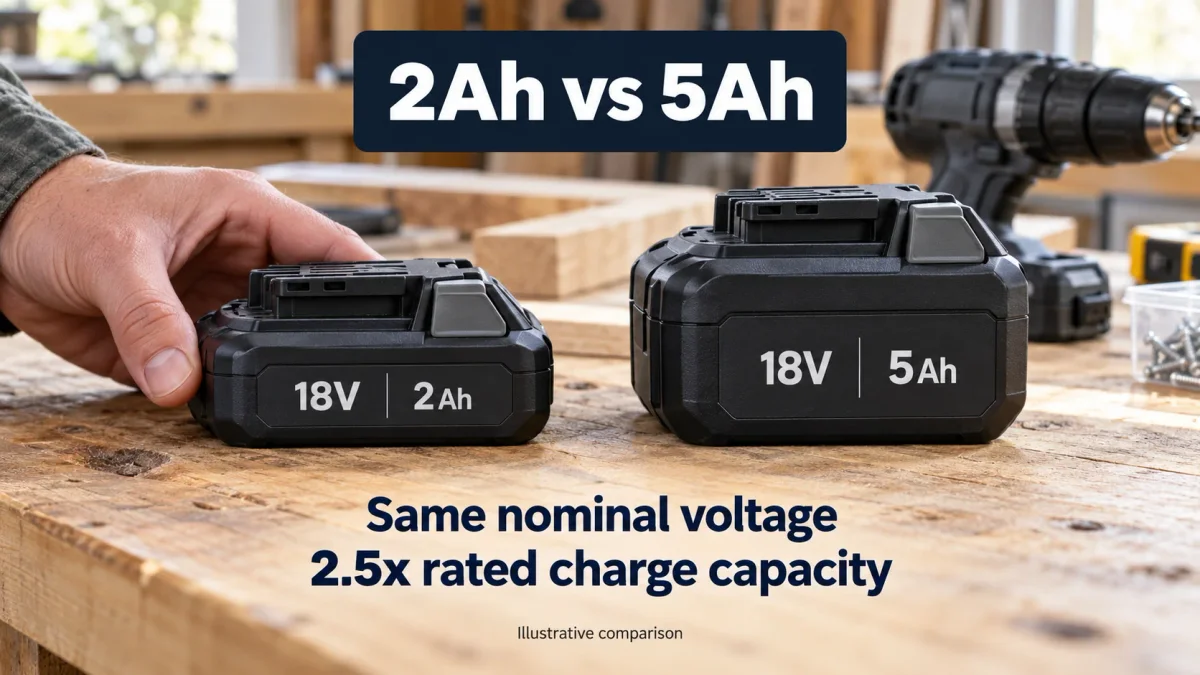
Same-voltage 2Ah and 5Ah tool batteries shown for comparison. The charge-capacity ratio does not guarantee a runtime or power ratio.
How Do You Estimate Battery Runtime from Ah?
For a steady DC current draw, start with:
Runtime in hours ≈ usable capacity in Ah ÷ current in amps
Use the charge available under your expected load. Victron's battery-capacity guide explains how discharge rate affects this, and why the effect varies with battery chemistry.
For a load rated in watts, first find nominal energy:
Nominal energy in Wh ≈ nominal voltage × Ah
Then estimate how much energy reaches the load:
Runtime in hours ≈ nominal Wh × usable fraction × delivery efficiency ÷ load in watts
Say a 12V 100Ah battery powers a steady 120W load through an inverter. Assume 80% of nominal energy is usable and delivery efficiency is 90%:
- Nominal energy: 12 × 100 = 1,200Wh
- Energy reaching the load: 1,200 × 0.80 × 0.90 = 864Wh
- Estimated runtime: 864 ÷ 120 = 7.2 hours
The 80% and 90% values are examples, not KUNETIC product specs. Count each loss once. If your usable-energy figure already includes a loss, don't subtract it again.
A changing load or inverter standby use can change runtime. Temperature and battery age also matter. Check power limits before choosing a pack. Our battery backup sizing guide covers larger projects.
Ah vs. Wh: Why Battery Voltage Matters
Ah measures charge. Watt-hours (Wh) measure energy. For larger systems, 1kWh = 1,000Wh.
Voltage links Ah to energy. These example batteries all have a 100Ah rating:
Nominal battery rating | Rated capacity | Calculated nominal energy |
12V 100Ah | 100Ah | 1,200Wh / 1.20kWh |
12.8V 100Ah | 100Ah | 1,280Wh / 1.28kWh |
51.2V 100Ah | 100Ah | 5,120Wh / 5.12kWh |
A battery sold as "12V" may list 12.8V nominal voltage. Use the datasheet value in your math.
The 51.2V example stores four times the nominal energy of the 12.8V example. Both have the same Ah rating.
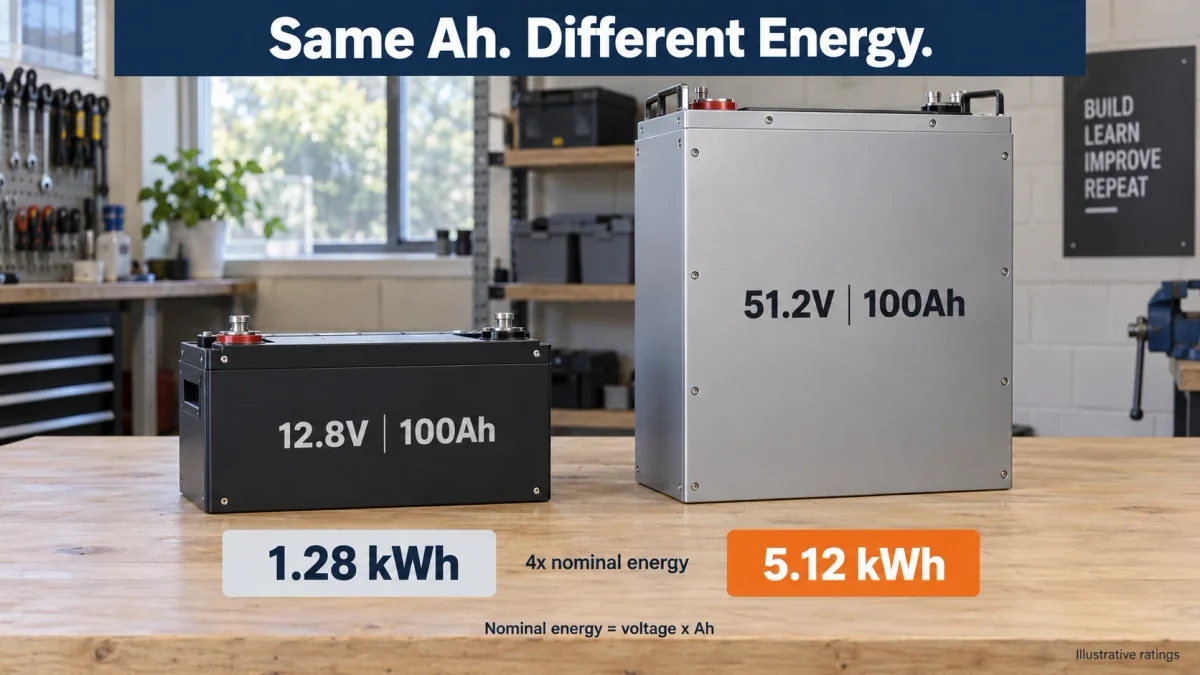
Example ratings: 12.8V × 100Ah = 1.28kWh; 51.2V × 100Ah = 5.12kWh. These are not KUNETIC product specs.
Wh helps you compare packs at different voltages. Usable energy also depends on the system's limits and losses.
Battery Ah Meaning for Solar Storage
Solar battery modules may list Ah. Full energy storage systems often list kWh. Read kW separately: kWh measures energy, while kW measures power.
The KUNETIC eBlock cabinet has up to 120kWh of installed battery capacity. It is a DC battery cabinet. It needs an external power conversion system, or PCS, for use with an AC power system. Usable AC energy and backup runtime depend on the full system.
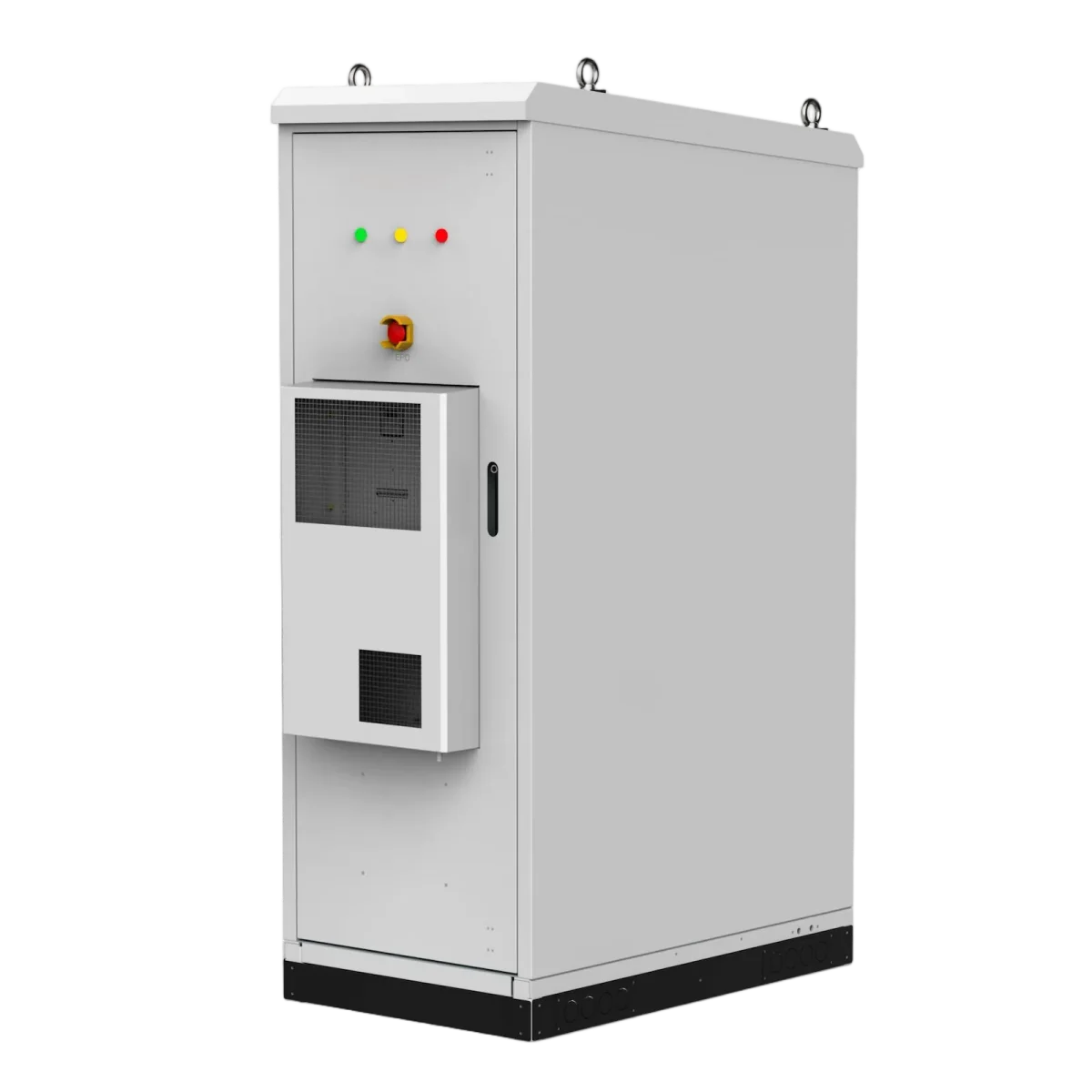
KUNETIC eBlock 120kWh outdoor DC battery cabinet.
Our guide to lithium-ion solar batteries covers chemistry and selection. Compare rated energy, usable energy and power.
Battery Ah FAQs
Can I replace a battery with a higher-Ah battery?
Follow the maker's replacement guidance. Check voltage, chemistry, charger and battery platform. Also check fit, terminals, polarity and current limits. Ah alone cannot tell you whether a pack will work.
Does a higher Ah rating mean a longer battery lifespan?
Runtime per charge and service life are different. A larger pack may use less of its charge on each job. Ah alone does not tell you how many years or cycles it will last. Charging, heat and discharge depth affect lifespan too.
What does Ah mean on a lithium battery?
Ah still measures charge. Check the rating conditions and discharge limits. Battery management controls can stop the pack from running. A lithium label does not mean all rated charge is available under every load or temperature.
Planning solar or backup storage? Share your load and required backup time with KUNETIC to discuss the right capacity.
