English
PROJECT DESIGN
Commercial Battery Storage for Peak Shaving at a Shopping Center
By midafternoon at a neighborhood shopping center, the air conditioning is working harder, the supermarket refrigeration is still running, and the food tenants are getting ready for dinner. If they draw power at the same time, that afternoon could set the month's highest demand at the main meter.
This project design pairs 522 kWh of nominal battery storage with a 250 kW power conversion system (PCS). The batteries would supply part of the center's load during those busy periods to bring down the power drawn from the grid.
The afternoon peak starts at the main meter
Start the site walk in the main electrical room. Which tenants and common areas are on the bill you want to reduce? A tenant with its own utility meter needs a separate assessment. The battery can only reduce the billed demand at the meter that sees its output.
Then line up the interval data with the electricity bill. Look for the demand charge, how the utility measures it, and when that charge applies.
A hot Saturday with a busy food court may look different from a typical weekday. If the highest billed demand comes from a period like that, use it to test the battery design. A monthly energy total in kWh cannot show how long the peak lasts. The battery peak shaving guide covers the billing and sizing checks in more detail.
Give the battery system a place beside the electrical room
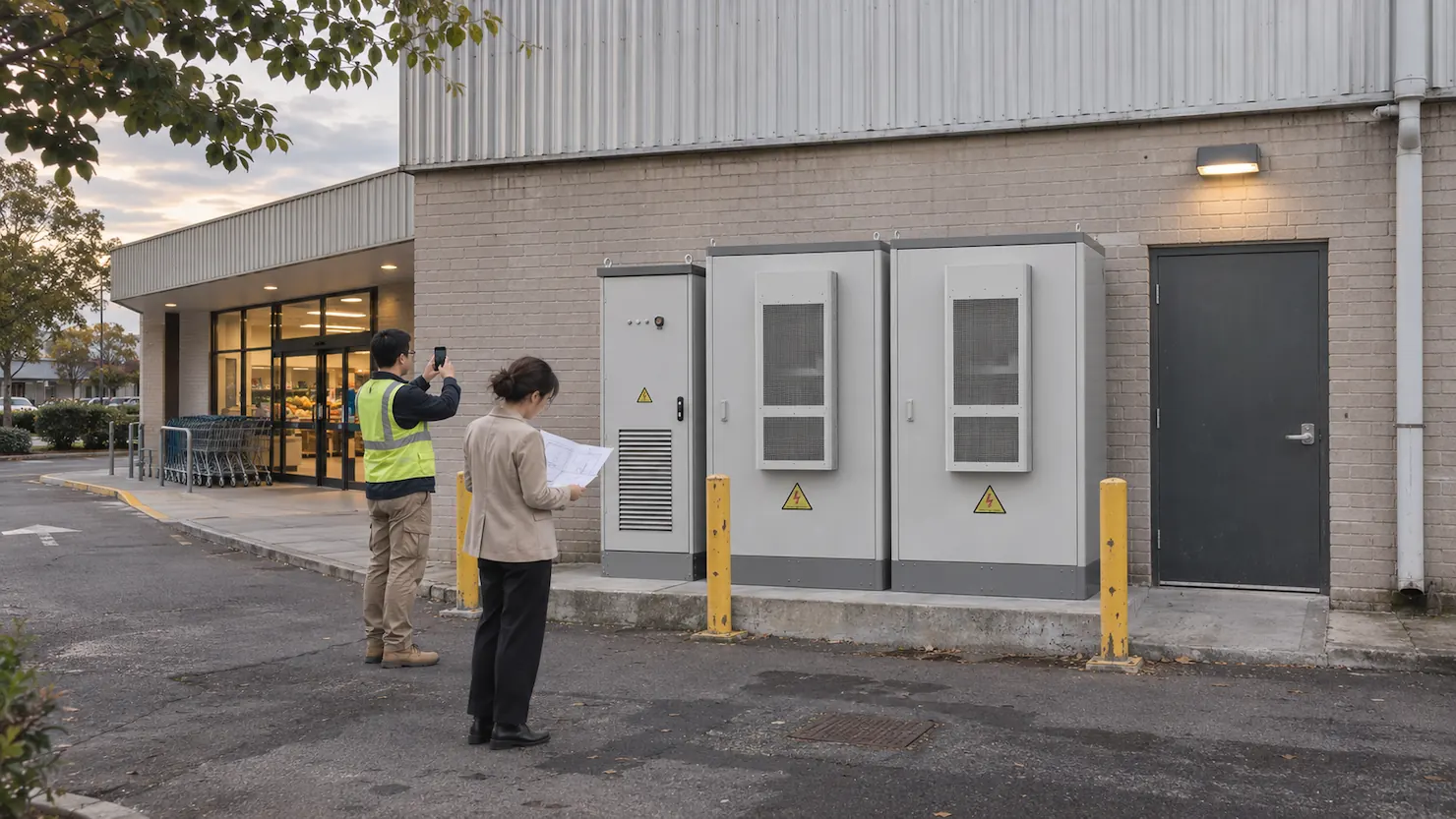
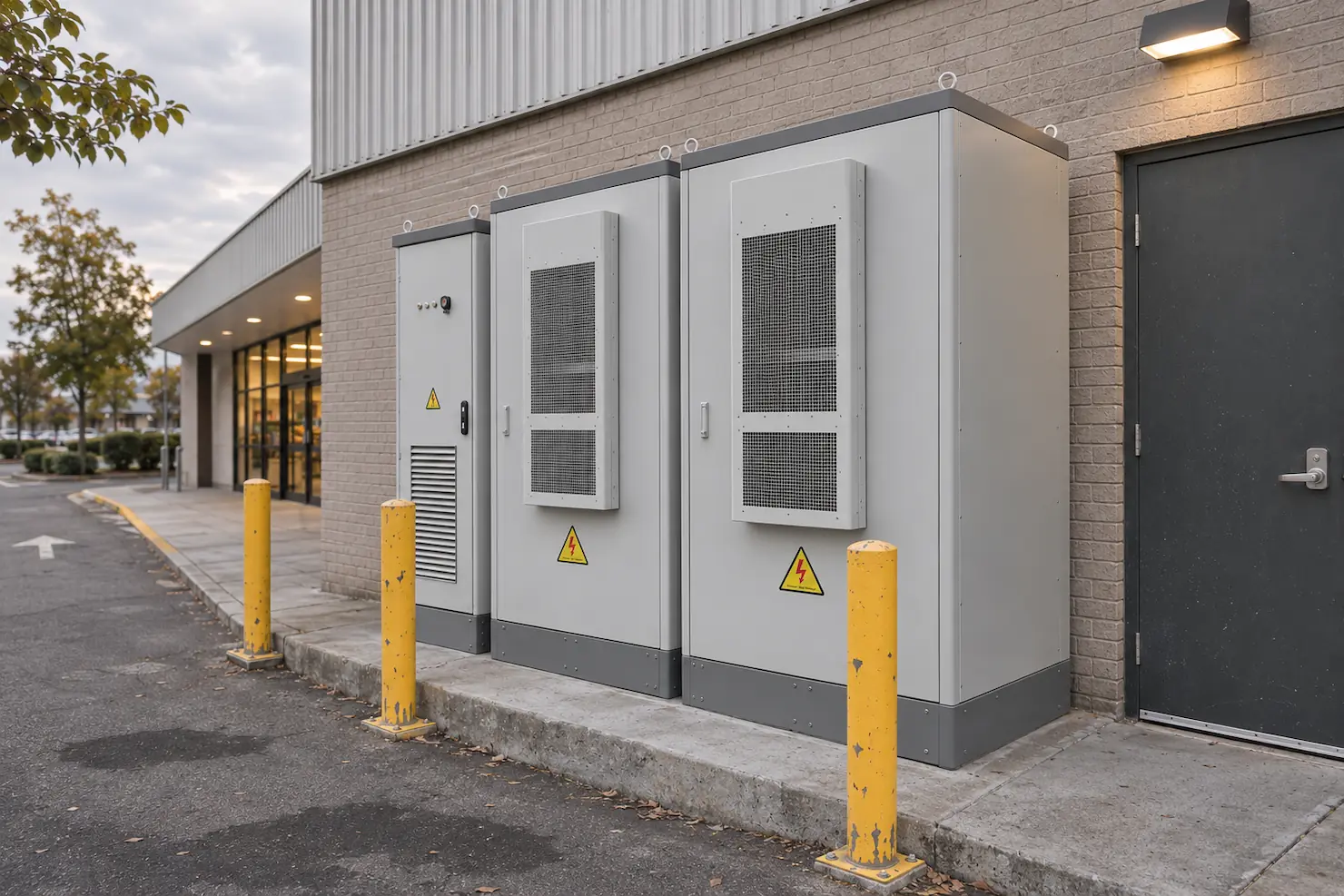
Behind the shops, the site team would look for a spot near the electrical room where deliveries still have room to turn. The proposed pad sits off the service lane and holds two battery cabinets and a separate PCS cabinet. The layout should allow staff to reach the cabinet doors and bring in replacement equipment while the loading areas remain in use.
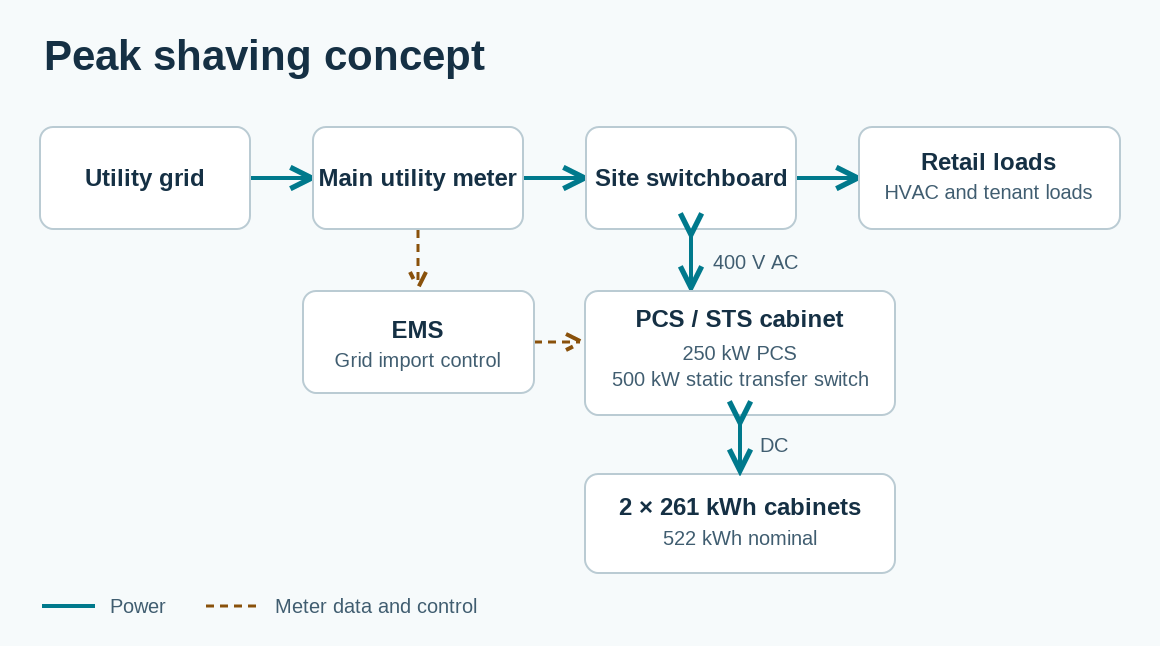
Each battery cabinet provides about 261 kWh of nominal storage. The independent cabinet houses two 125 kW PCS modules, with a combined rated output of 250 kW at a 400 V AC interface. The same cabinet includes a 500 kW static transfer switch (STS). The battery's rated discharge power through the PCS is 250 kW.
Before settling on a position, the electrical team would check the cable route to the existing switchboard and confirm the point of connection.
Set the grid import target and test the peak window
The energy management system (EMS) would track import at the main meter and dispatch the battery through the PCS as site demand approaches the chosen target. The property team can test that target against the same interval and time window the utility uses for billing. A reliable design needs enough power to cover the part of the load above the target and enough usable energy to cover the time it stays there.
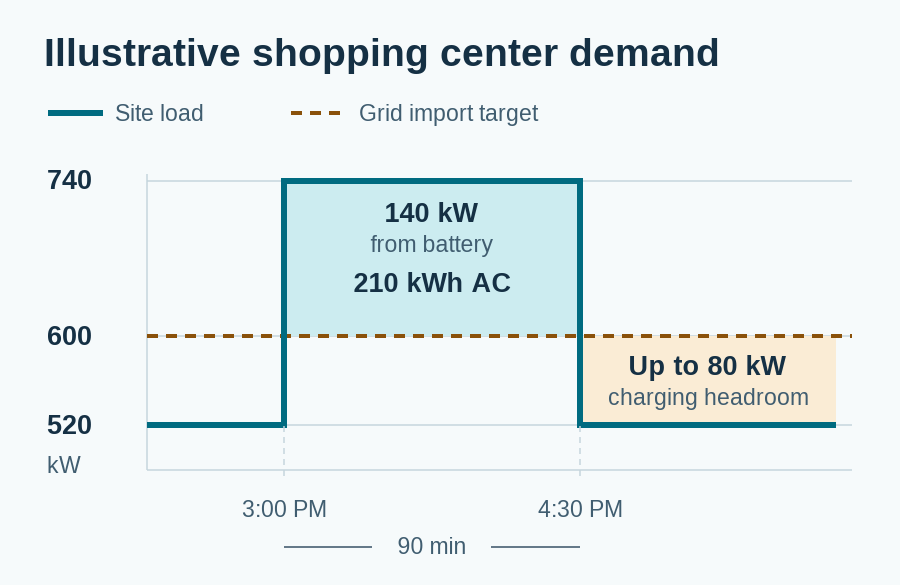
Say the center's load holds at 740 kW and the team tests a 600 kW grid import target. The battery would need to cover 140 kW. If the load stays there for 90 minutes, the battery system needs to deliver about 210 kWh on the AC side.
On a hotter day, the same gap could last twice as long and require about 420 kWh. Before settling on a target, check how much energy is available at the start of the peak. Account for conversion losses, discharge limits and any energy set aside for backup.
Recharge before the next busy period
As the afternoon load falls, the EMS can look for room to recharge. If the site is drawing 520 kW against a 600 kW import target, there is up to 80 kW of headroom in that example. Charging schedules can then be checked against the tariff, the utility's rules for grid charging, and any margin the property team needs for loads that could start unexpectedly.
How much charge the system needs before dinner depends on the next demand window. If refrigeration and food service keep loads high, there may be little time or headroom to refill the battery. In that case, the team can test whether charging can start earlier in the day, shift to a later window or fit a revised import target.
What the equipment budget covers
| Proposed supply | Quantity | Included in this design |
|---|---|---|
| Battery cabinets | 2 | About 261 kWh of nominal storage per cabinet, 522 kWh nominal total |
| PCS and STS cabinet | 1 | Two 125 kW PCS modules, 250 kW rated in total, a 400 V AC interface, and a 500 kW STS |
| Energy management system | 1 set | Local controller and cloud platform |
The indicative equipment budget is US$90,000–105,000, based on tax-inclusive equipment supply. The quote for a specific site depends on the cabinet configuration, metering and control interfaces. Solar equipment, freight, import charges, site transformers or distribution upgrades, installation, and commissioning are scoped separately.
Send the load profile for a design review
Share a recent bill, the demand tariff and interval data from ordinary and busy days. If the center has a seasonal demand peak, include a recent bill and interval data from that season too. Include a single-line diagram of the main distribution and a few photos of the available equipment area. If you already have a target for grid import, send that too.
KUNETIC can use those inputs to check how much of the peak the proposed system could cover, when it could recharge and what it would take to connect it. For other ways to use storage on a retail property, explore commercial building and retail energy storage.
Frequently asked questions
Should we size the battery for summer or weekend peaks?
Use the days that set billed demand under your tariff. If summer cooling or weekend trade changes the length of the demand peak, include those intervals in the design review so the team can test the same import target across different days.
Can the center shave peaks without solar panels?
Yes. The battery can charge from the grid where the utility and site connection allow it. A charging schedule should fit the tariff and leave room under the site's import limit. Solar can be evaluated separately if the center has an array or is planning one.
How much of the 522 kWh would the center be able to use?
Check usable AC energy at the start of the peak. Starting charge, the allowed discharge range, conversion losses and any backup reserve affect the energy available to cover the load. The interval data shows how much energy the center needs over that period.
Could the same equipment also provide backup?
The package includes a transfer switch. To assess backup, identify the circuits to keep energized, their running and starting power, and their acceptable interruption. Confirm the isolation and transfer arrangement with the site's electrical team, then reserve the battery energy those circuits would need.